Fender Design - Wheel Arch Challenge
Objective:Calculate the Wheel Arch gap at required points and check whether the car passes the European standard.
There are many factors that need to be considered during designing the fenders of the vehicle. One of them is the wheel arch area.
In a fender, the wheel arch is the semicircular part that is positioned above the wheel of the vehicle. While designing the fender care must be taken that the wheel arch of the fender meets the required standards.
Fig 2. Wheel arch area considerations in a fender design
In this report, we will study about:
- Different standards of the front wheel arch area requirements.
- Japanese Standards
- European Standards
- American Standards
- Examining the given part considering the European Standards.
- Checking whether the front fender wheel arch meets the standards.
1. Different standards of the wheel arch area requirements
Different countries follow different regulations based upon the country's road conditions, government regulations, geography, climate, and various other factors.
Therefore in our case, i.e. for the wheel arch area calculation, we will have a look at three different standards.
The main purpose of the wheel arch area regulation is that seeing the front fender and tire from the top, the tire must be inside the fender by a certain distance
a. Japanese Standards
Measure clearance L of the tire, hub, cap, and fender in three different positions within area K and produce a clearance check chart to validate.
Clearance must be greater than 5 mm in all the three positions (i.e., at A, B, C from fender curvature)
Wheel guard requirement: The value of 'a' shall be more than 5 mm at line 30* forward and 50* rearward from the central vertical axis of the wheel.
Fig 3. Japanese Standards
b. European Standards
Measure Clearance L at sections SA-SA, SB-SB, SC-SC, SD-SD, SE-SE and produce CL check chart to validate.
In all five sections, the Clearance L value should be greater than 10 mm to satisfy the European regulations.
Fig 4. European Standards
c. American Standards
Make clearance check details on all positions from -100* to 100* and make the clearance check table.
All values should be greater than 5 mm to satisfy the regulations.
Fig 5. American Standards
3. Examining the given part considering the European Standards
We will examine the given fender design as per the European standards mentioned below
Fig 5. European Standards
Fisrt we make a sketch in which have to make SB SA SC SD SE point on tyre outer face and then
project these point on fender outer face the measure the distance or clearence
the image is attched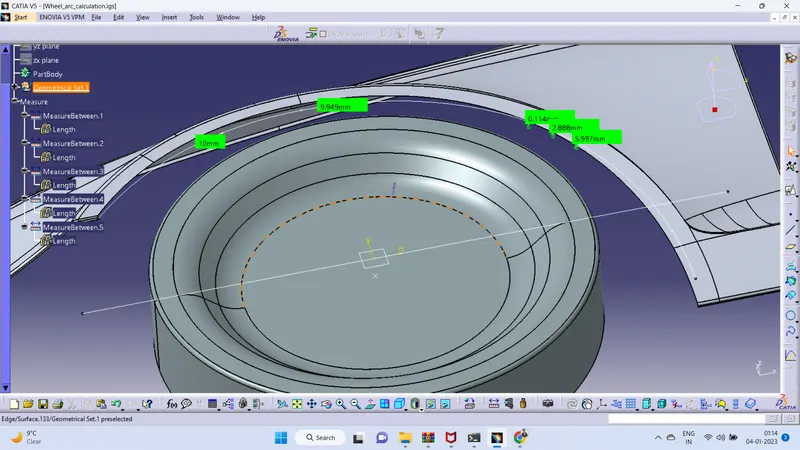
| POSITON | OBSERVE CLEARANCE VALUE | REQUIRED CLEARANCE VALUE | GO & NO GO |
| SA | 10 | 10 | GO |
| SB | 9.949 | 10 | NOGO |
| SC | 0.144 | 10 | NOGO |
| SD | 2.888 | 10 | NOGO |
| SE | 5.997 | 10 | NOGO |
Conclusion:
Hence from the above observations, since the positions SB, SC, SD, and SE have a clearance of less than 10mm which is the minimum requirement for the European regulations, it is clear that the front fender's wheel arch area does not pass the European Regulations.