Fender Design - Wheel Arch Challenge
AIM: To Calculate the Wheel Arch gap from front fender at required points and check whether the car passes the European standards.
INTRODUCTION:
Fender is the American English term for the part of an automobile, motorcycle or other vehicle body that frames a wheel well (the fender underside). Its primary purpose is to prevent sand, mud, rocks, liquids, and other road spray from being thrown into the air by the rotating tire. Fenders are typically rigid and can be damaged by contact with the road surface.Sticky materials, such as mud, may adhere to the smooth outer tire surface, while smooth loose objects, such as stones, can become temporarily embedded in the tread grooves as the tire rolls over the ground. These materials can be ejected from the surface of the tire at high velocity as the tire imparts kinetic energy to the attached objects. For a vehicle moving forward, the top of the tire is rotating upward and forward, and can throw objects into the air at other vehicles or pedestrians in front of the vehicle.
Wheel arch claddings are there to stop water and dirt ingress from getting into tight spots around the wings of the car to prevent corrosion. They also protect any electrics or pipework from the water.
European Fender Wheel Arch Regulations:
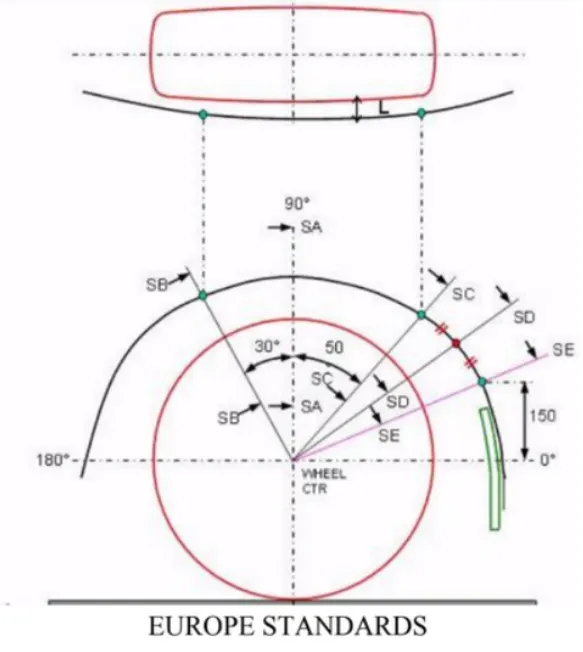
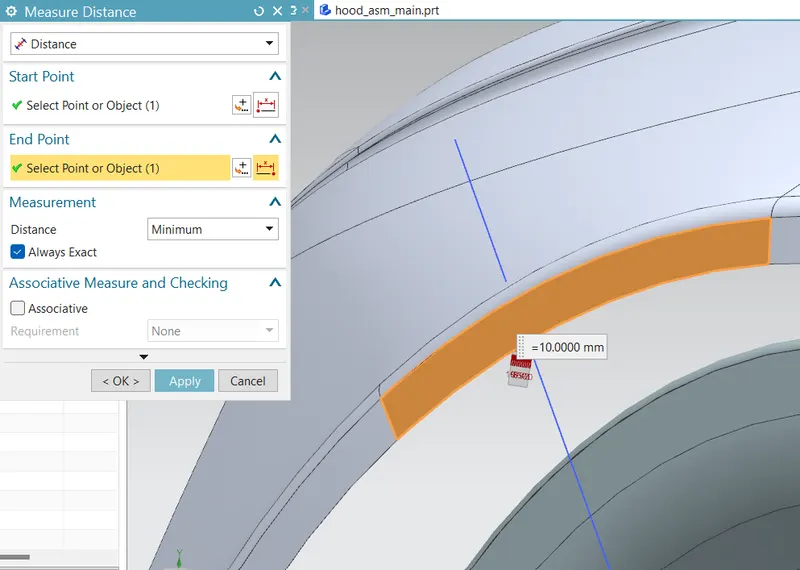
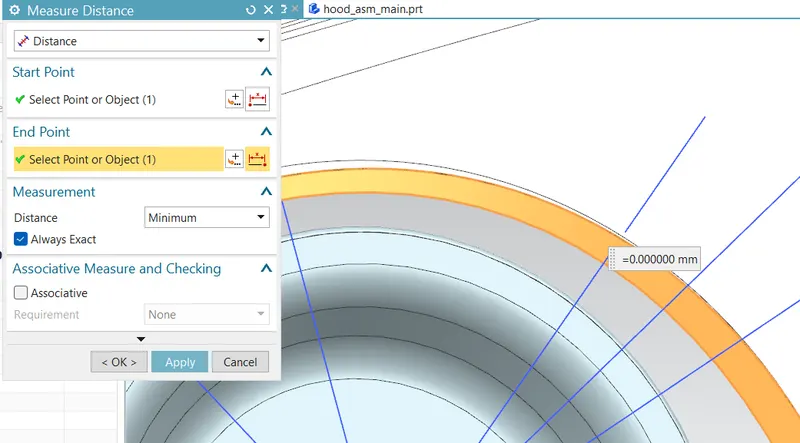
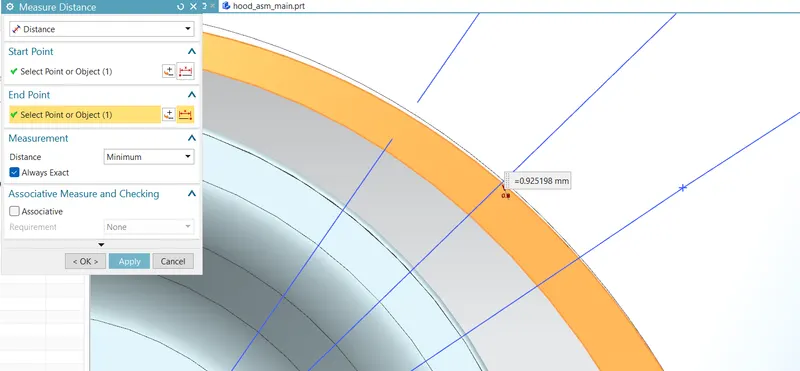
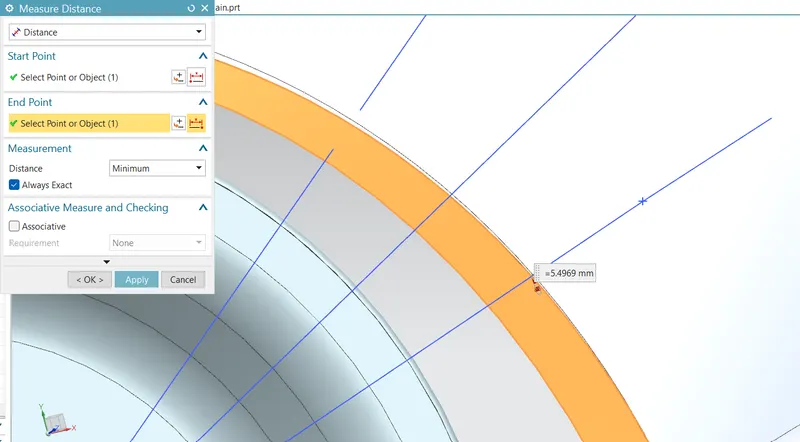
- The clearance 'L' should be measured at SA-SA, SB-SB, SC-SC,SD-SD,SE-SE and should be clearly noted in a tabular format.
- At all the sections the value of 'L' should be greater than 10 mm in order to satisfy the european standards.
- The value of 'a' should be more than 5 mm at 30 degrees forward from the central line and 50 degrees backward from the central line.
WHEEL ARCH GAP CALCULATION PROCESS:
- First we need to create a sketch on outermost surface of the wheel.
- In this sketch we need to draw a horizontal base line (180, 0 degrees) at center of the datum plane or the wheel.
- From this center point we need to draw a vertical line(SA) as well (90 degrees), which is taken as the reference line/axis for the other lines.
- From this central line we need to draw a line(SB) with 30 degrees forward(left side of central line) and 50 degrees backward(SC)( right side of central line).
- Now from the base line( horizontal line) we create a point at a distance of 150 mm towards the right side of central line.
- Now draw line(SE) passing through this point which is 150 mm above.
- Draw a line ( SD) in between (SC) and (SE).
- Close the sketch and after that measure the distance/gaps and measure various parameters and check wheather its matching european standards or not.
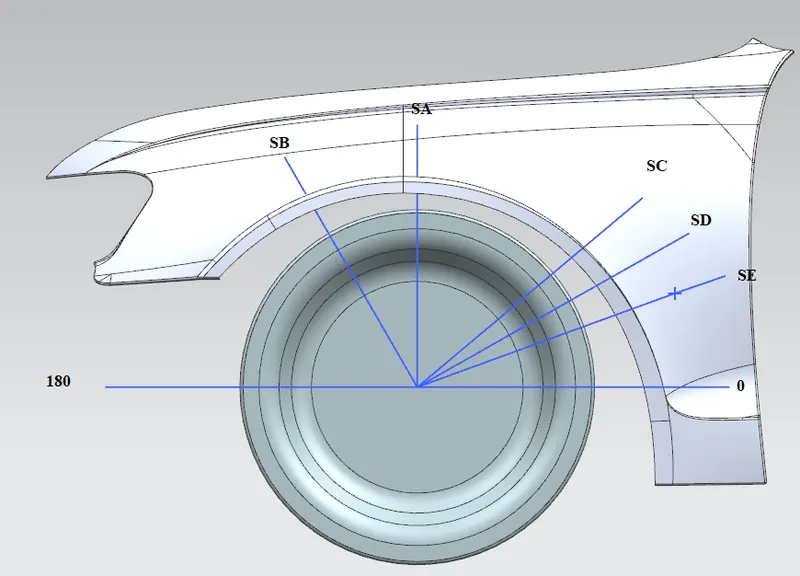
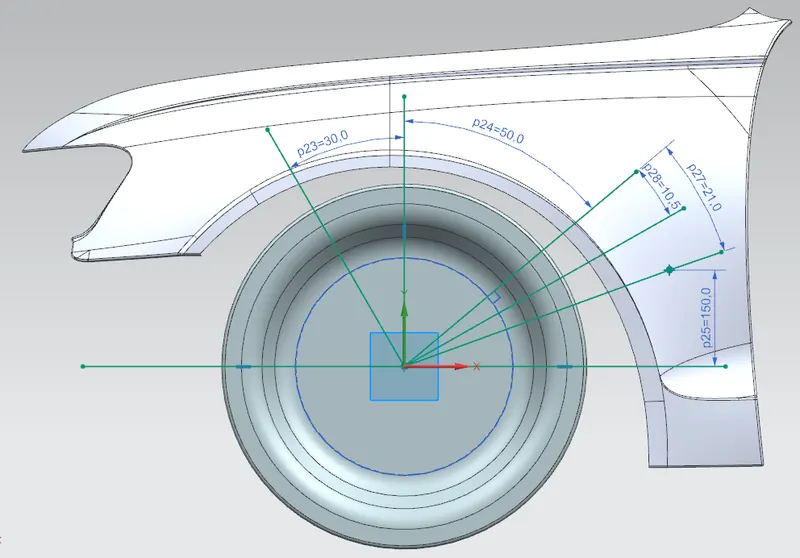
MEASURING CLEARANCE VALUE 'L' AT 5 DESIGNATED POINTS:
CLEARANCE 'L' AT SA-SA: ( 9.94 mm)
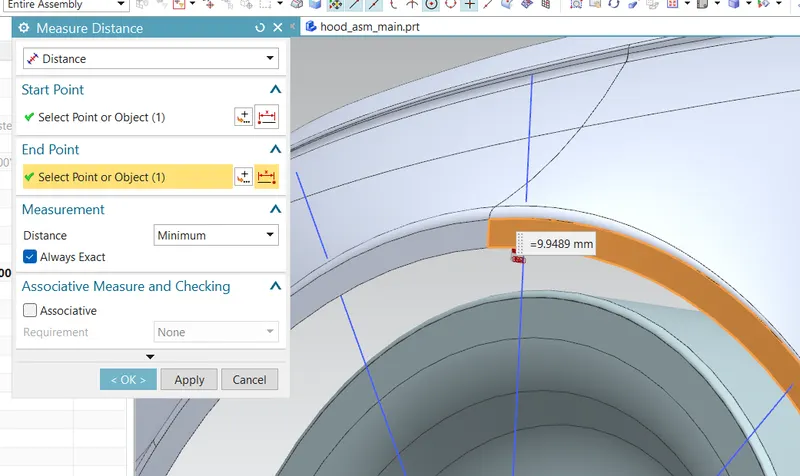
CLEARANCE 'L' AT SB-SB: ( 10 mm )
CLEARANCE 'L' AT SC-SC: ( 0.00 mm )
CLEARANCE 'L' AT SD-SD: ( 0.92 mm )
CLEARANCE 'L' AT SE-SE: ( 5.49 mm )
MEASURING CLEARANCE VALUE 'a' FOR WHEEL GAURD REQUIREMENT:
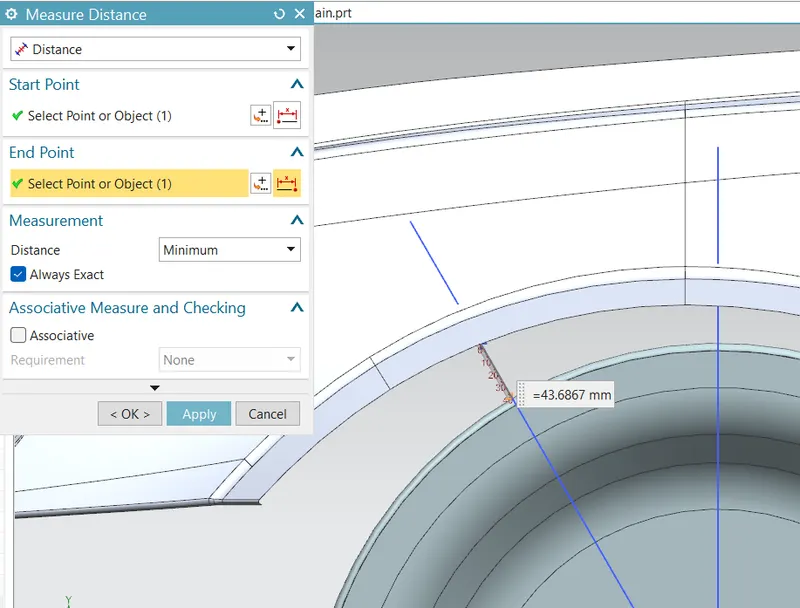
CLEARANCE 'a' AT 30 DEGREES LINE (SB): ( 43.68 mm )
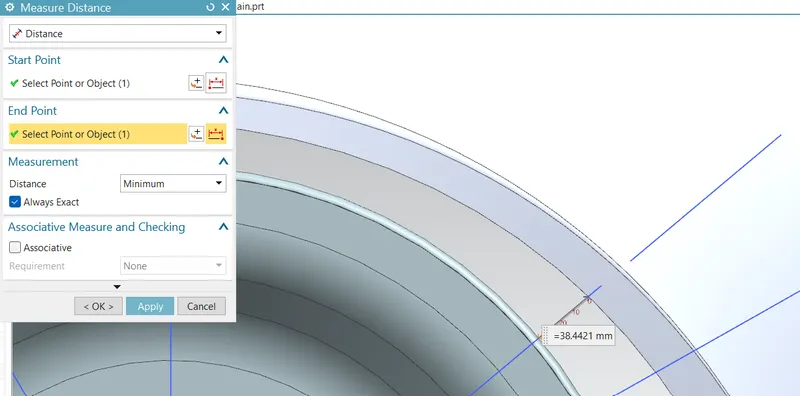
CLEARANCE 'a' AT 50 DEGREES LINE (SC): ( 38.44 mm )
FINAL OUTPUTS TABLE:
MEASURING CLEARANCE VALUE 'L' AT 5 DESIGNATED POINTS:
| SECTION | L(> 10 mm) | RESULT |
| SA-SA | 9.94 | FAIL |
| SB-SB | 10 | PASS |
| SC-SC | 0 | FAIL |
| SD-SD | - 0.92 | FAIL |
| SE-SE | - 5.49 | FAIL |
MEASURING CLEARANCE VALUE 'a' FOR WHEEL GAURD REQUIREMENT:
| SECTION | a (> 5 mm) | RESULT |
| SB | 43.68 | PASS |
| SC | 38.44 | PASS |
CONCLUSION: Hence based on the outputs, we can conclude that the given model/design does not meet the european regulations for the gap between fender wheel arch and wheel.