Fender Design - Wheel Arch Challenge
Aim:
To calculate the wheel arch gap at required points and check whether the car passes the European standard.
Objective:
- Study about the different wheel arch gap standards.
- Draw the lines at the required angle and points for the European standard.
- Measure the distance at each angle and mention given model is pass or fail.
Given part file of Wheel Arch: -
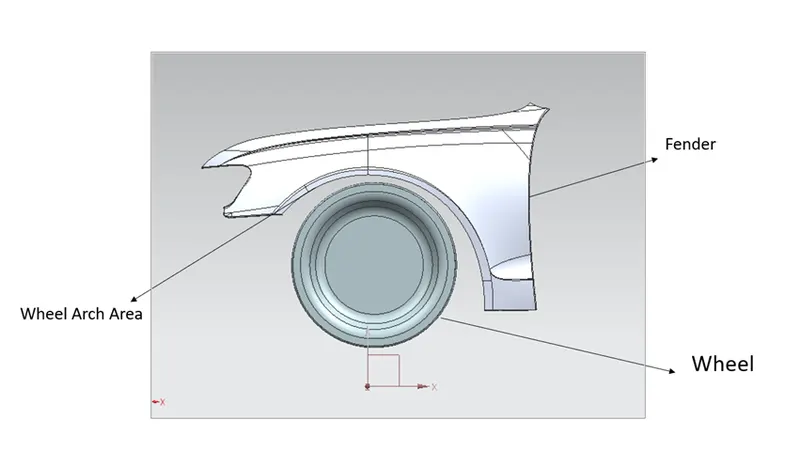
Fender:
- Fender is a part of an automobile, motorcycle or other vehicle body that frames a wheel well (the fender underside). Its primary purpose is to prevent sand, mud, rocks, liquids and other road spray from being thrown into the air by the rotating tire. Fenders are typically rigid and can be damaged by contact with the road surface.
- The main purpose of fenders on cars is that they shield the wheels and they protect the passenger the pedestrains and the other vehicles from stones, mud, liquid and other debris that can fly in the air because of the speeding rotating wheels while the car is running.
- Most passenger automobiles have four fenders, one over each wheel. For vehicles with a narrow car body that exposes the tire, the fender is an exposed curve over the top of the tire. For wide body vehicles that cover the tire, the fender forms the wheel well surrounding the tire, and is not directly visible from above the car body.
- Wheel wells tend to be much larger than the diameter of the tire, because they do not move with the tire suspension and consequently must be large enough to allow the full range of tire motion on the suspension without touching the interior of the wheel well.
- More elaborate designs include fender skirts for enclosing the outside edge of the wheel well, and stylized pontoon fenders for exposed fenders.
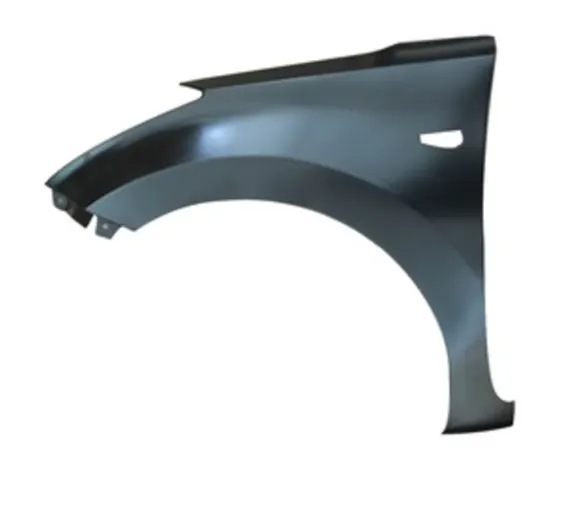
Wheel Arch:
- It is a curved part of the fender positioned right above the wheel.
- The wheel Arch is designed such that it protects both the pedestrian and car cabin from mud, water rocks and other road spray.
- Different countries have different wheel arch regulations in place, and the wheel arch design has to comply with them to be deemed usable in that country.
- For avoiding design alterations of the same vehicle to meet the different regulations parameters are taken into consideration for design purpose.
Fender Wheel Arch Regulations:
Japan Regulation:
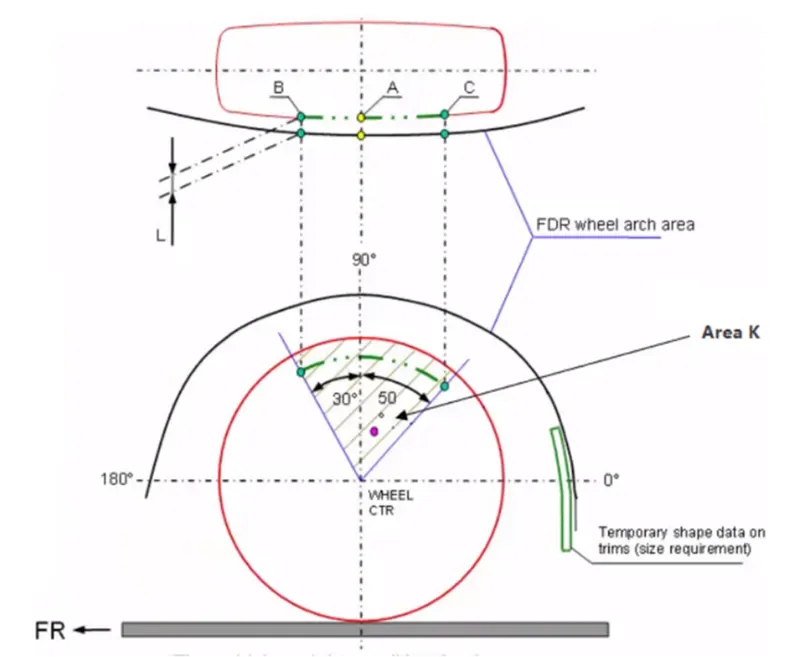
- The clearance "L" for tire, hub, cap and fender is to be measured within area K and create clearance check chart to validate.
- The value of L should be more than 5mm at all marked positions.
- Wheel guard requirement: The value of "a" should be more than 5mm at line 30degree forward and 50degree rearwards from the central vertical axis of the wheel.
US Regulation:
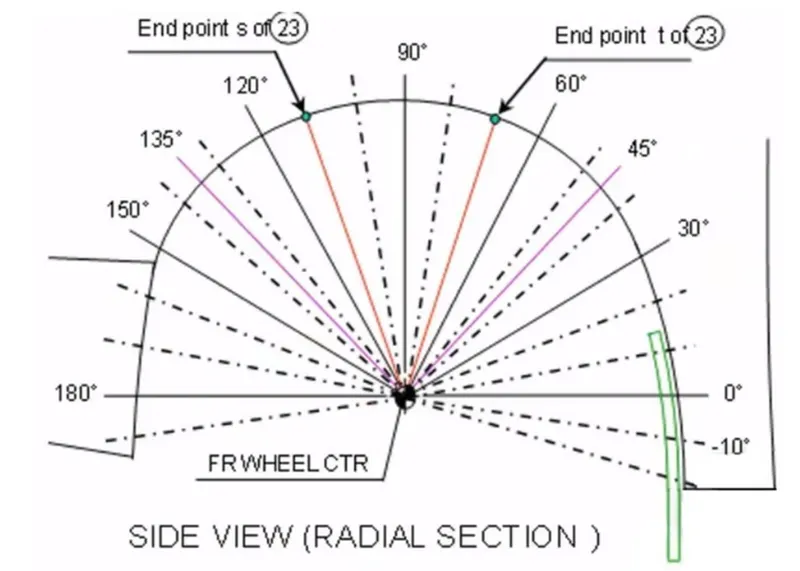
- Clearance "L" is to be checked at all positions from -100degree to 100degree and create clearance check chart to validate.
- The value of L should be greater than 5mm to satisfy the regulations.
- Wheel guard requirement: The value of "a" should be more than 5mm at line 30degree forward and 50degree rearwards from the central vertical axis of the wheel.
European Regulation:
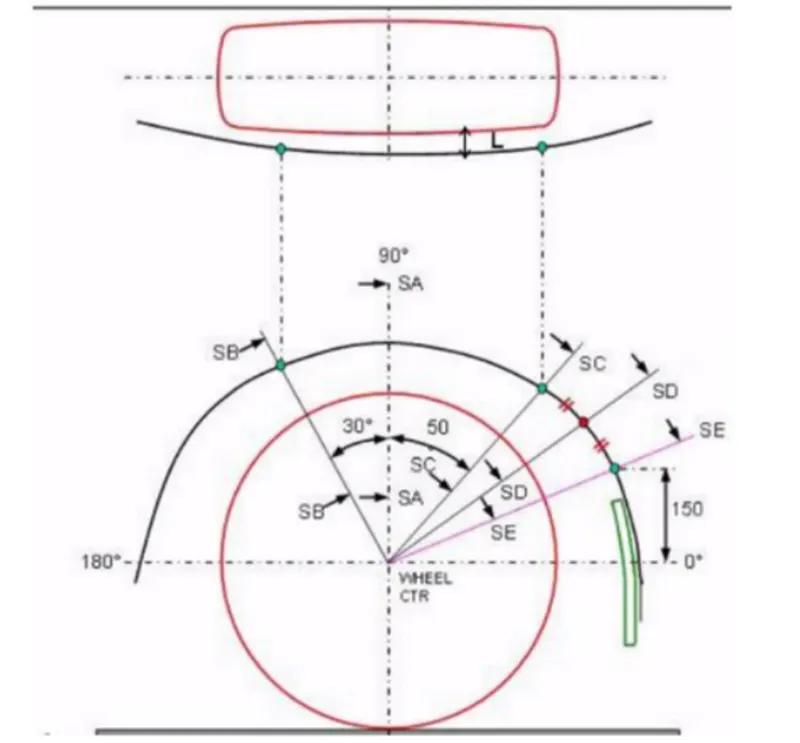
- The clearance "L" should be measured at sections SA-SA, SB-SB, SC-SC, SD-SD and SE-SE and create clearance check chart to validate.
- At all the five sections the value of L should be more than 10mm to satisfy the European Regulations.
- Wheel guard requirement: The value of "a" should be more than 5mm at line 30degree forward and 50degree rearwards from the central vertical axis of the wheel.
Steps followed in creating the sketch requirement for European standards:
- The vertical axis intersection point is labelled as A.
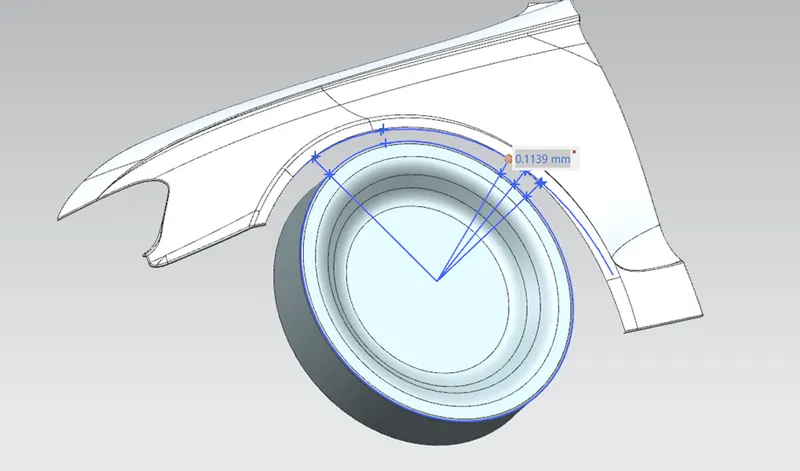
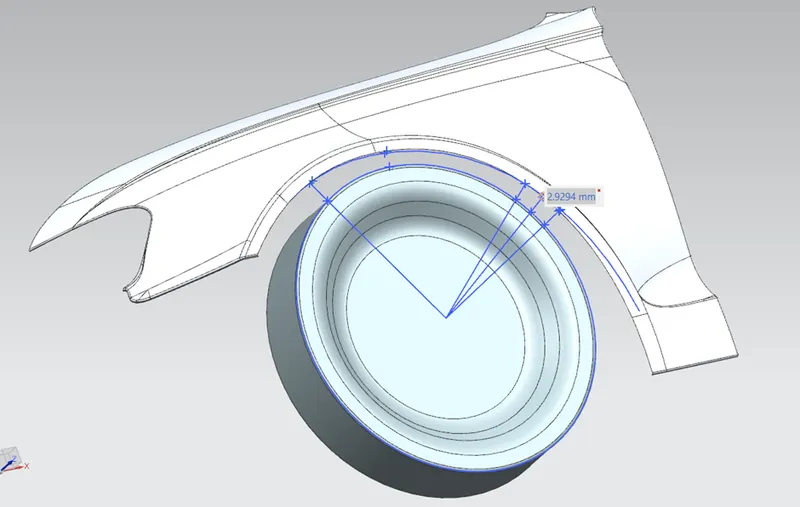
- Similar references are drawn at 30 degrees to left and 50 degree to the right and named it as B and C respectively.
- A line of 150mm is drawn perpendicular to the horizontal axis and normal from the normal point on fender which gives point E.
- The midpoint of the arc cut by the sections C and E results in a new section D.
- The value of 'L' at each section and the value of 'a 'are found out to determine whether the fender satisfies the european standards as shown below.
- A Horizontal and vertical axis is drawn from the centre of the wheel.
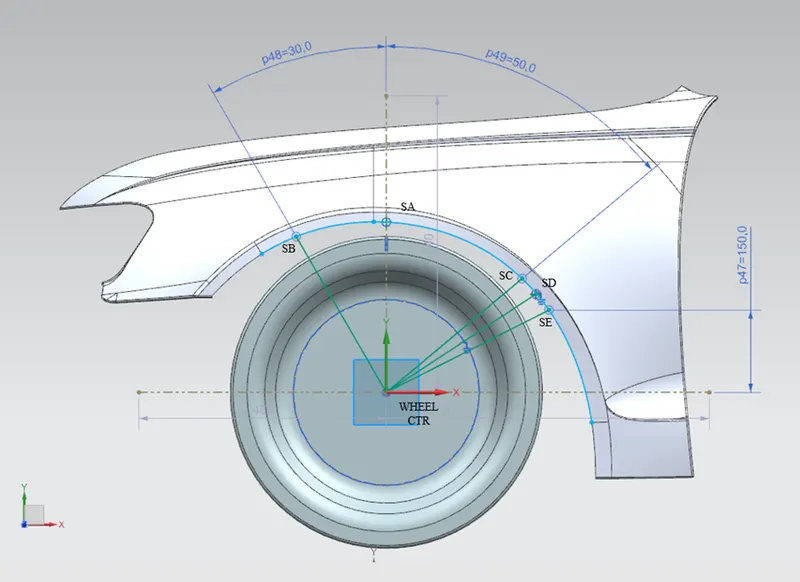
Calculation of the clearance value "L" as following: -
The Measuring 'L' for the given wheel and fender at SA- The value of 'L' at SA= 9.949 mm.
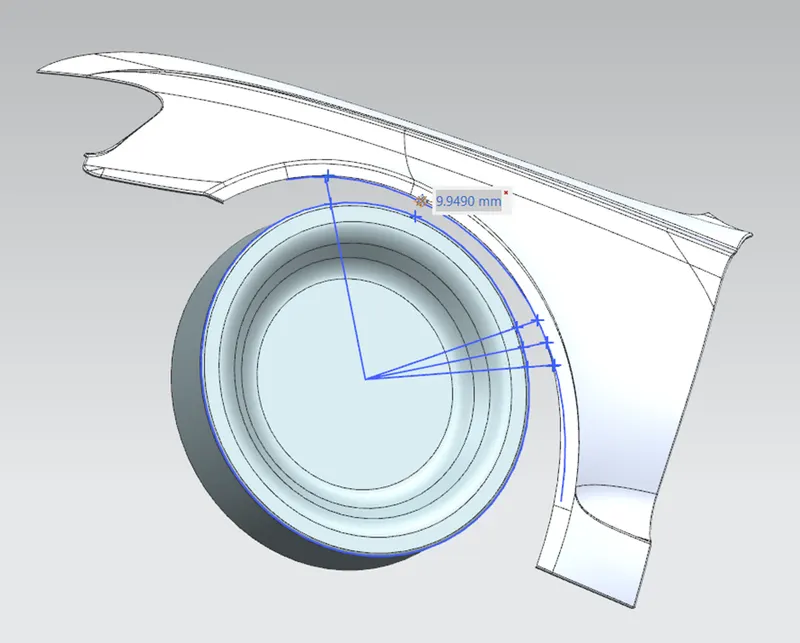
The Measuring 'L' for the given wheel and fender at SB- The value of 'L' at SB= 10 mm.
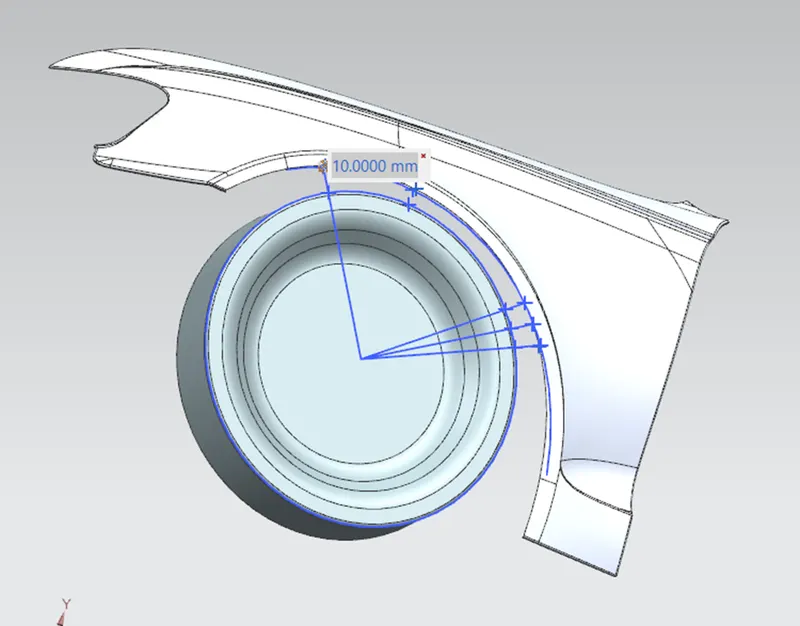
The Measuring 'L' for the given wheel and fender at SC- The value of 'L' at SC= -0.1139 mm.
The Measuring 'L' for the given wheel and fender at SD- The value of 'L' at SD= -2.9294 mm.
The Measuring 'L' for the given wheel and fender at SE- The value of 'L' at SE= -5.9973 mm.
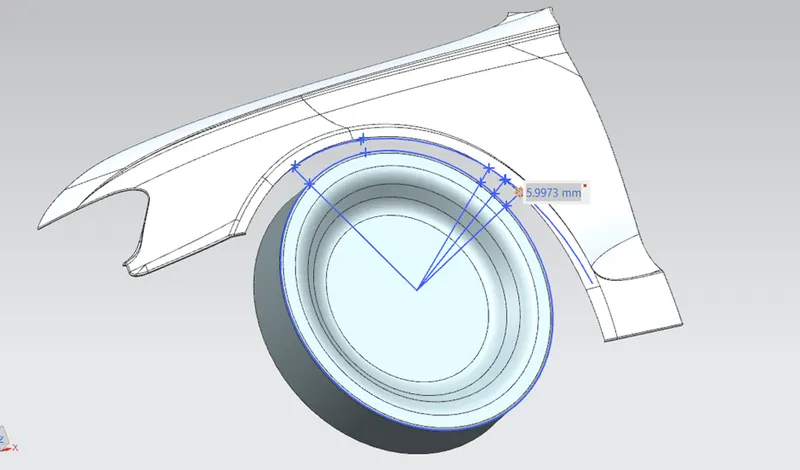
L value tabulate for Requirement Of European standards
|
SECTION |
RANGE |
RESULT |
|
SA |
9.949 < 10.00 |
Fail |
|
SB |
10 = 10 |
Pass |
|
SC |
-0.1139 < 10.000 |
Fail |
|
SD |
-2.9294 < 10.000 |
Fail |
|
SE |
-5.9973 < 10.000 |
Fail |
Measuring the clearance vlaue'a' for Wheel Guard Requirement
Clearance 'a' at 30° line SB
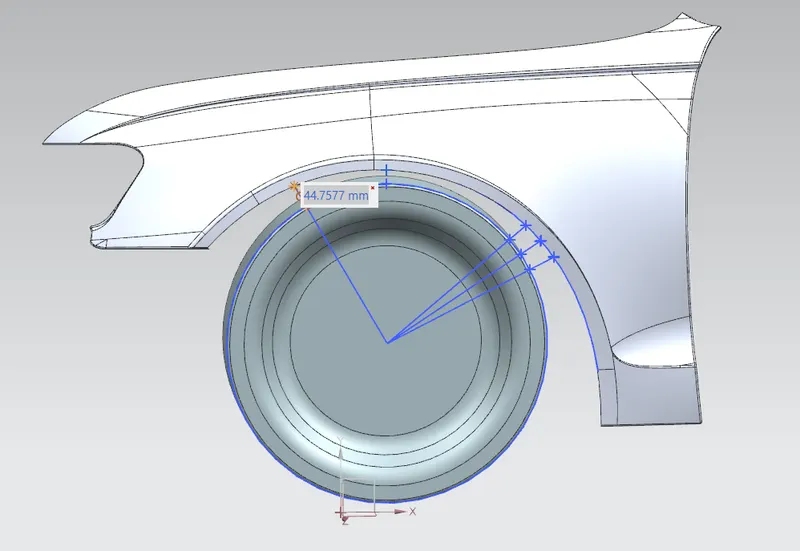
a = 44.7577 mm
Clearance 'a' at 50° line SC
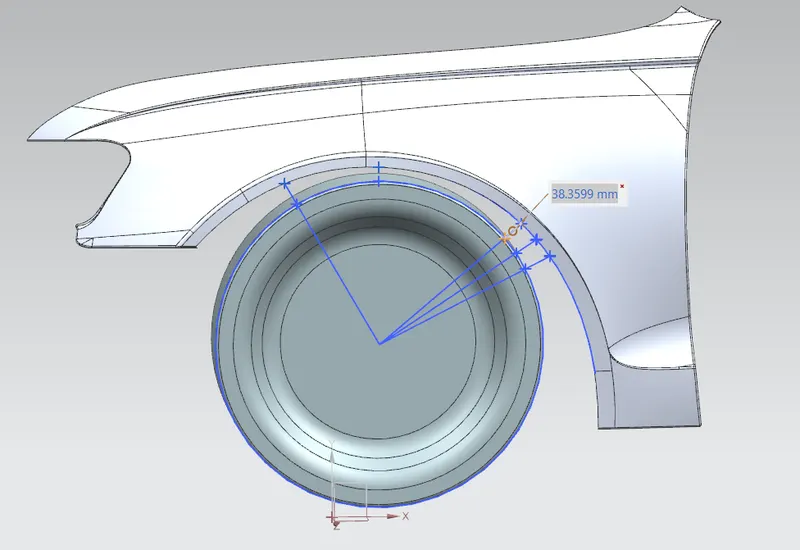
a=38.3599 mm
"a" value tabulate for Requirement Of European standards
|
SECTION |
RANGE |
RESULT |
|
SB |
44.7577>5 |
PASS |
|
SC |
39.3599>5 |
PASS |
Conclusion: -
- Negative sign indicates that the wheel arc is behind the wheel
- All the section doesn’t have the Clearance L value at least 10mm, only SA is seen to have value 10mm
- We have conclusion that the fender does not pass the European Regulations, as the Minimum Clearance value of 'L' between the fender wheel arch and wheel for vehicle and Safety is 10 mm and this design doesn’t meet the requirement.