Exhaust Port Challenge
AIM:-
To conduct a CHT Analysis on the Exhaust Port And to give a breif discription on why and where this analysis is used also to calculate the wall to surface heat transfer Co-efficient and to justify the HTC predictions are correct.
INTRODUCTION:-
Conjugate heat transfer analysis(CHT) can accurately predict heat transfer by simultaneous solving all the relevant solid and flow field heat transfer processes,For Instance it can predict conduction through solids, free and forced convection in the gases/fluids and thermal radiation.The term conjugate heat transfer is used to describe processes which involve variations of temperature within solids and fluids, due to thermal interaction between the solids and fluids.
THEORY:
ANSYS CFD solvers are based on the finite volume method,
- Domain is discretised into a finite set of control volume.
- General conservation equations for mass, momentum, energy, species, etc. are solved on this set of control volumes.
- Partial differential equations are discretised into a system of algebraic equations.
- All algebraic equations are then solved numerically to render the solution field.
Initially the process involves three major Categories,
Pre-Processing
- Geometry
- Mesh
- Physics
- Solver Settings
Solve
- Compute solution.
Post Processing
- Examine results.
Advantages and Applications of CHT Analysis:-
Conjugate heat transfer corresponds with the combination of heat transfer in solids and heat transfer in fluids. In solids, conduction often dominates whereas in fluids, convection usually dominates. Efficiently combining heat transfer in fluids and solids is the key to designing effective coolers, heaters, or heat exchangers.Hence by using CHT analysis we can predict heat transfer Co-efficent by solving all the relevant solid and fluid heat transfer processes to give a proper and predictive results.Therefore this approach has benefits for those applications where heat transfer is either non-uniform or difficult to calculate empirically.Some of the areas where CHT analysis used to Assess;
- Overall heat transfer coefficient, e.g. for a car radiator.
- Highest (or lowest) temperature in a system, e.g. in a gas turbine, chemical reaction vessels, food ovens.
- Temperature distribution (related to thermal stress), e.g. in the walls of a spacecraft.
- Temperature response in time dependent heating/cooling problems, e.g. engine cooling, or how fast does a car heat up in the sun and how is it affected by the shape of the windshield.
- To get optimized design for High voltage systems such as Motor and Battery thus increasing its life.
- Results of CHT analysis become input to structural simulations as thermal loads.
- It is also used in the advancements in Cooling for Applications such as Gas Turbine Engine.
Geometry
- The base geometry is loaded into the space claim.
- We use Volume Extraction Option to create a Fulid Volume.
- Then by using Share Topology We create a link between the Fulid and Solid Volume.
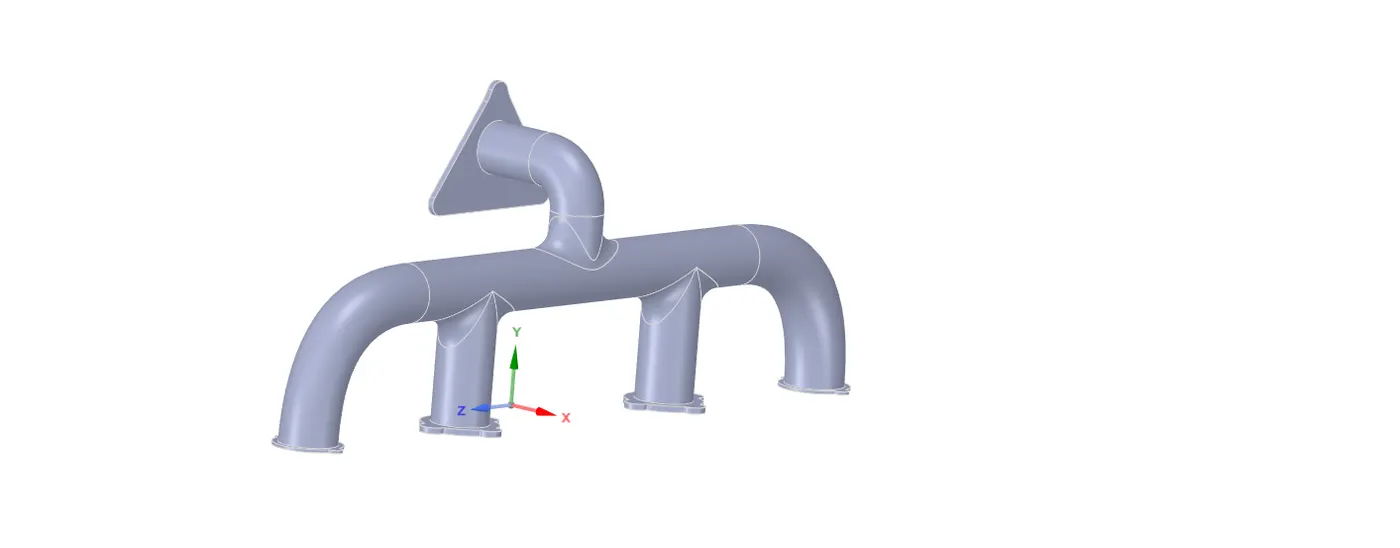
FINAL GEOMETRY
MESHING
- After Opening the MEshing Software Are going to use Refined model for our simulation.
- Hence Inflation layers are added to get maximum refinement in the Fluid Volume.
- THen by using Body Sizing option we use to size the mesh upto 10mm to enhance and refined the mesh Quality.
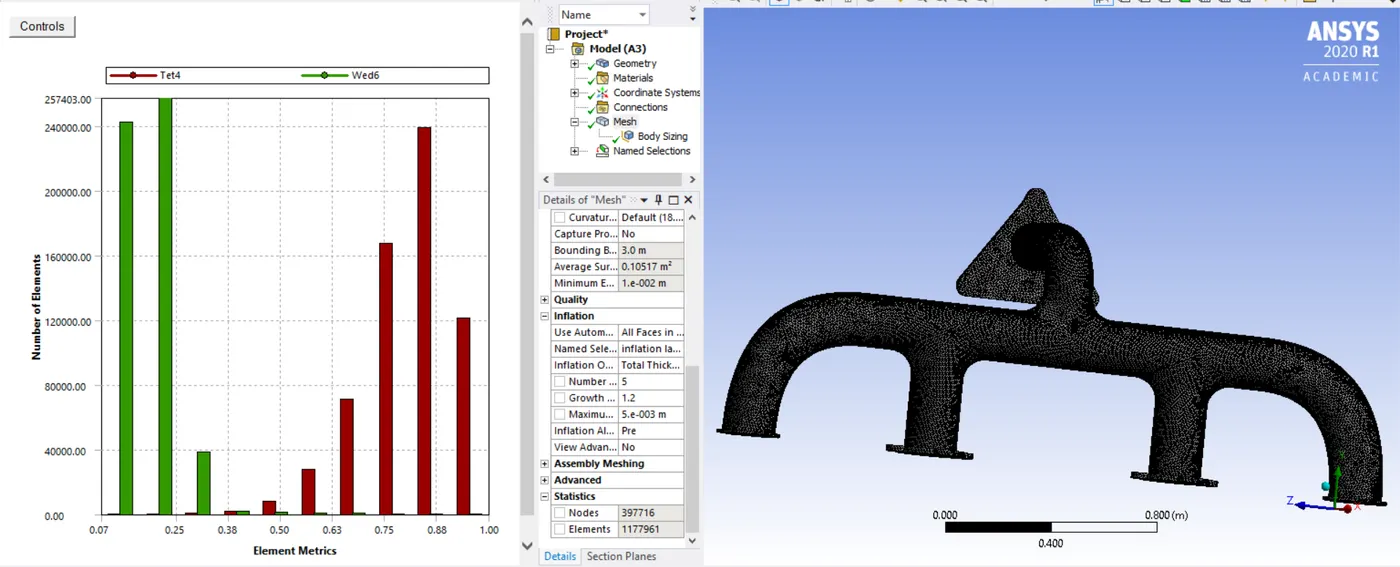
Final Mesh
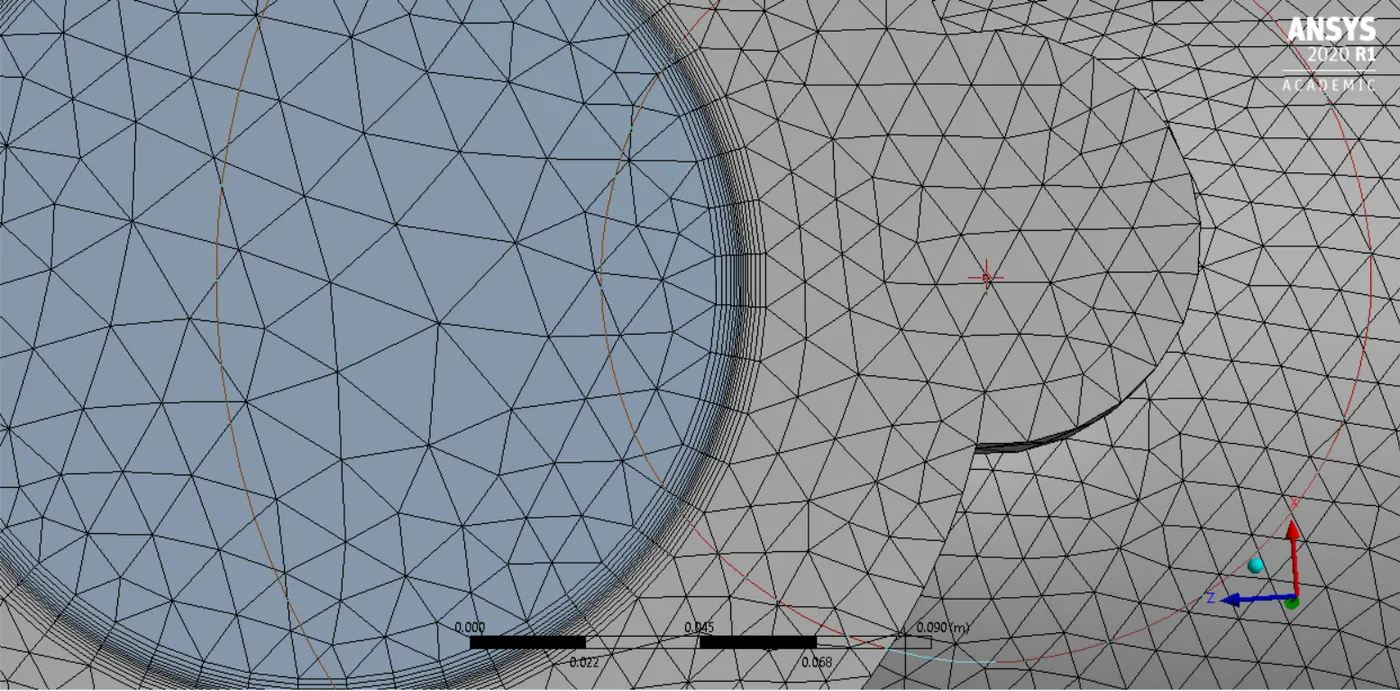
INFLATION LAYERS
SETUP and SOLVING:-
- We are Going to use a pressure Based Solver at Steady state conditions.
- Energy Equation is turned On and K omega SSt model is selected as Viscous Model to get the nice results in the boundary.
- Inlet Velocity and Temperature is set at 5m/s and 700K.
- Fluid Material used is Air and Solid material used is Aluminium.
- Hybrid Intialization is done and run for 250 Iterations.
- The Wall Heat Transfer co-efficient is around 234.8 W/m2 K.
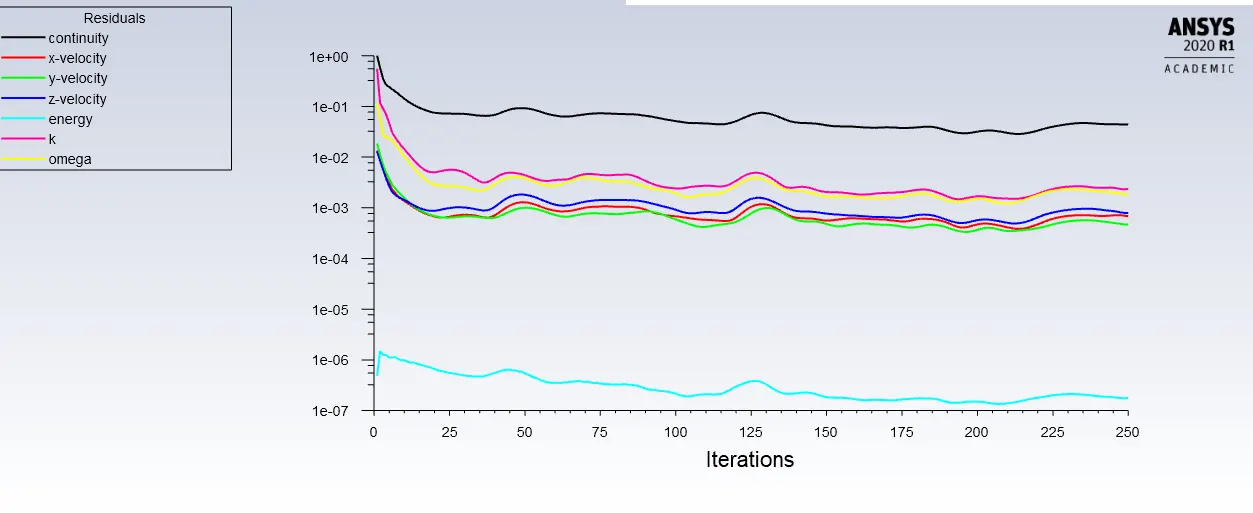
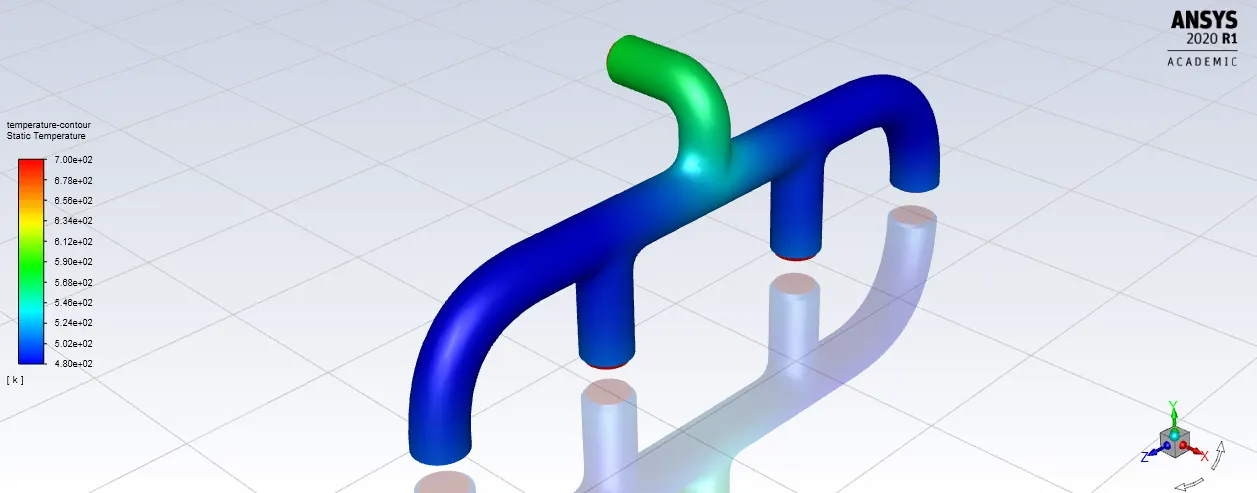
Pressure Contour.
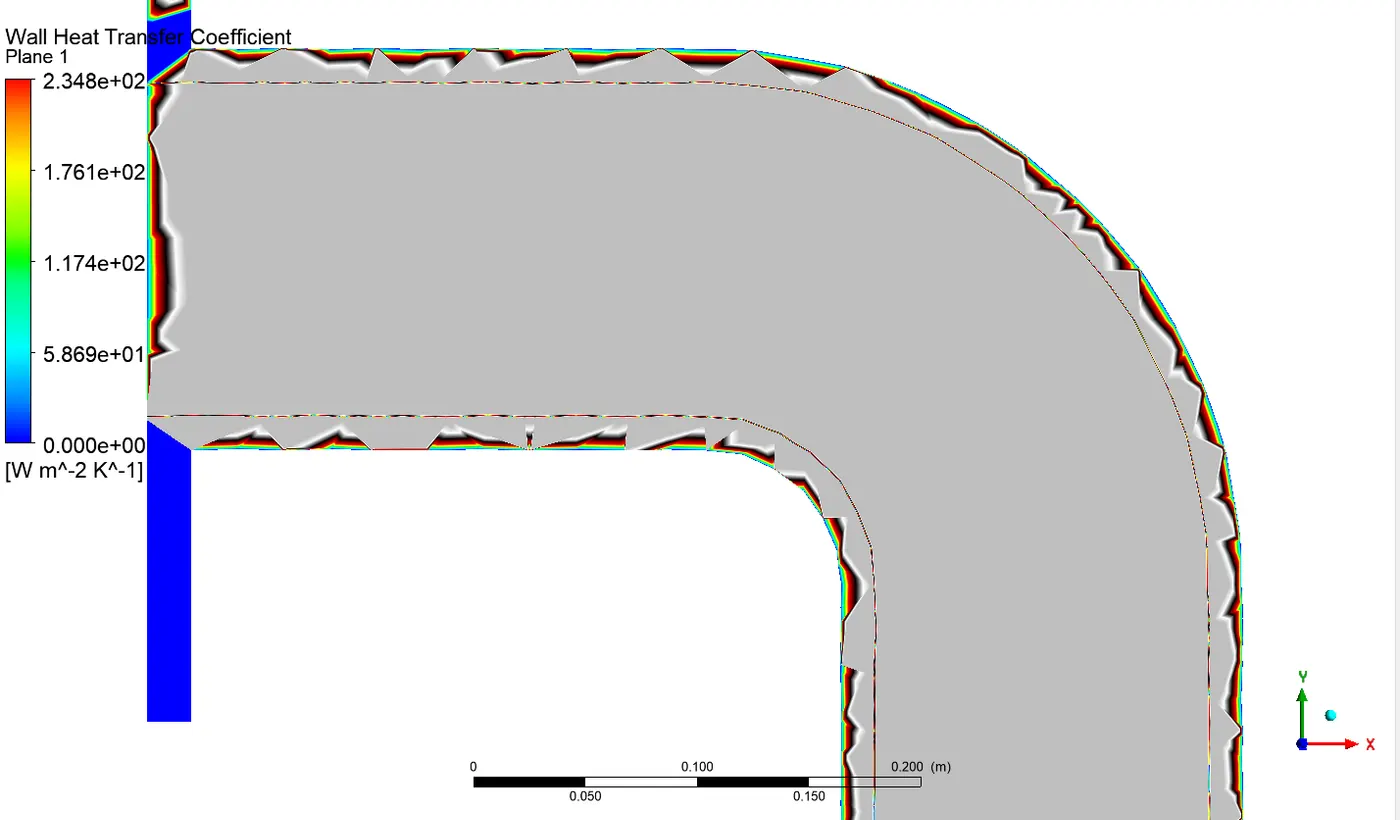
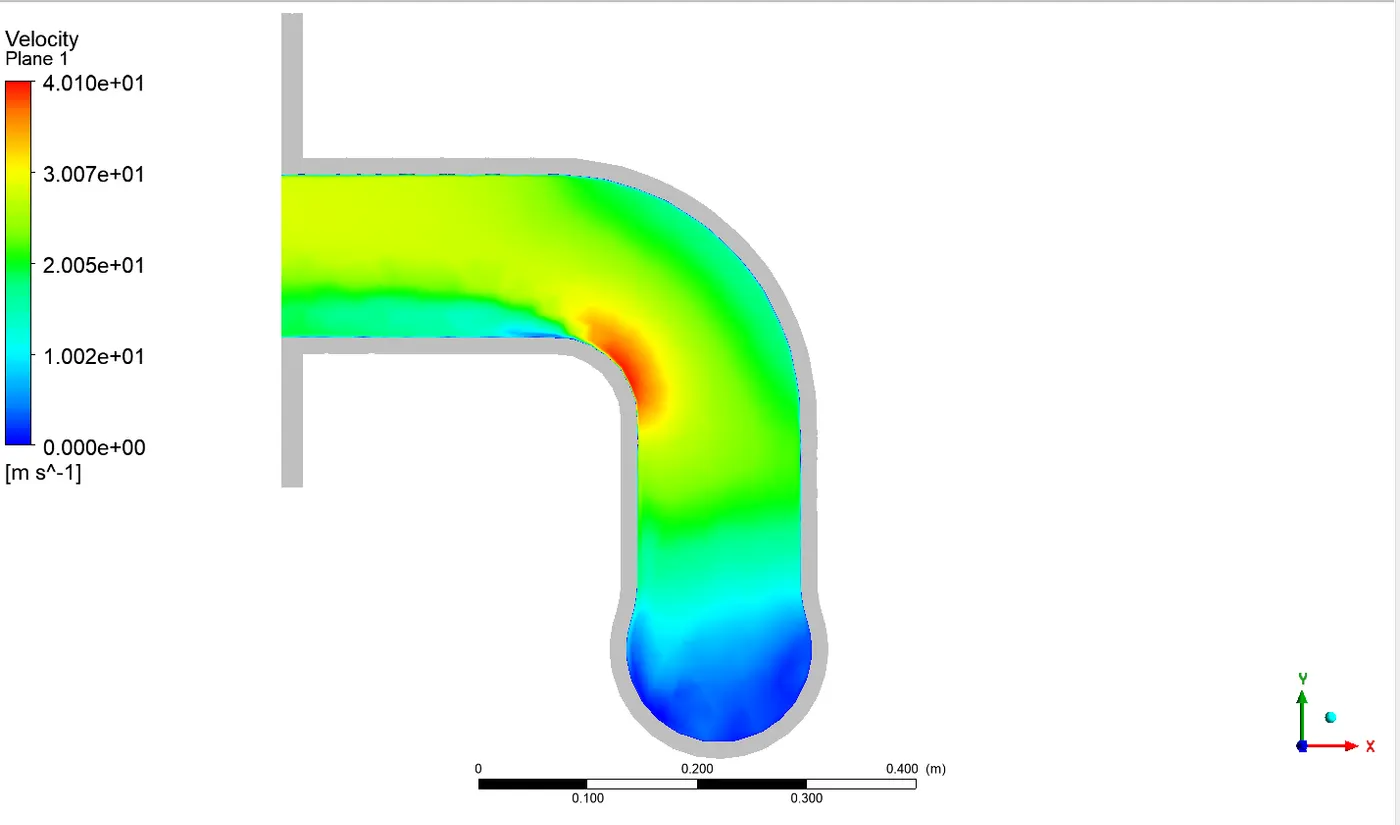
WAll Heat TRansfer Co-Efficient Velocity Vector
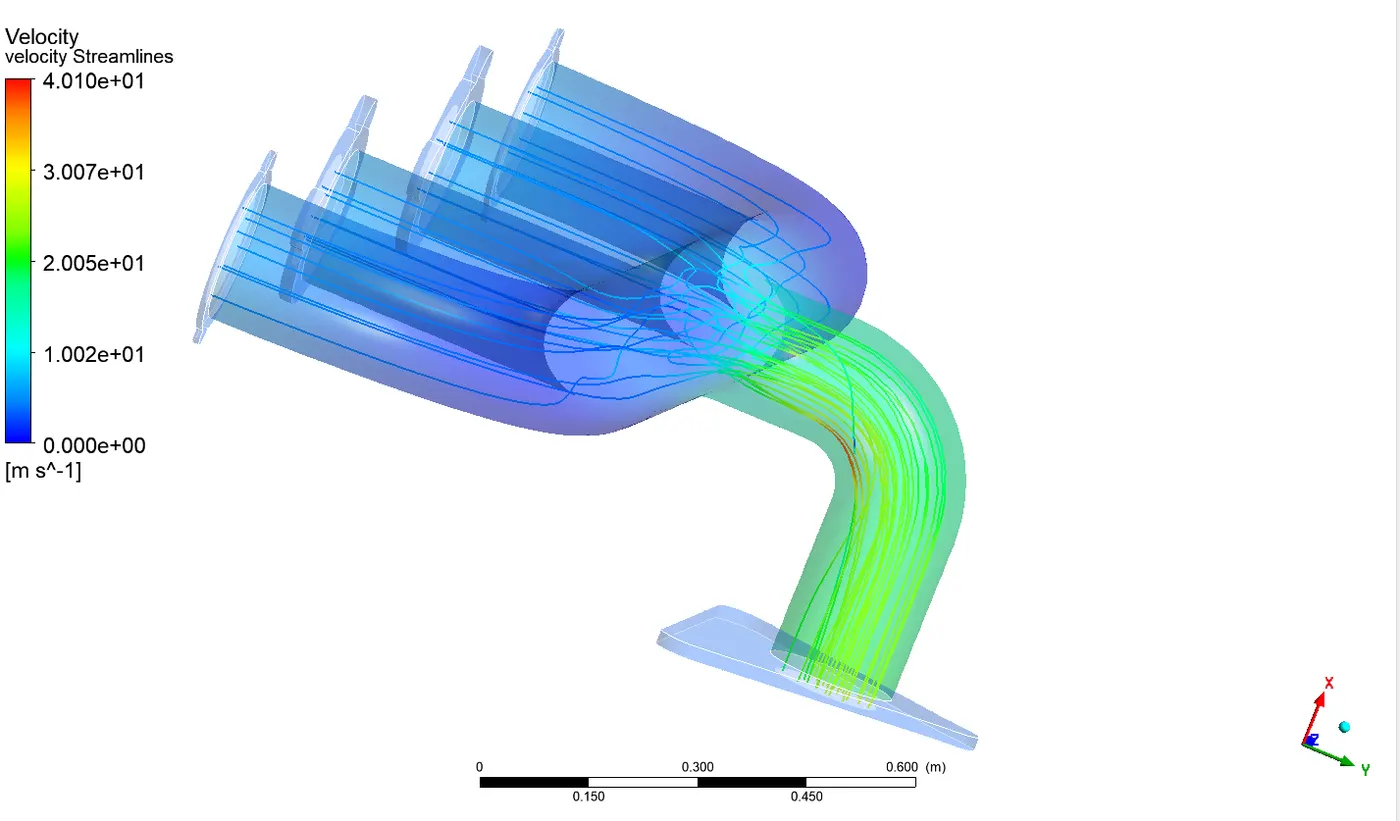
Velocity Stream Lines
To Verify the HTC Predictions:-
Nusselt Number is Given By,
Nu=0.023Re^4/5 Pr^n.
where,
D is the inside Dia
Pr PRandtl Number
n=0.4 for heated Condition
Nu=Nusselt Number
Re=Reynolds Number.
We know Nusselts number is a function of Reynolds number , which inturn is a function of velocity.
we can infer that from the above images both the velocity and HTC is maximum near the Outlet .
Hence, the HTC simulations from the report is Correct.