Door Arm Rest Week 8 Challenge
For successfully creating a component that is moldable or in other words that can be manufactured, Draft Analysis of the component should be carried out.
- What is a Draft?
Essentially, draft angles for injection molding are a design consideration that makes it much easier for a part to release cleanly from a mold. A draft angle is calculated as a degree measurement from the vertical axis of a mold, and it helps account for thermoplastic shrinkage, a practical reality of the injection molding process for most materials.
By accounting for thermoplastic shrinkage during the cooling process, draft angles greatly reduce friction between the finished, cooled part and the side of the mold. Not only does this create a much easier release process, it offers several other benefits, depending on the design of the part:
- Reduces the chance of damage to the part due to friction during release
- Reduces wear and tear and chances of damage to the mold
- Ensures a uniform, smooth, unscratched finish when required
- Ensures the integrity and uniformity of other surface finishes and textures
- Reduces overall cooling time by lessening or eliminating the need for unconventional ejection setups
- Most, if not all, of these benefits offer either direct or indirect overall production cost reductions
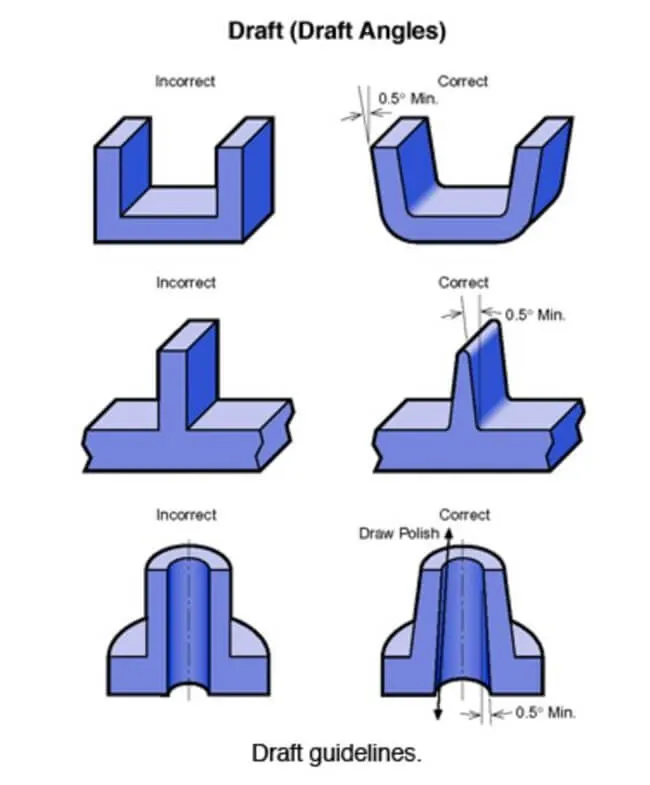
Steps for creating the Tooling Axis:
- The first and foremost step for conducting the Draft Analysis is to create the Tooling Axis. The Tooling Axis is the direction in which the mold opens and closes.
- To create the Tooling Axis, first insert a point in the center and then create the Dummy Tooling Axis by inserting a line along the Z direction.
- The compass direction method was used for creating the Main Tooling Axis in this case.
- In this method, once the Dummy Tooling Axis is created, the compass is placed on the axis and rotated to check for the optimal orientation in which the required faces are seen to clear the Main Tooling Axis
- The compass orientation is then locked and a line is inserted along the compass direction. This is the Main Tooling Axis
Steps for creating the Side Tooling Axis:
- For creating features like ribs in the door arm rest, the creation of side tooling axis is mandatory.
- The side tooling axis is simply created along the Y direction, along the face on which the ribs are located.
- By creating the side tooling axis, it is ensured that all the faces have the minimum required draft of 3 deg and the component is moldable.
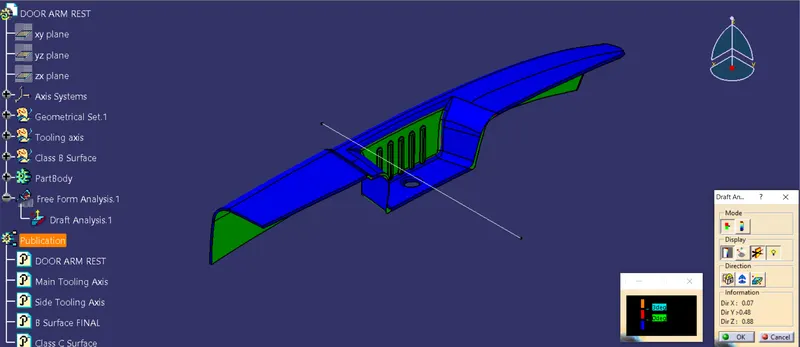
Steps for Draft Analysis:
- Go to Views and Customize View Parameters. Change to material.
- Click the Draft Analysis tool and use the compass to define the draft direction as the main tooling Axis.
- Once placed correctly, lock the draft direction.
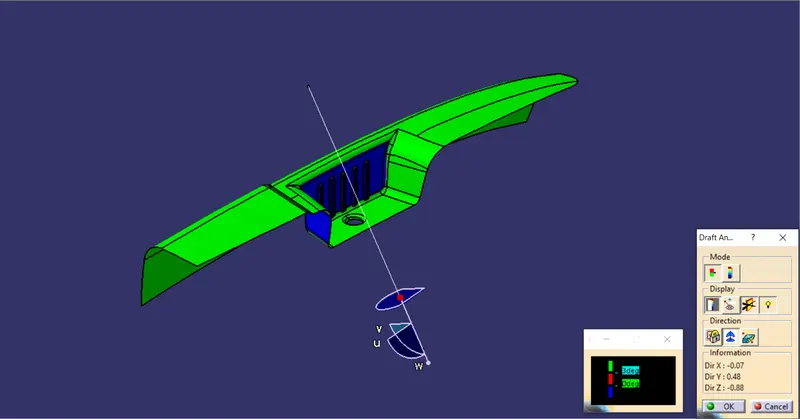
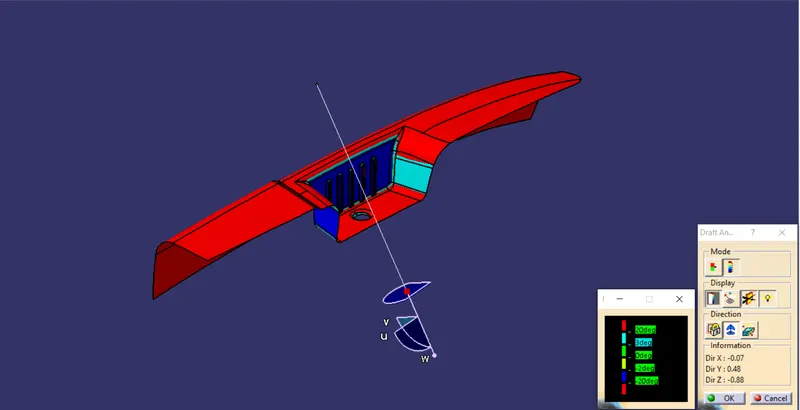
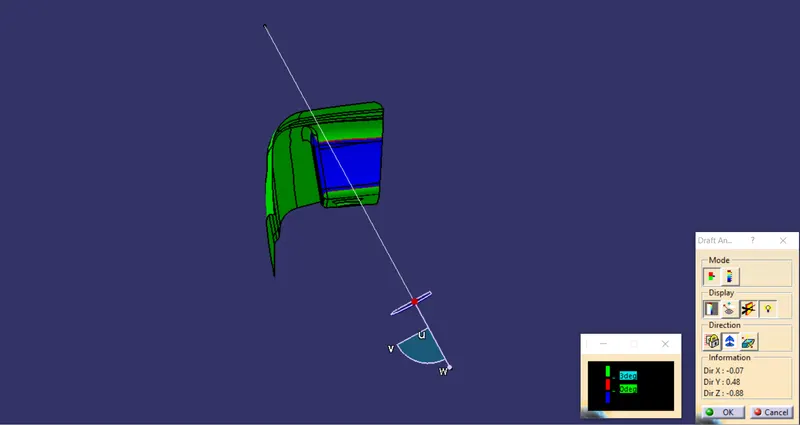
- Now, since the minimum draft angle for plastic components is 3 deg, define the value as 3 deg and select the Door Arm Rest
- The Draft Analysis is completed
Front View
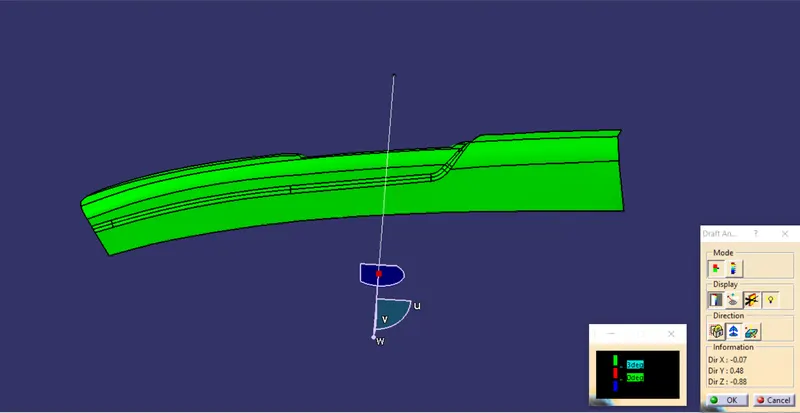
Side View
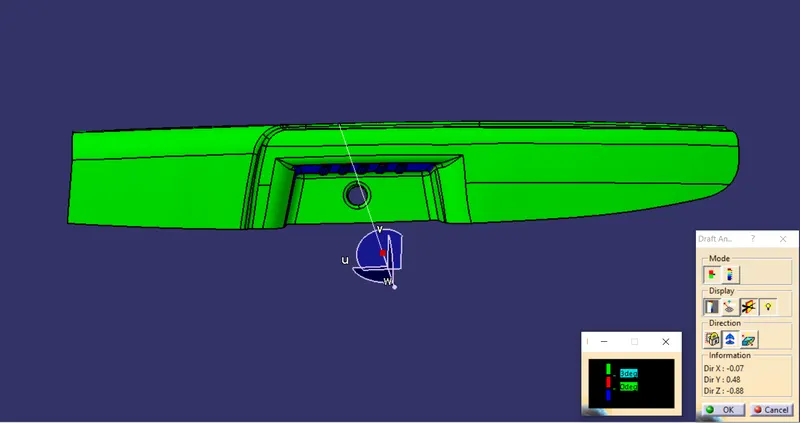
Top View
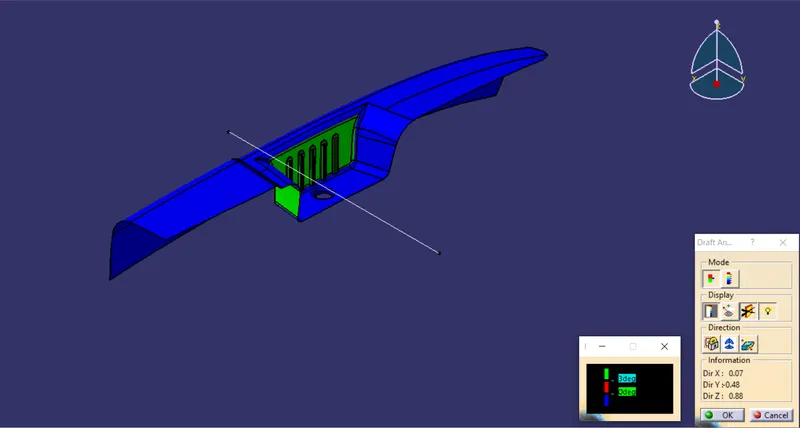
Side Tooling Axis
Results/ Conclusion of the Draft Analysis: By referring to the colour scale, the minimum draft angle of 3 deg is achieved and the component can be manufactured. The running point analysis tool can be used to find the value of draft angle at any point. If under any circumstances, the draft angle is found to be less than 3 deg, then appropriate changes should be done in defining the correct Tool Axis so that the draft angle is achieved and the component is manufactured.
Steps for giving thickness:
- Creation of B Surface
- Creation of C Surface
- Creation of Closed Surface
- The following features/commands were used- Extract, Untrim, Extrapolate, Offset, Trim, Split, Edge Fillet, Boundary, Multiple Extract, Join, Smooth Curve, Intersection, Sweep, Fill, Blend, Multiple Section Surface, Close Surface
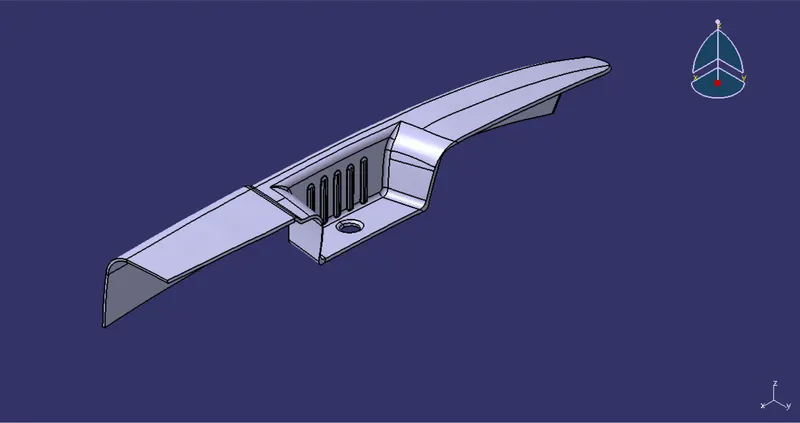
Isometric View
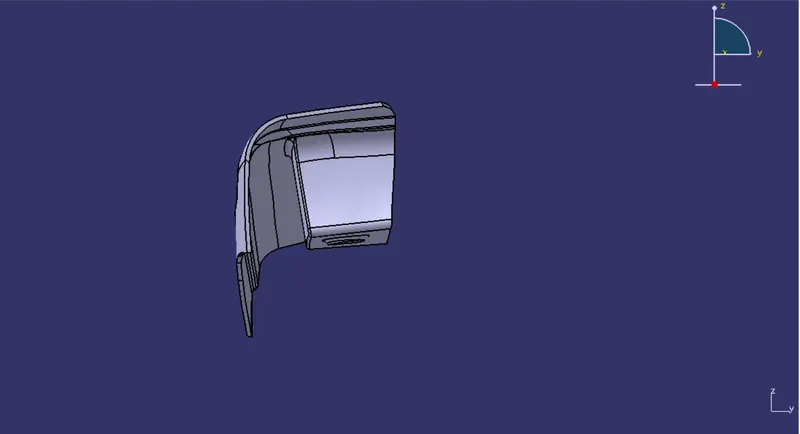
Front View
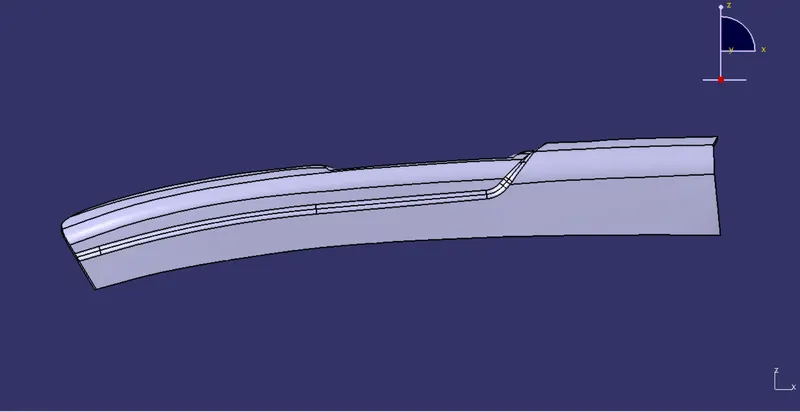
Side View
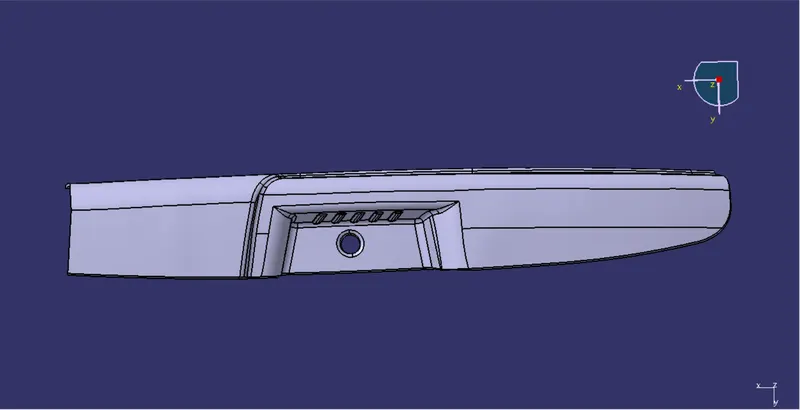
Top View
Draft Analysis on Solid part:
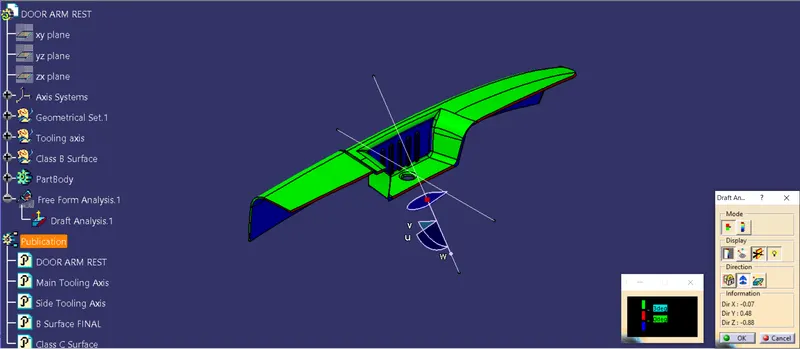
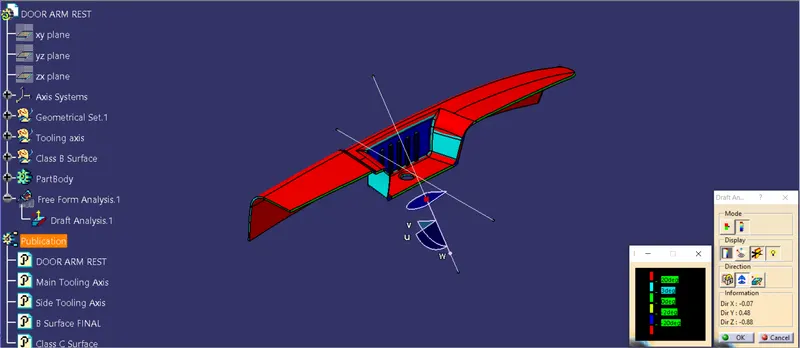
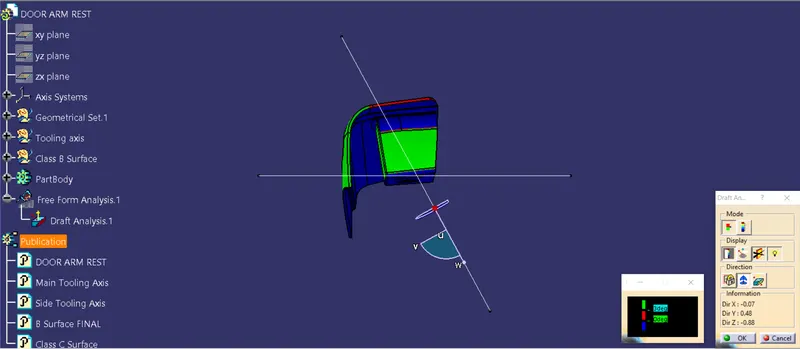
Front View
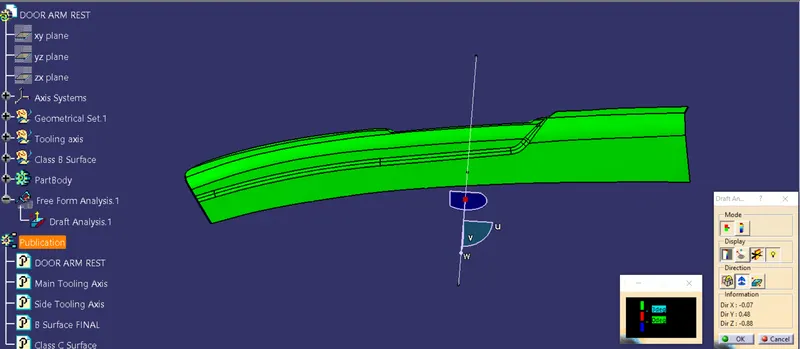
Side View
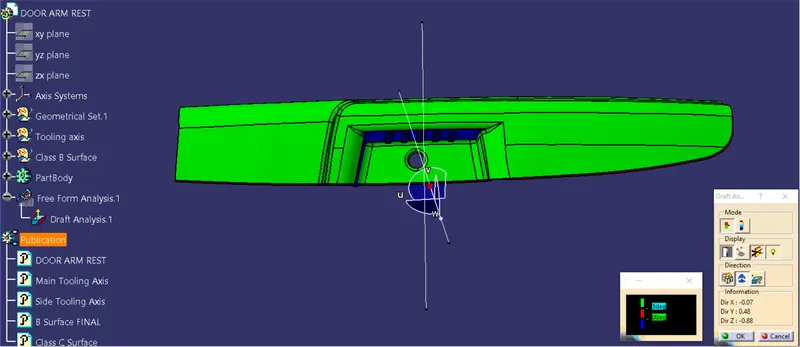
Top View
Side Tooling Axis