DFMA STUDY AND IMPLIMENTATION OF DFMA GUIDLINE ON HOSPITAL BED DESIGN
Application of design of manufacturing and assembly methodology in hospital bed assembly
Abstract:
Design for manufacturing and assembly is widely used by product designers and engineers to design products with lesser number of parts which helps in ease of assembly and thereby reducing the overall cost. This report gives an overview on Design for Manufacture and assembly, an application that can be used throughout various industries to reduce the overall costing of a product, hence helping to improve the overall company productivity. Two case studies with respect to DFMA usage and its advantages are presented in the current study. The products are analyzed for DFMA and redesigned for cost reduction.
Introduction:
DFMA is developed to give engineers a method to evaluate assembly and the manufacturability of a product and an aid to product development. Today companies worldwide are battling to reduce the cost of the products in order to increase profitability. Cost cutting of a product begins at the design stage. This is where DFMA takes its role. DFMA consists of a two part analysis of a product, Design for Assembly (DFA) and Design for Manufacturing (DFM) (Boothroyd, 1994). DFMA presents a methodology for product structure simplification through an integration of the DFMA software with the Theory of Invention Problem Solving (Lucchetta et.al, 2005).
By DFMA concepts, design effectiveness is improved and integration is facilitated when:
- Fewer active parts are utilized through standardization, simplification and group technology retrieval of information related to existing or preferred products and processes.
- Manufacturability is enhanced through incorporation of DFM practices.
- Design alternatives are evaluated and design tools are used to develop a mature and producible design before release for manufacture.
- Product and process design includes a structure to balance product quality with design effort and product robustness.
Design for manufacturing and assembly:
Since the improvement of CAD/CAM technologies, the term DFM has been drawing more interest. Even though design takes into account of the manufacturing process, often DFM practices are not followed. In common, the interaction between design and production functions has been very less. In a non-CIM environment, this interaction is not so significant. In fact, poor interaction gives both the design and production departments some flexibility, and to some extent, independence in achieving their nominal objectives. Recently, CAD/CAM has forced a change in this approach because improvements in the product can be cost effective only through design over an extended time period. One might expect that in a CAD/CAM environment the design need not be perfect from a manufacturing point of view, because computers can accommodate last minute changes without difficulty. But, the converse is actually true. Designers must now give closer attention to their ideas and drawings from the manufacturability point of view. They are expected to design what the available tools and personnel are capable of producing. Designs, therefore, are customized according to the production and assembly facilities in which the products will be manufactured. The enormous power of CAD/CAM workstations assist in doing this by providing designers with detailed information on the capabilities of existing manufacturing resources. Therefore term DFM emphasizes design production interface more significantly in a CAD/CAM environment than in a non-CIM environment.
DFM integrates product design, process planning, and production with the objectives of:
- Identifying product concept that is inherently easy to manufacture.
- Focusing on component design for ease of manufacture.
- Integrating product design with process design to attain optimum results.
Some typical guidelines to implement DFM to component design are:
- Minimize part variations.
- Attempt multi-functionality of parts
- Design for ease of fabrication.
- Design with as few parts as possible.
- Design parts for multiple uses.
Guidelines to implement DFA to product design are:
- Minimize part count
- Build fasteners into part design
- Use the same tools across assemblies
- Pay attention to symmetry
- Make it impossible to install parts incorrectly
- Design using COTS parts. (Commercial off the shelf parts.)
Case study: DFMA of adjustable electric operated hospital beds
Analysis of the Re- Designed hospital bed:
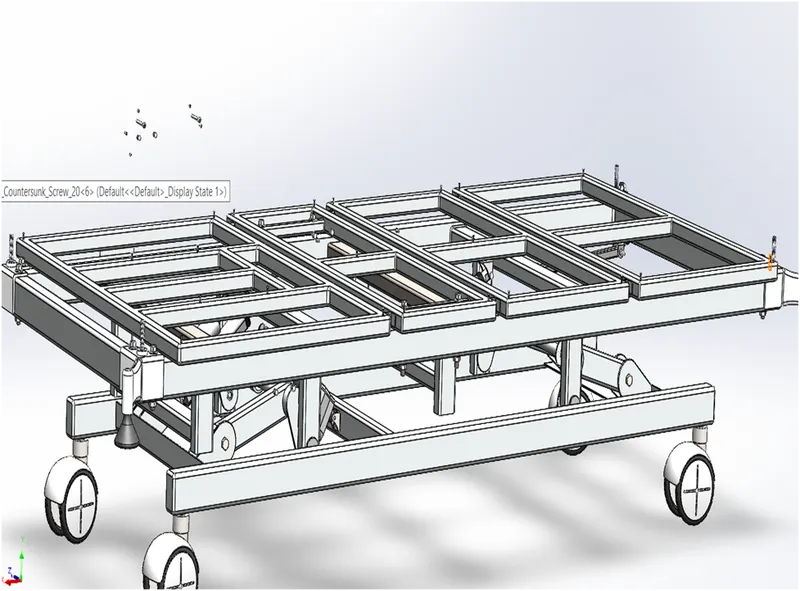
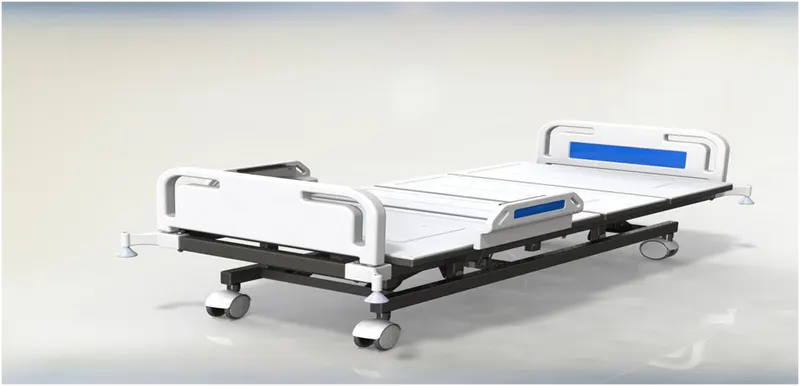
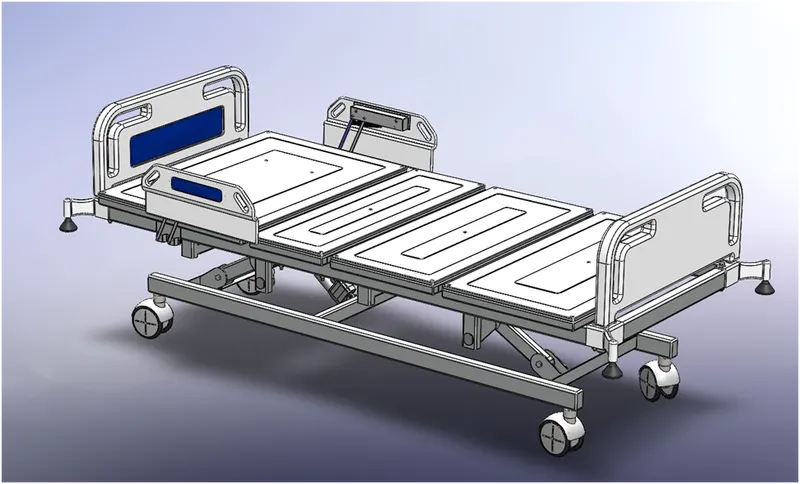
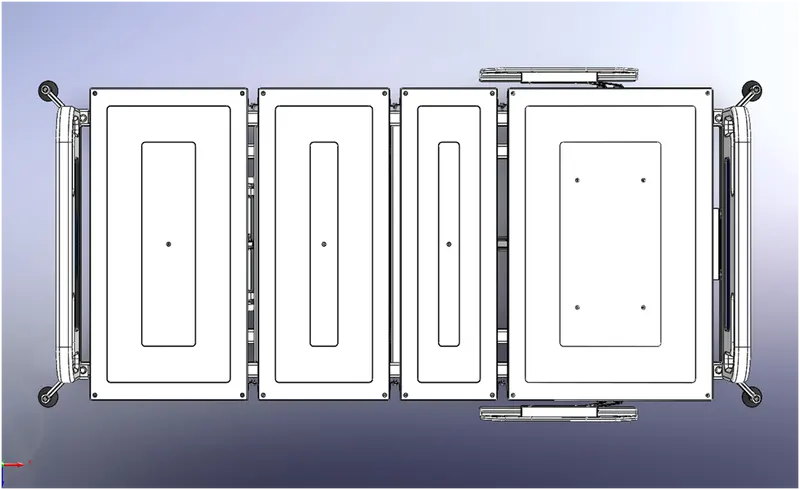
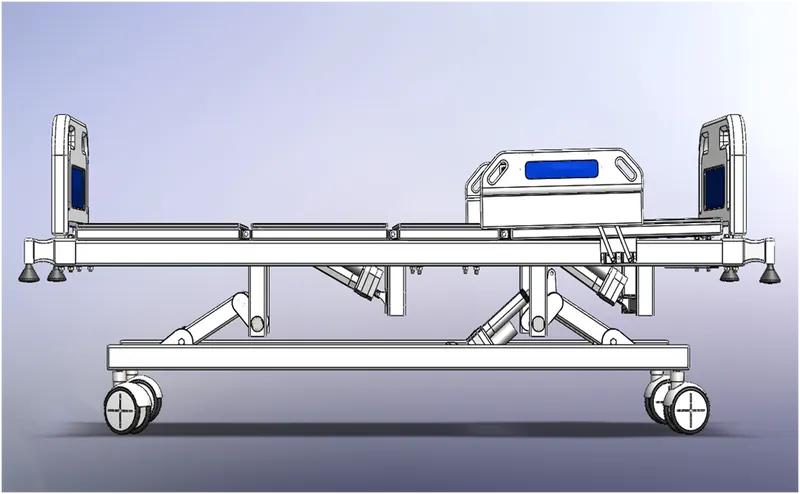
An electric operated bed is combination of base structure, bottom frame, headboard (2), side railing (2), special motor operated lead screw mechanism(3),caster wheel, etc.
These beds are designed for hospitalized patients or others in need of some form of health care. These beds have special features both for the comfort and well-being of the patient and for the convenience of health care workers. They can be used in various ill care conditions. The CAD model is shown in the fig 1 below. The existing design of the hospital bed consists fully fix head board with the base structure which are non convenient for the disassembly purpose, the side railing are also fix with the base structure and which can be pull up and pull down by the locking screw. This base frame consists of a rectangular hollow frames and other structural member and made up of solid round bar, which are much thicker when compared to the re-designed model, making the frame heavier, hence more expensive.
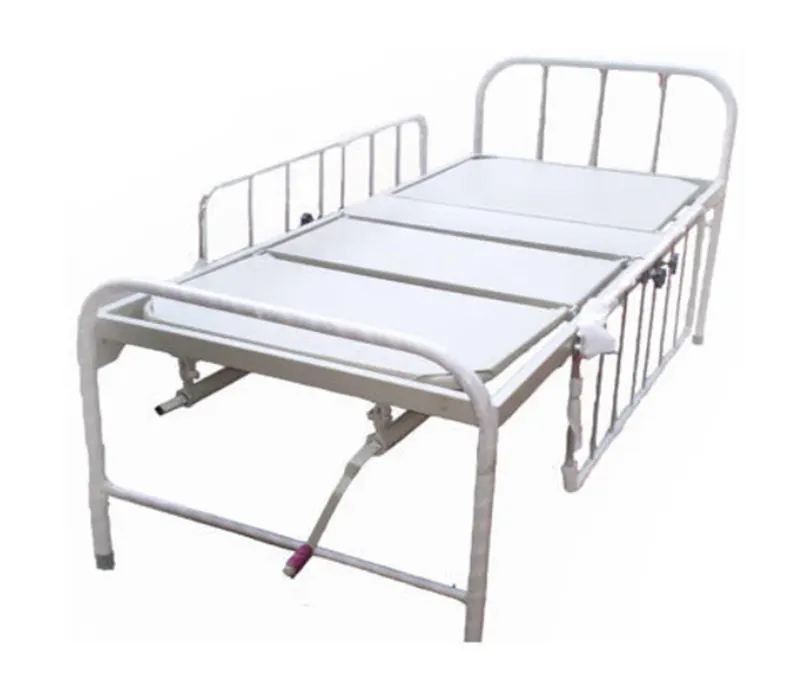
Fig.1
DFMA IMPLEMENTED AREA:
- BASE FRAME:
|
PART NO. |
PART |
PROCESS |
MATERIAL |
|
1 |
40*60 REACTNGULAR BAR |
CUTTING/WEALDING/DRILLING |
SS304 |
|
2 |
30*50 RECTANGULAR BAR |
CUTTING/WEALDING/DRILLING |
SS304 |
|
3 |
30*30 BAR |
CUTTING/WEALDING/DRILLING |
SS304 |
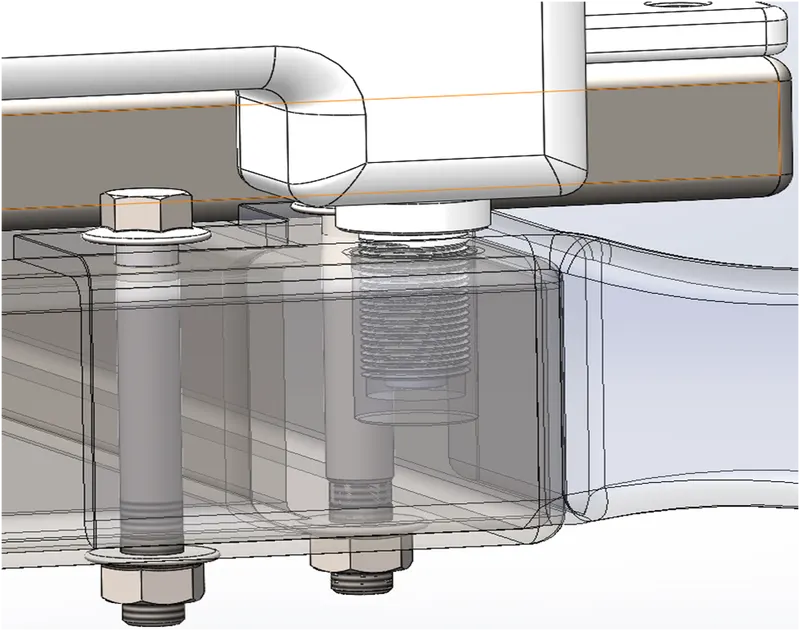
- Head board clamping unit:
|
PART NO. |
PART |
PROCESS |
MATERIAL |
|
1 |
HEAD BOARD MOUTING BASE |
INJECTION MOULDING |
ABS |
|
2 |
HOUSING |
INJECTION MOULDING |
MILD STEEL |
|
3 |
4*CLAMPING ROD |
TURNING/ DRILLING |
|
|
4 |
8*M10 NUT |
|
MILD STEEL
|
TABLE-2: AFTER DFMA
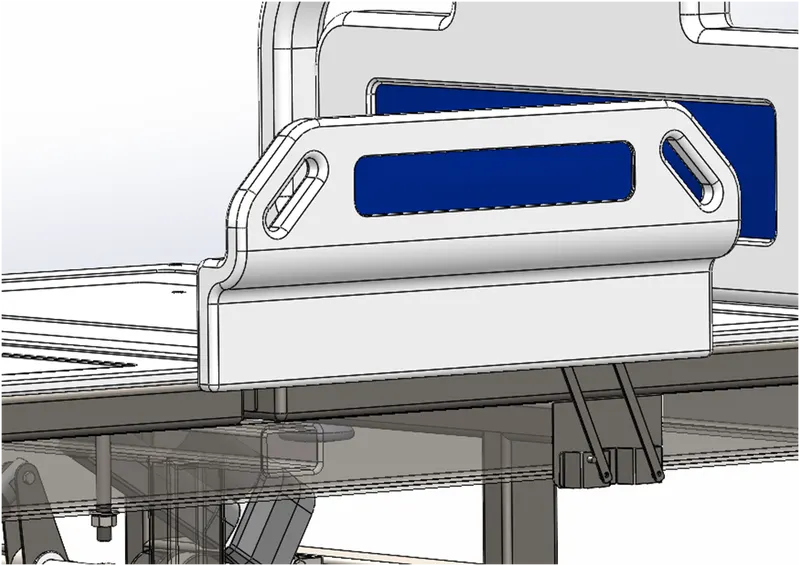
- SIDE RAILING:
|
PART NO. |
PART |
PROCESS |
MATERIAL |
|
1 |
SIDE BOARD |
INJECTION MOULDING |
ABS |
|
2 |
50MM STROKE GAS SPRING |
||
|
3 |
MOUNTING PLATE |
CUTTING/BENDING |
SS304 |
|
4 |
SHOULDER SCREW |
MILD STEEL |
|
|
5 |
BRACKET |
CUTTING/BENDING/DRILLING/WELDING |
SS304 |
|
6 |
4*M3.5 MACHINE SCREW |
STEEL |
|
|
7. |
4*SHOULDER SCREW |
MILD STEEL |
TABLE-4: AFTER DFMA
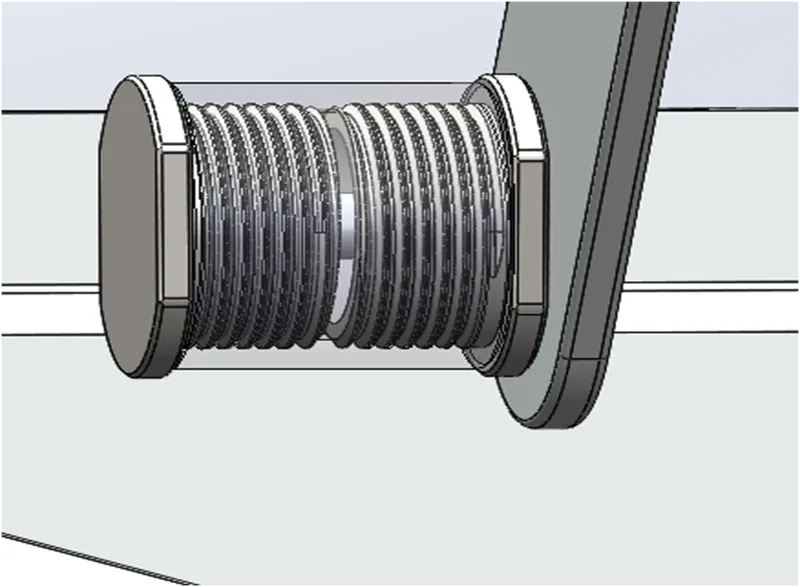
- BOTTOM BRACKET:
|
PART NO. |
PARTS |
PROCESS |
MATERIAL |
|
1. |
2*THREADED END CAP |
CUTTING/THREADING/BORING |
SS304 |
|
2. |
24 DIA DOUBLE BALL BEARING |
CHROME STEEL SEA-52100 |
|
|
3. |
ROUNDED SHAFT |
SS304 |
FINAL OUTPUT:
|
PART NO. |
PARTS |
PROCESS |
MATERIAL |
|
1 |
BASE STRUCTURE 2*(60*40),2*(50*30), |
CUTTING/WEALDING |
SS304 |
|
2 |
MOVING FRAME (30*30) |
BENDING/ WEALDING |
SS304 |
|
3 |
BASE |
INJECTION MOULDING |
ABS |
|
4 |
2*SIDE BOARD |
INJECTION MOULDING |
ABS |
|
6 |
GAS SPRING |
STEEL |
|
|
7 |
4*CASTER WHEEL |
TPU/STEEL |
|
|
8 |
HEAD BOARD CLAMPING UNIT |
MOLDING/TAPPING |
ABS/STEEL |
|
9 |
4*HEAD BOARD HOLDING SOCKET |
BORING/WEALDING/CUTTING |
ABS |
|
10 |
4*HOLDING SOCKET INNER WASHER |
POLYURETHAN |
|
|
11 |
2* HEADBOARD |
INJECTION MOULDING/TAPPING |
ABS |
|
12 |
4*HEADBOARD MOUNTING ROD |
CUTTING/THREADING |
STEEL |
|
13 |
BOTTOM BRACKET |
CUTTING/DRILLING |
STEEL |
|
14 |
M3*0.5 FLAT HEAD SCREW |
MILD STEEL |
|
|
15 |
12*M10 NUT AND BOLT |
MILD STEEL |
|
CONCLUSION:
Design for manufacture and assembly was conducted on a Hospital bed and a more optimized design was created which helped improve the productivity of the product with respect to costing. Form the case studies it was analyzed that for a headboard mounting unit the total number parts of the mounting unit were reduced from 8 to 3, with the help of DFMA software. The design was modified for ease in assembly. There was a reduction in time for assembly of the product, as well. By selection of proper materials and manufacturing processes along with optimized assembly helped reduce the overall cost of the hospital bed.
REFRENCES:
- https://en.wikipedia.org/wiki/DFMA#:~:text=DFMA%20stands%20for%20Design%20for,product%20for%20ease%20of%20assembly.
- https://www.researchgate.net/profile/Cd-Naiju/publication/299337403_Application_of_Design_for_Manufacturing_and_Assembly_DFMA_Methodology_in_the_Steel_Furniture_Industry/links/56f10dfc08aeedbe3ce46b84/Application-of-Design-for-Manufacturing-and-Assembly-DFMA-Methodology-in-the-Steel-Furniture-Industry.pdf
- https://www.sciencedirect.com/science/article/abs/pii/S1386505604001856
- https://www.ncbi.nlm.nih.gov/pmc/articles/pmc1089232/