DEVELOPMENT OF DOOR TRIM PANEL
AIM : To design a lower door trim panel of automotive uing CATIA V5.
SOFTWARE USED: CATIA V5
INTRODUCTION :
To create the Door Trim Lower's Plastic Component using the Class A Surface that is provided. Desired Thickness of the Plastic Component is 2.5mm with 3.2 degrees as the Draft Angle.
Firstly, we have to create the required Tooling-Axis for the given Class A Surface while meeting the requirements of the necessary Draft Angle & then perform the Draft-Analysis Operation on the Class A Surface itself.
After that, we have to create the required Class B & Class C Surfaces using which we have to create the Final Plastic Component and perform Draft Analysis on it as well.
OPERATIONS AND THEIR NEED :
CLASS - A SURFACES:
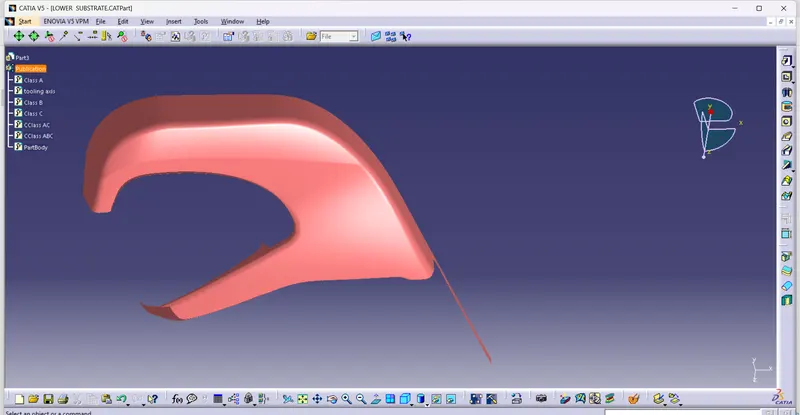
A-class surfaces are those free form surfaces, which are visible to us (interior/exterior), having an optimal aesthetic shape and high surface quality. Mathematically class-A surfaces are those surfaces which are curvature continuous while providing the simplest mathematical representation needed for the desired shape/form and does not have any undesirable waviness. This is the reason why in design industries Class-A surfaces are given more importance. In automotive design, a class-A surface is any of a set of freeform surfaces of high efficiency and quality.
CLASS - B SURFACES:
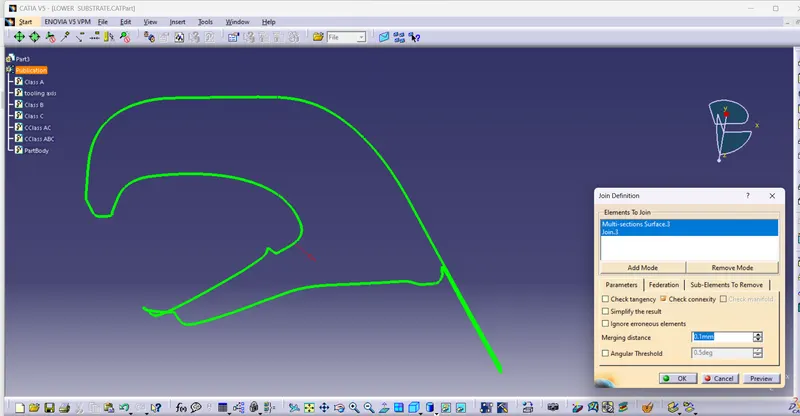
Class-B surfaces are the secondary surfaces that can be seen sometimes, but are less important, such as the inside of your glovebox, ash tray, etc. These must be smooth and "error-free" as well, but are not held to the standards that class-A surfaces are.
CLASS - C SURFACES:
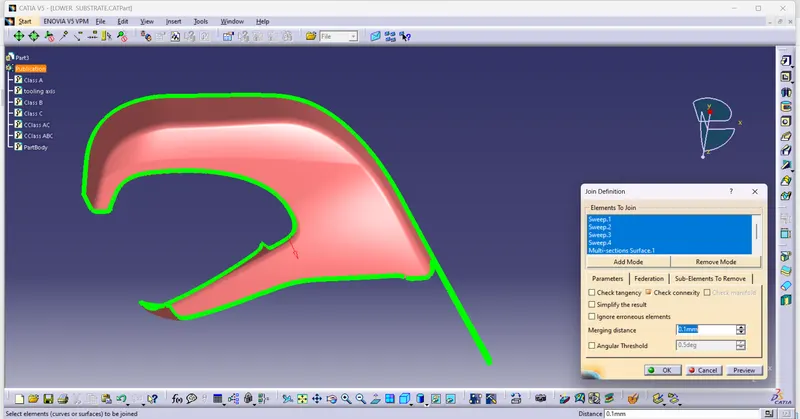
Class C surfaces are the backside surfaces that can have tool marks, flash and other imperfections without hurting appearance, function, etc.
DRAFT ANALYSIS:
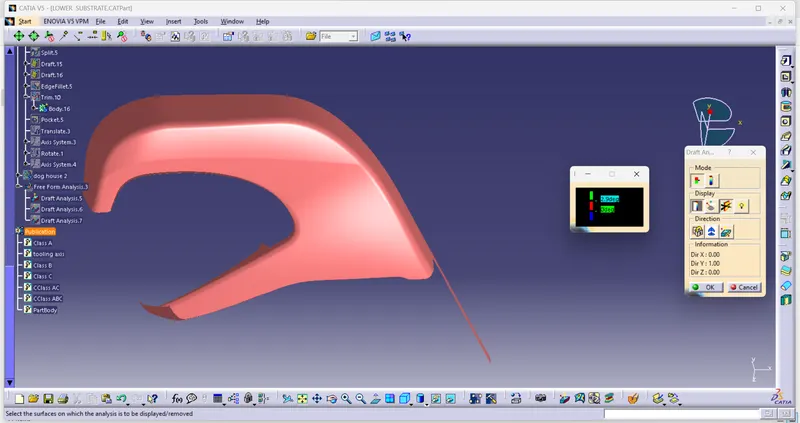
- The draft analysis command enables you to detect if the part you drafted will be easily removed. This type of analysis is performed based on color ranges identifying zones on the analyzed element where the deviation from the draft direction at any point, corresponds to specified values.
- The maximal draft analysis accuracy is 0.01 deg. According to the graphic card performance, this accuracy can be debased.
- The different mapping analyses of the same surfaces cannot be displayed simultaneously, even if you have set the mapping analyzes in no show. You need to visualize them one after the other.
DOG HOUSE :
Dog house is an engineering feature used in plastic trim design. Dog houses are used as supporting features. Sometimes other engineering features like snaps; locators etc. are mounted on them to increase their strength. Dog houses are subjected to draft analysis to prevent breakage of the component during ejection from mould cavity. Dog house and other engineering components are built on a B-surface.
HEAT STAKING :
Heat Staking is a pulsed-heat process to join two or more parts out of which one at least is made of plastic. The process is to deform the plastic material using heat and force at a set process time. The bond is made by partially de-forming the plastic part in order to fix the other.
Heat Staking makes it easy to bond metal to plastic and is commonly used in high volume/low cost applications such as automotive, IT and consumer appliances.
Heat Staking Benefits:
- Similar and dissimilar materials may be joined: metal to metal, plastic to plastic, metal to plastic
- Accurate control operating within a small process window
- Local heating resulting in no damage to surrounding materials
- Processing of glass-filled materials
- No mechanical vibration
- Many heat-stake shapes are possible through custom designed tools.
Materials best suited for Heat staking:
Heat staking technology is ideal for most native and blended thermoplastics on the market today, as well as the most robust glass and/or other- filled plastics. It produces high quality results when used with any of the following materials:
- Polycarbonate (PC)
- Polypropylene (PP)
- Polystyrene (PS)
- Acrylonitrile butadiene styrene (ABS)
- Nylons (GFN or Nylon 6/6)
- Ultem (GFN or Nylon6/6)
Sequence of Operations to generate CAD Model of a plastic component:
-
- Extracting the input Class-A surface into different parts of Assembly.
- Looking for defects in Class-A surface.
- Improving Class-A surface by patching defects.
- Improving Class-A surface as per Master section.
- Creating Tooling Axis.
- Creating Class-B surface.
- Creating Class-C surface.
- Creating a Closed Body.
- Creating Dog House as per Master Section and OEM standard design Rules.
- Creating Locator as per Master Section.
- Creating Ribs as per requirement.
- Draft Analysis.
- Adding Draft as per requirement.
- Creating Side core Tooling Axis.
Door Trim Panel consists of following Components.:
- Door Arm-Rest.
- Upper Map Pocket.
- Lower Map Pocket.
- Lower Substrate.
- Upper Substrate.
- Flanges.
- Heat stakes and Dog Houses.
PARTS (OR) COMPONENTS :
DOOR TRIM PANEL ASSEMBLY :
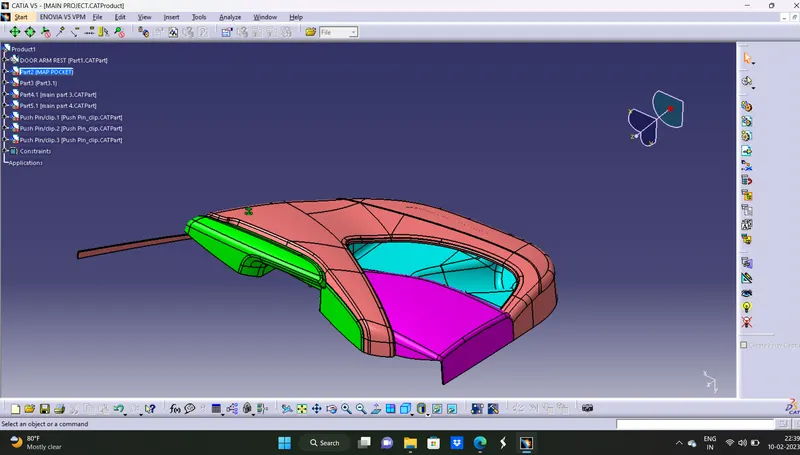
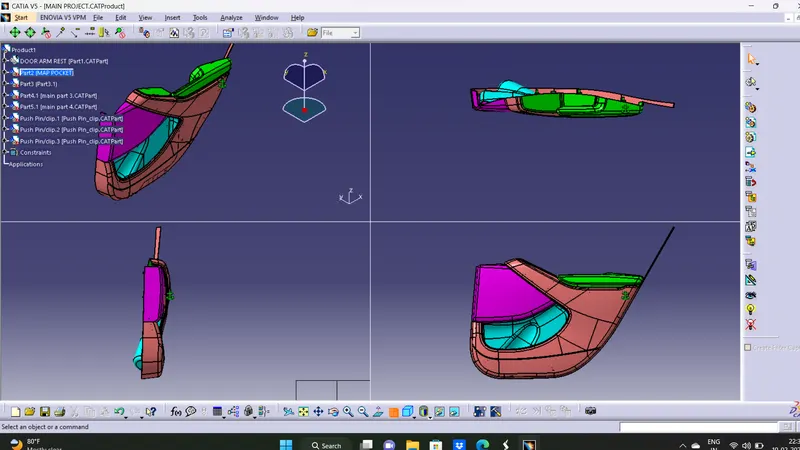
1) DOOR ARM REST :
TOOLING AXIS :
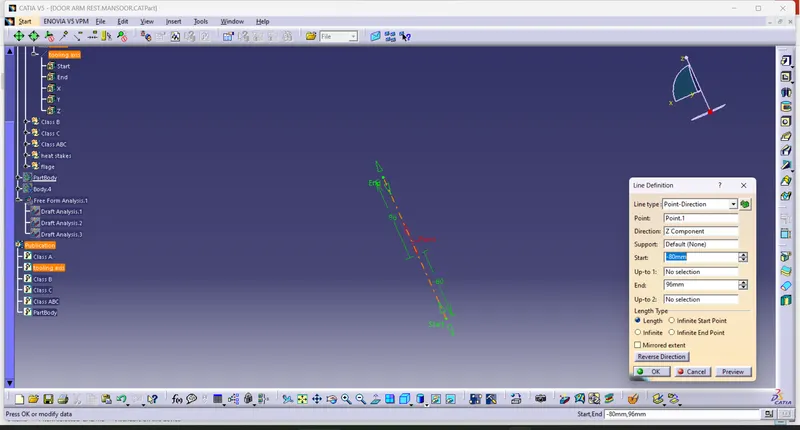
CLASS A :
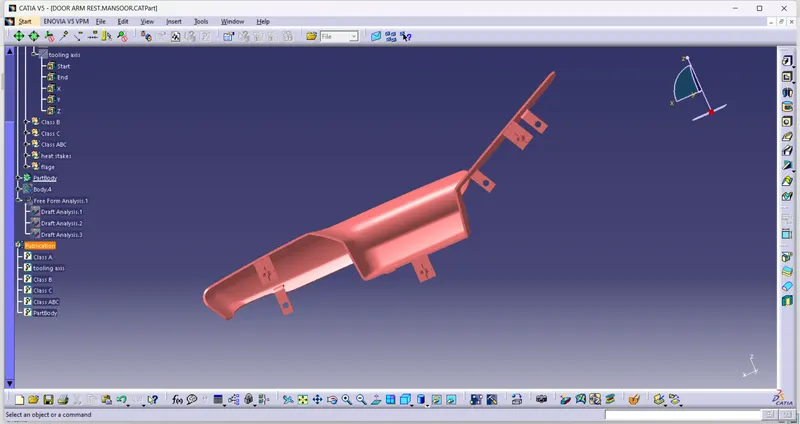
CLASS B :
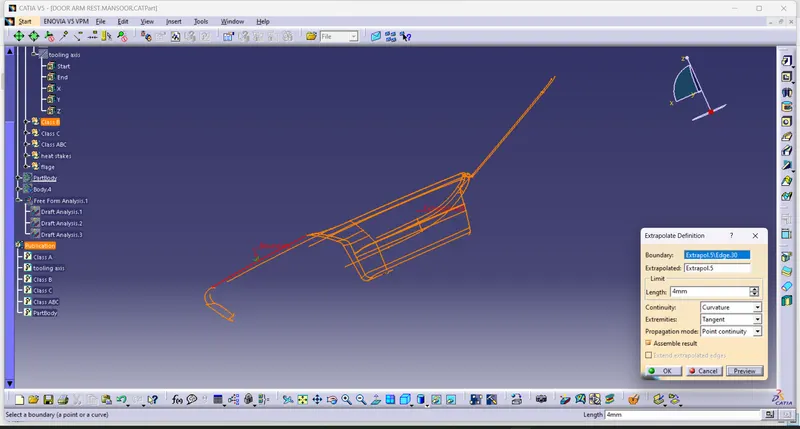
CLASS C :
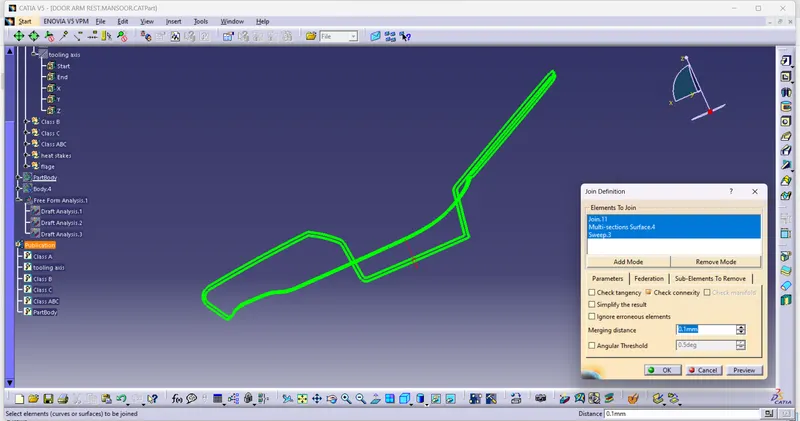
DRAFT ANALYSIS :
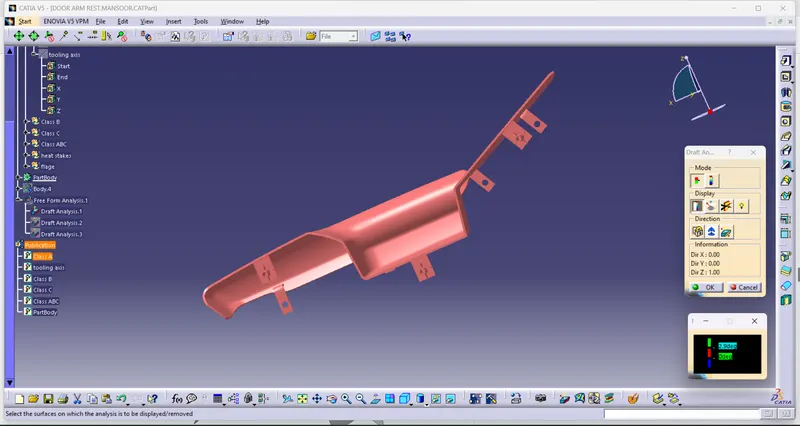
2) MAP POCKET :
CLASS A :
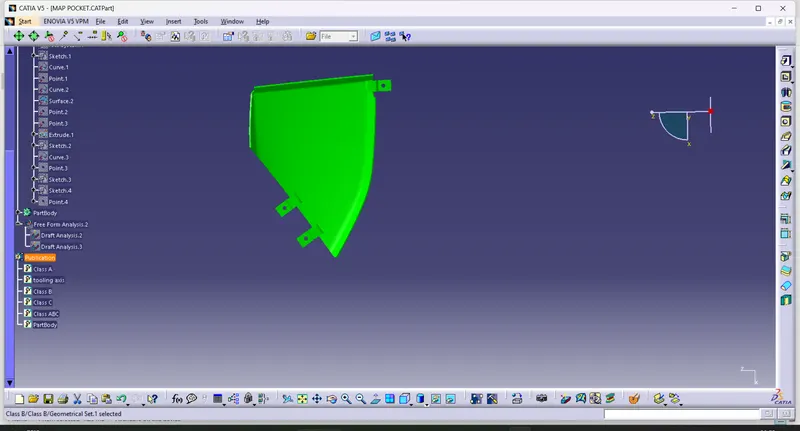
CLASS B :
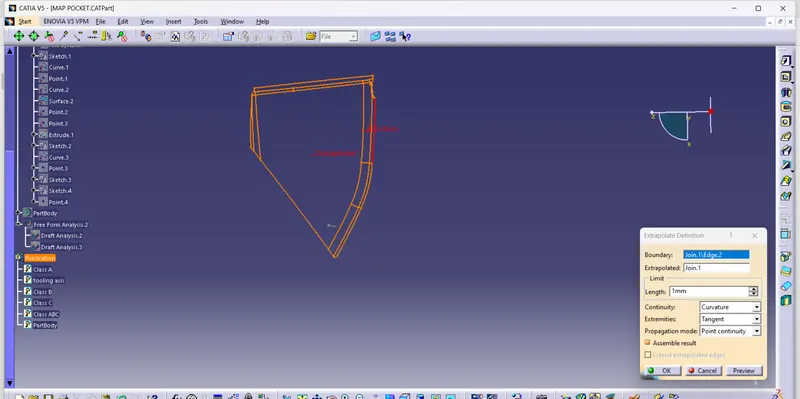
CLASS C :
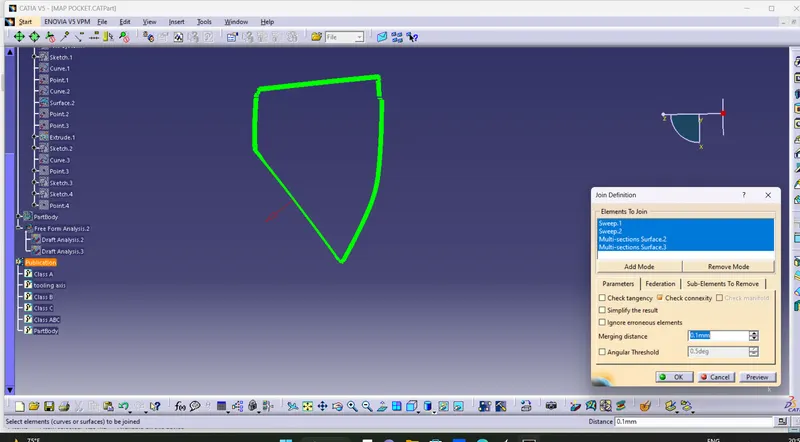
DRAFT ANALYSIS :
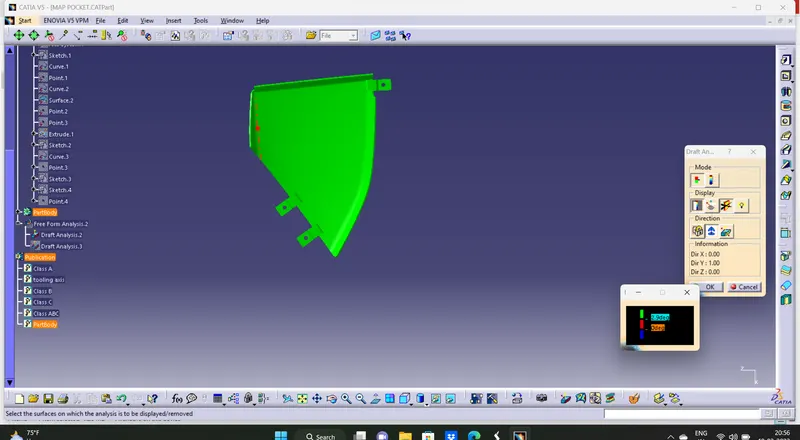
3) SUBSTRATE :
TOOLING AXIS :
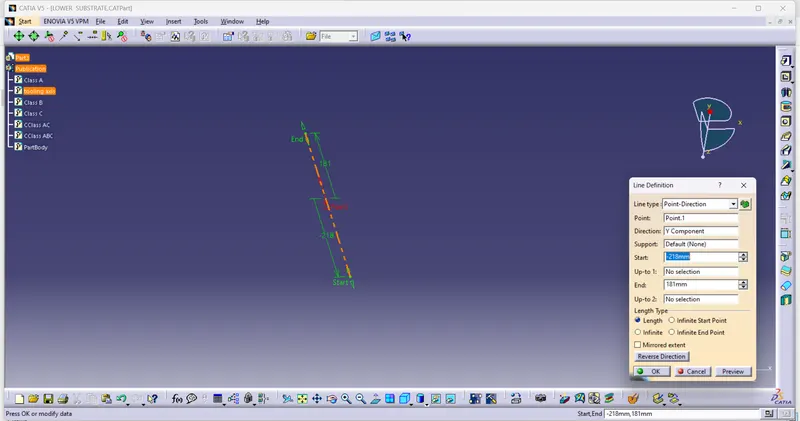
CLASS A :
CLASS B :
CLASS C :
DRAFT ANALYSIS :
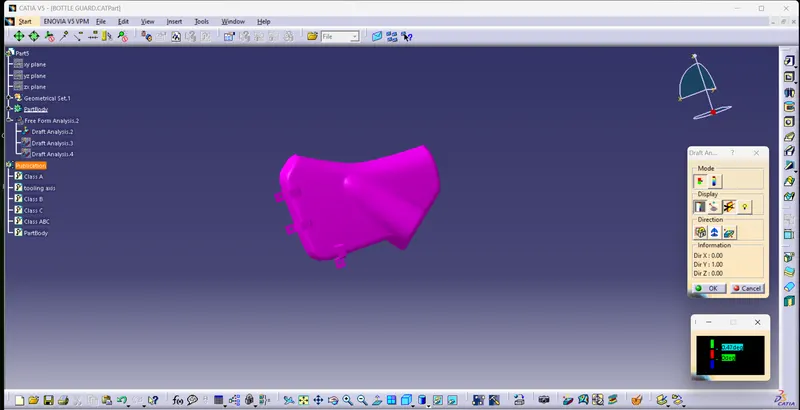
4) BOTTLE GUARD :
TOOLING AXIS :
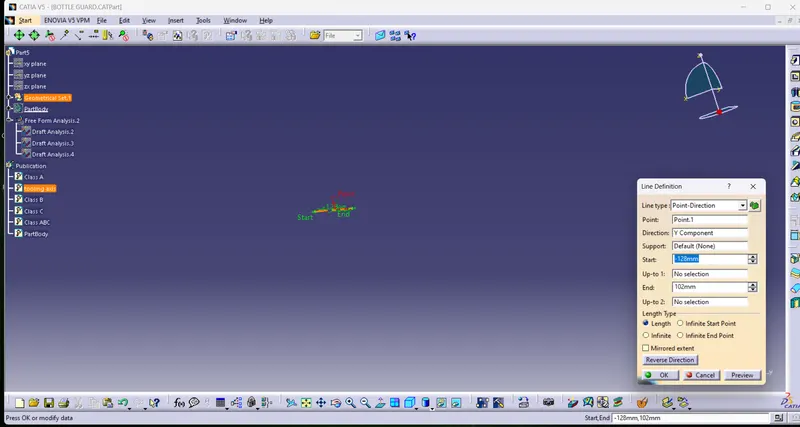
CLASS - A :
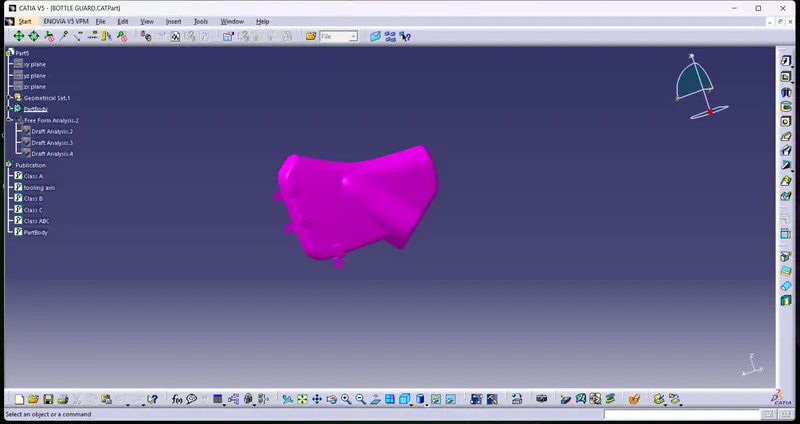
CLASS - B:
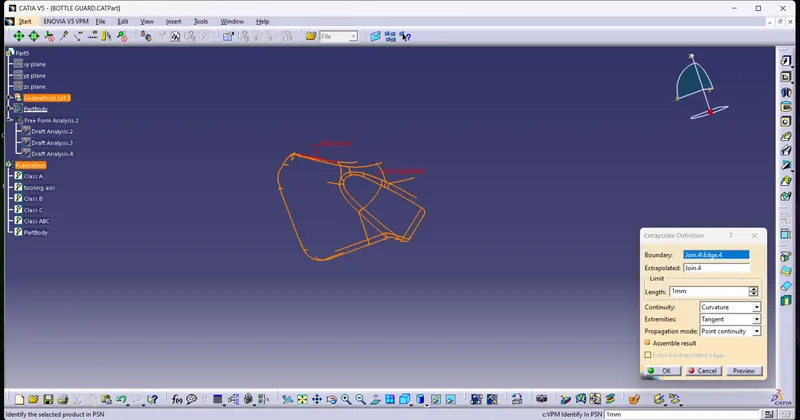
CLASS - C :
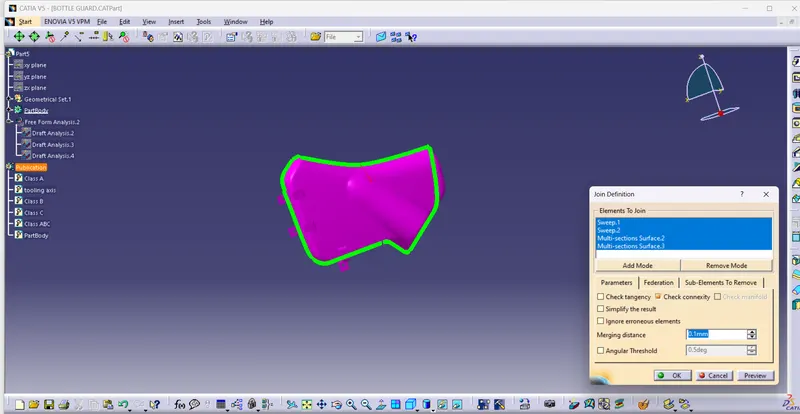
DRAFT ANALYSIS :
CONCLUSION : Door trim panel was sucessfully designed door trim panel using CATIA V5.
BY
Talluri Eswarsarathchandra