Design of backdoor
Aim:
To design the backdoor as per the standard methodologies and also provide proper reinforcements and embosses
Introduction:
Backdoor of a car is also called tailgate. A tailgate, or sometimes a hatch, is a hinged board or door at the rear of a vehicle that can be moved up or down while loading and unloading. Also called a tailboard, it is commonly found in pickup trucks or hatchback vehicles. This car’s tailgate panel consists of an inner and outer glass fiber composite panel bonded together, along with a toughened and heated window glass attached to the outer surface. A striker pin in each rear corner of the car’s tailgate engages with a spring-loaded latch plate on the body, with a single release cable operating both latches and terminating the release handle on the driver's side of the cabin's rear bulkhead. A car backdoor consists of inner panel, 2-3 outer panel & reinforcements. Car backdoor is mainly made of steel or aluminum based on the budget of a car. The inner panel consist of hinge reinforcement, gas stay reinforcement, latch and striker reinforcement & wiper motor housing. Using aluminum improves the strength of the parts as well as reduce the weight of the backdoor& also we can vary thickness in the aluminum parts due to which we can avoid the reinforcement. The only drawback is the cost of aluminum. For steel parts we cannot vary thickness of the parts and theses parts are stamped & more number of parts are added which in turn increase the weight of the backdoor. The structure of the backdoor usually contains 2 to 3 panels depending on the budget of the vehicle. Reinforcements are also placed in required areas for the hinges, gas-stays and striker. While the panels maybe 0.75 - 0.65 mm the reinforcements are required to be 1 - 1.5mm.
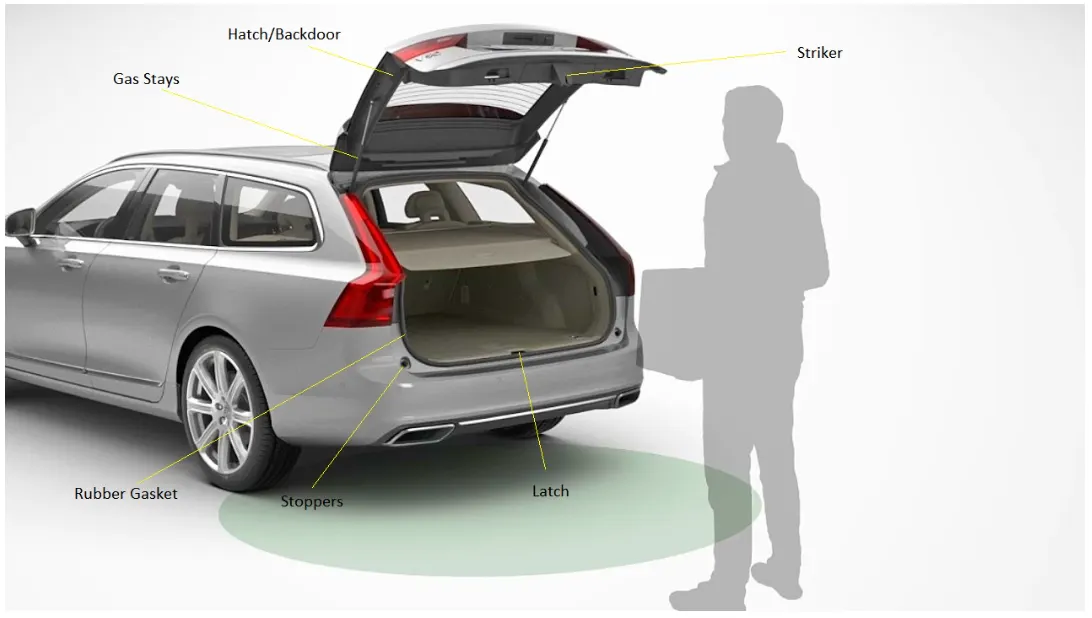
The constrains that must be followed while designing the backdoor:
- Rear visibility requirements
- Hinge, gas-stay and latch reinforcement locations
- Luggage capacity
- The external aesthetic of the vehicle
- position of tail lights
The parts of the backdoor are:
Inner Panel.
Outer Panel.
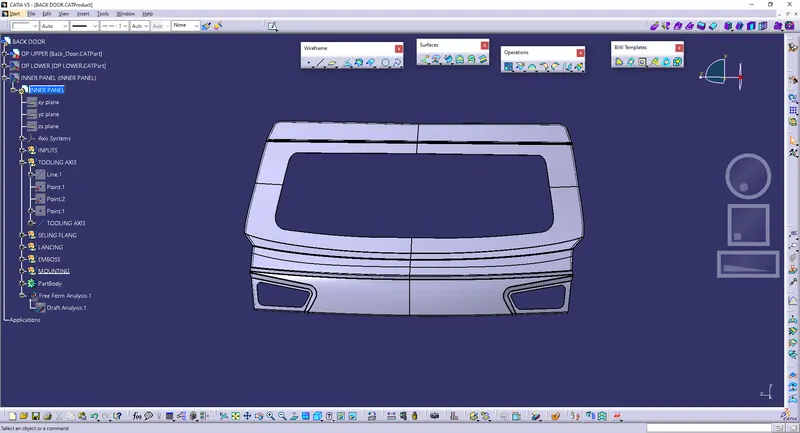
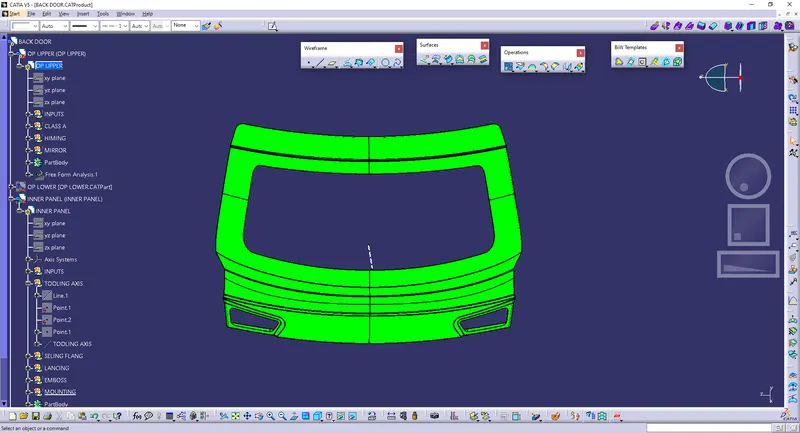
Outer Panel Upper.
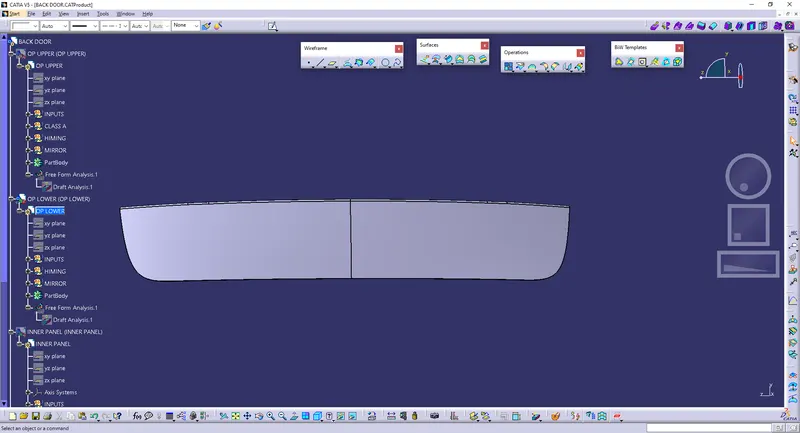
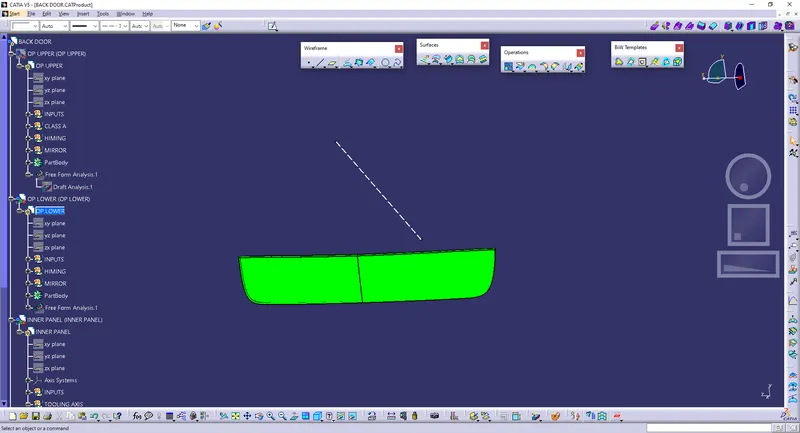
Outer Panel Lower.
Reinforcements.
INNER PANEL:
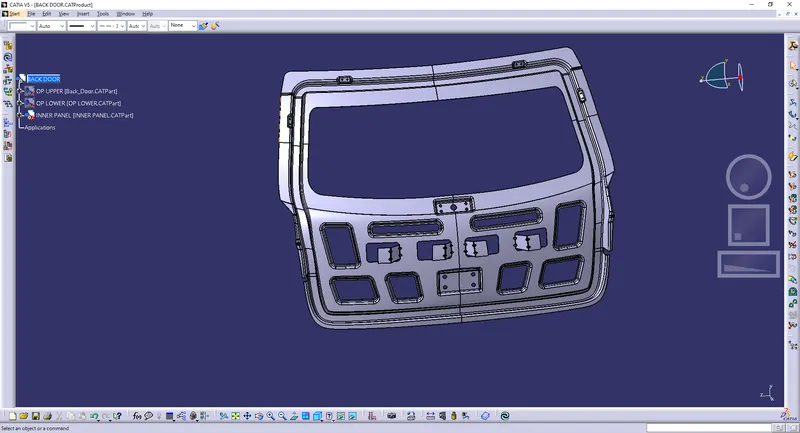
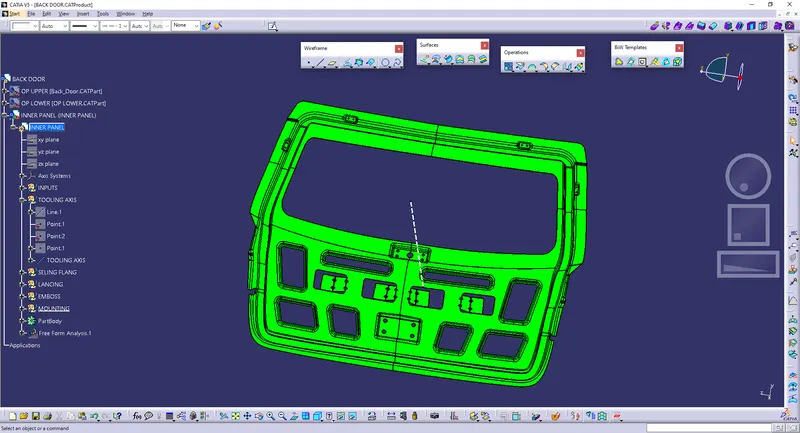
The inner panel provides the structure to support the outer panel and reinforcements. Both the panels are fixed to each other by mastic material or spot welds, but care is taken so that the welds are not seen the external surface of the door. In the inner panel for it to act as a good reinforcement it needs to disperse the stress outwards and not inwards, hence in this design the embossing is designed to move the stress outwards away from the center.
OUTER PANEL:
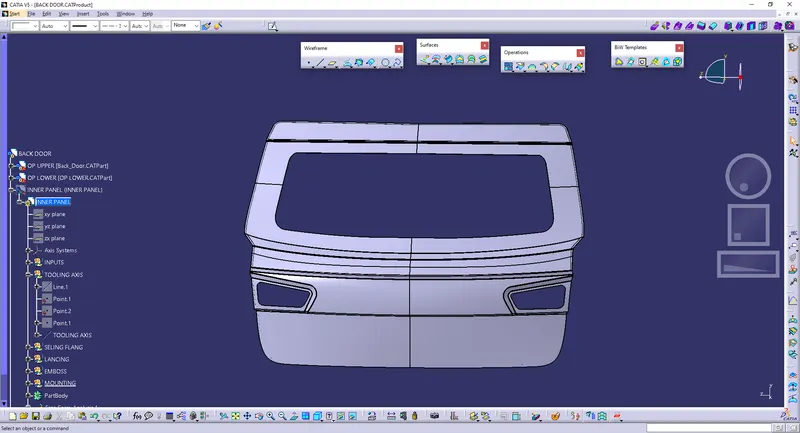
The outer panels are the provide the outer structure and provide mounts for the tail lights depending on the model. There may be only one or two outer panels depending on the budget requirements. The outer and inner panels are fixed to one another through hemming and proper reliefs are provided at corners.
OUTER PANEL UPPER:
OUTER PANEL LOWER:
GAS STAY:
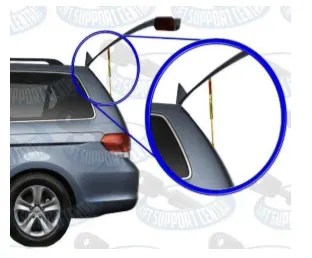
Gas stay is an apparatus for a back door of a car, which can safely keep an tail gate in an open state even if an external force is abruptly generated due to vibration, wind and can facilitate an opening/closing operation of the tail gate. It works on a typical mechanical spring that relies on elastic deformation, uses compressed gas contained within an enclosed cylinder sealed by a sliding piston to pneumatically store potential energy and withstand external force applied parallel to the direction of the piston shaft. It is weightier than support rod and doesn’t need man power.
REINFORCEMENTS:
Reinforcements are provided strategic places where components are fixed or additional strength is needed, they usually range from 1mm to 1.5mm. The hinge reinforcement is positioned in accordance with the hinge position and the latch and striker. It must be strong enough to hold up the weight of the door. Hinges support the weight of the whole backdoor. Hence a reinforcements are provided here too. Emboss is designed such that the hinges should operate freely. The electrical wiring looms are through the holes along the periphery to keep them hidden An angled or Diabolic emboss is provided for the gas stay mounts. The angle makes it easy to be machined and stamped. It is reinforced with a thicker sheet.
EMBOSSES:
To reduce the weight of Hood, some materials are removed and embosses are created to give stiffness to the panel. Sheet metal embossing is a stamping process for producing raised or sunken designs or relief in sheet metal. In this project the Embosses are created to divide the force towards the hinge joints during collision.
HEMMING END EDGE RELIEF:
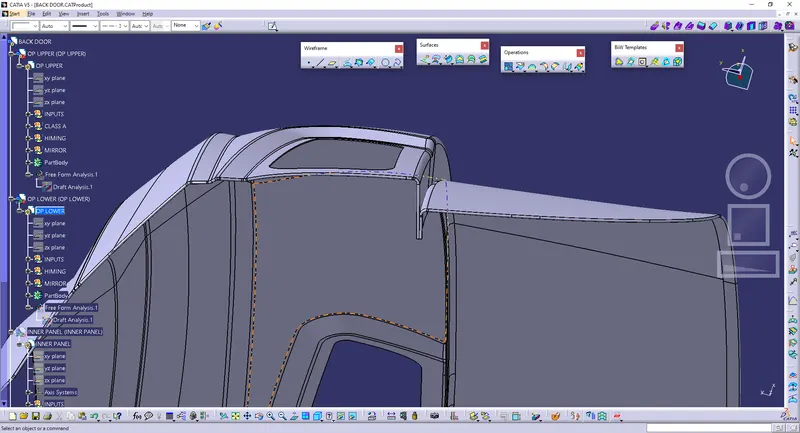
Hemming is a forming operation in which the edges of the sheet are folded or folded over another part in order to achieve a tight fit. Normally hemming operations are used to connect parts together to improve the appearance of a part and to reinforce part edges. Typical hemming defects are split or wrinkles in the flange, material overlaps in the corner areas or material roll-in. This issue can be overcome by facilitating a viable amount of corner relief in every corner of the hemmed component. Relief is done to decrease the stress concentration along the corners and also to decrease the clumping of metal along the corners, this is done by trimming the corner by a minimum radius for the rollers to pass along smoothly.
DRAFT ANALYSIS:
Draft analysis is done to show that the metal can be drawn with the particular design without any tear in the metal of disfiguration. So, the design has been analyzed using the tool on NX CAD with having 5 degree as the allowance.
CONCLUSION:
Thus, the back door is designed with proper methodologies, reinforcements and embosses.