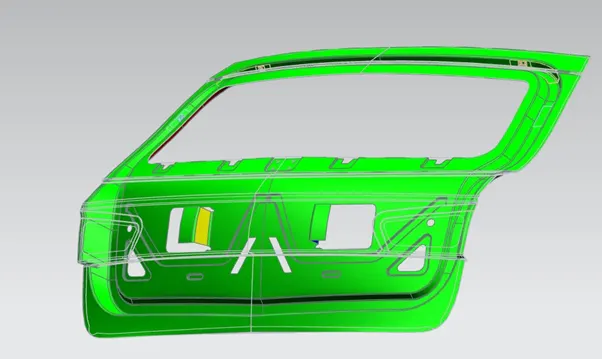
Design of backdoor
DESIGN OF TAILGATE
OBJECTIVE: The objective of this challenge is to design BIW tailgate(backdoor) of passenger car through using NX-Cad. The report constitutes about positioning of Latch and Stricker, Wiper motor. Tail light mounting, Gas stay Reinforcements with suitable emboss definitions and Hemming flanges.
BACKDOOR: A tailgate or backdoor is the panel that covers the boot or trunk of an automobile. It enables access to the main luggage compartment. A hinge allows the boot lid to be raised, while devices such as springs or gas cylinders hold it up in the open position.
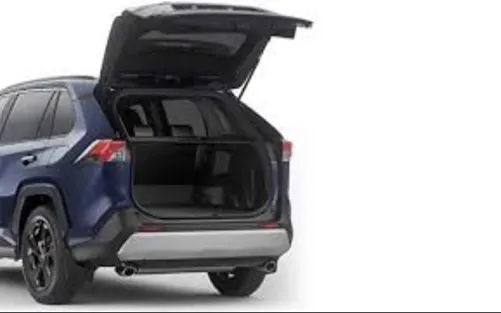
In principle, boot lids have to full fill similar requirements and are subject to the same design guidelines as bonnets. However, aluminium sheets are used much less for tailgate than for bonnets. Backdoor or Tailgate are hinged at the top and open upwards, tailgates are lateral opening doors which are hinged at the left or right side. They greatly benefit from a reduced weight due to easier handling. In addition, a reduced weight can translate into significantly lower rear axle loads (as these panels overhang the rear axle) and hence additional seating capacity.
DESIGN CONSIDERATION: The styling surface is checked for surface integrity and irregularities and saved for further surface developments. To improve the luggage, compartment the panel is drawn thinner with considerable space for all the mounting parts and wire harness.
Parts of the Back-door Assembly:
- Outer panel
- Inner panel
- Sealing Flange
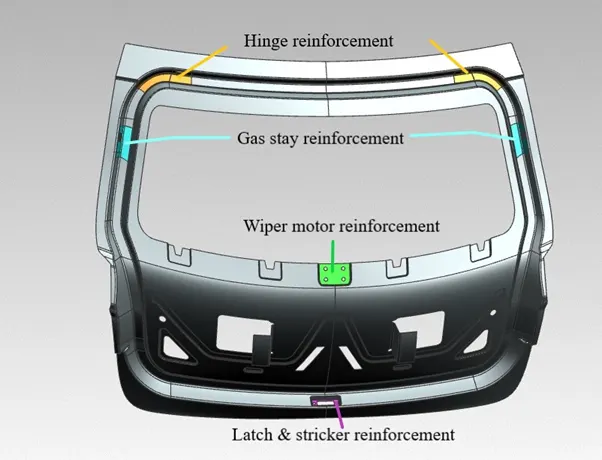
- Hinge reinforcement
- Gas stay reinforcement
- Wiper reinforcement
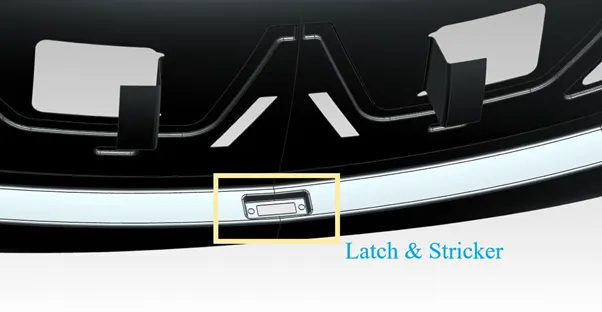
- Latch and Stricker reinforcement
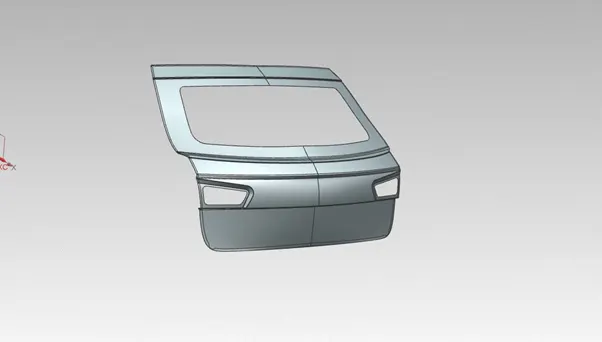
OUTER PANEL: The outer panel of the back door is similar to other BIW components where it is the aesthetic part of the vehicle. The coating provided is the multi stage which has the property of scratch resistance, rust prevention and smooth and attractive finishes. The outer panel also has the provisions for the tail lamp, rear fog lamp also has the provision for licence plate mountings. Most of the hatchback cars have the provision of wiper motor.
INNER PANEL: The inner door panel is a component which is used for strengthening the door assembly and it is one of the most important components on which all accessories are mounted like hinges, glass guide channel, moulded trim, latch etc…. The possible method is the integration method, in this method the part is stamped out of a single blank. This reduces the number of tools needed the assembly cost and eliminates any fit ability problem.
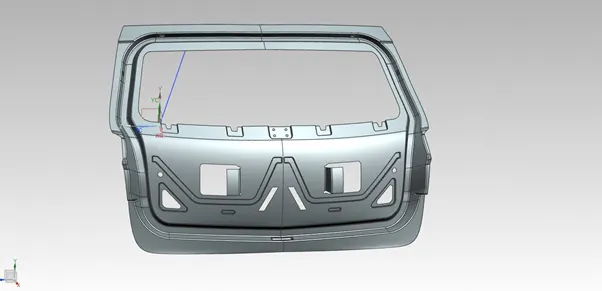
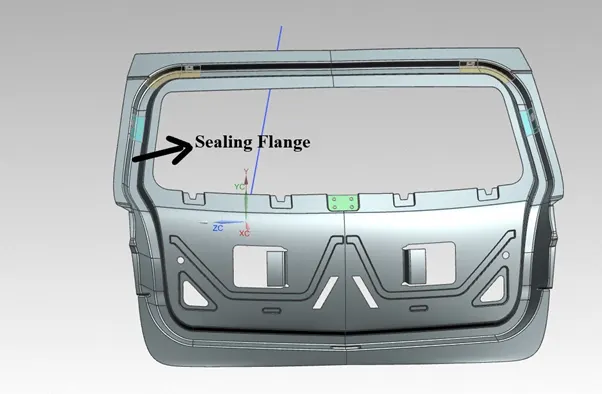
SEALING FLANGE: The Sealing Flange section shown forms an integral part as it contacts with Roof, Body Side Door and Rear Lower panel.
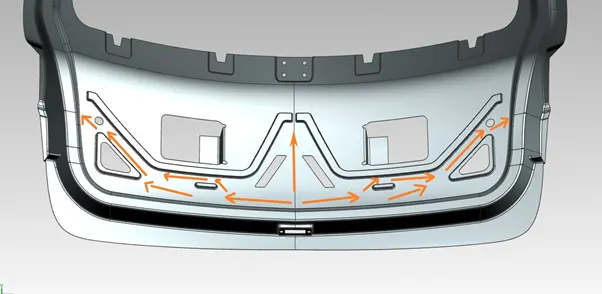
EMBOSSING: Embossing is a metal forming process for producing raised or sunken designs or relief in sheet material by means of matched male and female roller dies, theoretically with no change in metal thickness. Embosses are created to provide addition strength and to direct the forces towards the hinge and body of the car.
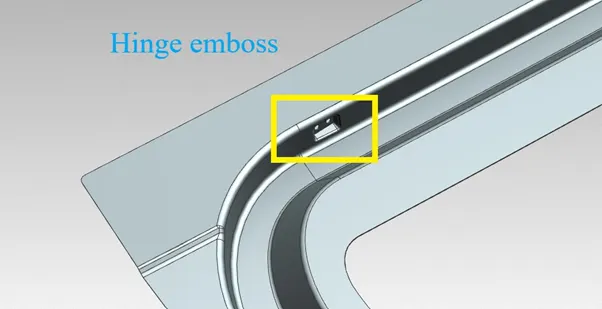
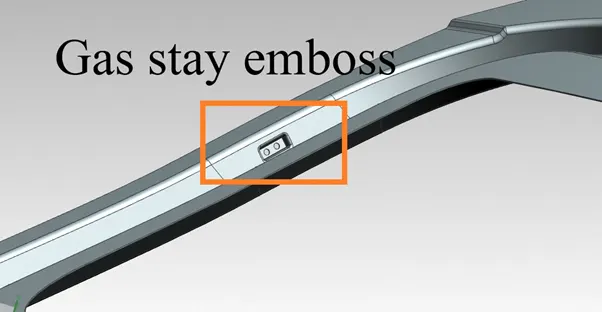
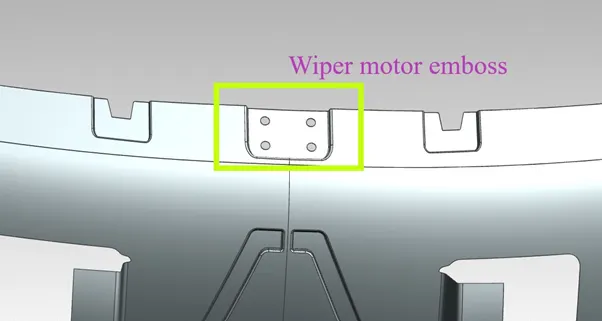
REINFORCEMENT: Instead of making the whole inner panel of a thicker sheet, a sheet with less thickness in addition to local reinforcement is provided to increase the strength of the component and reduce the weight.
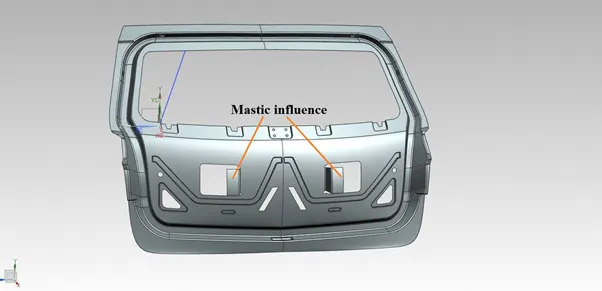
MASTIC INFLUENCE: Apart from Hemming the outer and inner panel are joined using mastic influence points to avoid the rattle noise improve the NVH and Trim part mounting points are provided which are usually snap fits.
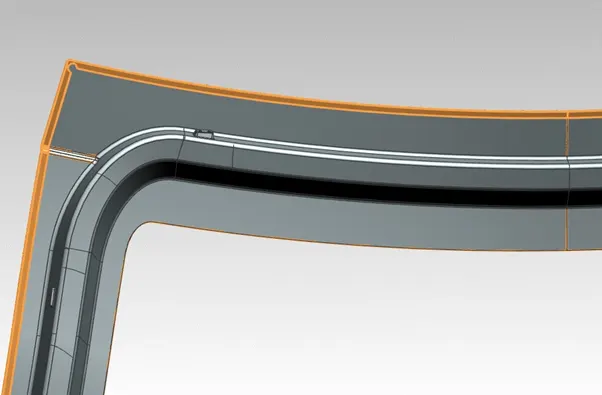
HEMMING & RELIEF ANGLE: Hemming is the process in which the edge is rolled flush to itself, while a seam joins the edges of two materials. Normally hemming operations are used to connect parts together, to improve the appearance of a part and to reinforce part edges. Relief is provided onto the part or component in order to remove any stresses developed in a particular area i.e sharp corners that takes place during the hemming process is carried out. Thus corners are rounded or chamfered.
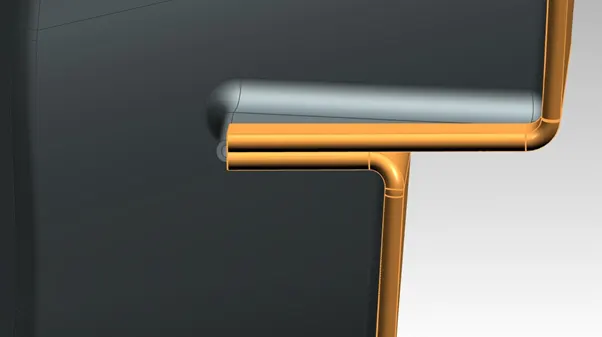
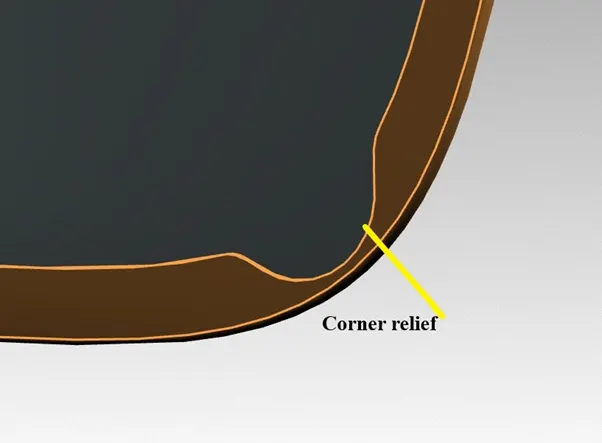
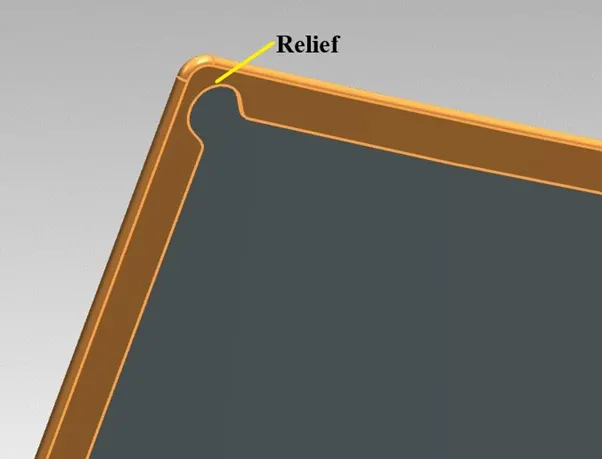
LATCH & STRICKER TRAJECTORY: To define the opening and closing trajectory, the hinge and latch are positioned based on the hinge axis and trajectory. The circle drawn should perpendicular to the latch and Stricker to satisfy the condition. Based on the rotation trajectory the hinge axis, Latch Stricker and predefined Gas stay are corelated for smooth kinematics of door opening and closing. Based on the type of gas stay, Door weight and kinematics the distance between the Gas stay and Hinge axis is 60 – 90mm and an angle of 85-90.
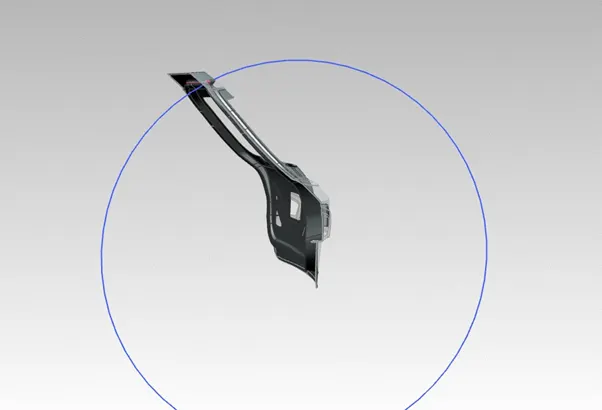
STRESS FLOW DIERECTION: In the inner panel for it to act as a good reinforcement it needs to disperse the stress outwards and not inwards. Hence in this design the embossing is designed to move the stress outwards away from the centre.
DRAFT ANALYSIS: Draft analysis is done to show that the metal can be drawn with the particular design without any tear in the metal of disfiguration. So the above design has been analysed using the tool on NX CAD with tooling direction.
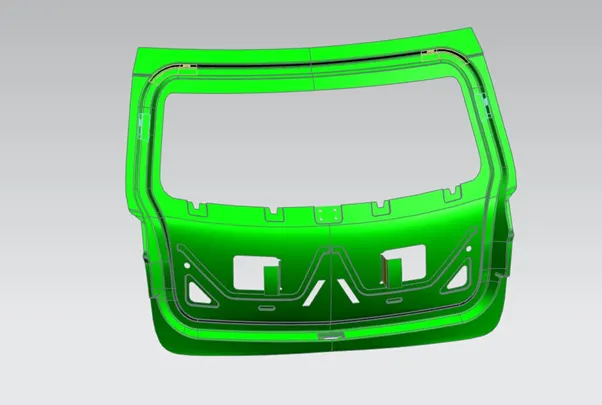
The mastic influence section, Connecting Flange and Reinforcements needs separate tooling direction.