Design of backdoor
Design of Backdoor of a car
Aim: To design a backdoor of a car using the styling surface provided to us by following the industrial standards.
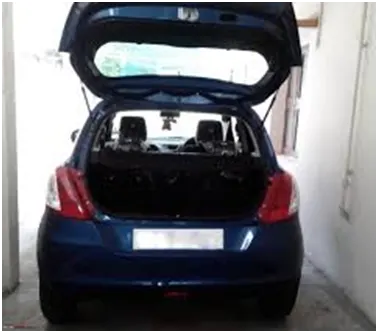
Backdoor: Backdoor or rear door or tailgate is a part of the car which swings upward to provide access to the cargo or luggage area.
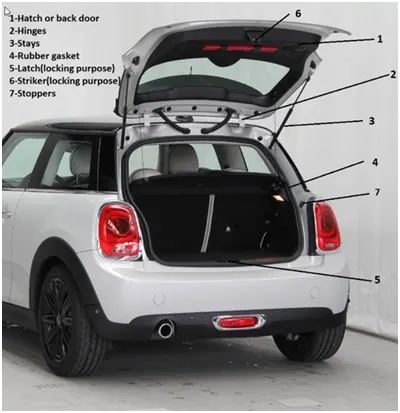
Parts of a backdoor or tailgate:
- Outer panel- Upper
- Outer panel-Lower
- Inner panel
- Hinge reinforcements and mountings
- Gas stay reinforcements or mountings
- Latch and striker reinforcements and mountings
- Wiper motor reinforcements and mountings.
Types of backdoors depending on the position of hinge mountings:
- Top mounted.
- Bottom mounted and
- Side mounted.
Design considerations while designing backdoor:
- Visibility criteria
- Force dissipation
- Latch and striker reinforcement position
- Gas stay reinforcement position
- Hinge reinforcement position
- Selection of material
- Space for luggage
- Hemming and reliefs
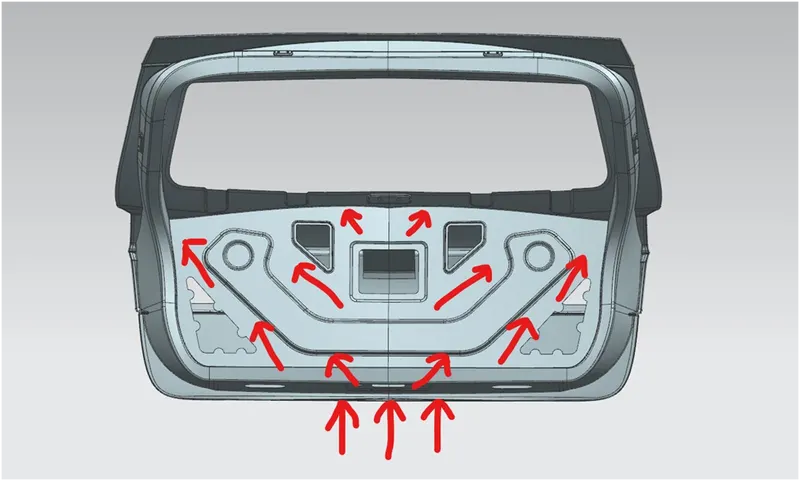
Force dissipation: In case of a collision or impact the force should be dissipated in such a way that the damage caused is minimum. This is the main criterion which has to be considered while designing any part. To solve this purpose embosses are made on the surface of the inner panel. Widely used shapes of embosses are either Y or V. With this kind of designs the force gets dissipated towards the side of the body instead of directly reaching the inside of the cabin.
Latch and striker reinforcement position:
All the reinforcements have to be positioned correctly so that the backdoor closes and opens smoothly. Their positions are related to each other. With the midpoint of the line joining the centers of the two hinges we draw a circle. This circle is the path followed by the striker. The center points and the tangent line have to be perfect for the opening and closing of the door to be smooth.
Material selection:
This factor plays an important role in deciding the cost of the vehicle. Mostly there are two types of materials used in car manufacturing. They are: Aluminium and Steel. Aluminium has less density and hence it is very light in weight. Steel has higher density when compared to Aluminium this makes it heavier. But steel is cheaper when compared to Aluminium. High budget cars make use of Aluminium which makes them light in weight. The overall weight of the car reduces by 6-10kg. High end models like BMW, Porsche, Benz and Audi make use of Aluminium. Parts of the car made of Aluminium are casted. The draft angle which we give while casting is much lesser when compared to the 7degree draft angle given while manufacturing deep drawn parts. Because of this the luggage space increases in a casted backdoor.
The type of car which is being designed in this assignment is a medium budget car or cost effective car which is widely used. Hence we make use of steel to manufacture its backdoor.
Hemming:
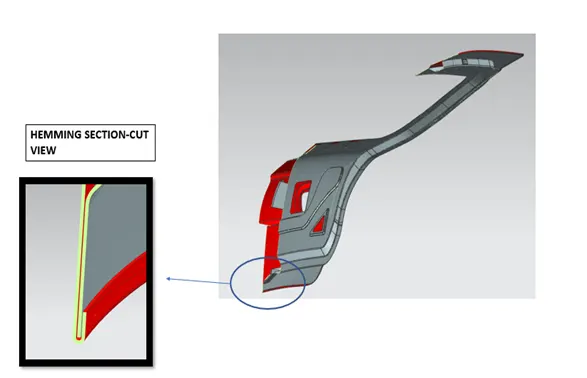
The backdoor outer panel is a styling surface and hence the backdoor outer and inner panels are not joined by riveting or spot welding. The surfaces are joined by hemming. The outer panel is offsetted and then trimmed with a 12mm width. The offset is made for 2.65mm i.e. (0.75*3+0.2*2) mm. 0.75 being the thickness of the sheet. The outer panel is thickened inwards whereas the inner panel is thickened upwards, towards the outer panel. 0.2mm gap is maintained because we have to apply mastic sealant. Reliefs are given at the edges.
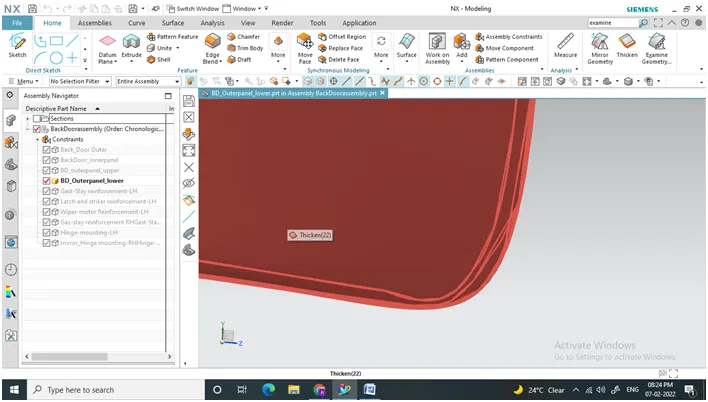
Different parts in different views:
- Upper outer panel with hemming:
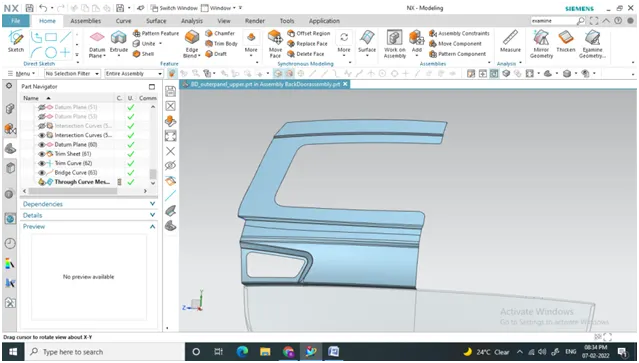
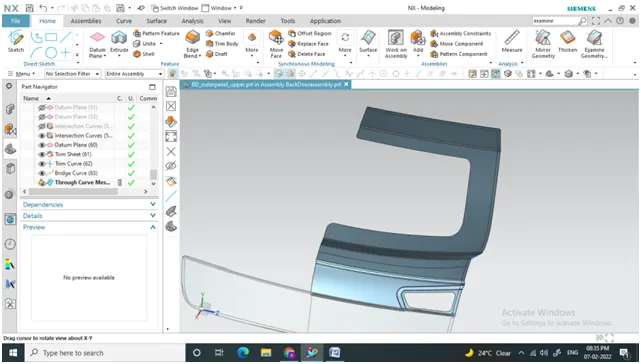
- Lower outer panel with hemming:
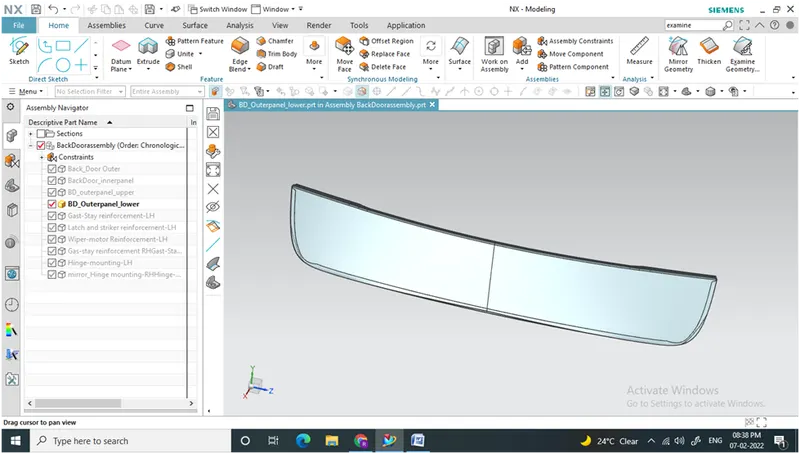
- Reinforcements:
Gas-stay reinforcements, Latch and striker reinforcement, Hinge-reinforcement, Wiper-motor reinforcement.
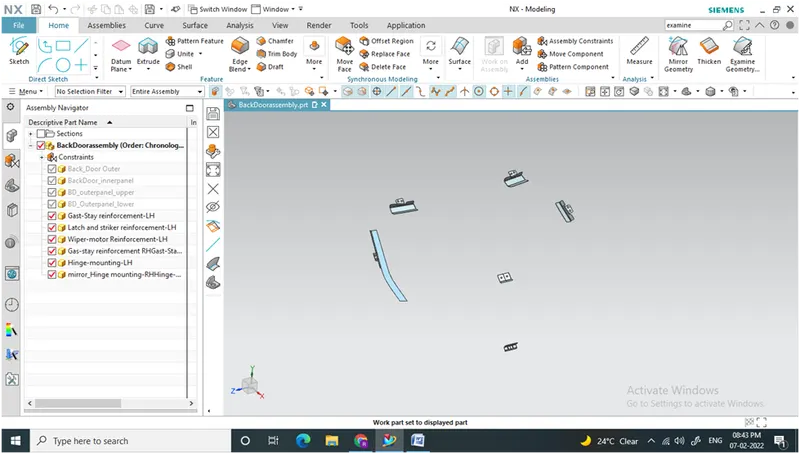
- Inner-panel:
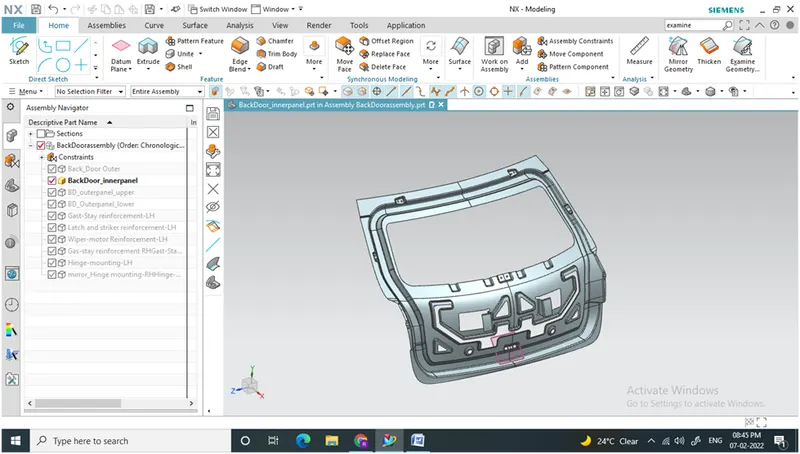
Inner panel with tooling direction:
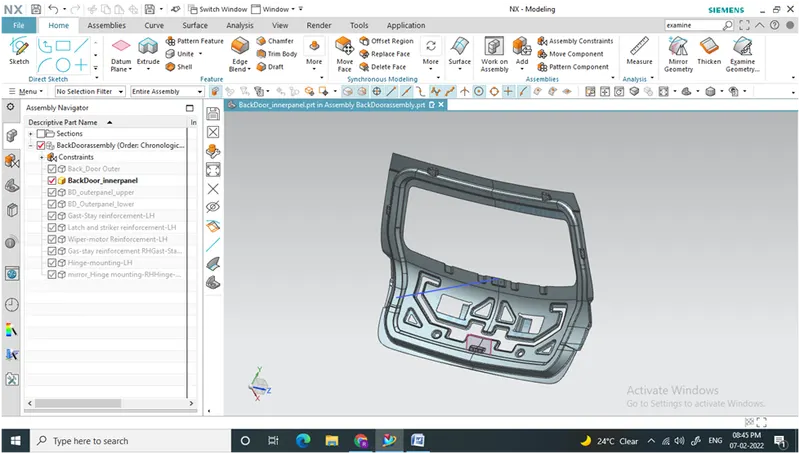
Different views:
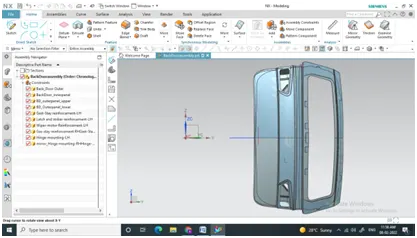
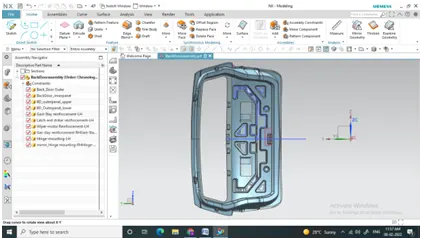
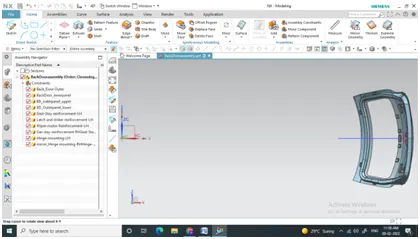
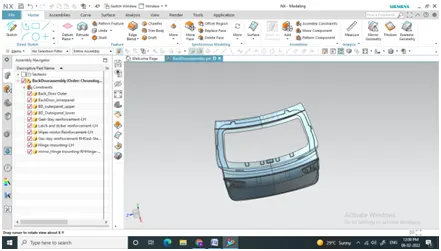
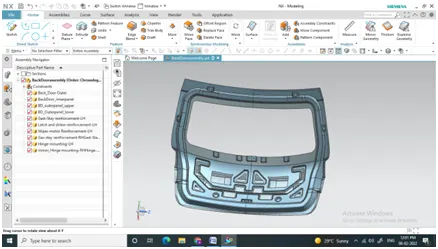
Conclusion: The design of backdoor is thus completed.