Design of backdoor
Google Drive Link is given below .
1.0 AIM
Use the provided styling surface to come up with a back door design, use appropriate design methodologies, and provide the necessary reinforcements and embosses
2.0 INTRODUCTION
2.1 BACK DOOR
Back door or tail gate simply refers to the back of the car that can open and close.it covering the rear of the vehicle.It provide access to a cargo area (trunk/boot ).A tailgate hinged at the roof is a predominant characteristic of hatchbacks, estates/station wagons and liftbacks .The door or opening of a cargo area may be hinged at the top, side, or bottom.
In most cars, usually this process will be done manually. One has to get down the car to open and close the tail-gate with the car key.Nowadays, automobile manufacturers providing Advanced features like the automated tail-gate. An automatic tail-gate in the car will do the process of shutting and opening the tail-gate electronically.

fig.2.1 back door (split tailgate)
3.0 MANUFACTURING PROCESS
Conventional tailgate assemblies are made from stamped metal panels welded together to form a tailgate. Latches are added on either side of the tailgate to engage a striker on the pickup sides. A handle operates the latches to open and close the tailgate assembly. Steel tailgate assemblies provide a durable and secure closure for the pickup bed.
Another disadvantage of steel tailgate assemblies is the cost of the tooling required and equipment required to stamp metal tailgate components. Metal tailgate components are generally produced in a large stamping press. The stamping presses generally require finely machined tools made from hardened steel. The cost of tooling a metal tailgate is much more expensive.
3.1 MATERIAL FOR BODY PANELS
Materials for car body panels require certain specific characteristics to meet the industry’s challenges: rationalisation of specifications for leaner inventory, improved formability for reduced rejection rate and better quality. Higher Strength Low Alloy (HSLA) steels of thinner gauges, are getting preference for weight reduction and the resulting better fuel economy.Other quality characteristics under demand are higher yield stress (strength), toughness,fatigue strength, improved dent resistance as well as corrosion resistance in materials used for body panels for improved durability and reliability.
To obtain consistent quality of autobody skin panels without failures during stamping, the formability/ductility specifications of strip steels are the basic requirements.Most of the steels used in automotive application are aluminium-killed steels of about 0.7 to 0.9 mm thickness.
An intensive research and development are going on for alternate materials, manufacturing processes and stamping tools for sheet-metal components with the main objectives of cutting down the weight and unit cost of the vehicle. Simultaneously, the steel content of the car is falling with the use of aluminium and new materials, such as plastics. Aluminium may provide the most sought after solution to reduce the weight of the vehicles. A reduction of 30% in weight is achievable if the same strength, stiffness, and stability of the component are to be realised by substituting steel with aluminium. Possibility of significant reduction in die cost will be another advantage with aluminium. However, problems related to strength, serviceability,
manufacturability, and above all the cost, require effective solutions before the acceptance of aluminium as a substitute to steel for body panels. Plastics for bumpers,
3.2 STAMPING PROCESS
Stamping processes to be used for a panel depend on its design. However, normally the processes used extensively are blanking, drawing, piercing, forming, notching, trimming,hemming, etc. Blanking prepares the initial approximate form of the part in flat sheet. Drawing is generally the first operation to attain depth related form. Piercing, notching, hemming, are product design related operations. Trimming generally removes the extra material on the periphery of the panel provided for blankholding during draw operation. Decision on trim line is very important and becomes deciding factor to obtain good draw.
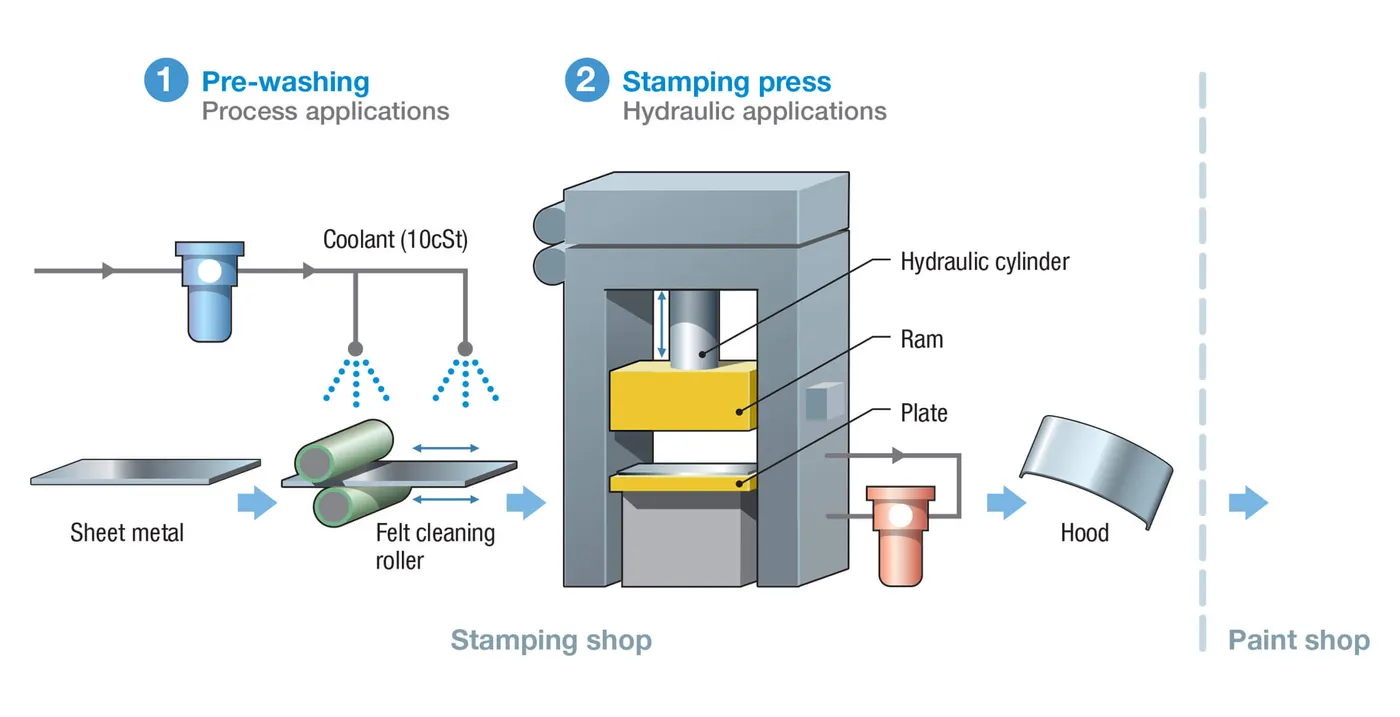
fig.3.2.1 stamping process
1. Blanking
When required, blanking is the first step of the stamping process. Blanking is the process of cutting larger sheet or coils of metal into smaller, more manageable pieces. Blanking is usually performed when a stamped metal piece will be drawn or formed.
2.Piercing
If a part requires slots, holes, or other cutouts, piercing can be employed. Piercing, which can be performed simultaneously with blanking, punches the requisite shapes out of the metal sheet.
3.Drawing
Drawing is the actual stamping in the metal stamping process. A punch forces a section of metal through a die, providing the primary shape of the part. When the depth of the part is less than the primary opening, it is considered shallow drawing; parts with a depth greater than the opening are deep drawn.
4.Bending
Bending is a fairly self-explanatory process. The part-in-progress is placed on a specially designed die and a ram pushes against the metal, providing the required bend. Bending is performed after drawing, as attempting to punch an already bent piece of metal causes the entire part to deform.
5.Hemming
Hemming is a technology used by the automotive industry to join inner and outer closure panels together (hoods, doors, tailgates, etc.). It is the process of bending/folding the flange of the outer panel over the inner one. The accuracy of the operation affects significantly the appearance of the car’s outer surfaces and is therefore a critical factor in the final quality of a finished vehicle.
roller hemming :-The robotized hemming systems use a standard industrial robot integrated with a roller hemming head, offering a very flexible solution. This roller hemming head consists of a body, some guides and a number of rolls that are designed according to the geometry of the part in each case.
fig.3.2.2 roller hemming
What is back door of a car?
A door which is located at the rear side of a car which gives access for the boot space to store luggage, spare wheel etc.
These doors can be operated manually or electric powered. In most of the luxury cars door is electrically operated.
Types of doors based on working position,
- Top Mounted Door
- Side mounted Door
- Bottom Door
Gas Stay Powered:
Electric Operated:
Back Door Assembly:
- Inner panel
- outer panel
- hinge and its reinforcement
- wiper motor reinforcement
- latch & stricker and its reinforcement
Different Sheetmetal processes used for manufacturing the Back Door
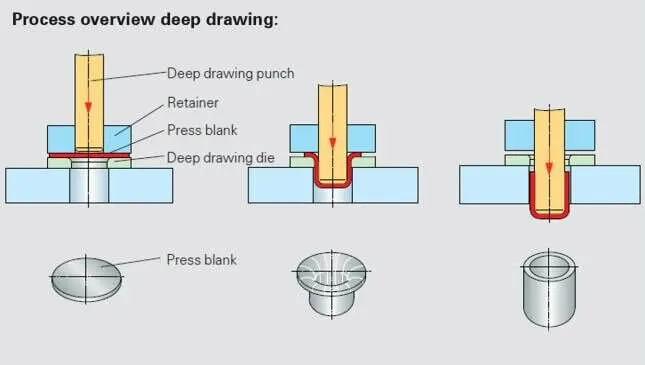
Deep Drawing:
The metal deep drawing process is an effective method of manufacturing of cups, cans and other similar deep drawing products. The deep drawings having two main categories.
- First- stage drawing: The blank shape of metal is placed on the die and contact with the punch. When the metal specimen is flat piece of sheet metal used in forming and finish the product. Initially the punch moves in downward direction. The outer rim of blank is subjected to pure radial drawing (drawing toward in vertical axes) between die and blank metal. The metal become a bend and sliding over die and also stretched between die and punch. The metal in vicinity of punch head and contact with it bend and slide over radii and stretch over punch head.
- Redrawing: The components drawn from first stage again it is redrawn convert into more depth to form a cup shape in the die and punch. The second stage of drawing is called as redrawing.
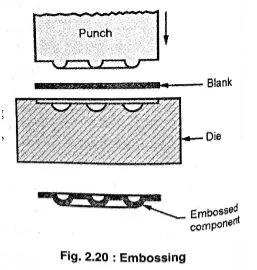
Embossing:
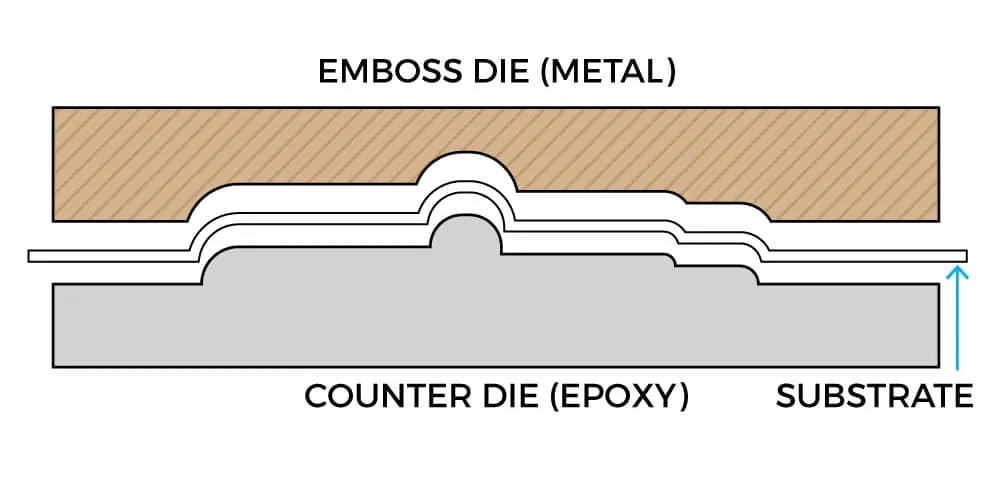
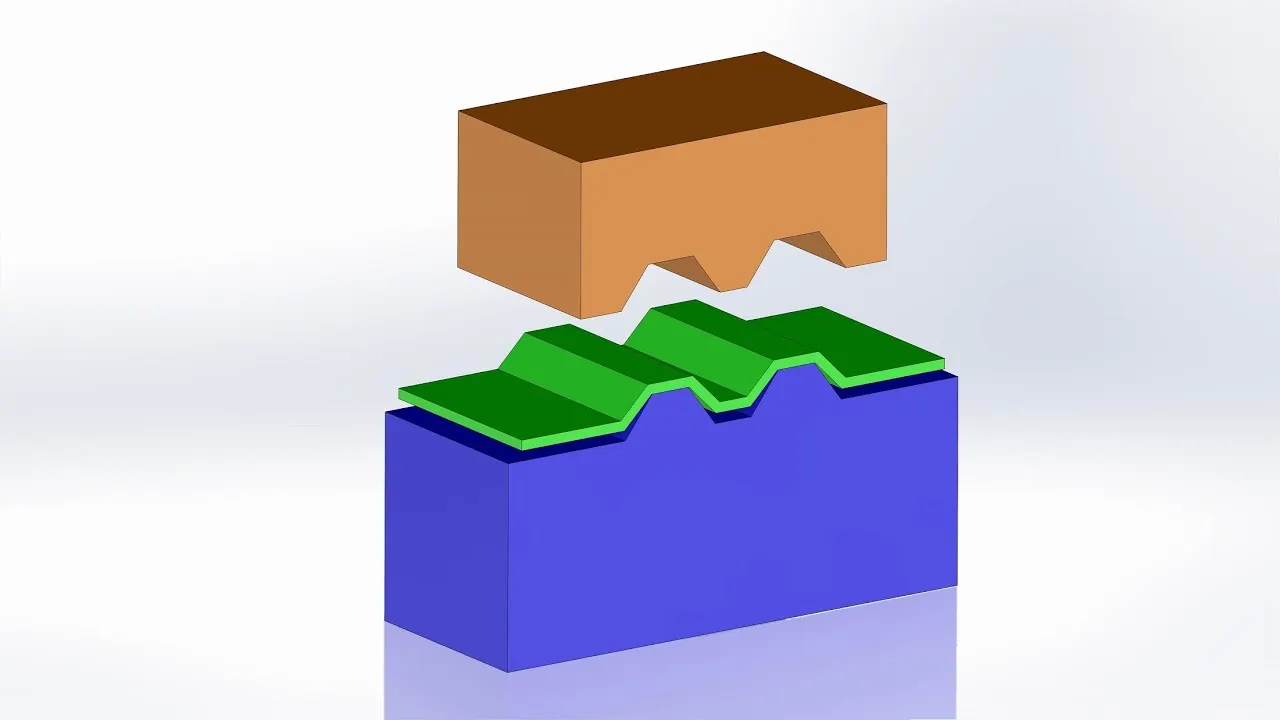
Embossing is a metal forming process for producing raised or sunken designs or relief in sheet materials by means of matched male and female roller dies, theoretically with no change in metal thickness or by-passing sheet or a strip of metal between rolls of the desired pattern. Metal sheet is drawn through the male and female roller dies producing a pattern or design on the metal sheet. Depending on the roller dies used, different patterns can be produced on the metal sheet.
Materials commonly used in the metal embossing process include:
- Aluminum alloys
- Steel alloys
- Zinc
- Copper
- Galvanized steel
- Brass
- Cold rolled steel
Hemming:
Hemming is a forming operation in which the edges of the sheet are folded or folded over another part in order to achieve a tight fit. Normally hemming operations are used to connect parts together, to improve the appearance of a part and to reinforce part edges.
In car part production, hemming is used in assembly as a secondary operation after deep drawing, trimming and flanging operations to join two sheet metal parts (outer and inner) together. Typical parts for this type of assembly are hoods, doors, trunk lids and fenders.
There are various types of hemming operations:
- Conventional die hemming: In conventional die hemming, the flange is folded over the entire length with a hemming tool.
- Roll hemming: In roll hemming, the hemming roller is guided by an industrial robot to form the flange.
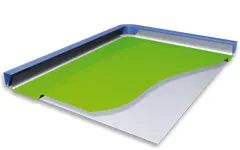
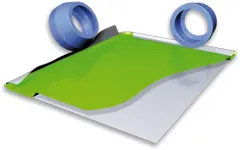
Open Hem: A Hem has a full round feature and a return flange. In open hem bend angle is equal to 180 degrees.
Tear drop Hem: In tear drop hem the bend angle is greater than 180 degrees.
Closed Hem: Hems without any inside radius are called as closed hem. Closed hems are not recommended if the hem geometry is to be painted or if the material used is SST or Aluminium.
Blanking:
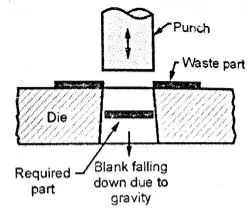
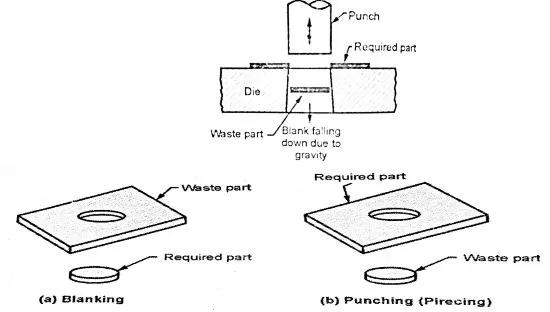
Blanking is a cutting operation of a flat metal sheet and the article punched out is known as blank. Blank is the required product of the operation and the metal left behind is considered as a waste.
Punching:
It is similar to blanking only the main difference is that, the hole is the required product and the material punched out from the hole is considered as a waste.
SPOT WELDING:
Spot Welding is a form of resistance welding also known as Resistance Spot Welding (RSW). Spot Welding involves using heat produced by resistance to an electrical current to join materials together. The current heats the materials to a point where they become malleable. The use of strong pressure bonds them together.
Another form of resistance welding is Projection Welding. This process involves fusing a fastener’s embossed or coined projections to the metal base material to form a weld. As the materials never melt, they do not intermix. This means the resulting weld is more like a forging of the materials.
Spot welding is only suitable for a small selection of base materials. Low carbon steel is the most suitable material for spot welding. This is because it is more resistant to electricity and has a lower thermal conductivity than the copper electrodes used to create the required electrical current.
High carbon steels and aluminium alloys can form brittle welds that don’t last with the spot welding process. Pure aluminium can qualify for spot welding but requires higher current levels. This is because it has a lower resistance to electricity than low carbon steel.
The outter panel upper and outter panel lower are joined through the spot welding .So there must be no gap between the outter panel upper and outter panel lower.
Design of Back door in NX CAD:
Door parts thickness is given below,
- Outer Panel - 0.75 mm
- Inner Panel - 0.75 mm
- Reinforcements - 1.5 mm
Parts Of the BackDoor
Inner Panel
Hinge Mounting Bracket ( LH & RH )
Gas Stay Bracket ( LH & RH )
Wiper Motor Support Bracket
Latch
Latch Reinforcement
Hinge reinforcement ( LH & RH )
Gas Stay Reinforcement ( LH & RH )
Given Data,
Given surfaces has to be repaired according to the smoothness. After repairing the surfaces, the door is divided into two parts as Door Outer Upper and Doo Lower Panel.
First, we need to create the Tooling direction for the Deep drawing operation. It shows that all the operations like embossing is done by considering this vector direction and it will help in manufacturing the part,
After that we have to create Sealing Flange by offsetting the outer panel to the specific distance.
Then we will be creating the Back door inner panel flange by offsetting the outer surface at a distance considering the sheet thickness and thickening direction.
Then created the connecting flange to join the inner panel and sealing flange.
Then for the windshield panel mounting, windshield panel is created and joined with sealing flange.
Then to improve the strength of the inner panel and to reduce the weight 'Y' type emboss and other cut-outs are created. Also, for Latch and Stricker mounting cut-out is created. This cut-out is also done on other side of the inner panel to maintain the centre of gravity of the Back door.
Parts Of the BackDoor
Inner Panel
Hinge Mounting Bracket ( LH & RH )
Gas Stay Bracket ( LH & RH )
Wiper Motor Support Bracket
Latch
Latch Reinforcement
Hinge reinforcement ( LH & RH )
Gas Stay Reinforcement ( LH & RH )
NNER PANEL
Inner door panel is a component which is use for strengthening the door assembly and it is one of the most important components on witch all accessories are mount like hinges, glass guide channel and gas stay.Back door inner panel is mounted with the the Roof.Inner is mounted with the outer panel with the help of hemming process.
- Materials used for the Inner panels are steels,Aluminum.
- For giving more strength to the inner panels by Adding extra reinforcements to strengthen the parts.
Above picture shows that the inner panel for Back door of a car.
In the Inner panel i used embosses,Outer panel and inner panel mounting area,space for Harness,Wind Glass Mount and fillets,No sharp corners.
Embossing
Embossing is a metal forming process for producing raised or sunken designs or relief in sheet material by means of matched male and female roller dies, theoretically with no change in metal thickness, or by passing sheet or a strip of metal between rolls of the desired pattern.
- Metal sheet is drawn through the male and female roller dies producing a pattern or design on the metal sheet. Depending on the roller dies used, different patterns can be produced on the metal sheet.
- Emboss should be in 7 degree to 25 degree inclinte in angle and it should not be in 90 degree angle,why because when we do stamping in manufacturing the stamping tool fits the sheet metal hence it will not come out of that sheet metal,So this is the main reason why the emboss face is in angle.
Characteristics of the metal embossing process include:
- Its ability to form ductile metals,
- Its use in medium to high production runs,
- The ability to maintain the same metal thickness before and after embossing,
- The ability to produce unlimited patterns, depending on the roll dies, and
- The ability to reproduce product with no variation.
- Located within the embossing stand itself are two engraved and mated hardened steel rolls, geared together to maintain top-to-bottom pattern registration. The width and diameter of these rolls depends on the strip width, material thickness, pattern depth, and material tensile strength and hardness.
- In most machines, the upper roll blocks are stationary, while the bottom roll blocks are movable. The pressure with which the bottom roll is raised is referred to as the tonnage capacity. This figure also depends on the aforementioned parameters.
- Embossing machines are generally sized to give 2" of strip clearance on each side of an engraved embossing roll. Many embossing machines are custom-manufactured, so there are no industry-standard widths. It is not uncommon to find embossing machines in operation producing patterns less than 6' wide all the way up to machines producing patterns 70"+ wide.
- The illustration that follows provides a two-dimensional look at a typical embossing line setup with an embossing roller in the middle. The illustration shows the metal sheet entering the roller, and then the embossed sheet leaving toward the drawing rollers.
- Embossed metals are used in industry for two reasons: aesthetic and functional. Aesthetic applications also include appliance panels, building products, elevator panels, garage door panels, automotive trim, metal office furniture, and others.
- Functional applications are those in which a performance characteristic is enhanced. This can include a metal products ability to disperse liquid more effectively, reduction friction and static, increase a metal panel’s stiffness and rigidity, increase a metal surface area for acoustic or heat transfer applications, and improve traction.
- The embossing process can produce a variety of patterns. Some of the most common patterns include stucco, leather grain, wood grain, weather grain, and rough sawn cedar. Most embossers will tool to form any needed pattern, depending on the cost parameters involved.
Materials commonly used in the metal embossing process include:
- Aluminum (All Alloys)
- Aluminum (T1/T2)
- Brass
- Cold rolled steel
- Copper
- Galvanized steel
- High strength, low alloy, steel
- Hot rolled steel
- Steel (All Alloys)
- Zinc
Cable Harness Gaps
I left some gap for Headlamp Harness and tailgate light harness cables.
Left some gap also dissipates the force when collision happens.
To much of cutting the inner panel leads to weaken the panel.
I & O Panal Mounting Flange ( Inner and outer )
Highlighted red spot is the mounting portion of inner panel to the outer stylish part.
I provided two mounting Flanges for mounting the inner panel with outer stylish panel.
Two flanges is wnough strength for holding the outer and inner panels with the help of sealants.
In between inner panel and outer panel we providing sealants.
MASTIC SEALANTS
A mastic sealant is a type of liquid sealant that cures in an elastic state, thus making it flexible while holding the bond of the surfaces that has attached together. It adheres to just about any material making an all-purpose type of sealant.
- The main purpose of the outer panel is for the aesthetic looks. Thus we cannot use bolts or welding. This has to be done with the help of the hemming and mastic sealants. Mastic sealants are elastic compound that behaves like the rubber. It is placed between the outer and inner panel. Initially is it in paste form, but after the hot furnace bath it gets hardened thus joining the outer and inner panel. Mastic sealant has the tendency to increase the strength of the panel and has influence of 80mm diameter.
PROS
- One positive characteristic of mastic sealant is that it has a very smooth exterior while keeping its rigid form underneath.
- Surfaces do not have to be primed when using this type of sealant, and although applied thick, it adheres smoothly to any surface. It is important that the area to be joined or sealed be clean and dry, just like any other sealant on the market.
- Mastic sealant may be used outdoors as well because of its waterproof quality. It can be applied on rain duct leaks outdoors, for example.
- It is also favored for areas under high or low temperatures such as heater vents or drier vents and contains ultraviolet inhibitors to make sure that it is protected from damaging effects of the sun that will often weaken other types of sealants. That makes it a good choice for use on roofs, or any surface that is constantly exposed to sunlight. Most mastic sealants will also work well with metal because they do not corrode over time.
- it functions well in areas with mild vibration and heat, like heating ducts.
CONS
- Mastic sealant is not recommended for areas that have too much joint movement, or anything that will be moved a long length.
- It works well with constant pressure on it, but not constant movement.
- It also works best when applied thickly and is not recommended if only a thin layer is needed such as touch ups. Another sealant is a better choice for those types of repairs.
Sealant Space in between Inner and Outer Panel
As you see in the above picture represents the how the mounting takes place in between inner and outer panel.
Transparent panel is outer panel and charcoal color represents inner panel of the back door.
Mounting the inner panel and outer panel with the help of sealants.
I given gap between inner and outer panel about 4-5mm for sealants.Sealants can hold the outer and inner panel and also it reduces the NVH of the vehicle.
DRAFT ANALYSIS:
Draft analysis of inner panel is carried out through the tooling direction only.Only the green areas are acceptable and i worst cases yellow regions are accepted but the blue and red regions are never accepted.
The draft angle for aluminium casted panel is 2 to 3 degrees is enough but if it is steel then the angle is more than 7 degrees.
In this project i considered it as steel and used 7 degrees as draft angle and direction is choosen as tooling direction which is the deep drawn direction.
WIPER MOTOR MOUNTING
Below picture represents wiper motor mounting area,Highlighted red spot area is for wiper motor mouniting area.
Below Picture represents the wiper motor mounting area,Four holes for Mounting the wiper motor.
REINFORCEMENT
Vehicle Door reinforcement structures as provided to reduce impact in collisions. In one embodiment, the structure is to include a lower reinforcement panel configured to mount to a vehicle chassis and an upper reinforcement panel welded to the lower reinforcement panel wherein the deflection of a front deformable wall of the upper reinforcement panel is configured to trigger deflection of rear deformable wall of the lower reinforcement panel.
Latch and Stiker Reinforcement:
To reduce the impact to the occupants inside the car, additional latch and hinge reinforcement to the hood. When latch and striker are placed, there is drop in strength at that position thus reinforcement is required. Also stiffness pads are placed to reduce NVH. Hinge and latch reinforcement thickness is kept at 1.5 mm but it may vary.
Where there is movements like hinge,hood opening and closing,Doors etc,In this cases there is less strength in that particular opening and closing areas in that we need to add Reinforcement to giving the additional strength to that areas.
Hinge Reinforcement
What is HINGE ?
Hinges are simple mechanical bearing devices that are used to connect two parts and allow them to rotate relative to each other about a fixed axis. Depending on the type employed, the components can move (most commonly) within a limited arc or with 360° freedom.
Material Used for HINGE
Due to the applications in which they are applied, hinges need to be able to withstand the stress of consistent opening and closing. To fulfill this requirement, many hinges are made of stainless steel as the strength of steel materials allows the hardware to bear heavy components, and the stainless characteristics prevent rust and corrosion. The latter is important because hinges used in external applications, especially near the ocean or salt lakes, can experience fatigue and failure much quicker due to exposure to moisture and salt in the environment.
Why we need Reinforcement ?
Hinge rotates in the rotational axis in that it will loose some strength there,It means huge Back door opens with the help of small hinges only in this case hinge needs extra strength,For this we providing extra strength in the form of Reinforcement
Hinge Reinforcement thickness be 1.2mm to 1.5mm.
Gas Stay Reinforcement
What is Gas Stay or Gas Spring ?
Gas springs, or gas struts, are rods that provide support for doors, hatches, lids and covers that are horizontally hinged. They act as support in a variety of ways including, lifting, positioning and lowering; because of this versatility they are used in a wide range of applications.
Wiper Motor Reinforcement
What is Wiper Motor ?
Windshield wipers are powered by a small electric motor, usually mounted on the firewall or under the cowl (the area under the windshield's base). The motor activates linkage that moves the wiper arms back and forth. On vehicles with a rear window wiper, a separate motor powers the one in the rear.
RELIEF DATA:
Relief is provided onto the part or component in order to remove any stresses developed in a particular area i.e sharp corners that takes place during the hemming process is carried out. Thus corners are rounded or chamfered.
We leaving 2 mm from sheet metal for Roll hemming process.
POSITION OF LATCH:
Position of latch and striker is perpendicular to the hinge then only the latch and striker mechanism works properly when the door closing and opening position.
For the proper opening and closing of the Door, the striker should be perpendicular to the trajectory of the Door. For this, hinge is assembled at its position. Once it is placed, hinge axis is drawn.
- To check the hinge axis as the center we draw a big circle to the position the latch in such a way that it is perpendicular to the hood trajectory.
- In between the two hinges the striker is perpendicular to the midpoint of two hinges,Why because while closing and opening of latch and striker the opening position be similar actions.
CONCLUSION:
Thus,For the provided styling surface of a back door design, I used appropriate design methodologies and provided the necessary reinforcements and embosses for the BackDoor design.thus i designed a back door.
GOOGLE Drive link : back door part
https://drive.google.com/file/d/1NHgZNT-N-Esirw5QwmHjxxN8zEJvZ3Ed/view?usp=drive_link