Design of backdoor
Design of Backdoor
Aim
To design the backdoor of a car using the given class A surface.
Introduction
Backdoor or tailgate is a door, located at the rear of the car, which provides access to the luggage compartment. They are hinged to the body and operated manually or electrically according to the car model.
The doors can be top-mounted, side-mounted or bottom-mounted.
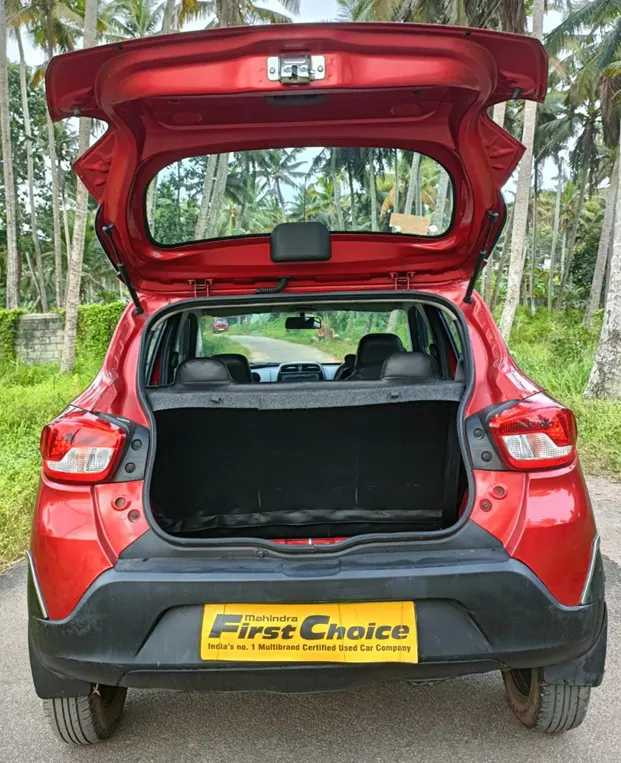
Fig 1. Top-mounted tailgate.
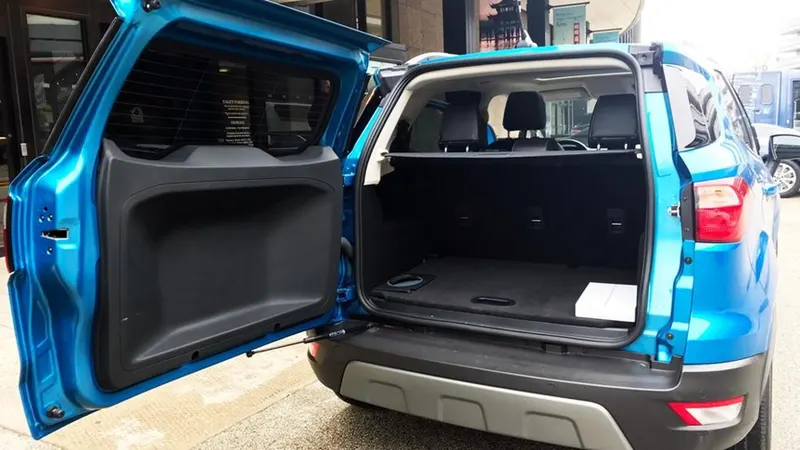
Fig 2. Side-mounted tailgate.

Fig 3. Electrically controlled tailgate.
Material used
The materials commonly used for the tailgate are Steel and Aluminium. The use of steel adds more weight since it is denser than Aluminium. But budget cars usually depend on Steel as they are cheaper when compared to Aluminium.
Differences between Aluminium and Steel parts:
|
Steel |
Aluminium |
|
Parts are stamped |
Parts are casted |
|
Reinforcements are necessary |
Reinforcements can be neglected |
|
Has only uniform thickness |
Local thickness can be varied |
|
Heavier in weight and more number of components |
Lighter in weight and less number of components |
|
The minimum draft angle is 7°. |
Minimum draft angle is 3° in casted parts which helps in adding luggage space. |
Despite all these benefits, Aluminium is very much costlier when compared to Steel.
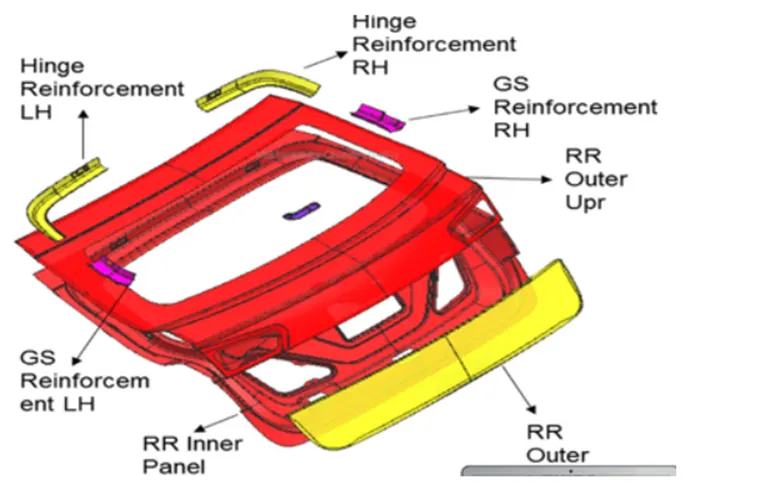
Fig 4. Parts of backdoor when steel is used.
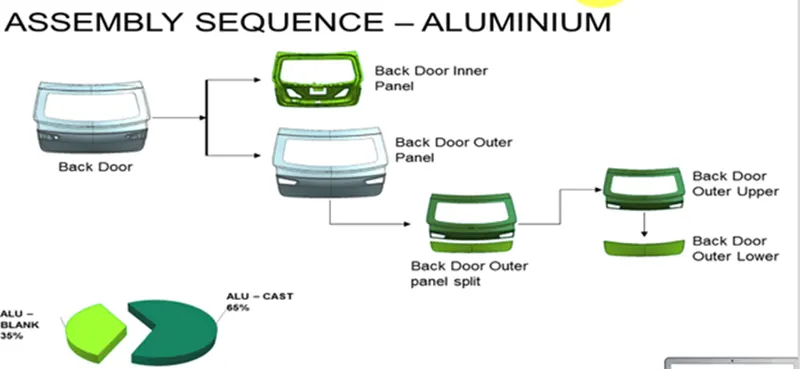
Fig 5. Parts of backdoor when Aluminium is used.
Since no reinforcements are required for Aluminium, the inner panel would be a single, casted part.
Load Analysis
The part is subjected to various load conditions and determined whether they return to the original position.
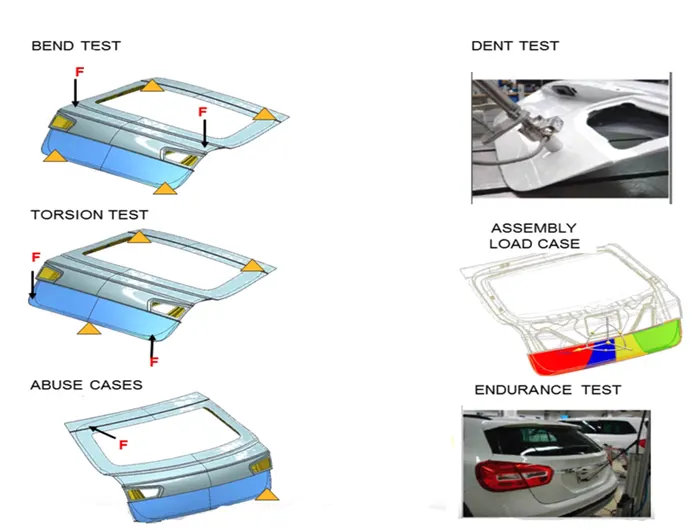
Fig 6. Different types of load tests.
Bend test: All the four corner regions are constrained, and load is applied along the centre region.
Torsion test: The top two corner regions and the striker emboss region is constrained, and load is applied at the two corners at the bottom in opposite direction.
Abuse cases: The door is subjected to conditions like over slamming, hanging on the door, like resting the hands on the door and analysed.
Dent test: Dents are created on the surface and tested.
Assembly load case: The various forces that are likely to occur during the assembly of the vehicle are exerted and tested whether the tailgate is able to withstand them.
Endurance test: Here the backdoor is opened and closed a particular number of cycles and their workability is determined.
Manufacturing processes adopted
Deep drawing: Deep drawing is a sheet metal forming process that involves complex material flow and force distributions. It is a shape transformation process with material retention. The process is considered “deep” drawing when the depth of the drawn part exceeds its diameter.
In this process, a sheet metal blank is radially drawn into a forming die by the mechanical action of a punch. The punch and die setup is somewhat similar to a sheet metal cutting operation, such as punching or blanking. Two main factors will cause the punch in deep drawing to draw the metal into the die cavity, rather than shearing it. Deep drawing process is adopted for the manufacturing the backdoor using Steel.
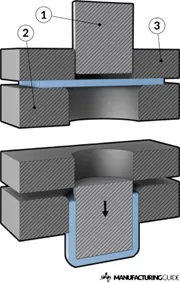
Fig 7. Deep drawing process
Hemming: Hemming is a sheet metal forming process in which sheets are joined by bending it usually to 180 degree. Automotive body panels and automotive parts such as deck lids, trunk lids, doors, hoods and tailgates are formed by hemming process. In the backdoor design, hemming is done between the outer panel and the inner panel where the outer panel wraps the inner panel. A 0.2mm clearance is provided between the surfaces to facilitate the sealant applied to ooze out.
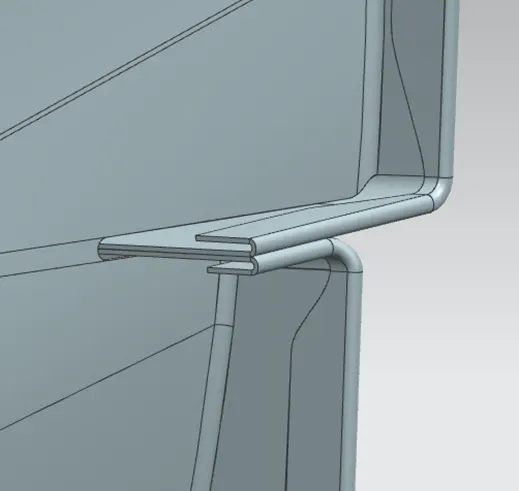
Fig 8. Hemming done for outer panel.
During hemming, reliefs are provided at corner regions to avoid stress concentration and vibrations due to the action of hemming rollers. It helps to prevent failures that are likely to occur.
In contrast to the conventional press hemming, the roller hemming is completed incrementally by an industrial robot driven hemming roller. The advantages of roller hemming against the conventional process are based on technological and economic criteria.
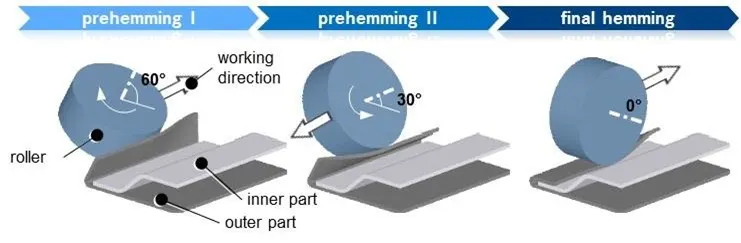
Fig 8. Roller hemming.
Components of Backdoor
- Outer panel or Styling surface
The outer panel is the given Class A surface for designing the backdoor. In this design, the given Class A surface is repaired by bridging the gaps and by providing proper blends and sewing. The outer panel is split into two- Outer panel upper and outer panel lower.
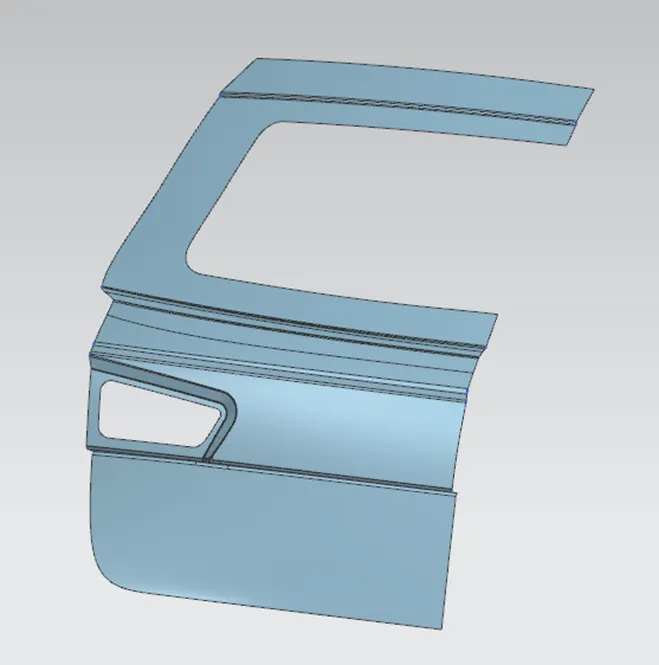
Fig 9. Class A surface.
Hemming is done on both the upper and lower parts of the outer panel for wrapping the inner panel. The upper and lower parts of the outer panel are joined together by brazing or spot welding.
Brazing is a metal-joining process in which two or more metal items are joined together by melting and flowing a filler metal into the joint, with the filler metal having a lower melting point than the adjoining metal. Brazing differs from welding in that it does not involve melting the work pieces.
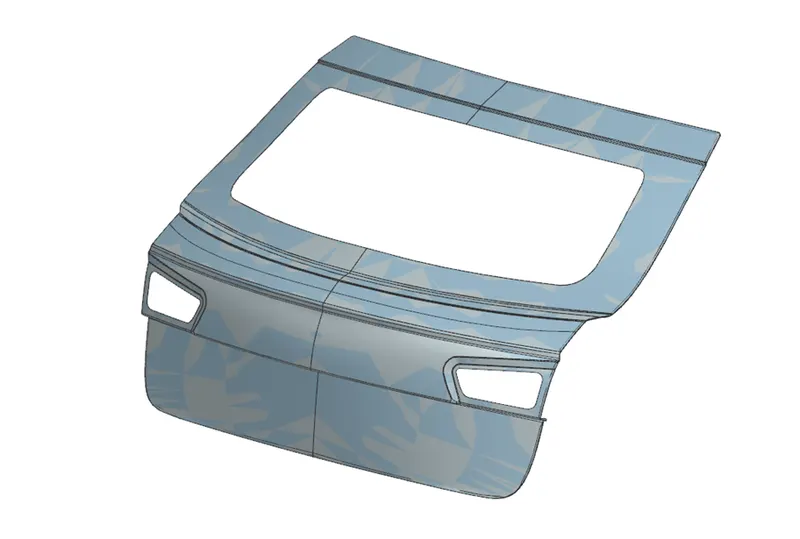
Fig 10. Outer panel upper and lower.
- Inner panel
The inner panel of the backdoor is an essential part which provides strength to it. The mountings of hinges, striker, gas stay and wiper motor are given on the inner panel. Embosses (V or Y shaped) are given on the inner panel to dissipate the forces acting on the tailgate, thereby giving the part more strength and protection from failures. Inner panel is produced by either deep drawing or casting. If steel is used, then deep drawing process is adopted. For deep drawing, tooling direction must be given.
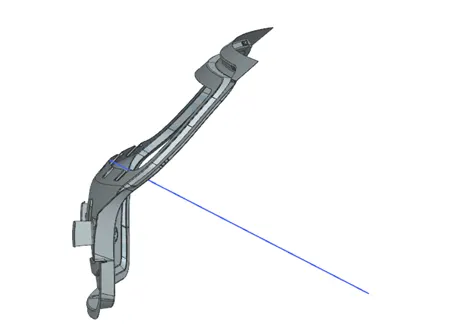
Fig 11. Tooling direction.
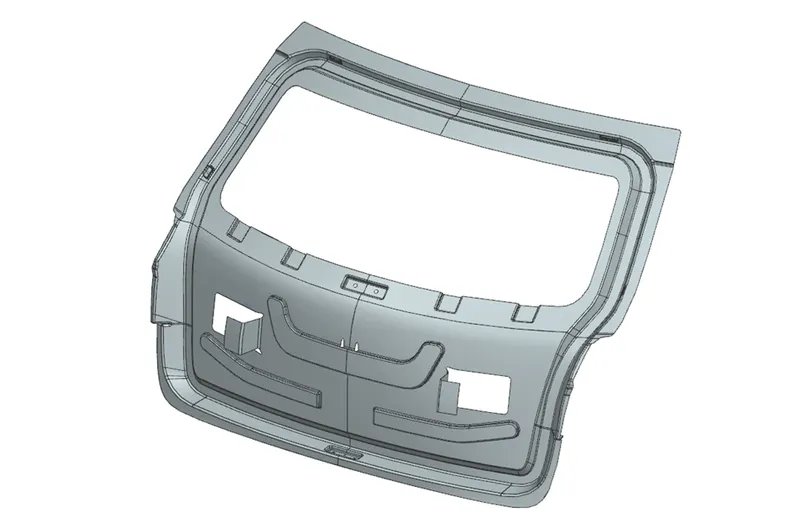
Fig 12. Inner panel.
Sealing Flange is the section of the inner panel which enables the backdoor to sit over the rear body side of the car. It is a crucial part, as it decides how a backdoor is mounted on the rear body side of the car and also restricts any external matter to enter inside the vehicle.
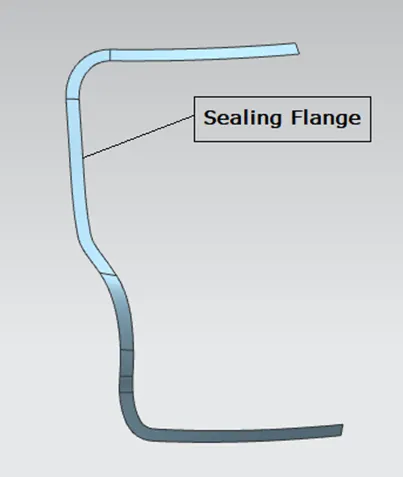
Fig 13. Sealing flange.
On the inner panel a surface is also given to join the inner panel to the outer panel with mastic and proper clearance is also given between the inner and outer panel.
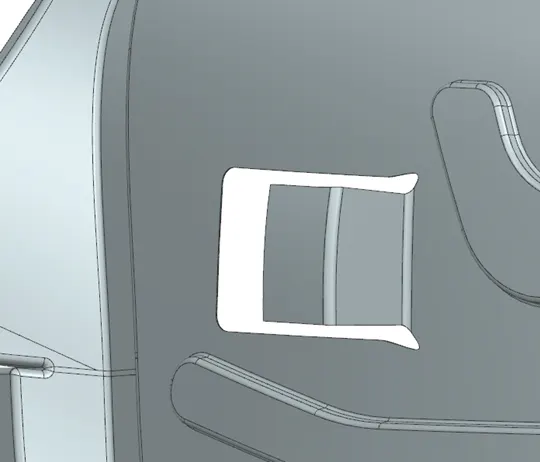
Fig 14. Flange for mastic sealant.
Reinforcements
Reinforcements are added on local regions where forces occur to improve the strength of the panel and to withstand the additional forces that occur on those regions. Hinge reinforcement, gas stay reinforcement, wiper motor reinforcement and striker reinforcement are given in this design. They are deigned as separate parts.
- Hinge reinforcements
Reinforcements are given for both the left and right hinges. Hinge is a pivot on which the backdoor rotates while opening and closing.
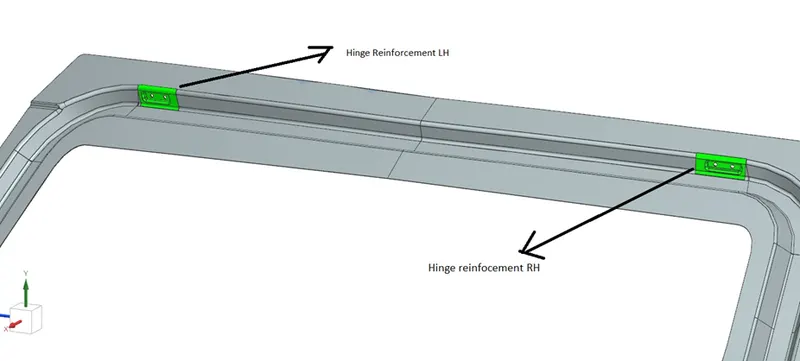
Fig 15. Hinge reinforcements.
- Gas stay reinforcements
Gas stay reinforcements supports the backdoor while opening or closing and it helps to keep the backdoor in its open position. A hydraulic piston arrangement is commonly used for backdoor. Reinforcements are given on both sides.
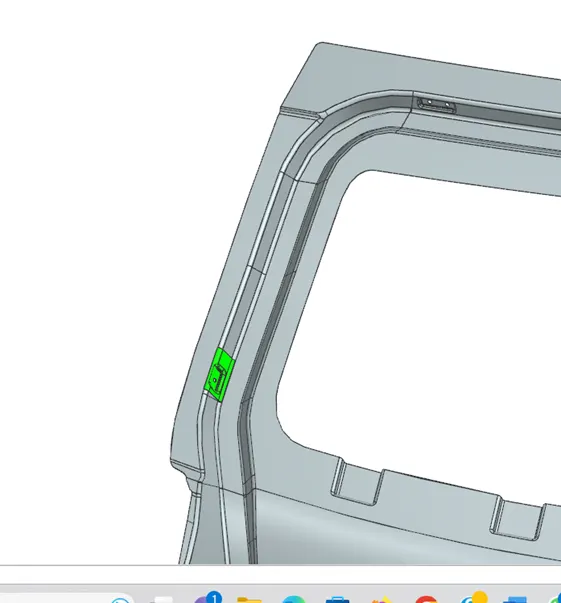
Fig 16. Gas stay reinforcement.
- Wiper motor reinforcement
The motor for rear wiper is mounted on the tailgate. In order to provide strength and to avoid deformations due to the heating of motor and to improve the NVH, reinforcements are provided for the wiper motor area.
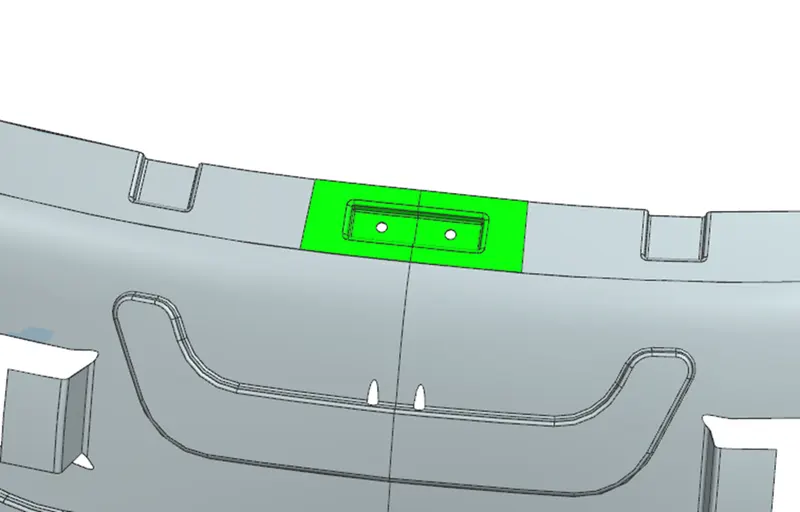
Fig 17. Wiper motor reinforcement.
- Latch and striker reinforcement
This reinforcement is given at the bottom portion for positioning the latch and striker. This reinforcement helps in withstanding the forces due to the over slamming of the backdoor.
This reinforcement is given according to the the hinge axis and the trajectory of the backdoor. A circle is drawn, with the hinge axis as its centre and the striker is positioned along the circle, which is the trajectory of the backdoor.
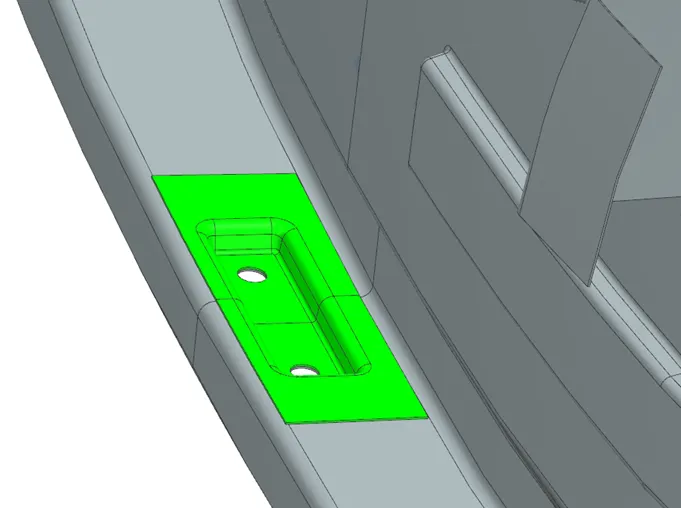
Fig 18. Latch and striker reinforcement.
Draft analysis
Draft analysis is done for the inner panel for manufacturing the panel by deep drawing process.
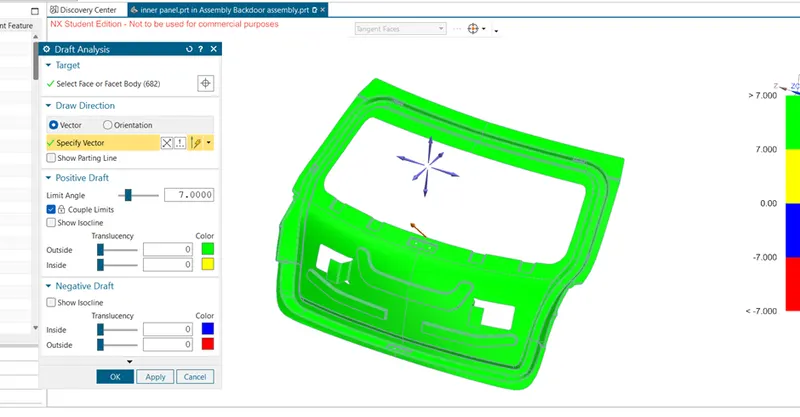
Fig 19. Draft analysis.
Conclusion
After the hemming, mirroring and required thickening of the parts, the final backdoor assembly design is completed.
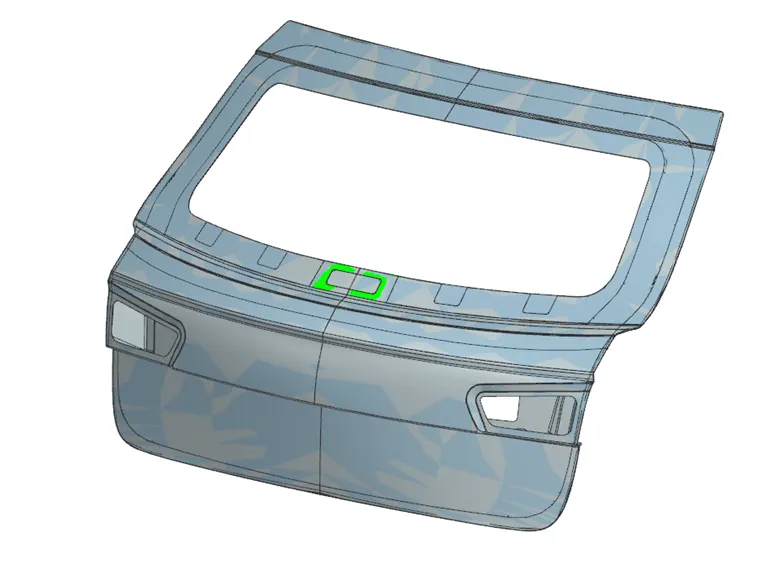
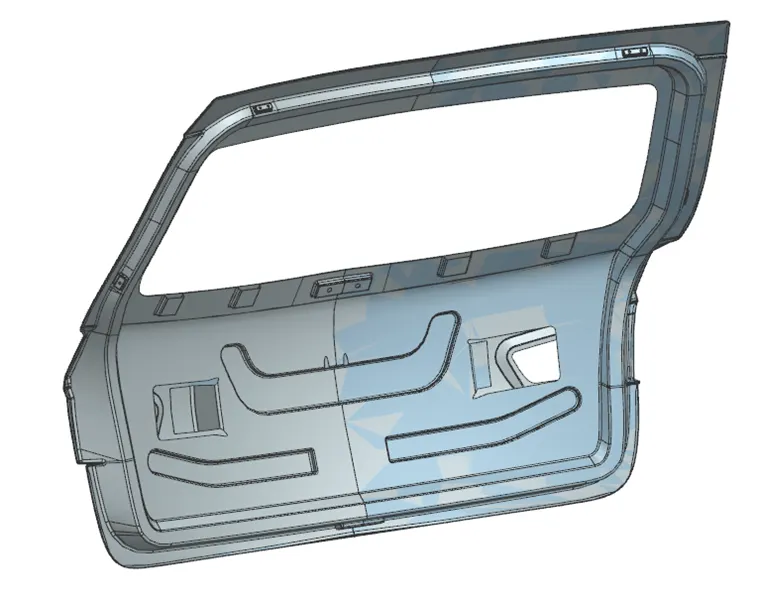
Fig 20 & 21. Final assembly design.