Hood design-Week 2
Design of Hood
A car hood, also referred to as a “bonnet” in some countries, is the hinged cover that rests over the engine bay of a front-engine vehicle. The car hood protects the engine and connected parts from the elements while providing easy access for repairs and maintenance.
The first important criteria that should be considered for designing a hood is the opening angle. It depends on the average height of the people in the respective region where the car is manufactured. The opening and closing of hood is controlled by the gas stay or the support rod. So a proper clearance should be ensured between the human head and the striker that is, the locking mechanism of hood.
Types of hood stay: 1) Support Rod: A device for supporting the engine hood of a motor vehicle in its open position by means of a rod.
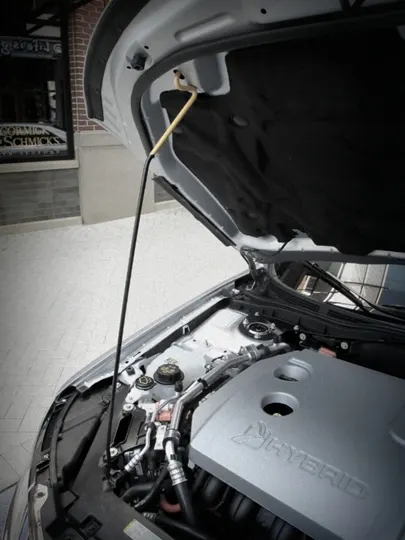
Support rod.
2) Gas stay: A device for supporting the engine hood of a motor vehicle in its open position by means of an actuator which is activated by gas.
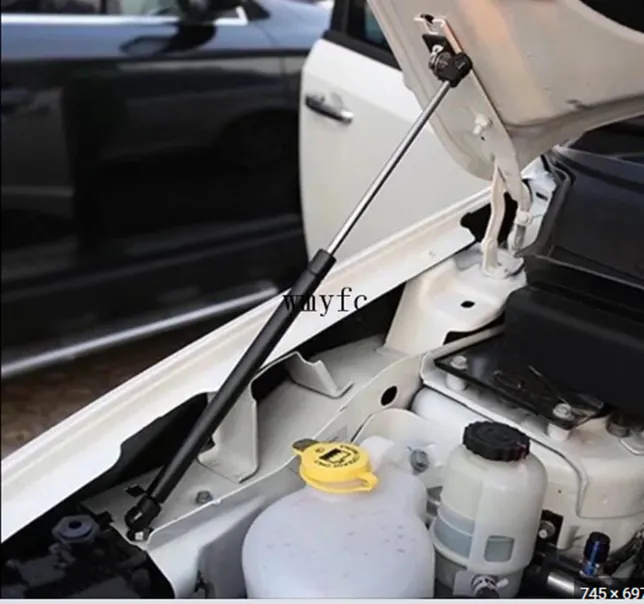
Gas stay.
The curvature of the support rod during the open position should be less than 35mm to prevent further bending of the rod due to the weight of the hood. Both the inner panel and outer panel of the hood are generally designed with a thickness in the range of 0.65-0.75mm.
Reinforcements
When we add additional components like the striker, and the hinge assembly, we provide additional material at those places called reinforcements to compensate for the loss of strength of the panel due to the addition. Reinforcements help to improve the strength of the panel also. The thickness of the reinforcements varies for different parts and for different models of cars.
Mastic sealant
An important feature we provide between the inner panel and outer panel is the Mastic sealant. It also helps to reduce the NVH (noise, vibration and harshness) of the vehicle. Every region where the mastic sealant is added will have the ability to improve the strength at a distance of about 80mm. Mastic is added in the form of a paste at the respective points. When it gets heated in the hot bath, it gets hardened and joins the outer panel and the inner panel. Spot welds and rivets should not be used here since the outer panel is a styling surface and the use of such techniques will affect the aesthetics of the part.
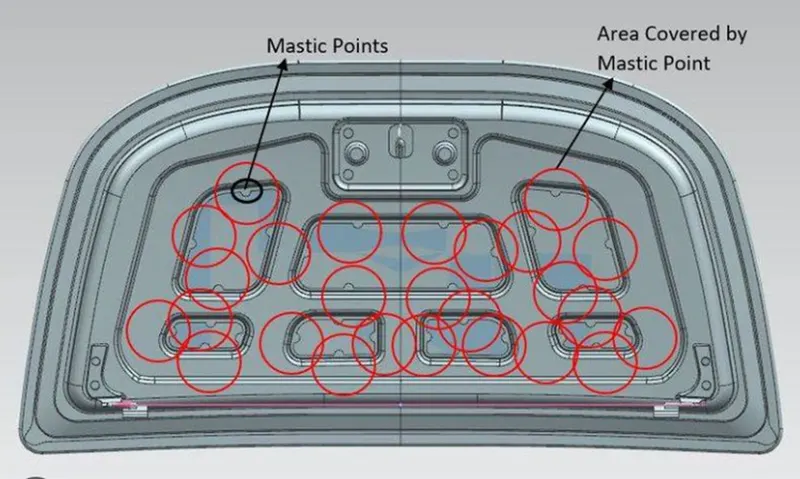
Mastic points.
Emboss
When a collision occurs on the front, the forces should be dissipated to the outside of the car. In order to do that, we create embosses along the respective directions and the force of the impact gets dissipated to the outside and along the hinges. So, the embosses enables the forces entering the cabin to be reduced drastically and helps in providing passenger safety.
Latch and striker trajectory
For the striker emboss and to fix the striker, the trajectory of the striker should be determined. Therefor the following steps should be done to determine the trajectory.
1) Select the hinge axis by joining the centre line of two hinges by a line and take the midpoint of the axis.
2) Draw a circle with the midpoint of the axis as the centre and the circle should be passing though the predefined position of the striker and that should be considered as the trajectory.
3) Check whether the striker location is perpendicular to the trajectory at the area locally. If so, the circle can be the real trajectory. If not the position of the hinge should be modified, and new trajectory should be sketched.
If the trajectory is correct, then the closing of the hood would be smooth, and no problem arises. The striker reaches the latch which is mounted below in the correct position and the hood is closed.
Hemming
The outer panel is joined to the inner panel by the process of hemming. Hemming is a forming operation in which the edges of the sheet are folded or folded over another part to achieve a tight fit. Normally hemming operations are used to connect parts together, to improve the appearance of a part and to reinforce part edges. In car part production, hemming is used in assembly as a secondary operation after deep drawing, trimming and flanging operations to join two sheet metal parts (outer and inner) together. Typical parts for this type of assembly are hoods, doors, trunk lids and fenders.
There are various types of hemming operations; 1) Conventional die hemming, 2) Roll hemming. In conventional die hemming, the flange is folded over the entire length with a hemming tool. In roll hemming, the hemming roller is guided by an industrial robot to form the flange.
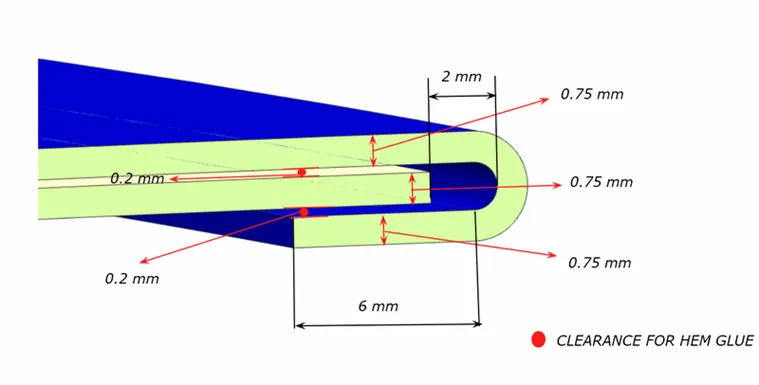
Hemming data.
The corners of the hemming are likely to have spring-back that is, the force by the rollers creates changes in the design of the outer panel. So, we provide reliefs to the corners by avoiding some sheet there and thus prevents the deformation.
Deep drawing
Deep drawing technique is used in the manufacturing of hood which is basically a sheet metal. Deep drawing is a sheet metal forming process in which a sheet metal blank is radially drawn into a forming die by the mechanical action of a punch. It is thus a shape transformation process with material retention. The process is considered "deep" drawing when the depth of the drawn part exceeds its diameter. Deep drawing of sheet metal is performed with a punch and die. The punch is the desired shape of the base of the part, once drawn. The die cavity matches the punch and is a little wider to allow for its passage, as well as clearance. This setup is similar to sheet metal cutting operations. As in cutting, clearance is the lateral distance between the die edge and the punch edge. The sheet metal work piece, called a blank, is placed over the die opening. A blank holder, that surrounds the punch, applies pressure to the entire surface of the blank, (except the area under the punch), holding the sheet metal work flat against the die. The punch travels towards the blank. After contacting the work, the punch forces the sheet metal into the die cavity, forming its shape.
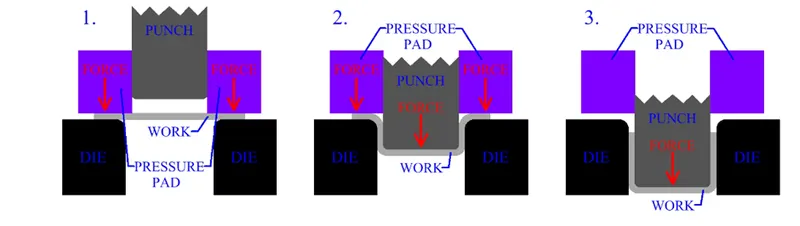
Deep drawing process.