Design of backdoor
AIM
Use the provided styling surface to come up with a back door design, use appropriate design methodologies, and provide the necessary reinforcements and embosses
Major Parts and Reinforcements:
- Backdoor Outer Panel (Upper)
- Backdoor Outer Panel (Lower)
- Backdoor Inner Panel
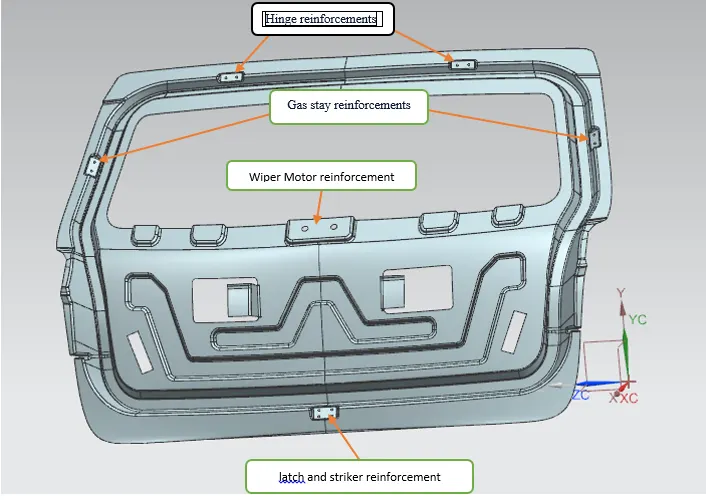
- Hinge Reinforcements (LH & RH)
- Gas-Stay Reinforcements (LH & RH)
- Latch and Striker Reinforcement
- Wiper motor Reinforcement
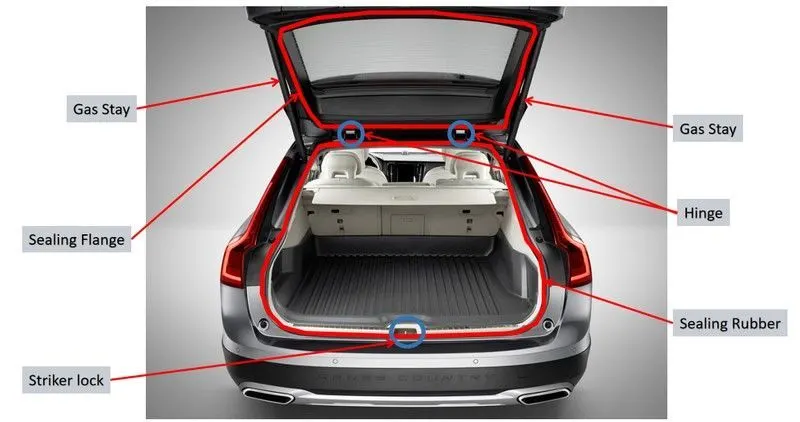
Tailgate
The car tailgate is the rear door of the car. It is the hinged panel that opens downwards and provides entry into the car for the passengers. The tailgate can also be used to store cargo.
DESIGN OF BACKDOOR OUTER PANEL:
The Outer Panel is the styling surface of the back door. Other components of the backdoor are designed with reference to the outer panel. It acts as the outer cover and deals with the aesthetics of the car.
In this design outer panel is divided into two parts
- Outer Upper Panel
- Outer Lower Panel
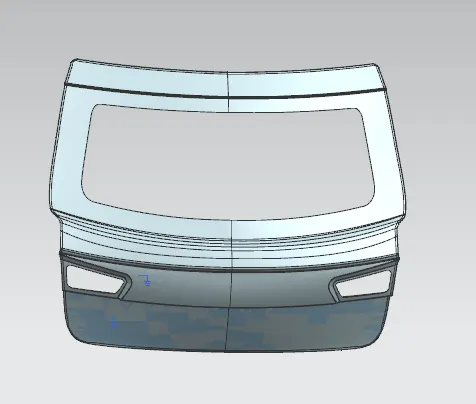
Outer Upper Panel:
- The Outer Upper Panel Extracted from a styling surface.
- The panel is altered for the required design with the surface tools of NX CAD
- The thickness provided for the outer panel is 0.75 mm
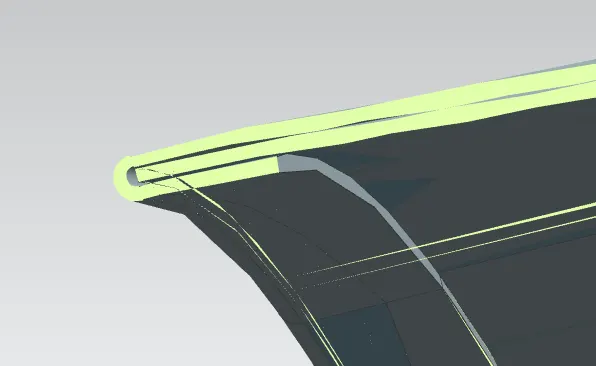
- Hemming is provided with the corner relief.
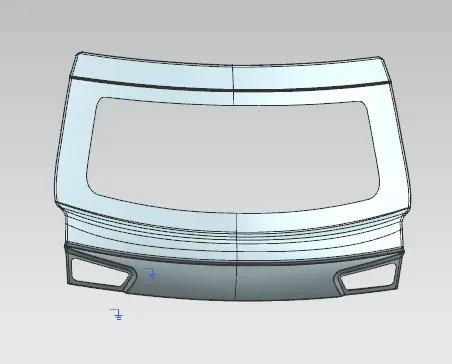
Outer Lower Panel:
- The Outer Upper Panel Extracted from a styling surface.
- The panel is altered for the required design with the surface tools of NX CAD
- The thickness provided for the outer panel is 0.75 mm
- Hemming is provided with the corner relief.
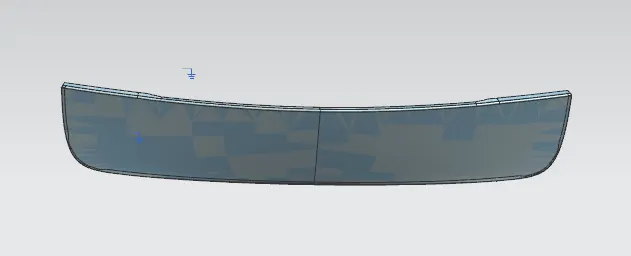
Tooling Direction:
- Before starting to design the inner panel of the back door the tooling direction for Deep Drawing purpose should be created.
- Then the styling surface needs to be checked and analyzed since it might have irregularities, hence it must be fixed first.
- Then the back door was designed using the top-down approach.
DESIGN OF BACKDOOR INNER PANEL:
- The Inner Panel Extracted from a styling surface.
- The panel is altered for the required design with the surface tools of NX CAD
- The thickness provided for the outer panel is 0.75 mm
Sealing Flange:
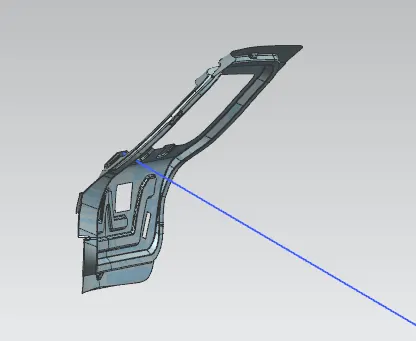
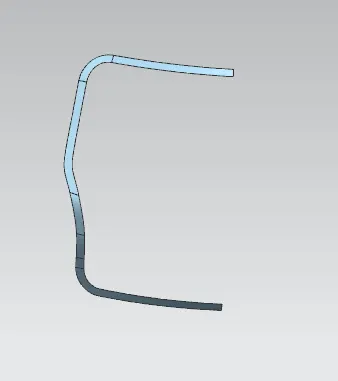
- It is that section of the inner panel which enables the backdoor to sit over the rear body side of the car.
- Its design is important as it decides how a backdoor is mounted on the rear body side of the car and also restricts any external matter to enter inside the vehicle.
Mastic Sealants:
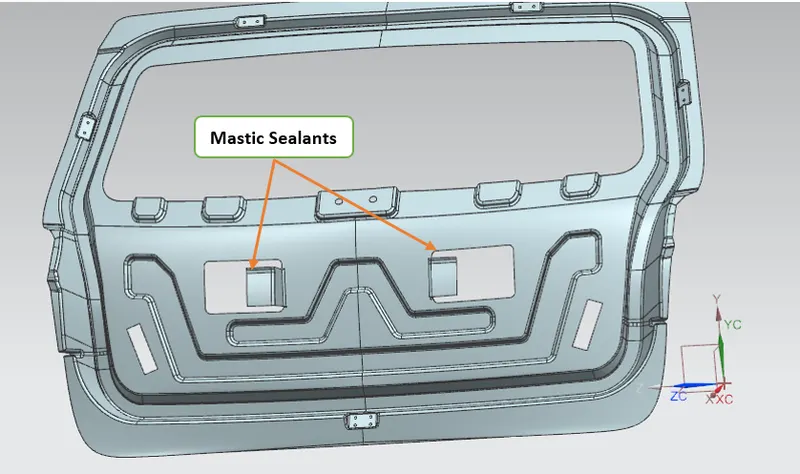
- As we know the outer panel gives the aesthetic look to the vehicle, so we can’t use bolting or spot welding or any other joining technique which damages the aesthetic looks of the panel. Thus mastic sealants are used for joining the Inner panel elements with outer panel.
- A maximum gap of 5mm is to be maintained in between parts where mastics are to be applied.
Embosses:
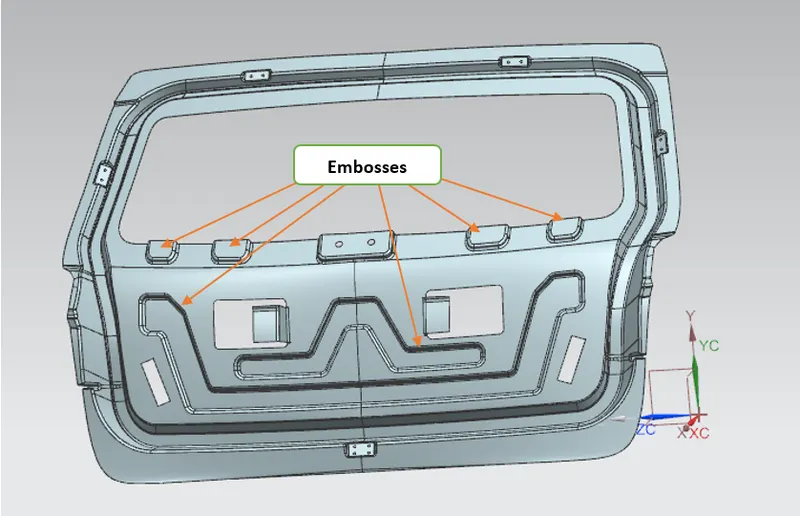
- It is provided to give extra strength to sheet metal panel and to help dissipate forces/energy towards a specific direction.
- Here embosses (Y/V emboss) are designed in such a way so as to direct them towards the outer end of the backdoor as shown in the image.
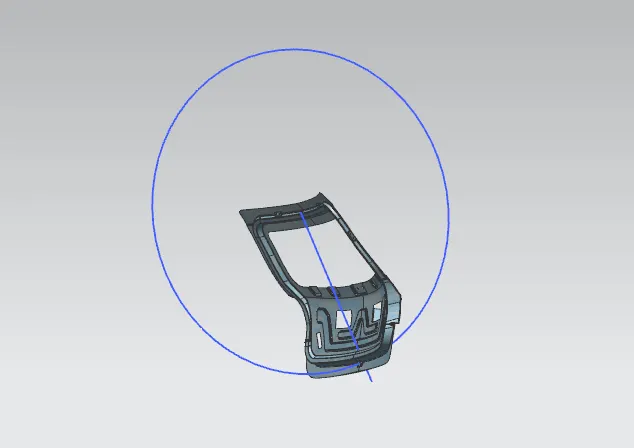
Positioning of Latch & striker/ Latch Trajectory:
- Backdoor is the swinging part which rotates about hinge axis.
- The position and orientation of latch striker is important for proper opening and closing of the backdoor.
- The positioning is done by sketching a circle with center as the axis of the hinge which passes through the striker at appropriate position with respect to inner panel.
Reinforcements
- Reinforcements are generally placed to increase the strength of the panel in localized areas which is relatively small compared to sheet metal parts for absorbing loads imposed thereon and dissipating such loads throughout the panel assembly to help maintain rigidity of the panel assembly.
- The reinforcements are usually 1-1.5mm thick as opposed to 0.75mm thick panel used in this part
Hemming
- Hemming is a technology used by the automotive industry to join inner and outer closure panels together (hoods, doors, tailgates, etc.).
- In addition adhesive bond provide for excellent joining of panels it also reduce vibration .
- here this design 0.2mm clearance provided for hem glue .
Corner Relief:
- During hemming process multiple rollers are used which causes vibrations and stress concentrations at the some locations due to which design intent of the panel shouldn’t be changed (i.e the panel should spring back to original formation after roller is removed).
- But most of the time that is not the case at corners so to avoid that situtaion reliefs are provided at corners.
DRAFT ANALYSIS:
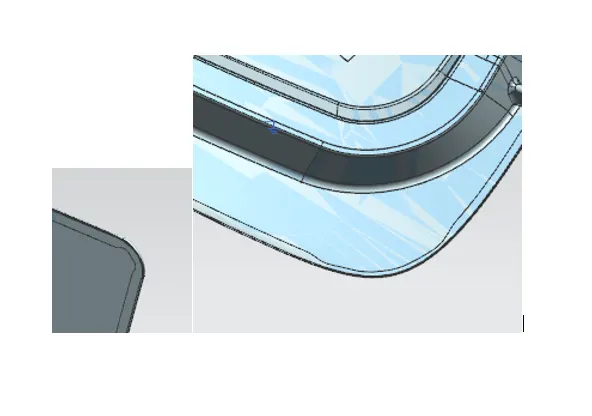
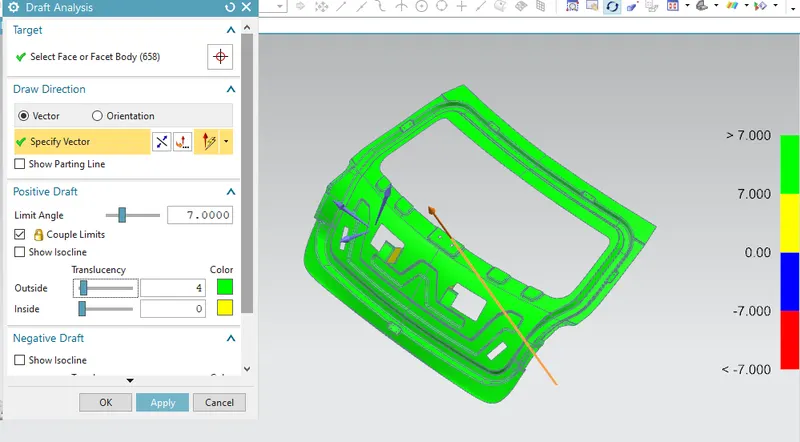
Draft analysis of inner panel is carried out through the tooling direction only.Only the green areas are acceptable and i worst cases yellow regions are accepted but the blue and red regions are never accepted.
The draft angle for aluminium casted panel is 2 to 3 degrees is enough but if it is steel then the angle is more than 7 degrees.
In this project i considered it as steel and used 7 degrees as draft angle and direction is choosen as tooling direction which is the deep drawn direction
CONCLUSION:
Thus,For the provided styling surface of a back door design, I used appropriate design methodologies and provided the necessary reinforcements and embosses for the BackDoor design.thus i designed a back door.