Design of backdoor
Aim: To design the Back door of the car using the appropriate design methodologies, providing the necessary Reinforcements and embosses in the inner panel for strength.
Design Considerations for a Back Door
- Rear Visibility for Functionality and Safety.
- Boot Space and Accessibility.
- Type of Backdoor Opening (For individual vehicle requirement).
- Fixing and Support Structures like Hinges and Gas stays.
- Mounts for Wiper Motor, Back Lights/Tail Lamps and Other Wiring loops.
- Fit and Clearance (For Assembly and Aesthetically looks).
- Strength Of Backdoor (Require in collision).
Back Door:
The Back door of a car is a component which hinges at the back of the car to cover the boot space or luggage area, But there are more functions that come with it which has to be considered while making a design of the same like rear visibility criteria and boot space.
This part is usually designed keeping the master section of the rear roof rail because of the sealant flange and also various other considerations, as it is also in contact with the side body of the car.
It has back lights/ Tail lamps and Braking lights which is termed as "Third brake light" mounts on it, rear windshield fixes between inner and outer panel, in some back door spare wheel can be mounted on it, sometimes car registration number plate mounts on it and it gives a complete closed design to the car.
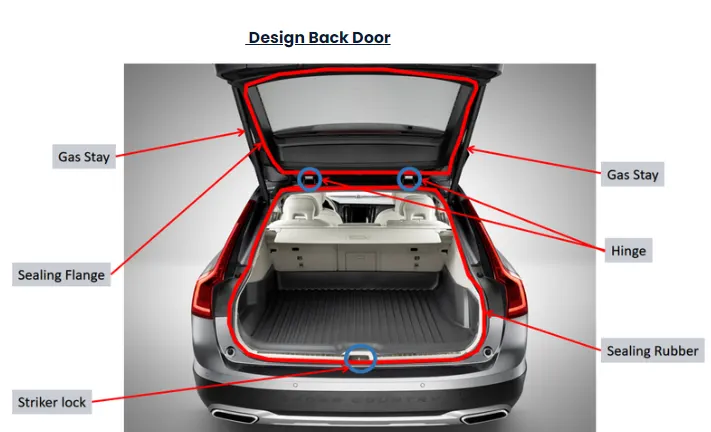
Design Considerations:
- Rear Visibility for safety and functionality
- Support Structures like Hinge and Gasstay/ Power lifter
- Rear Crash regulations
- Boot Space
- Mounts for wiper motor and lights
- Strength criteria
- Draft Analysis
Types of door openings:
- Top-mounted door
- Side-mounted door
- Bottom Door
Components of backdoor:
- Inner panel
- Outter panel upper
- Outter panel lower
- Hinge reinforcement LH
- Hinge reinforcement RH
- Gas stay reinforcement LH
- Gas stay reinforcement RH
- Wiper motor reinforcement
- Latch reinforcement
- Plastic trim
Manufacturing Processes Used to make Backdoor
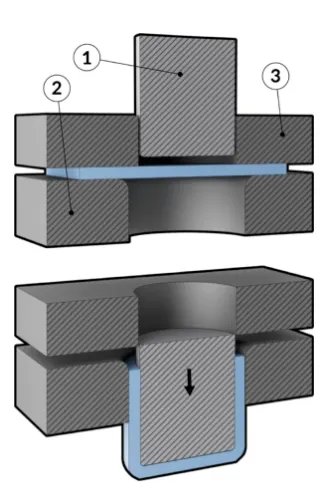
Deep drawing:
Deep drawing is a sheet metal forming process in which a sheet metal blank is radially drawn into a forming die by the mechanical action of a punch. It is thus a shape transformation process with material retention. The process is considered "deep" drawing when the depth of the drawn part exceeds its diameter. This is achieved by redrawing the part through a series of dies. The flange region (sheet metal in the die shoulder area) experiences a radial drawing stress and a tangential compressive stress due to the material retention property. These compressive stresses (hoop stresses) result in flange wrinkles (wrinkles of the first order). Wrinkles can be prevented by using a blank holder, the function of which is to facilitate controlled material flow into the die radius.
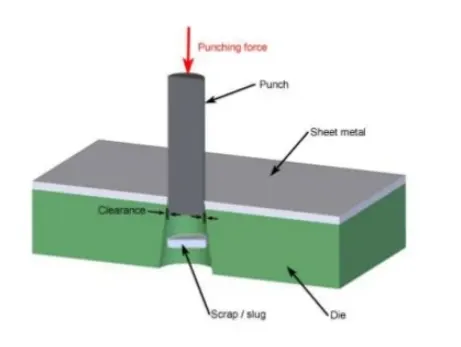
Punching:
Sheet metal punching is a cutting process in which material is removed from a piece of sheet metal by applying a great enough shearing force. CNC Punching can be used to produce holes and cutouts of various shapes and sizes.
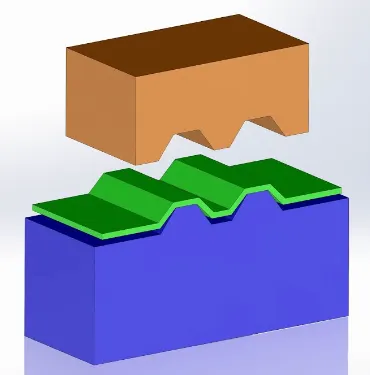
Embossing:
Embossing is a stamping process for producing raised or sunken designs or relief in sheet metal. This process can be made by means of matched male and female roller dies, or by passing sheet or a strip of metal between rolls of the desired pattern, theoretically with no change in metal thickness, or by passing sheet or a strip of metal between rolls of the desired pattern.
Metal sheet is drawn through the male and female roller dies producing a pattern or design on the metal sheet. Depending on the roller dies used, different patterns can be produced on the metal sheet.
Emboss should be in 7 degree to 25 degree inclinte in angle and it should not be in 90 degree angle,why because when we do stamping in manufacturing the stamping tool fits the sheet metal hence it will not come out of that sheet metal,So this is the main reason why the emboss face is in angle.
Hemming:
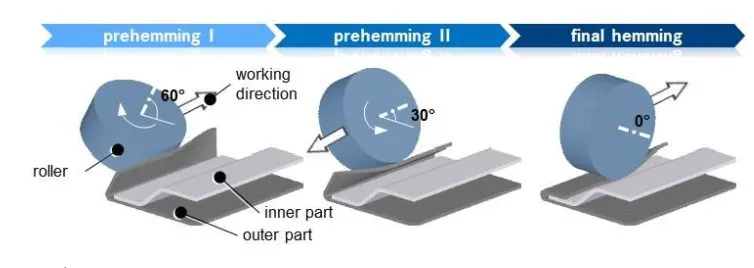
Hemming is a forming operation in which the edges of the sheet are folded or folded over another part in order to achieve a tight fit. Hemming is a technology used in the automotive industry to join inner and outer closure panels together (hoods, doors, tailgates, etc.). It is the process of bending/folding the flange of the outer panel over the inner one. The accuracy of the operation significantly affects the appearance of the car’s outer surfaces and is therefore a critical factor in the final quality of a finished vehicle.
Mastic Sealant:
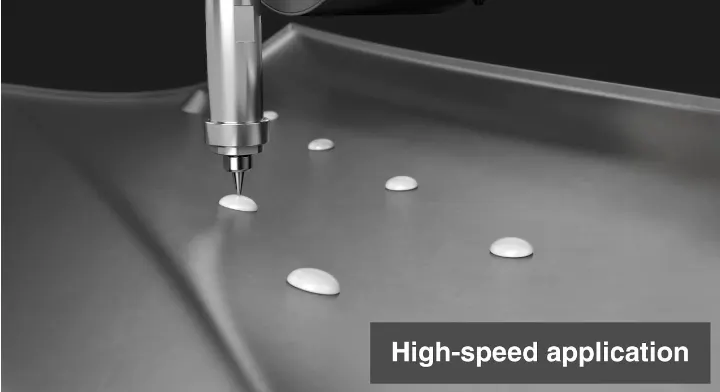
A mastic sealant is a type of liquid sealant that cures in an elastic state, thus making it flexible while holding the bond of the surfaces that has attached together. It adheres to just about any material making an all-purpose type of sealant.
The main purpose of the outer panel is for the aesthetic looks. Thus we cannot use bolts or welding. This has to be done with the help of the hemming and mastic sealants. Mastic sealants are elastic compound that behaves like the rubber. It is placed between the outer and inner panel. Initially is it in paste form, but after the hot furnace bath it gets hardened thus joining the outer and inner panel. Mastic sealant has the tendency to increase the strength of the panel and has influence of 80mm diameter.
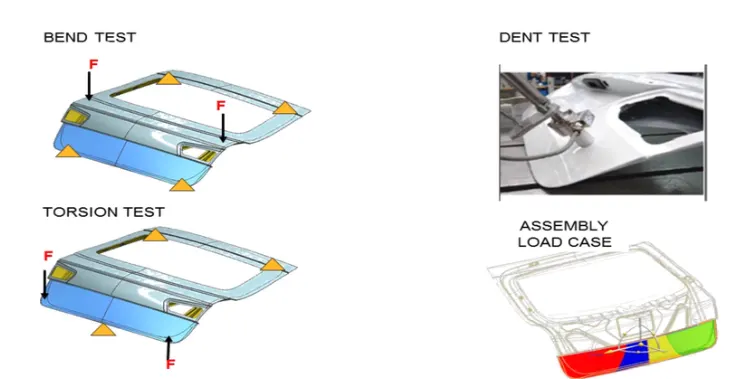
Some tests done on the backdoor
Design of Back door in NX CAD:
Door parts thickness is given below,
Outer Panel - 0.75 mm
Inner Panel - 0.75 mm
Reinforcements - 1.5 mm
Given Data,
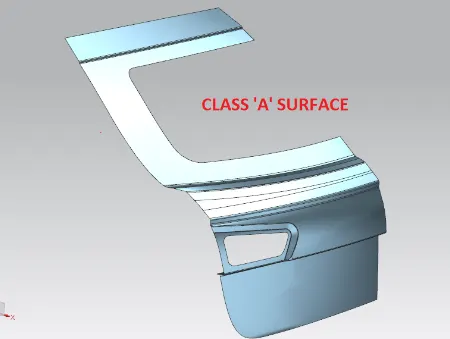
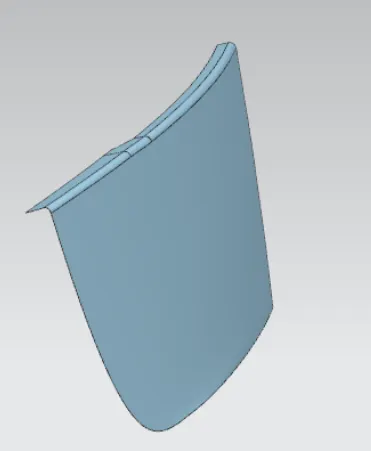
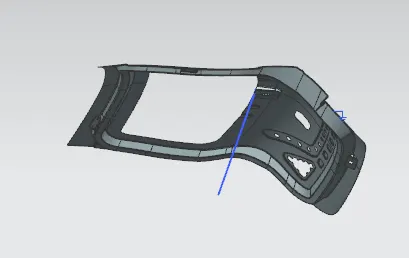
First, we need to create the Tooling direction for the Deep drawing operation. It shows that all the operations like embossing is done by considering this vector direction and it will help in manufacturing the part
Hinge reinforcement:
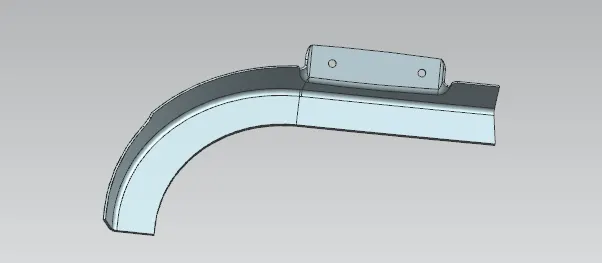
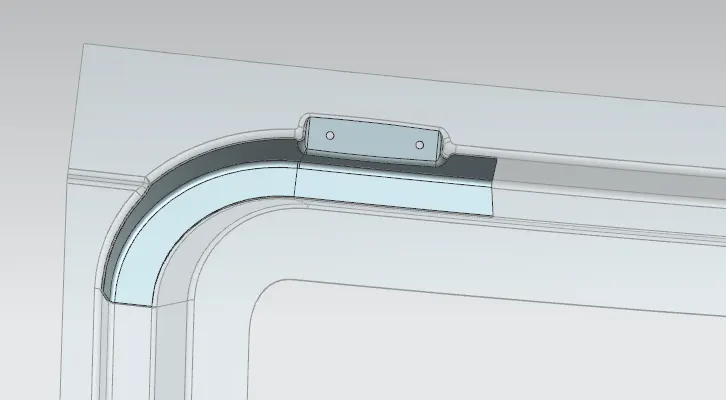
Latch reinforcement:
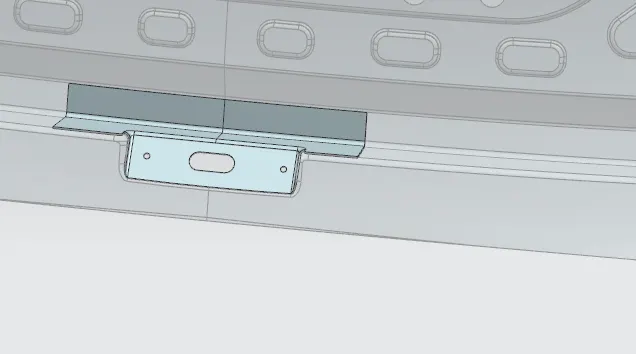
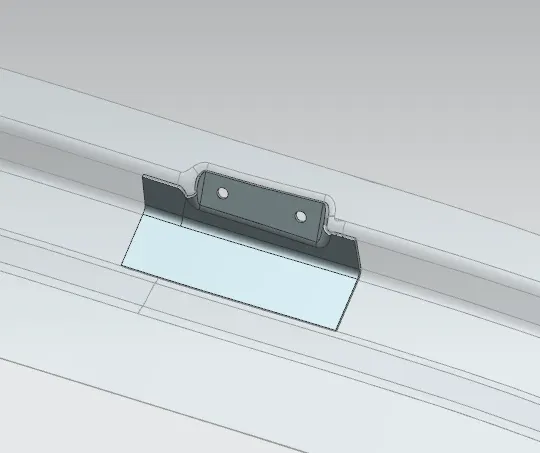
gas stay reinforcement:
Draft Analysis:
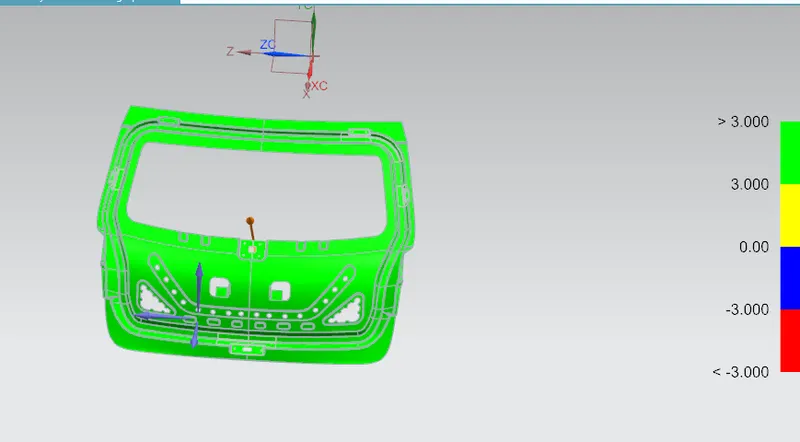
Draft analysis of inner panel is carried out through the tooling direction only.Only the green areas are accepteble and in worst case yellow region are accepteble but the blue and red region are never accepted.
Conclusion
The Back door was designed in Siemens NX with all the possible known required design guidelines for back door design and manufacturing.