Design of backdoor
BACK DOOR DESIGN
OBJECTIVE:- Design Back Outer Panel, Inner Panel and the necessary reinforcements by following the class A surfaces Provided.
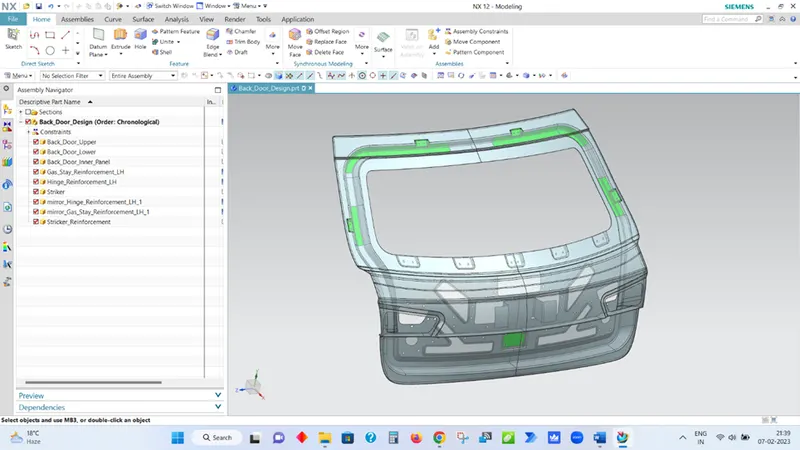
Complete Back Door Assembly
INPUTS
- Back Door Class A Surface
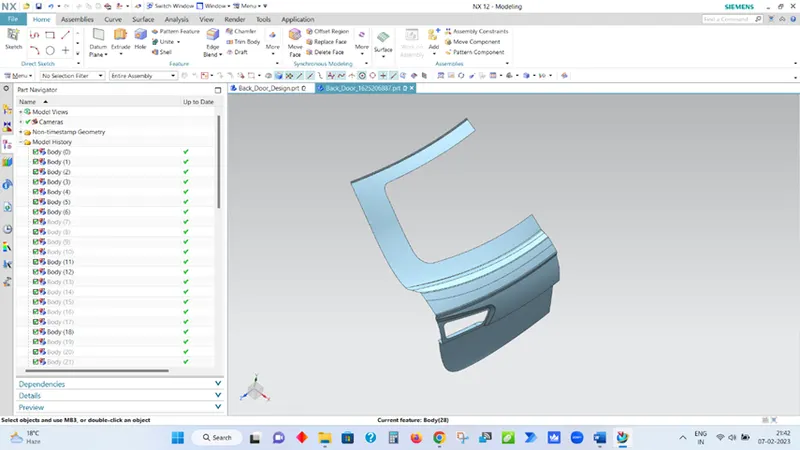
Design Procedure
- Design of Inner Panel from outer panel surface data keeping in mind back door functional Requirements.
- Design of Outer Panel.
- Design of Hinge & Striker Reinforcement.
- Assembly of Inner, outer Panel & Hinge Assembly.
- Creation Of Hinge Axis
- Assembly of Striker with respect to Hinge Axis so that striker follows the Opening & closing trajectory.
Design Consideration Of Back Door:
- Rear Visibility criteria
- Luggage Room consideration.
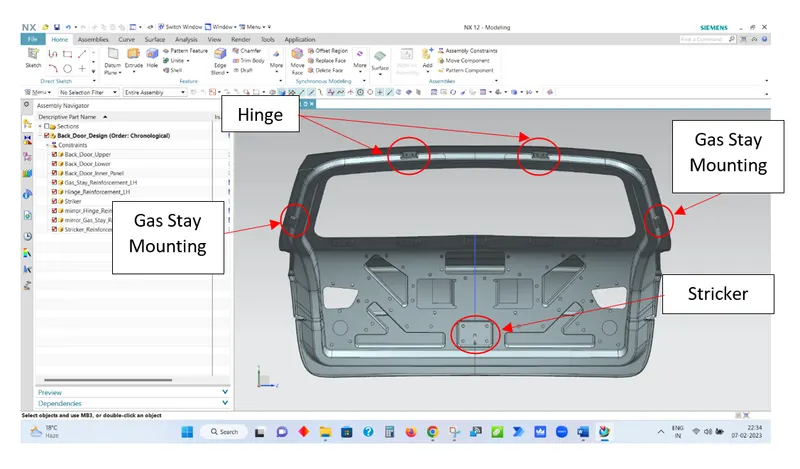
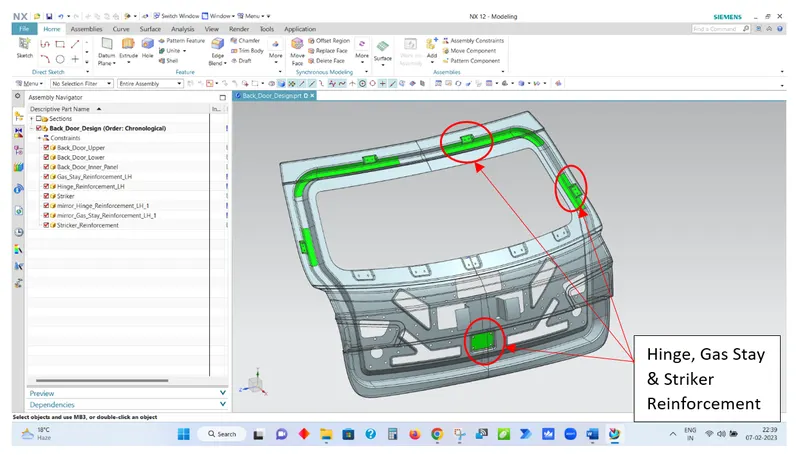
- Reinforcement Of Back Door (Hinge, Gas Stay & Stricker Reinforcement)
- Manufacturing Feasibility
Back Door Design & its Main Component
The trunk (North American English) or boot (British English) of a car is the vehicle's main storage or cargo compartment, often a hatch at the rear of the vehicle. It is also called a tailgate.
In Indian English the storage area is known as a dickey (also spelled dicky, dickie, or diggy), and in South-East Asia as a compartment.
The trunk or luggage compartment is most often at the rear of the vehicle. Early designs had an exterior rack on the rear of the vehicle to attach luggage trunk. Later designs integrated the storage area into the vehicle's body, and eventually became more streamlined. The main storage compartment is normally provided at the end of the vehicle opposite to which the engine is located.
Some mid-engined or electric cars have luggage compartments both in the front and in the rear. Examples include the Porsche 914 and Boxster as well as Toyota MR2. The mid-engined Fiat X1/9 also has two storage compartments, although the rear one is small, easily accessible, and practically cuboid in shape.
Rear-engined cars like Volkswagen Beetle or Porsche 911 have the trunk in front of the passenger compartment. The Volkswagen Type 3 featured a rear engine design that allowed for a shallow conventional trunk in the rear as well as space in the front for luggage.
Based on the opening trunk are of Three type namely
- Top Hinged
- Side Hinded
- Bottom Hinge
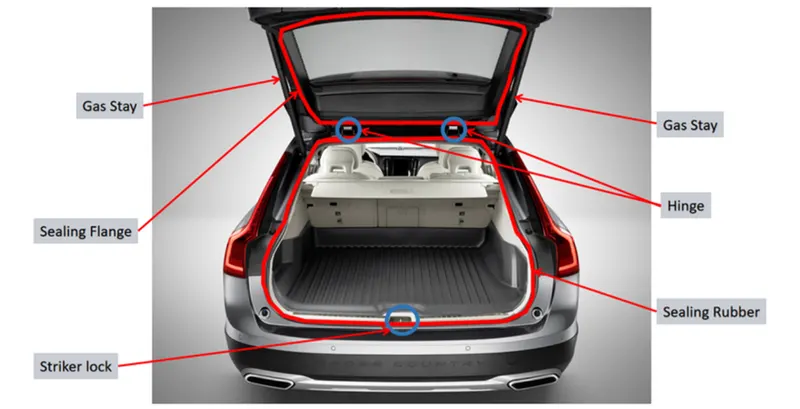
Back Door & its Main Component
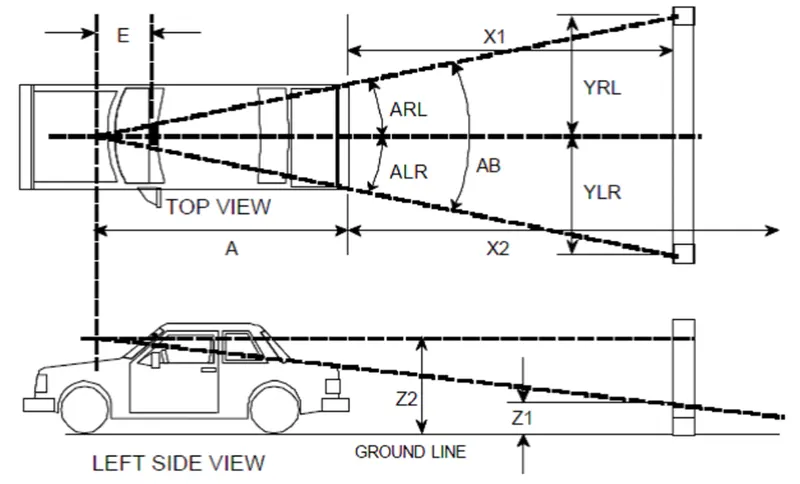
Visibility criteria
While designing Back door and its components one major factor is Visibility Criterial, every Vehicle have predefine visibility Criteria.
Back door inner & Outer pannel should be Designed keeping in mind that visibility of occupant should not hinder or reduced due to design of Back door outer panel & Rear roof rail.
Luggage Room consideration
Inner panel of back door should be thick enough to provide protection against rear crash and enable more luggage space.
Reinforcement Of Back Door
Reinforcements (such as Hinge, gas stay & Stricker reinforcement) are provided in back door to withstand the various load cases & rear crash test.
- Bend test
- Torsion test
- Abuse case test
- Dent test
Back Door Main Components
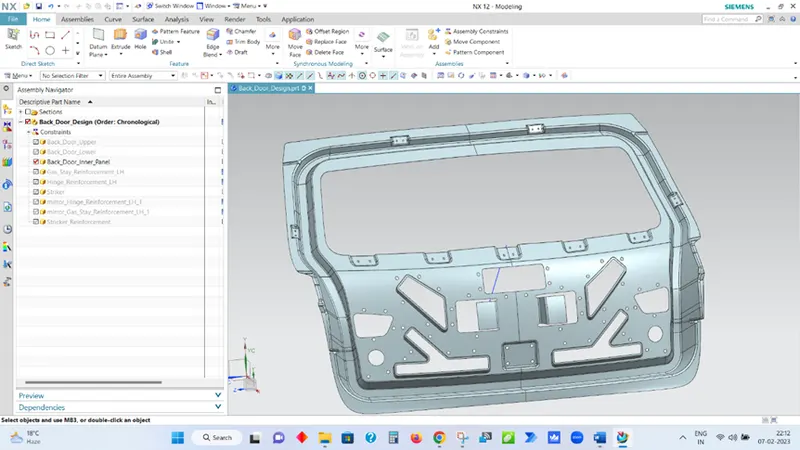
Inner Panel
Inner panel is that part of Back Door which provides strength to Outer panel. Inner panel itself considered as biggest reinforcement in Back door apart from hinge and latch reinforcement.
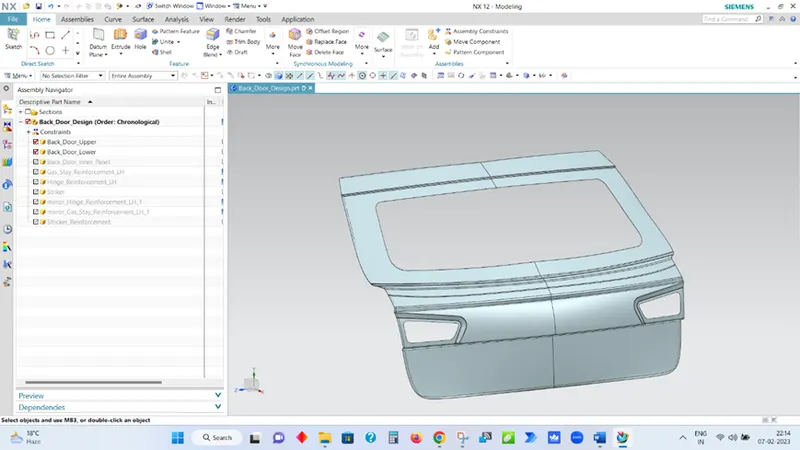
Outer Panel
Design of outer panel is mainly inspired by aesthetic but there is some engineering also to it. Here main purpose of outer panel is to cover the inner panel to provide aesthetic look at the same time Panel must be curve & sleek so that it behave aerodynamically and air hitting from bottom reflect from it efficiently.
Gas stay / Powered lift system
Now after opening the Back door there need a support system to keep it in elevated position. So that, one can access Luggage room & other parts such as (Spare tire, emergency Supplies, CNG tank, Tool Kit, Jack & Lug wrench)
So, to fulfil this, Gas stay/Powered lift system functions perfectly.
GAS STAY:
It is also a back door stay but it is automated or need some slight amount of force then gas itself actuates it and make it work desirably.
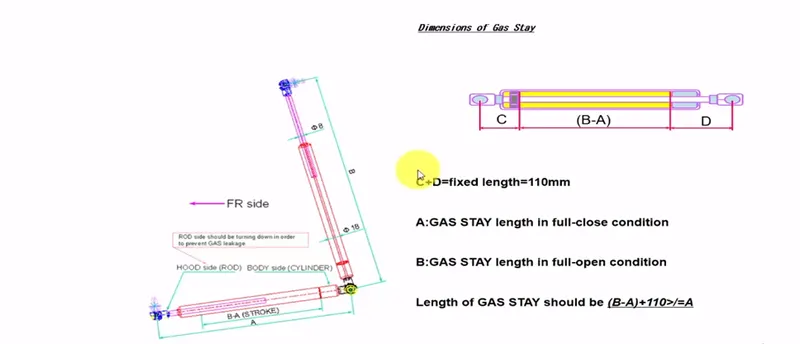
Design of Gas Stay
Advantages:
- It is automatic in nature
Disadvantages:
- It is costlier
- Here below it is shown how gas stay looks like
it uses compressed gas contained within an enclosed cylinder sealed by a sliding Piston to pneumatically store potential energy and withstand external force applied parallel to the direction of the Piston shaft.
In gas stay stud ball is used to connect it from the back door and body from both ends.
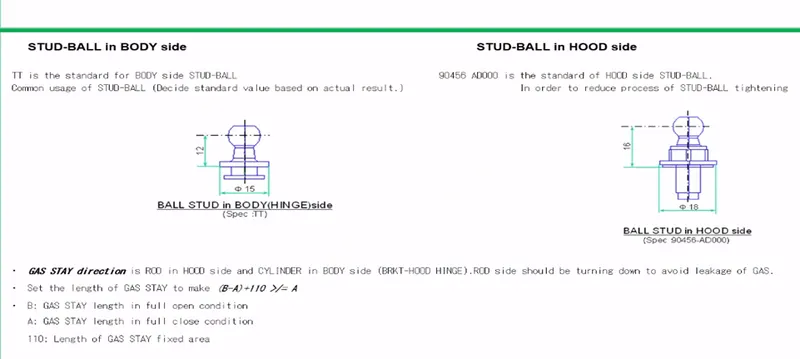
As gas stay is an additional component so we will use a bracket also for reinforcement to improve strength
Powered lift system:
Power trunk lid system is another sophisticated way of trunk/liftgate opening mechanism which is to automatically open and close of the trunk/liftgate and release of the latch by the touch of a button. The following image shows the component as used in the powered trunk/back door lift system.
Powered trunk lift system consists of a power latch, anti-pinch switch, PTG ass’y, PTG main switch. When the switch is pressed in the compartment or outside the power latch releases the latch and the entire backdoor is opened. The anti-pinch switch is located in order to avoid accidental hand insertion during the operation of the door.
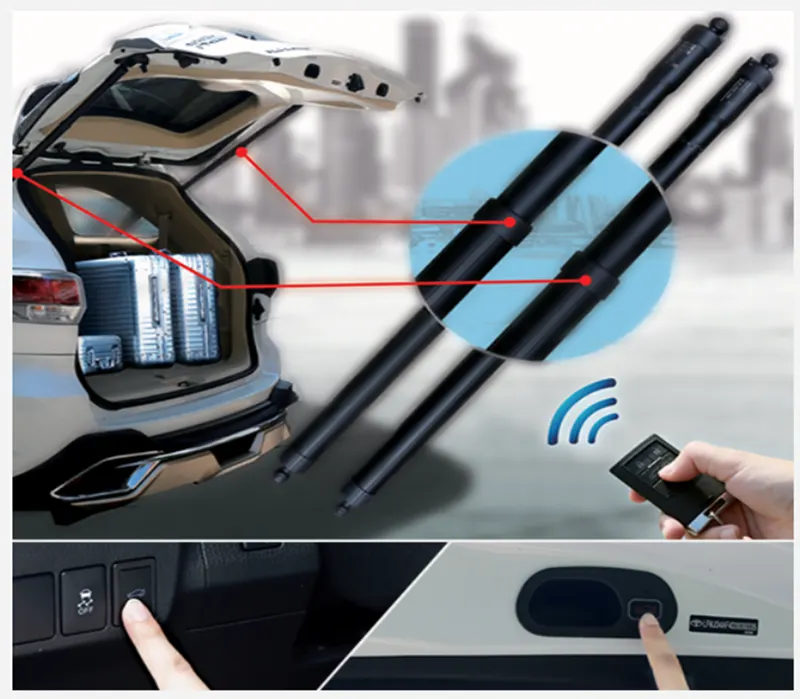
Powered lift system
Hinge and hinge reinforcement
Hinge is a mechanical bearing that connects two solid objects typically allowing only a limited angle of rotation between them it has one degree of freedom. So here hinge is providing rotation to hood about it’s own axis and also keep it connected to the fender portion.
So while creating space for hinge we need to provide emboss there, because of emboss and hole its strength got affected so to compensate that we provide hinge reinforcement.
Hinge reinforcement has thickness around 1 to 1.5 mm to provide reinforcement to hinge embossed region.
Mastic Sealants
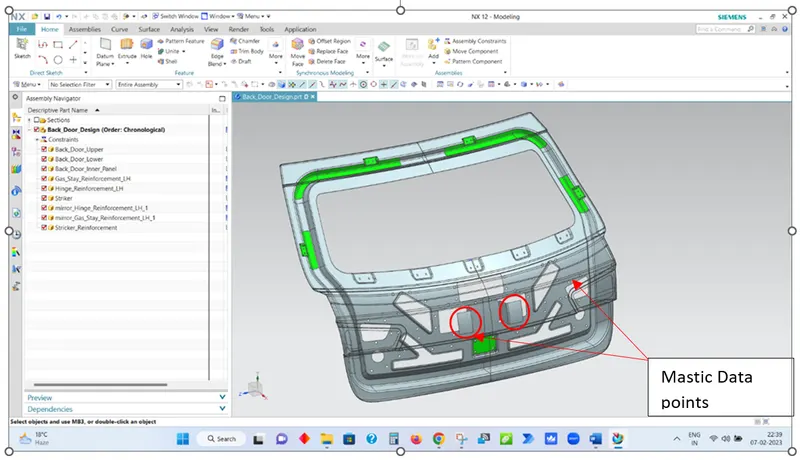
Mastci sealants/data are the type of rubber base adhesive used to join exterior automotive panels to the vehicle’s inner panel structure, such as on roofs, doors, and hoods. This one‐component synthetic rubber sealer remains elastic after curing to reduce panel flapping and to prevent panel distortion.
Advantages:
- Great application flexibility.
- Excellent adhesion to oily steel plates
- Ideal for aluminium panel bonding
- A formulation for virtually every need
Manufacturing Processes
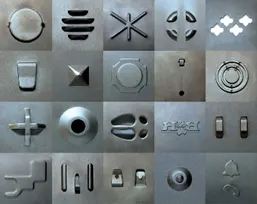
Emboss
Sheet metal embossing is a stamping process for producing raised or sunken designs or relief in sheet metal. This process can be made by means of matched male and female roller dies, or by passing sheet or a strip of metal between rolls of the desired pattern.
the metal sheet embossing operation is commonly accomplished with a combination of heat and pressure on the sheet metal, depending on what type of embossing is required. Theoretically, with any of these procedures, the metal thickness is changed in its composition.
Deep drawing
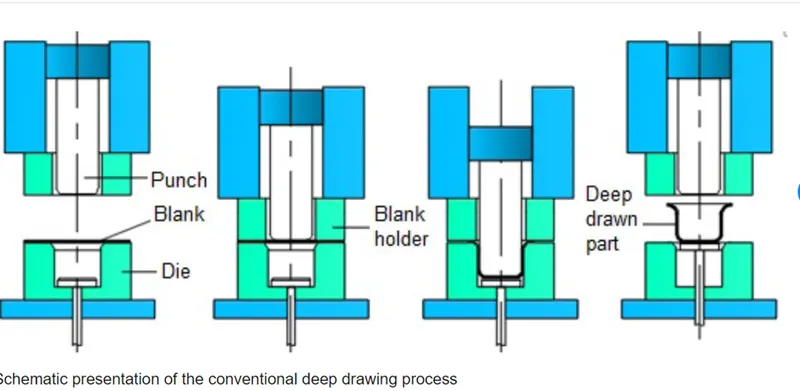
Deep drawing is a sheet metal forming process in which a sheet metal blank is radially drawn into a forming die by the mechanical action of a punch.[1] It is thus a shape transformation process with material retention. The process is considered "deep" drawing when the depth of the drawn part exceeds its diameter. This is achieved by redrawing the part through a series of dies.
Hemming
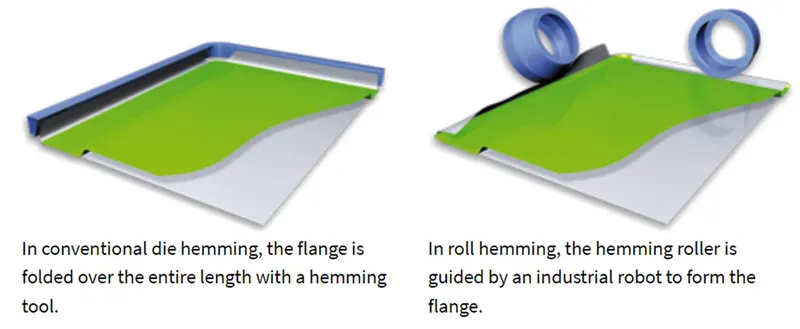
Hemming is a forming operation in which the edges of the sheet are folded or folded over another part in order to achieve a tight fit. Normally hemming operations are used to connect parts together, to improve the appearance of a part and to reinforce part edges.
In car part production, hemming is used in assembly as a secondary operation after deep drawing, trimming and flanging operations to join two sheet metal parts (outer and inner) together. Typical parts for this type of assembly are hoods, doors, trunk lids and fenders.
There are various types of hemming operations:
- Conventional die hemming
- Roll hemming
Hem Type
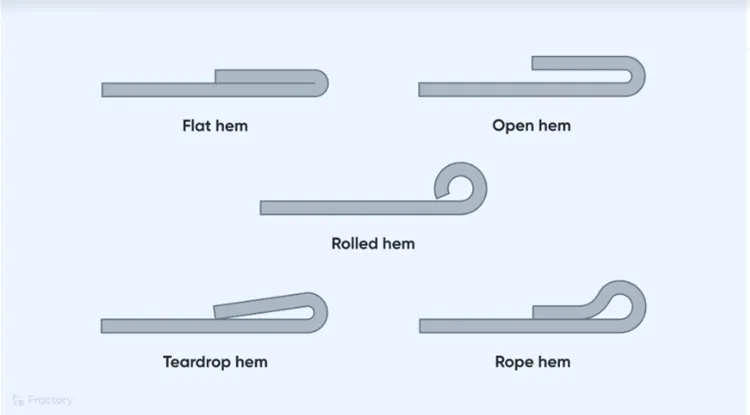
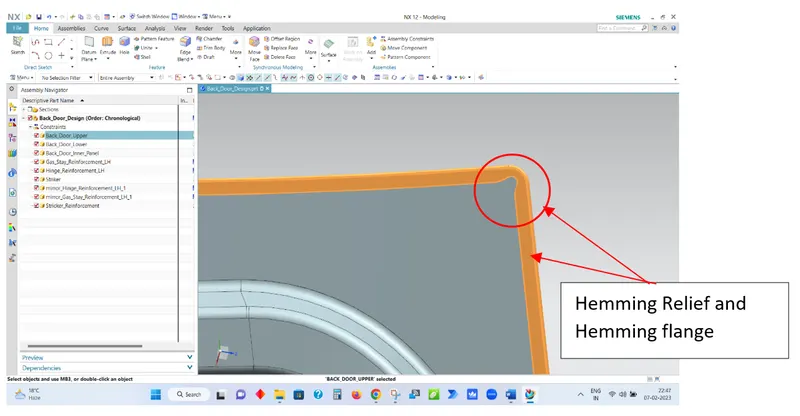
Hemming refief is provided at corners to pervent material deformation, Material overlap at corners while hemming operation.
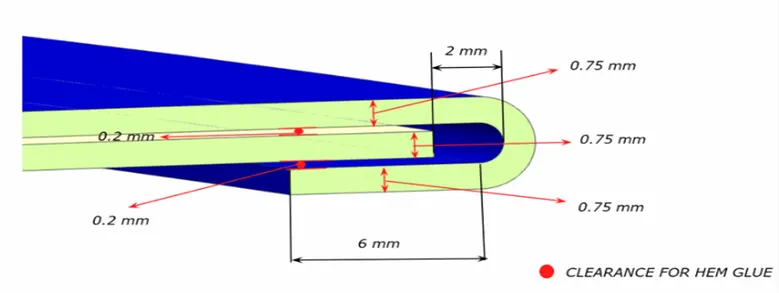
Hemming Data
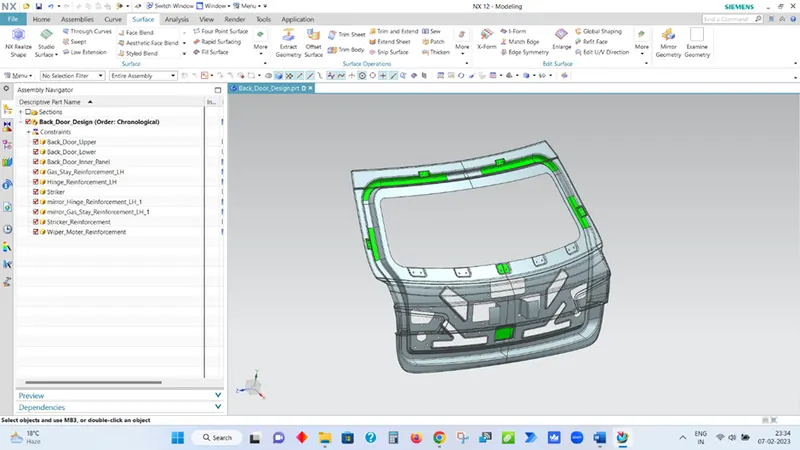
Back Door Assembly
Draft Analysis
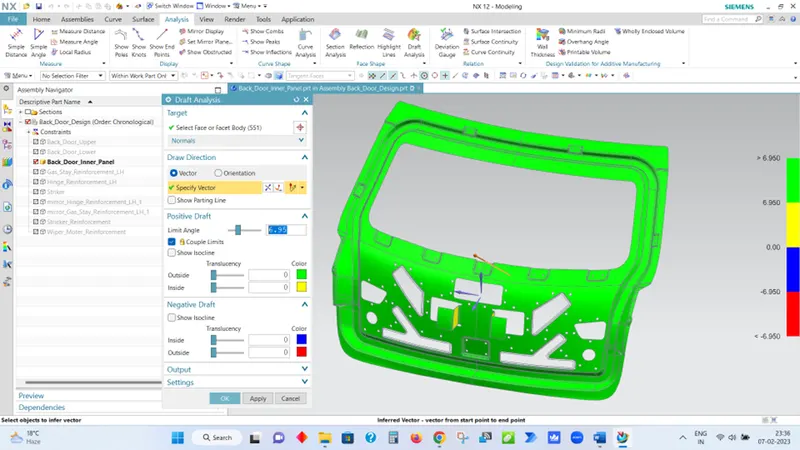
All surfaces are having 7 degree of draft
Conclusion
Design of back door is completed keeping in mind all the design requirements