DESIGN AND MODELLING OF AN AUTOMOTIVE HOOD IN NX-CAD
INTRODUCTION:
The hood is a part located in the front portion of a car, which serves as a cover and means for accessing the Engine Compartment & related parts in a front-mounted engine car. Also contributes to the aesthetic appael of a car. Thus an car hood must be designed by keeping in mind all the functional and ergonomical requirements.
The hood is a sub-assembly consisting of following components: Inner panel, Outer panel, Striker, Hinges and Support rod(s).
1. OUTER PANEL:
The outer panel is the part visible mostly when hood is in closed position. It forms a major part of the hood. The Outer panel is hemmed at the outer edges around the inner panel. It forms a major part of the hood.
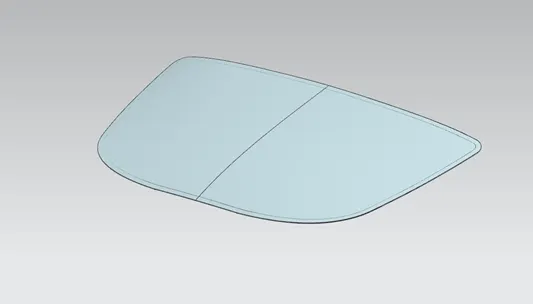
The Outer panel is hemmed at the outer edges such that it wraps around the inner panel. The hem is carried out by passing the rollers along edges over 3 times to get a smooth and uniform curvature of hem.
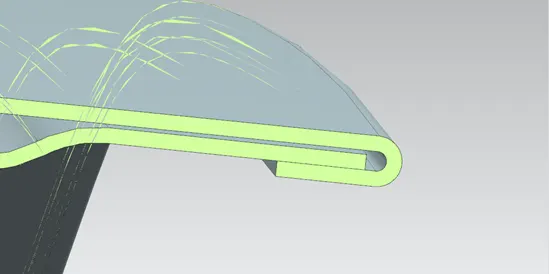
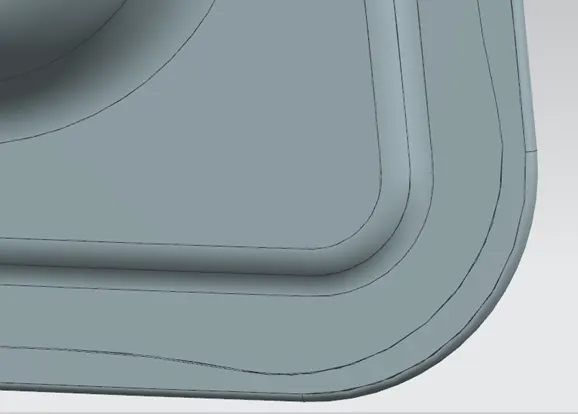
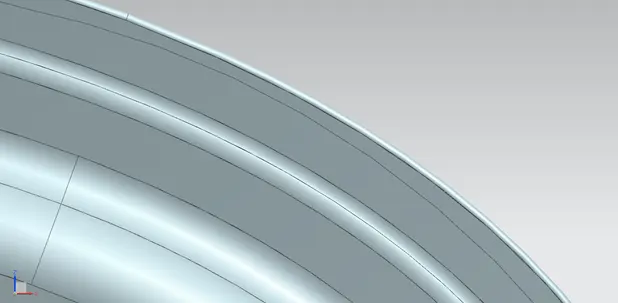
The hem has a relief (on underside) along certain sharp curves and edges to avoid warping of sheet metal.
2. INNER PANEL:
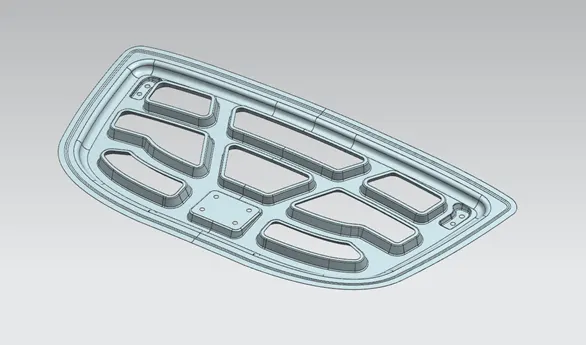
The inner panel is the part which is visible when the hood is in in open position. The inner panel is not uniform and has a distinctive cross-section and geometry. A master section is provided as per which an inner panel has to be designed by considering various considerations.
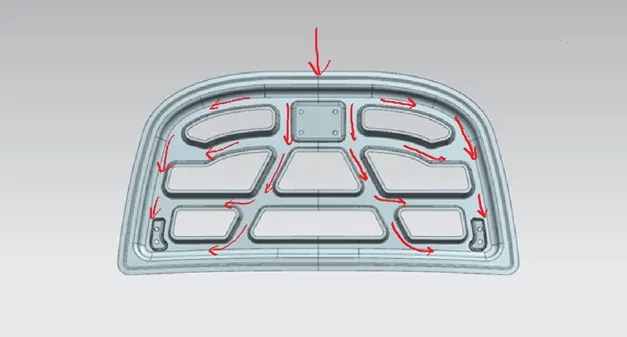
Along with the distinctive cross-section, embosses are created. Embosses are reliefs/stamps which are created in inner panel along with cut-outs such that in case of an impact the energy is dissipated/ diverted sideways. The cut-outs are done to reduce the bulk of material such that the overall strength of hood is fairly good.
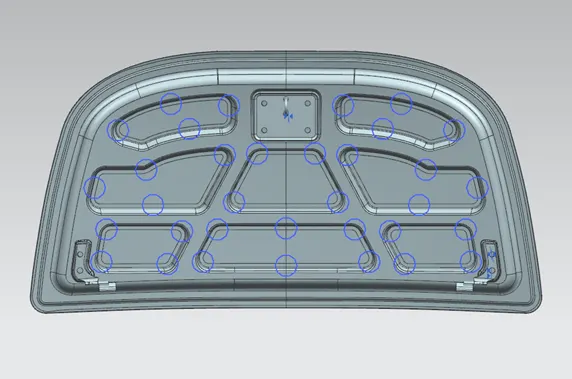
The gap between inner panel and outer panel over the embosses is filled with mastic sealants at certain specified places, which helps in reducing vibrations and thus overall NVH (Noise, Vibration and Harshness)
3. STRIKER:
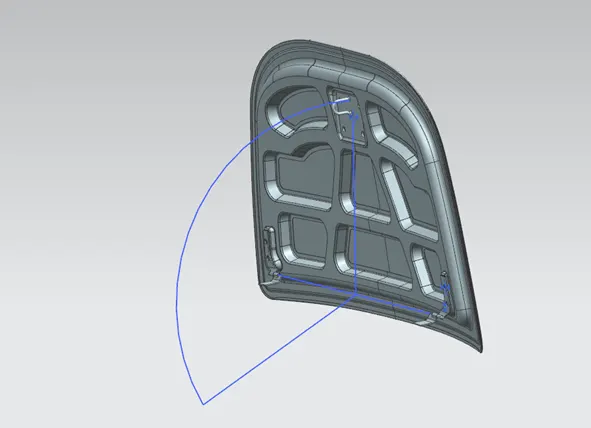
The striker is the part which attaches with the front area of body of car to close and hold the hood in place when there is no need for it to be open. The positioning of striker is very important so that it matches with receiving end on body. This is achieved by taking an imaginary axis collinear to hinges. Then from the midpoint of imaginary axis a line is drawn such that the striker must be perpendicular to it. Also, it must follow the same trajectory (curve formed by the radius).
SAFETY CONSIDERATIONS:
The safety standards for hood are set by EURO-NCAP.
The pedestrian safety is calculated mainly on the basis of head impact zones as head is the portion of the body to strike the hood. A dummy mannequin is made to hit and then observed as to where it hits on the hood.
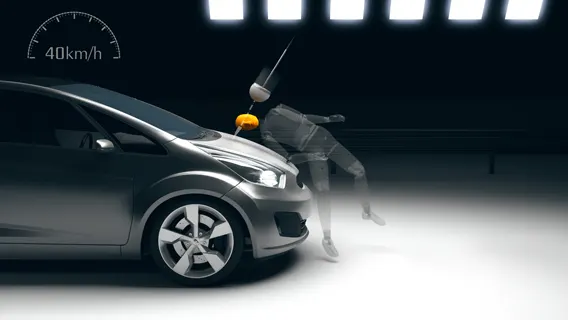
Then the safety rating is carried out on basis of effect of impact on mannequin and hood. Sometimes, deformable brackets are added to reduce the impact on human head and to absorb all energy of impact
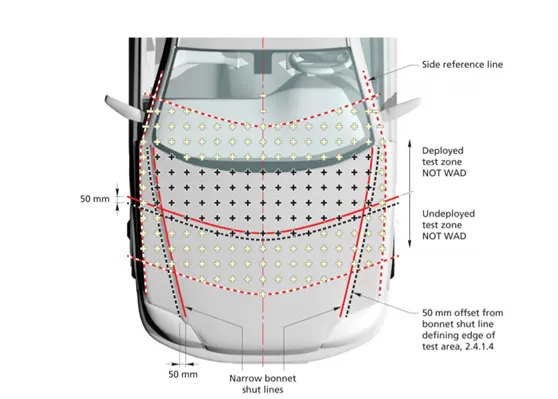
(Both images courtesy to www.euroncap.com)
For occupants safety, frontal crash and side crash analysis must also be carried out. This also includes the checking of functioning of Airbags as well.
CONCLUSION:
Thus in this manner an automotive hood is succesfully designed and modelled, which must be verified by the analysis team, and then manufactured effectively.
Also as a designer we must ensure that all the considerations are considered in the efficient modelling of the part.