DC machine torque speed characteristics.
AIM:- To find out the solution of given questions.
- Implement DC machine torque speed characteristics equations in MATLAB script file. It asks user to input data and plots speed (RPM) versus torque (Nm). Submit the .m file for evaluation and attach the screenshots of all the required plots
- How can you distinguish between power cables and signal cables and also prepare a table where these cables are used in the wiring of an electric vehicle?
- What voltage levels are considered as high & low for a battery pack of electric vehicles?
#ques. 1
A DC machine is an electromechanical energy alteration device. The working principle of a DC machine is when electric current flows through a coil within a magnetic field, and then the magnetic force generates a torque which rotates the dc motor.
The DC machines are classified into two types such as DC generator as well as DC motor.
The main function of the DC generator is to convert mechanical power to DC electrical power, whereas a DC motor converts DC power to mechanical power.
The AC motor is frequently used in the industrial applications for altering electrical energy to mechanical energy. However, a DC motor is applicable where the good speed regulation & ample range of speeds are necessary like in electric-transaction systems.
Dc machine torque speed characteristics:-
DC motors are relatively simple machines: when the load on the motor is constant, speed is proportional to supply voltage. And when supply voltage is constant, speed is inversely proportional to the load on the motor.
This second relationship—between speed and load (or torque)—is typically shown on the motor's torque-speed curve.
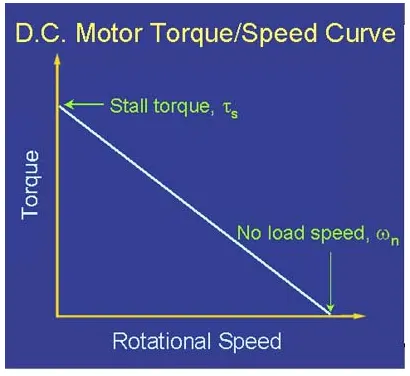
The inverse relationship between speed and torque means that an increase in the load (torque) on the motor will cause a decrease in speed. This can be demonstrated by the DC motor torque equation:
T=((v*k)/R-((k^2/R).*w))
Where: T = motor torque ,v = supply voltage, w = rotational speed k = motor constant R = resistance
code:-
clc
clear all
close all
% angular velocity
w=linspace(0,500,50)
%dc motor constant
k=0.1
%applied voltage to motor
v=24
%resistance
R=0.02
%Torque calculation
T=((v*k)/R-((k^2/R).*w))
%plotting
plot(w,T,'color','r','linewidth',2)
xlabel('w,omega(rad/sec')
ylabel('torque,(Nm)')
Explaination :
Step1:Create operating range rpm of the motor
Step2: Define constants , supply voltage and Resistance
Step3: Using the formula find out torque at all the 50 values of rpm
Step4:Create a plot and label them.
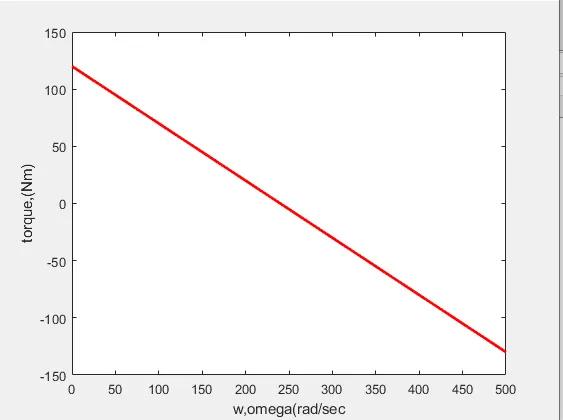
plot:-
ques.2)How can you distinguish between power cables and signal cables in wiring of an electric vehicle?
Power cables :This are the ones which carry electricity Signal cables are low power and current rated wires whereas power cable are high current rated and power.
The main difference between power and control cables is that control cables are plain annealed conductors whereas the power cables are conductors of copper and aluminum. Where power cables are made for transmitting electricity, the control cables act as controlling agents in the different process automation fields.
The range of the control cables goes up to 61 cores, which is rather impressive. The common thing between both the cables is that unlike the other kinds of cables, they tend to provide extremely high levels of conductivity and protection against electricity hazards. Signal cables has to carry 4-20 mA DC current only.
Power cables are thick whereas signal cables are thin sometimes single stranded as power required to transmit information is less.
ques3) What voltage levels are considered as high & low for a battery pack of electric vehicle?
The EV culture is developing distinct philosophies, each satisfying a unique user group.
This is visible with vehicle sizes and the associated batteries.
The subcompact EV comes with a battery that has 12-18kWh, the mid-sized family sedan has a 22-32kWh pack, and the luxury models by Testa stand alone with an oversized battery boasting 60-100kWh to provide extended driving range and achieve high performance.
In terms of carbon footprint, the electricity used to power the EVs would need to come from renewable sources.
Published reports say that emissions from EVs powered by America's electricity grids are higher than those from an efficient ICE.
Table 2 illustrates common EVs.
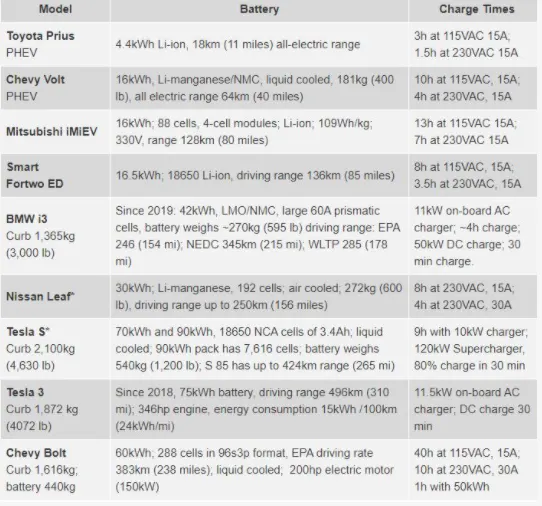
The makers of Nissan Leaf, BMW i3 and other EVs use the proven lithium-manganese (LMO)battery with a NMC blend, packaged in a prismatic cell. (NMC stands for nickel, manganese, cobalt.) Tesla uses NCA (nickel, cobalt, aluminum) in the 18650 cell that delivers an impressive specific energy of 3.4Ah per cell or 248Wh/kg. To protect the delicate Li-ion from over-loading at highway speed, Tesla over-sizes the pack by a magnitude of three to four fold compared to other EVs.The large 90kWh battery of the Tesla S Model (2015) provides an unparalleled driving range of 424km (265 miles), but the battery weighs 540kg (1,200 lb), and this increases the energy consumption to 238Wh/km (380Wh/mile), one of the highest among EVs.
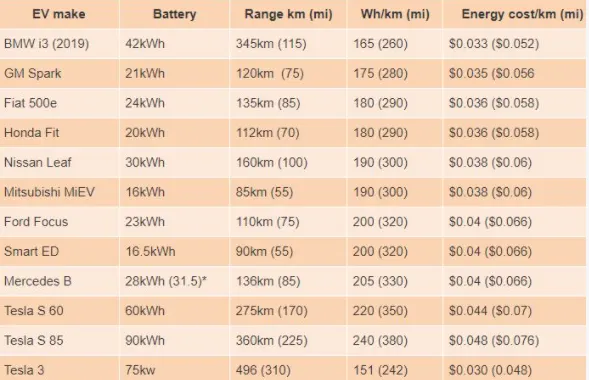
In comparison, the BMW i3 is one of the lightest EVs and has a low energy consumption of 160Wh/km (260Wh/mile). The car uses an LMO/NMC battery that offers a moderate specific energy of 120Wh/kg but is very rugged. The mid-sized 22kWh pack provides a driving range of 130-160km (80-100 miles). To compensate for the shorter range, the i3 offers REX, an optional gasoline engine that is fitted on the back. Table 3 compares the battery size and energy consumption of common EVs. The range is under normal non-optimized driving conditions.
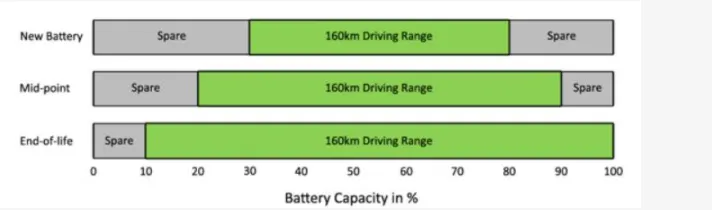
EV makers must further account for capacity fade in a clever and non-alarming way to the motorist. This is solved by oversizing the battery and only showing the driving range. A new battery is typically charged to 80 percent and discharged to 30 percent. As the battery fades, the bandwidth may expand to keep the same driving range. Once the full capacity range is needed, the entire cycle is applied. This will cause stress to the aging battery and shorten the driving ranges visibly. Figure 5 illustrates three SoH ranges of an EV fuel gauge.
The drawbacks of higher voltages include the necessity for higher-voltage-rated components in the entire system. They also prevent the ability to use DC fast-charging stations of a lower voltage without incorporating some type of DC-DC boost converter in the on-board charger. Common nominal pack voltages in current vehicles range from 100V-200V for hybrid/plug-in hybrid vehicles and 400V to 800V and higher for electric-only vehicles. The reason for this is higher voltages allow more power to be transferred with less loss over the same diameter (and mass) of copper cable.