Concept on positioning of Columns
Question 1:
Comment on the layout of the framing plan concerning earthquake resistance in the two horizontal directions, X or Y (dots are columns, and lines depict beams). Look into aspects of symmetry, redundancy, and bi-directional stiffness and flexibility.
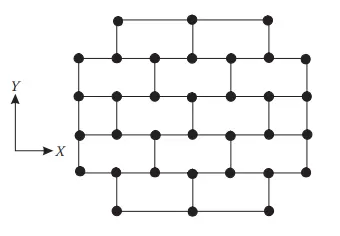
Ans:
Symmetry:
It is observed that the distribution of mass and stiffness across the plan has good symmetrical aspects.
This tends to reduce the horizontal displacements in the two Orthogonal Horizontal Directions.
It also has excellent uniformity.
Redundancy:
There need to be structural elements in the Periphery of the plan. This causes the uneven distribution of earthquake action effects in a nonlinear range across the project.
The energy dissipation across the structure is very low, resulting in a non-a reliable design.
Bi-directional Stiffness:
The building plan may be unable to resist the horizontal seismic actions in the shorter direction (Y-axis). Also, the resistance and stiffness in the more concise guide (Y-axis) are less when compared to the more prolonged exposure (X-axis).
Ductility:
The building may not resist the elastic earthquake forces in a shorter direction (Y-axis). So it may result in an inelastic Response.
The reduction in design force in the shorter direction (Y-axis) is to be compensated by Ductility.
Question 2:
What are the possible sources of irregularity in the building shown here? Could you explain how, as an engineer, each of these irregularities should be dealt with?

Ans:
Procedure:
The possible sources of irregularities are:
- Vertical Irregularities.
- Soft Storey Irregularities.
- Slopy Base Irregularities.
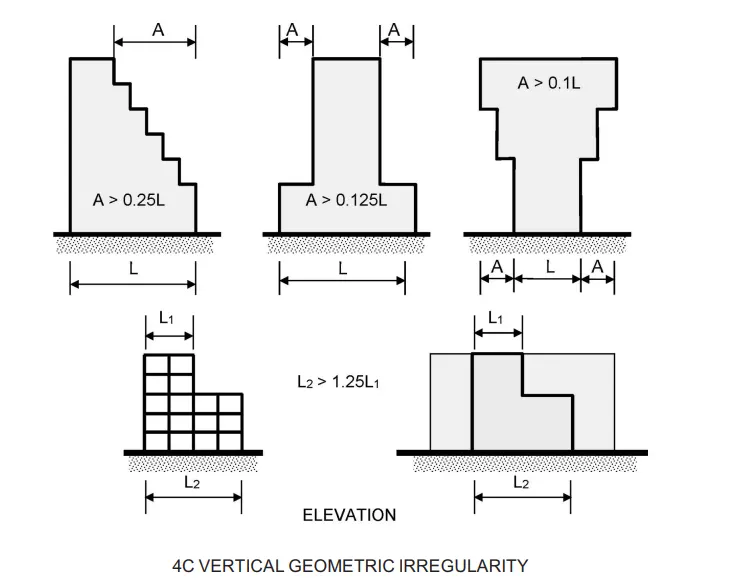
Vertical Irregularity: The building plan area is significant in the bottom stories. The floor plan areas are getting reduced with an increase in height. A structure is said to be irregular when its bottom edge is 25% more than the top edge. Hence, this building is subjected to vertical irregularity. These building offsets must be cross-checked concerning IS-1893:2016 table-6 serial number (iii).
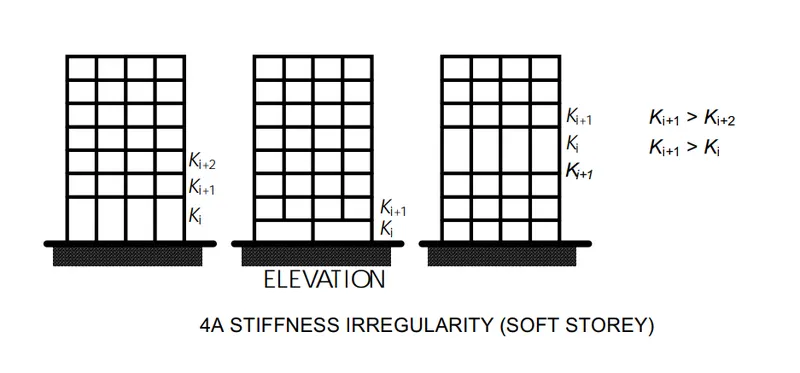
Soft-Storey Irregularities: A Soft story has a lower lateral stiffness than the above story. The building has uncovered opening space on the 6th Floor. No occupancy or a partition wall will lead to plastic hinge formation at the columns (concerning IS 1893:2016 Figure 4A). This has to be checked and sufficiently designed.
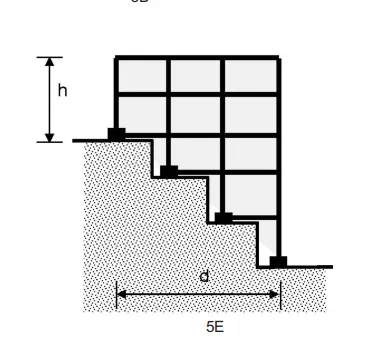
Sloppy Base Irregularities: The building is constructed on sloping ground on one side. This will lead to significant variations in the stiffness (concerning IS-1893:2016 figure 5E). Few levels may be subjected to a soft story mechanism.
Conclusion
Some provisions to avoid irregularities:
The building is torsionally irregular. So the building framing must be revised.
The mass irregularity is avoided by providing lightweight concrete/ Low weight masonry or structures with more wood materials.
The structure should be built in a well-symmetric manner.
The columns provided on the structure should be the same size and height throughout the building.
The weight of the building from the ground floor should decrease towards the top.
Question 3:
A 4-story hotel building has an open ground floor for the restaurant. Story 2 to 4 has one row of rooms along each long side in the plan, separated by a corridor. The two short sides of the perimeter are fully in-filled in all stories, except for specific openings at the corridor's ends at stories 2 to 4 and along the right-hand side of the ground floor. A staircase is near the upper left-hand corner, with straight flights between landings at floor levels and in-between bases. Cross-section dimensions are written next to the member no. in meters.
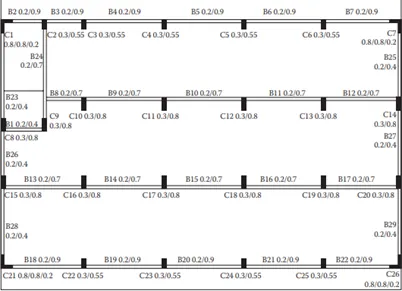
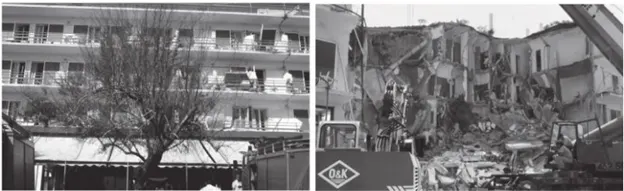
Comment on the structural design features structural design and the layout of infills, which are essential for earthquake resistance and seismic performance. How do they relate to the almost total collapse of this building (the extreme left-hand bay with the staircase survived, one long-side façade in the rear end, and the frame along the right-hand side in the plan)?
Ans:
Aim: To comment on the structural design features and the layout of files essential for earthquake resistance and seismic performance.
Procedure:
- Open Ground Floor: This denotes a soft story mechanism acting in the building.
- Rooms along two bays separated by an open corridor: The bays filled with rooms will have a higher mass than the middle bay left open for the passage. So, the two sides, i.e., the top and bottom portion of the plan, will have heavier mass and hence more stiffness compared to the middle part, which is left unoccupied. This leads to irregularity in the group. The central portion will collapse during earthquake excitation due to lower stiffness, whereas the other two sides may sustain. This includes mass irregularity along height uniformly.
- Two Shorts sides covered with infill walls: The building's left and right sides periphery is stiffer during seismic forces(especially along north-south). Since the lateral force resisting systems, i.e., the walls, are continuous from the foundation, this imparts greater strength and stiffness to the structure in these locations. The left and right edges remain intact after the earthquake excitation.
- Staircase portion at left top corner: Usually, staircase and lift fragments are stiffer than others because of concentrated concrete elements. So the staircase portion stiffness in the provided building plan. There is also redundancy in the staircase portion due to the increased number of columns. This is the reason why the left-hand bay survived after the excitation.
- From the plan, it is clear that there is no beam along the Y direction, i.e., there is no structural member to transfer the load from the floor to the columns. This may cause the floor to become flexible. Due to this, the column will be subjected to irregular loading, increasing the chances of collapse, especially when the direction of an earthquake is along the Y-direction.
Result:
I've commented on the structural design features, and the layout of essential earthquake infills with proper justification.
The structure is not symmetric.
More considerable strength is provided hence low ductility.
In this building, masonry infill walls must be placed appropriately.
In this building, Redundancy in the vertical direction must be provided correctly.