Comparison of different cooling strategies implemented on a Li-ion battery pack and its effect using thermal analysis.
Problem statement:
To perform CFD and thermal analysis on a battery pack. Suggest different cooling strategies (natural air cooling, forced air cooling and liquid cooling) based on simulation results and compare those strategies in other aspects such as cost, feasibility, complexity etc.
Assumptions:
- Consider cell placement arbitrarily. But stick to one kind of placement for all cooling strategies.
- Vehicle operating condition (speed) can be assumed but should be constant for all the cases.
- Assume all the air is directed to the battery pack. There are no bodyworks.
- All other assumptions made should be stated specifically.
CAD model:
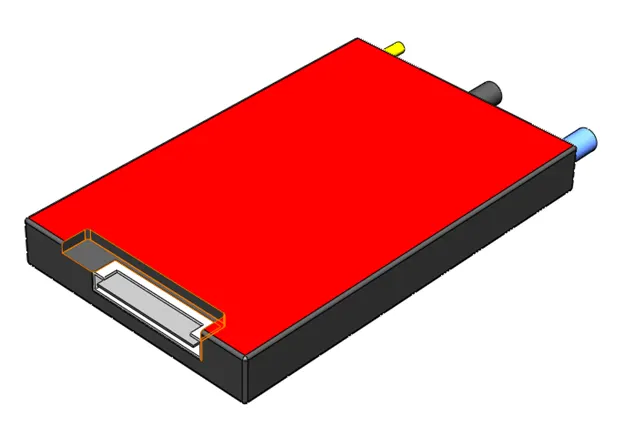
Before performing CFD simulations, an enclosure is prepared around the CAD model. Because of the license limitations, mesh element size is kept at 70mm. Connector side of the battery pack is named as outlet. The side opposite to the connectors is named as inlet. Three types of cooling conditions are simulated in the project.
Information on battery pack:
- 2 battery packs with 48 volts each connected parallelly.
- Battery capacity: 20 Ah each
- Total rated energy: 30 kWh
- Dimensions w*d*h (200*100*400) mm each
- Discharge rate: 1C upto 60 degree Celsius.
Natural air cooling:
Let us consider the velocity of air flow across the battery pack under natural air flow be 7m/s. Temperature of this air flow is considered to be 315K.
The outer wall of the battery pack is assumed to be aluminium. Wall thickness is assumed to be 0.000113m. Optimum working temperature of Li-ion battery packs is approximately from 313K to 323K. Assumed temperature of the battery wall is 350K. Also, heat transfer coefficient is assumed to be 60 W/m^2-K.
K-epsilon model with energy equation is used to solve this model. K-epsilon model is used to analyze the flow of air around the battery pack and the energy equation is used for thermal analysis. Hybrid initialization is used for simulation.
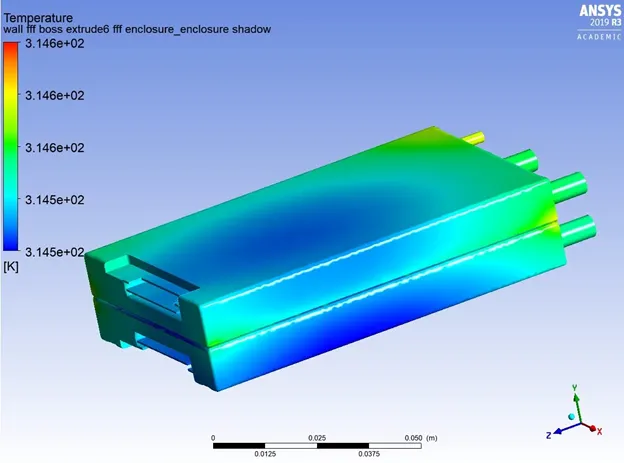
According to the results from the simulations, the temperature of the battery pack wall is reduced to 314K from 350K.
Forced air cooling:
Let us consider the air is forced at a velocity of 20m/s over the battery pack. This will reduce the temperature of the battery pack even further.
All the pre-processing and boundary conditions are kept the same.
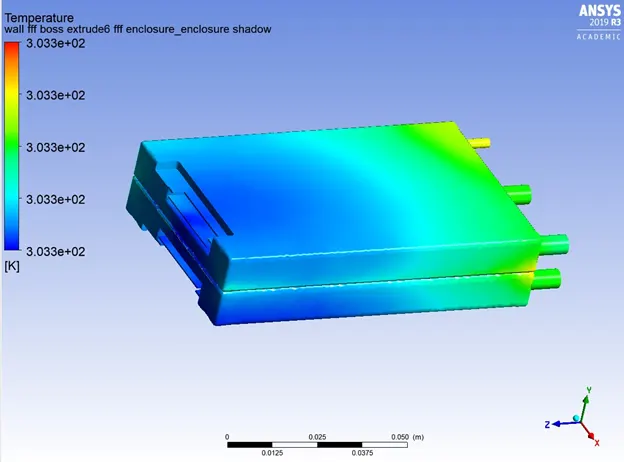
As expected, the temperature of the battery pack is reduced further compared to natural air cooling to 303K.
Liquid cooling:
Let us consider a system of water filled aluminium sheets in between the cells connected with pipes with each other.
For simulations, let us consider the water to be at 298K. For consistency in the thickness of walls, let us consider the thickness of aluminium sheets to be 0.000113m.
In this case, enhanced wall treatment is used in order to obtain the values near the walls especially of the aluminum sheets, as accurately as possible.
All the other pre-processing and boundary conditions are kept same.
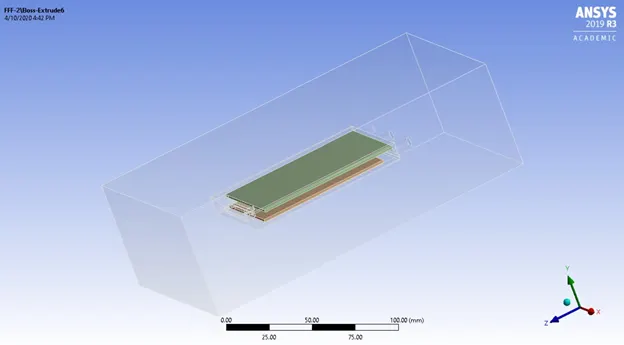
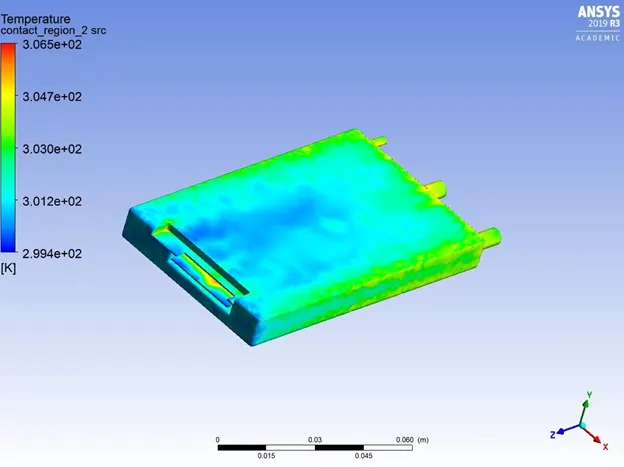
From the results obtained, the lowest temperature of the battery pack achieved is 299K.
Comparison of the three cooling strategies:
According the image shown above, the temperature ranges from 299K to 306K. This difference of 7K is because of the construction of liquid cooling system. By a much more sophisticated system of cooling, this difference can be eradicated and the results could be enhanced further.
According to the results obtained from various cooling strategies, it is clear that liquid cooling the most effective way of cooling system for a Li-ion battery pack. But in case of liquid cooling, it is important to consider the type of liquid being used because using an expensive fluid such as PCM (phase changing material) can make the battery too expensive which will not be feasible.
Forced air cooling is also a viable option in order to reduce the cost of the battery even further. By proper designing of the infuser with a fan at one end could the cheapest option of cooling but might become ineffective as the temperature of the battery pack increases or the surroundings.
Natural air cooling can also work but it will be quite difficult to keep the temperature of the battery within range and even if it is possible to achieve that it will always be on the higher side of the range which will reduce the battery life at a much higher rate.
Hence, liquid cooling using an inexpensive fluid with the required properties might be the way to go. This will spare us to design an infuser with a fan and its placement on the vehicle. Liquid cooled battery might slightly increase the dimensions of the battery and may be a bit complex in nature but that will be much more efficient and feasible compared to other cooling methods.