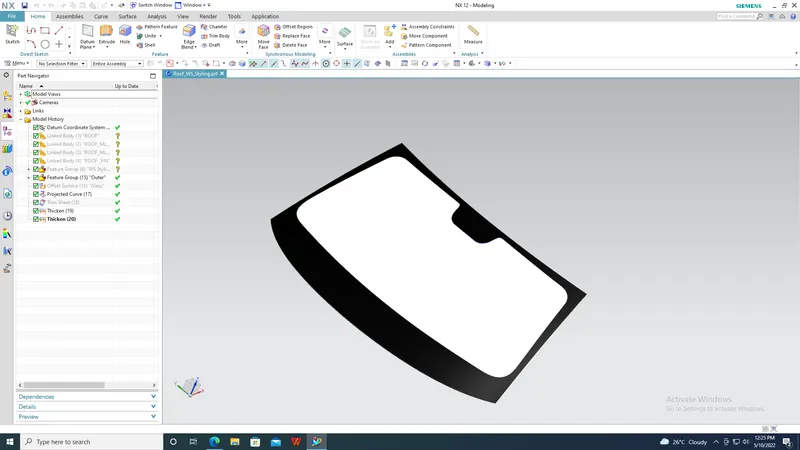
Challenge 4-Windshield Modeling
WINDSHIELD
Windshields protect the vehicle's occupants from wind and flying debris such as dust, insects, and rocks, and provide an aerodynamically formed window towards the front. In 1904 the windshield was invented. The windshield became very important in protecting passengers from outdoor elements, particularly as cars became more powerful and could ravel at faster speeds. The early windshields, unfortunately, were manufactured from glass that shattered upon impact.
Types of windshield glasses:
- Lamination type:
The lamination process begins when two sheets of glass are placed on different sides of a thin sheet of poly-vinyl butyral or PVB. These sheets are bonded to form one piece under heat and pressure. An autoclave heats each component as they are pressed in between rollers. This technique fuses all three layers and makes the layers strong and see-through.
Features:
Laminated glass helps in boosting the fuel efficiency of the car. Since air cooling uses a significant amount of fuel, adopting laminated glass reduces the heating up of the car and minimizing the burden on your vehicle’s cooling system. Recent tests have shown that using laminated glass instead of standard glass helps to lower the temperature by 6-7 degrees celsius. The owner can also choose to use an infrared coating on the glass which further makes it better to park your car in the sun. Reduced workload on air conditioners equals better fuel efficiency.
Another factor of laminated glass that improves fuel consumption is the lightweight of the glass. The demand for lightweight products is increasing every day since it makes the performance of the vehicle better. For every 0.5mm thickness reduction in the windshield, there is a 3kg per meter square reduction in the weight. Thus using laminated glass reduces the overall weight and saves fuel.
Other than this, Laminated glass provides many more benefits. It is strong and proves to be difficult to break, giving safety to the occupants of the car. Due to the ability to hold its pieces when cracked, minimizes the damage and adds to the safety in case of breakage.
Another such advantage of using laminated glass is noise reduction. Keeping the car away from outside noise, traveling by car becomes quieter and more comfortable. People can talk or enjoy the music even better when there is less noise and disturbance.
- Tempered type:
Windshields, on the other hand, are also made from tempered glass by using the tempering technique. In this process, the sheet of glass is heated up to a certain temperature. Then, the glass is cooled rapidly with cold air. This process causes the glass to constantly expand and contract resulting in the outer layer hardening and the inner layer being induced with tension. This tempered glass is used for rear glass replacement or side window replacement. Thickness is from 2 to 3mm and it is much stronger than the laminated glass.
Features:
Once broken, tempered glass cannot be repaired, and the only solution is to replace it. Although each windshield glass has different functions, together, in an accident, they protect you from broken glass. In the case of a rollover, windshields retain the roof’s rigidity while the side airbags protect the passengers within.
Design considerations:
- A windshield consists of two parts
- Gradient lines.
- Windshield glass.
A part of the windshield glass is painted black. This is to hide the electronic wiring and some sensors which are there to assist the driver for rear view etc.
On the rear windshield glass there are lines. These are filaments which act as defoggers on the glass.
- The open type of design is the most recommended type of of shape of a windshield. In the closed type it is necessary that the radius is greater than or equal to 130mm. If the radius at the corners is less than 130mm it becomes hard to work with the glass as it is a brittle material.
- The total thickness of a windshield is around 4.7mm. More the thickness more is the scrap material. The bend radius should also be around 20mm. More is the bend, more will be the scrap material and hence the wastage, because when a bigger windshield is rejected more will the wastage of the material.
Lamination glass production process:
- Marking and cutting: Raw glass is worked upon to make it reach a transparencylevel and is cut to the required shape after marking.
- Edge grinding: Depending on the shape( whether its opened or closed) the edges are ground into shape.
- Printing: Gradient lines are printed.
- Bending: the glass is made malleable in the bending furnace and is bent to not more than 20mm.
- Washing: The glass is washed.
- Assembly: The film made of poly-vinyl butyralis pressed on either side by a glass of thickness 2.3mm. And is trimmed.
- Pressing by vacuum: The three sheets are pressed together and the lamination is done.
- Auto-claving: Here the glass is checked for any bubbles. After this process the part is either considered or rejected.
Tempered glass production process:
Until printing the glass production process for tempered glass is the same as the laminated glass.n After that either of these three processes are used.
New gravity method:
The bending is done by sending the glass into a furnace. In the furnace the glass is heated till 650 deg- 680 deg and is quenched immediately. Vacuum is used in the bending process.
Gashearth process:
In this process, instead of vacuum inert gases are used for bending process.
Press forming process:
Very light dies are used to make the sheet malleable.