Calculation of Stiffness in Structural elements
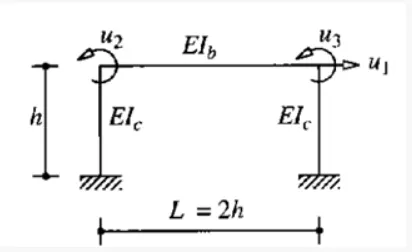
Question 1:Compute lateral stiffness of the one story frame with an intermediate realistic stiffness of the beam. The system has 3 DOFs as shown. Assume L = 2h and Elb = Elc .
Answer.
- In this question first of all we have to determine the stiffness matrix by using the stiffness matrix method of analysis.
- Here we can see that the degree of freedom is 3 hence the stiffness matrix will be in the form of the 3 X 3 matrix form.
- It is given in the above question:
`EIunderset(b)`=`EIunderset(c)`=`EI`
L = 2h
(a) First Case:
where `Uunderset(1)`= 1 `Uunderset(2)`= 0 `Uunderset(3)`= 0
Now the stiffness matrix can be calculated as:
`Uunderset(1)`= `frac{24EIc}{h^3}`
`Uunderset(2)`= `frac{6EIc}{h^2}`
`Uunderset(3)`= `frac{6EIc}{h^2}`
And the equation will become as:
`frac{24EIc}{h^3}+frac{6EIc}{h^2}+frac{6EIc}{h^2}` (Equation 1)
(b) Second case:
where `Uunderset(1)`= 0 `Uunderset(2)`= 1 `Uunderset(3)`= 0
`Uunderset(1)`= `frac{6EIc}{h^2}`
`Uunderset(2)`= `frac{4EIb}{2h}+frac{4EIc}{h}`
`Uunderset(3)`= `frac{2EIb}{2h}`
And the equation will become as:
`frac{6EIc}{h^2}+frac{4EIb}{2h}+frac{4EIc}{h}+frac{2EIb}{2h}` (Equation 2)
(c) Third case:
where `Uunderset(1)`= 0 `Uunderset(2)`= 0 `Uunderset(3)`= 1
`Uunderset(1)`= `frac{6EIc}{h^2}`
`Uunderset(2)`= `frac{2EIb}{2h}`
`Uunderset(3)`= `frac{4EIb}{2h}+frac{4EIc}{h}`
Now the equation will become as:
`frac{6EIc}{h^2}`+ `frac{2EIb}{2h}`+ `frac{4EIb}{2h}+frac{4EIc}{h}` (Equation 3)
Now solve the equation 1,equation 2 and equation 3,then we will get the below equation:
`frac{EIc}{h^3}``[[24,6h,6h],[6h,6h^2,h^2],[6h,h^2,6h^2]] [[U1],[U2],[U3]]=[[fs],[0],[0]]` (Equation 4)
And according to the stiffness matrix method,equation 1 and equation 2 can be expressed in terms of the lateral displacement as given below:
`[[U2],[U3]]-[[6h^2,h^2],[h^2,6h^2]]^-1 [[6h],[6h]]U1`
Now solve this above equation:
= `-(frac{1}{36h^4-h^4)) [[h^2,h^2],[h^2,-6h^2]]6h[[1],[1]]U1`
= `-frac{6h}{35h^4}[[6h^2,-h^2],[h^2,6h^2]]((1),(1))U1`
= `frac{6h}{35h^4}[[5h^2],[5h^2]]U1`
`-frac{6h}{35h^4}xx5h^2[[1],[1]]U1=((U2),(U3))`
`((U2),(U3))=-frac{6}{7h}((1),(1))U1` (Equation 5)
Now from equation 1 we will get:
`fs=frac{EIc}{h^3}(24U1+6hU2+6hU3)` (Equation 6)
Now substitute the value of equation 5 in equation 6,then we will get:
`fs=(frac{24EIc}{h^3}-frac{6}{7}frac{EIc}{h^3}(6h+6h)[[1],[1]])U1`
`fs=(frac{24EIc}{h^3}-frac{6}{7h}frac{EIc}{h^3}xx(12h))U1`
`fs= (frac{EIc}{h^3}(24)(-frac{6}{7h})xx(12h))U1`
`fs=frac{EIc}{h^3}(24-frac{72}{7})U1`
`fs=frac{EIc}{h^3}(frac{168-72}{7})U1`
`fs=frac{EIc}{h^3}(frac{96}{7})U1`
`fs=frac{96}{7}(frac{EIc}{h^3})`
Question 2: For the following structures:
- Determine the number of degrees-of-freedom for dynamic analysis.
- Establish the equation of motion.
- Calculate their natural frequencies.
(a)
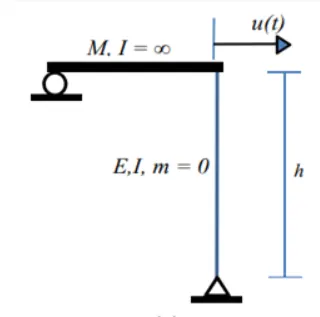
- Determine the number of degrees of freedom for dynamic analysis:
Degree of freedom = 2+1
= 3.
- Establish the Equation of motion:
Equation of motion:
mu + ku = 0 (Equation 1)
Whereas,the stiffness of this frame is:
K = `frac{3EI}{h^3}` (Equation 2)
Now put the value of equation 2 in equation 1:
Equation 1: mu + ku = 0
mu + `frac{3EI}{h^3}` u = 0.
- Calculate their natural frequency (fn) :
fn = `frac{1}{Tn}` (Equation 3)
Tn = `frac{2pi}{omega n` (Equation 4)
Therefore; `omega n`=`root`K/m (Equation 5)
Now put the value of equation K in equation 5,then the equation 5 will become as:
`omega n`= `root`(3EI/h^3)/m
= `root`(3EI/mh^3) (Equation 6)
Again put the equation 6 in equation 4 then we will get:
Therefore; Tn = `frac{2pi}{omega n}`
Tn = `frac{2pi}{sqrt 3EI}/{sqrt mh^3}`
Tn = `frac{2pi sqrt mh^3}{sqrt 3EI`
Tn = `frac{2pi sqrt mh^3}{sqrt 3EI` (Equation 7)
Now to get the natural frequency fn put the value of equation 7 in equation 3:
fn = `frac{1}{Tn}`
fn = `frac{1(sqrt 3EI)}{2pi sqrt mh^3}`
`therefore` fn = `frac{3EI}{2 pi sqrt mh^3`
(b)
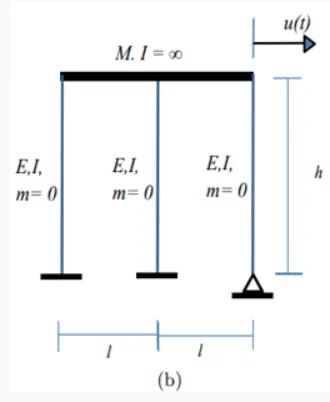
- Determine the number of degrees of freedom for dynamic analysis:
Degree of freedom = 0 + 0 + 1
= 1.
- Establish the Equation of motion:
Equation of motion:
mu + ku = 0 (Equation 1)
Whereas,the stiffness matrix of this frame is:
K = `frac{12EI}{h^3} + frac{12EI}{h^3}+frac{3EI}{h^3}`
K = `frac{ (12+12+3) EI}{h^3}`
`therefore` K = `frac{27EI}{h^3}` (Equation 2)
Now substitute the value of K in equation 1,then we will get the below equation:
mu + ku = 0
`therefore` mu + `frac{27EI}{h^3}`u = 0.
- Calculate their natural frequency (fn) :
fn = `frac{1}{Tn}` (Equation 3)
Tn = `frac{2pi}{omega n}` (Equation 4)
`omega n`= `frac{sqrt K}{sqrt m}` (Equation 5)
Now substitute the value of K in equation 5, then we will get the below equation:
`omega n = frac{sqrt 27EI}{sqrt mh^3}` (Equation 6)
Put the value of `omega n`in equation 4,we will get the below equation:
`therefore` `Tn=frac{2pi}{omegan}`
`Tn=frac{2pi sqrtmh^3}{27EI}` (Equation 7)
So in order to get the natural frequency,put the value of Tn in equation 3,the we will get the below equation:
fn = `frac{1}{Tn}`
`therefore` `fn=frac{27EI}{2pi sqrt mh^3`
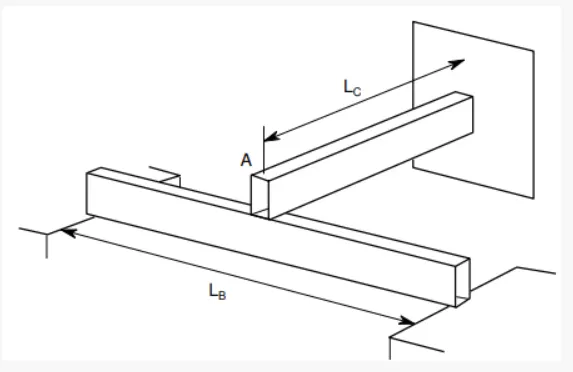
Question 3:Consider the propped cantilever shown in the figure below. The beams are made from the same steel section and have lengths as shown on the diagram. Determine the natural period of this system if a large mass, M, is placed at the intersection of the beams at point A. The weight of the beams in comparison with the mass M is very small.
Answer.
- In this question there are two beams that are connected with each other.
- One beam is the canteliver beam while the other beam is the simply supported beam as we can see in the above image.
`therefore` For the simply supported beam:
Lateral stiffness, `K=frac{48EI}{L^3}` (Equation 1)
`therefore` For the cantilever beam:
Lateral stiffness `K=frac{3EI}{L^3}` (Equation 2)
Now add both the equations i.e, equation 1 and equation 2, then the equation becomes as the below equation:
`K=frac{48EI}{L^3}+frac{3EI}{L^3}`
= `frac{(48+3)EI}{L^3}`
`K=frac{51EI}{L^3}` (Equation 3)
- Natural Period of Vibration (Tn):
`Tn=frac{2pi}{omega n}` (Equation 4)
`omega n=frac{sqrt K}{sqrt m}` (Equation 5)
Now put the value of K in the equation 5,then we will get another equation as given below:
`omega n=frac{(sqrt 51EI)/L^3}{sqrt m}`
`omega n= frac{sqrt 51EI}{sqrt mL^3}` (Equation 6}
Now put the value of equation 6 in equation 4,we will get the below equation:
`Tn=frac{2pi}{omega n}`
`Tn= frac{2pi sqrt(mL^3)}{sqrt51EI}`
Question.4 Determine an expression for the effective stiffness of the following systems.
Answer.
(a)
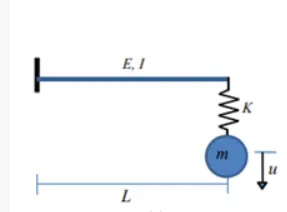
The stiffness coefficient of the beam is:
`frac{3EI}{L^3}`
The spring coefficient of the spring is K.
Here,the stiffness elements are in series, so
`frac{1}{Ke}=frac{L^3}{3EI}+frac{1}{K}`
`frac{1}{Ke}=frac{LK^3+3EI}{3EIK}`
`Ke=frac{3EIK}{KL^3+3EI}`
`therefore` An expression for the effective stiffness for this system is:
`Ke=frac{3EIK}{KL^3+3EI}`
(b)
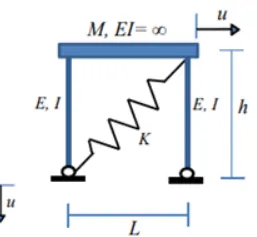
In the above question we can clearly see that there are three components that are connected with mass(m),there are2 columns i.e, K1 and K2 and one is spring i.e,K3.
- And these three members are connected in parallel form.
Therefore,the effective stiffness equation will be given as:
`Keff= K1+K2+K3`
As K1 and k2 are columns therefore:
K1 = K2 = `frac{12EI}{h^3}`
and K3 = K
So the equation for the effective stiffness will be given as:
`Keff=K1+K2+K3`
`Keff=frac{12EI}{h^3}+frac{12EI}{h^3}+K`
`Keff=frac{24EI}{h^3}+K`
`therefore` `Keff= frac{24EI+Kh^3}{h^3}`
(c)
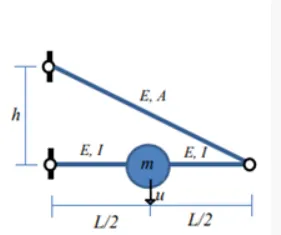
- In the above image we can see that there are two components that are connected to the mass (m),one is beam with the flexural rigidity and the other is the beam with the axial rigidity i.e K1 and K2.
- And these are connected parallel.
- Because they are connected parallel then the equation will become as:
`Kunderset(eff)`=`K1+K2`
whereas; `K1=frac{48EI}{L^3}`
and; `K2=frac{AE}{sqrtL^2+sqrth^2}`
`therefore` `Kunderset(eff)`= `frac{48EI}{L^3}+frac{AE}{sqrtL^2+sqrth^2}`