Bird Strike - Project - 2
AIM:
To simulate the non-linear transient birdstrike simulation where the bird tries to hit the has turbine blade.
THEORY:
Bird strike is common and can be significant thread to aircraft saftey. For smaller aircraft, significant damage may be caused to the aircraft structure and all aircraft, jet engined ones are vulnerable to the loss of thrust which can follow the ingestion of birds into the engine air intakes.
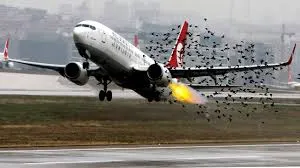
The nature of the aircraft damage form bird strikes which is significant enough to create a high risk to continued safe flight differs according to the size of the aircraft. Small propeller driven aircraft are most likely to experience the hazardous effects of strikes as structural damage such as the penetration of flight deck windscreens or damage to the control surface.
Large jet engined aircraft are most likely to experience the hazardous effects of strikes as the consequences of engine ingestion. Partial or complete loss of control may be secondary result of either small aircraft structural impact or large aircraft jet engine ingestion. Loss of flight instrument function can be caused by impact effects on the pilot static system air intakes which can cause dependent instrument reading to become erroneous.
Bird strikes happen most often during takeoff or landing, or during low altitude flight. However, bird strikes have also been reported at high altitudes, some as high as 6,000 to 9,000 m (20,000 to 30,000 ft) above the ground. Bar-headed geese have been seen flying as high as 10,175 m (33,383 ft) above sea level. An aircraft over the Ivory Coast collided with a Rüppell's vulture at the altitude of 11,300 m (37,100 ft), the current record avian height. The majority of bird collisions occur near or at airports (90%, according to the ICAO) during takeoff, landing and associated phases. According to the FAA wildlife hazard management manual for 2005, less than 8% of strikes occur above 900 m (3,000 ft) and 61% occur at less than 30 m (98 ft).
The point of impact is usually any forward-facing edge of the vehicle such as a wing leading edge, nose cone, jet engine cowling or engine inlet.
Jet engine ingestion is extremely serious due to the rotation speed of the engine fan and engine design. As the bird strikes a fan blade, that blade can be displaced into another blade and so forth, causing a cascading failure. Jet engines are particularly vulnerable during the takeoff phase when the engine is turning at a very high speed and the plane is at a low altitude where birds are more commonly found.
The force of the impact on an aircraft depends on the weight of the animal and the speed difference and direction at the point of impact. The energy of the impact increases with the square of the speed difference. High-speed impacts, as with jet aircraft, can cause considerable damage and even catastrophic failure to the vehicle. The energy of a 5 kg (11 lb) bird moving at a relative velocity of 275 km/h (171 mph) approximately equals the energy of a 100 kg (220 lb) weight dropped from a height of 15 metres (49 ft).However, according to the FAA only 15% of strikes (ICAO 11%) actually result in damage to the aircraft.
Bird strikes can damage vehicle components, or injure passengers. Flocks of birds are especially dangerous and can lead to multiple strikes, with corresponding damage. Depending on the damage, aircraft at low altitudes or during take-off and landing often cannot recover in time.US Airways Flight 1549 is a classic example of this. The engines on the Airbus A320 used on that flight were torn apart by multiple bird strikes at low altitude. There was no time to make a safe landing at an airport, forcing a water landing in the Hudson River.
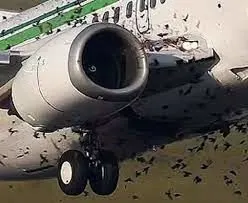
Remains of the bird, termed snarge,are sent to identification centers where forensic techniques may be used to identify the species involved. These samples need to be taken carefully by trained personnel to ensure proper analysis and reduce the risks of infection.
The largest numbers of strikes happen during the spring and fall migrations. Bird strikes above 500 feet (150 m) altitude are about 7 times more common at night than during the day during the bird migration season.
Large land animals, such as deer, can also be a problem to aircraft during takeoff and landing. Between 1990 and 2013, civil aircraft experienced more than 1,000 collisions with deer and 440 with coyote.
PROCEDURE:
Part Creation:
1.Open the Bird strike keyword file and import in LS-DYNA.
2.The keyword contains Engine Casing, Blades, Hub and Bird.
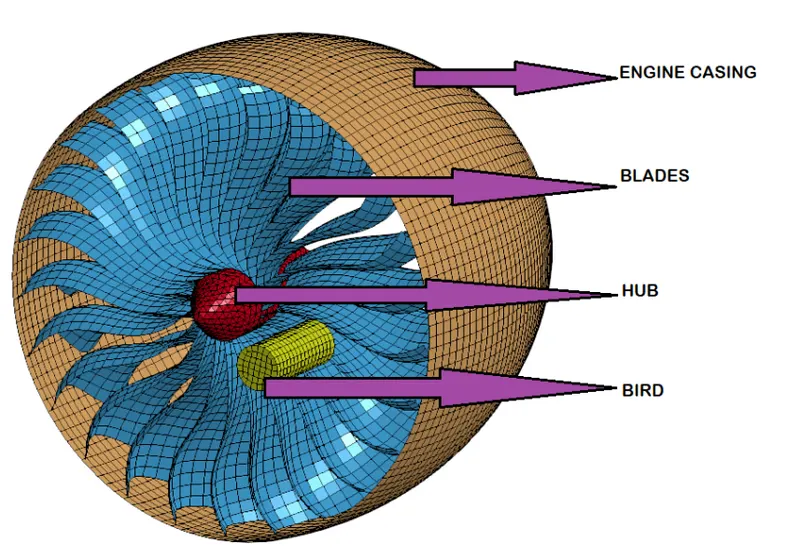
3.A new keyword is created individually for each parts.
Material And Section Creation:
Birds Material:
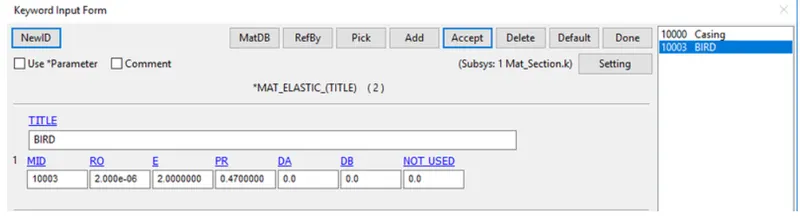
1.Material and section is created for assiging to the parts created with the unit system KG, mm, ms.
2.As the bird is a soft material a density of 2.0e-06 kg/mm^3 is assigned.
3.Youngs modulus of the Bird is given as 2Gpa and poisson's ration as 0.47.
Engine Casing:
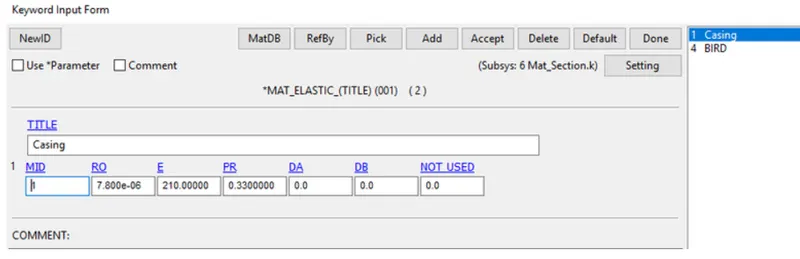
1.For engine casing Mat elastic card is assigned with properties of steel.
Engine Blades:
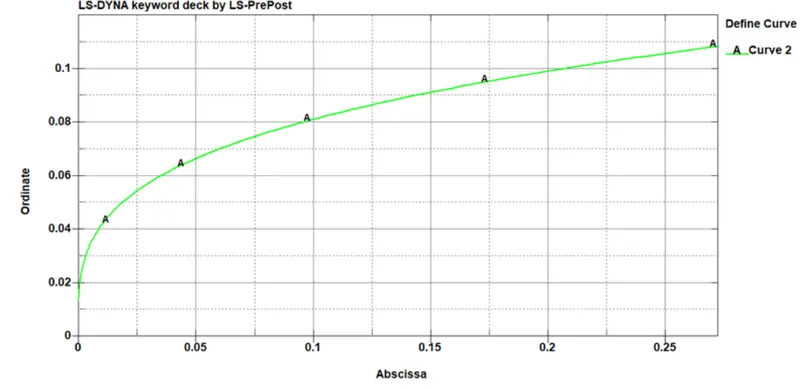
1.For engine blades MAT24 piecewise linear plasticity is assigned with properties of aluminium 9945 an dload curve is assigned for the plastic strain behaviour.
Hub:
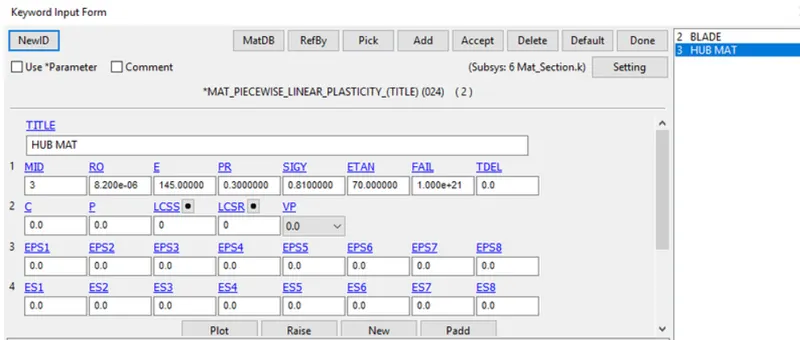
1.For the hub MAT24 piecewise linear plasticity is assigned with the properties of steel.
Section Creation:
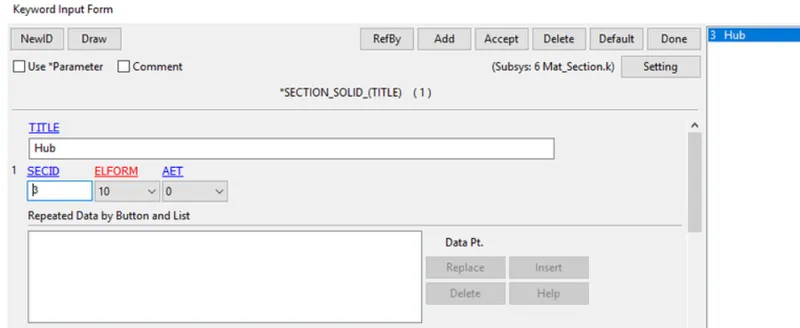
1.The hub is modeled with the solid elements the section solid_card is assigned with ELFORM=10.
2.Engine casing, bird and blades are modelled with shell elements so section_ shell card is assigned with respective thickness of each.
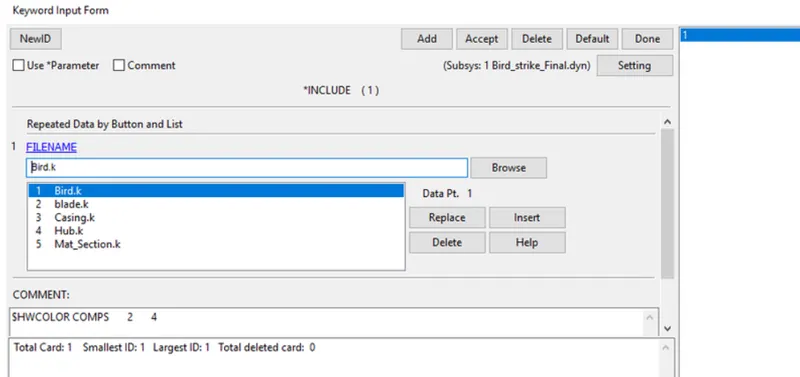
3.The part keywords and the material and section keywords are included into the single keyboard using include > include opiton.
Contact Creation:
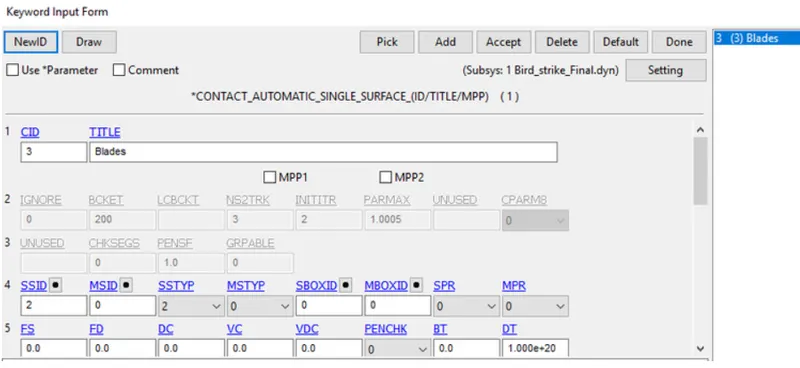
1.After the impact there is a wide chance of blades getting broken and collide with each other for that case automatic single surface card is assigned considering blades as slave and master.
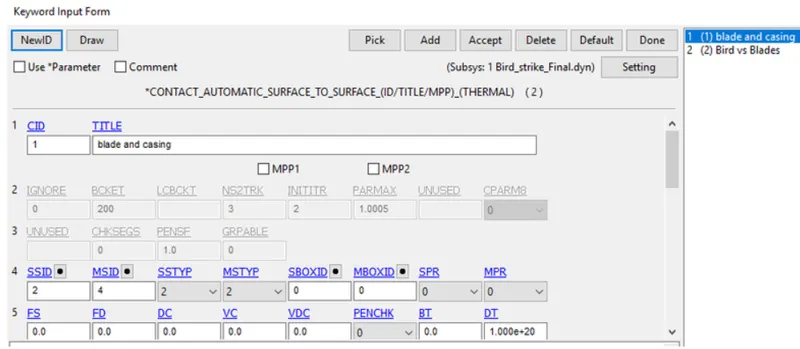
2.During the case of impact the blades might get broken and chances of hitting the case for this automatic surfact to surface contact is assigned as casing as master and the blades as slave.
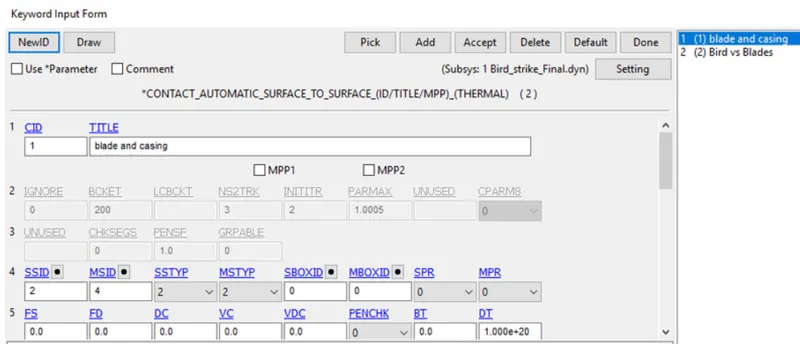
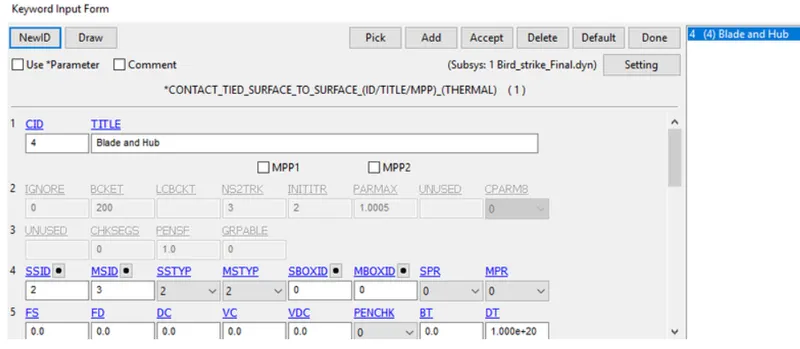
3.As the hub is modeled with solid elements and the blades are modelled with shell elements it is tied to each other with the tied surface to surface contact as hub as master and blades as slave.
BOUNDARY CONDITIONS:
Initial Velocity:
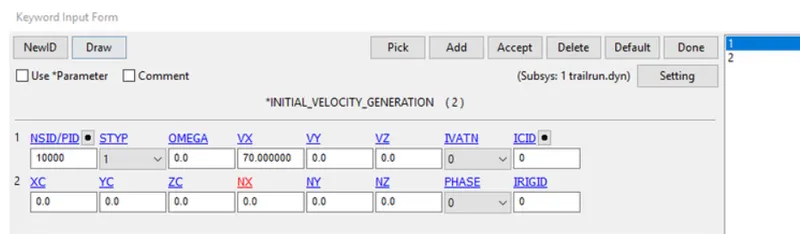
1.The average velocity in which bird travels is taken from the outside sources and it is found to approximatley from 20 to 80 mm/ms which may varies according to the bird's weight.
2.As the weight of the bird here is around 9.126e-06 Kg which is very less so the minimum velocity is assigned to the bird as 70mm/ms along X-axis.
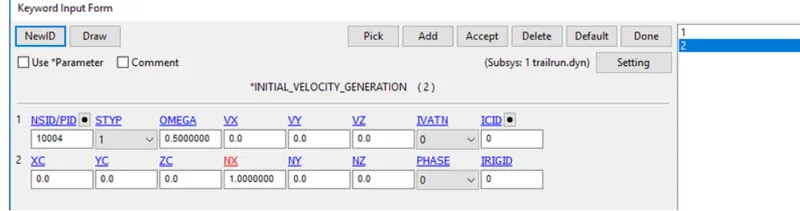
3.For the blades and hub angular velocity must be defined.
4.The average speed of an aircraft turbine is around 3000 to 20,000 rpm.
5.The rpm is considered as 5000 which is 0.5rad/ms.
6.The angular velocity is given as 0.2rad/ms in the case along X direction.
SPC:
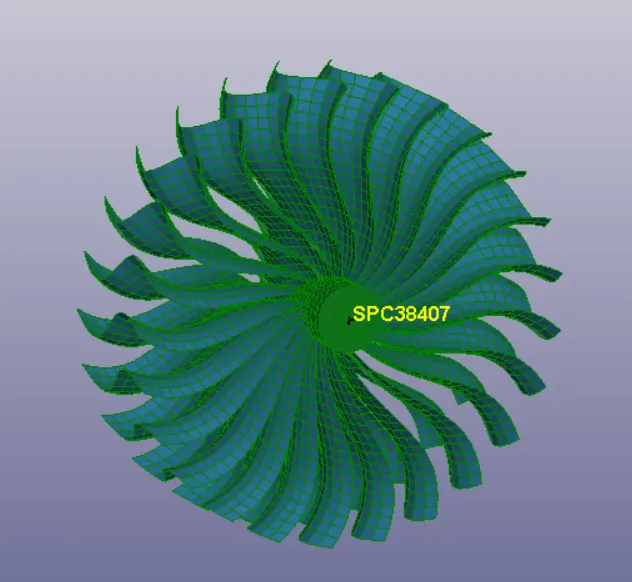
1.The casing is constrained in all axis as it should remain unmoved during the time of impact.
2.The blades and the hub should be unmoved at the time of impact so the corners of the blades and centre point of the hub is constrained in X-axis.
Boundary Prescribed Motion:
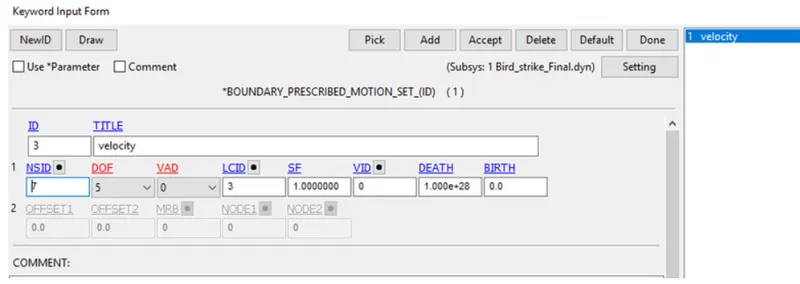
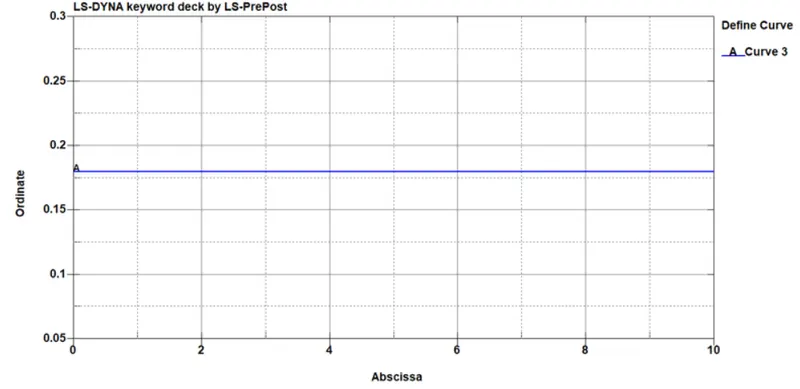
1.The time of bird impacting on the blades the velocity of the blades might get reduced which is against real time sceanrio so prescribed motion is assigned to the hub and the blade to maintain a constant velocity throughtout the simulation.
Renumbering ID's:
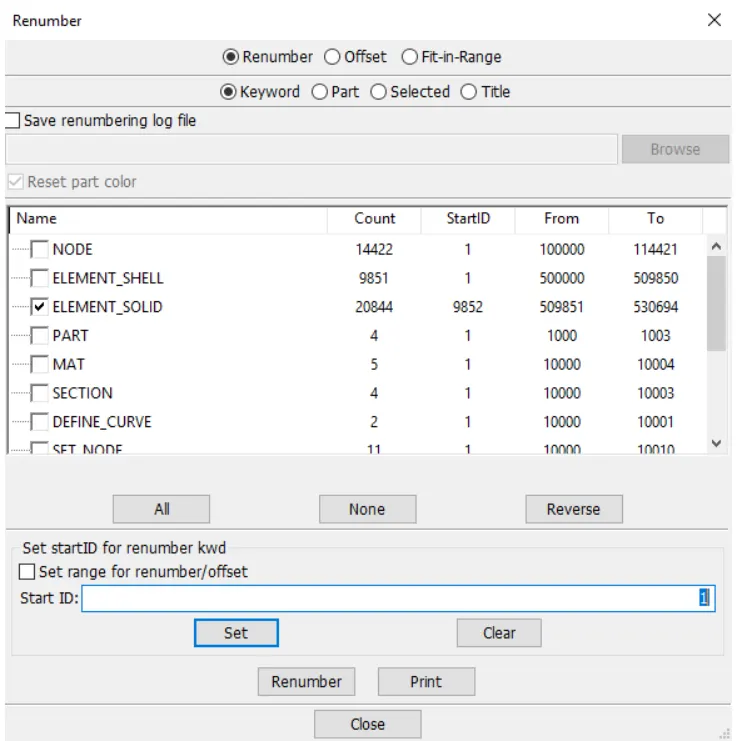
1. Each part of the model setup is opend individually and their node, element and part ID's are renumbered accordingly in such a way that 100,000+ nodes 50,000+ for elements and 1000+ for the parts.
2.This methods follows a consistent numbering approach which is used commonly in industries that deal with complex projects.
Control Cards:
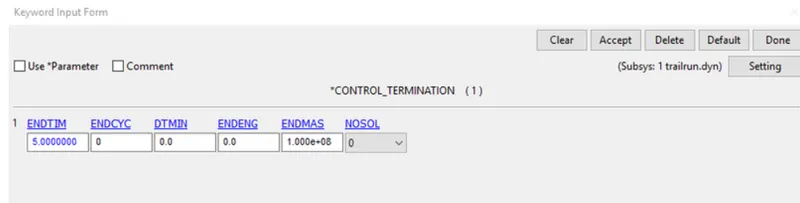
1.Run time of the simulation is set to 10ms using control termination card.
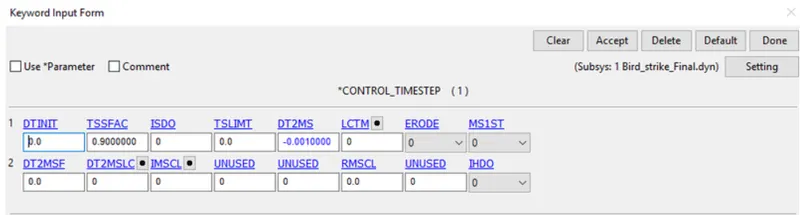
2.For performing the simulation faster control time step card is assigned with a random mass scaling value.
OUTPUT:
1.Check the model using model checker for any errors and save the keyword.
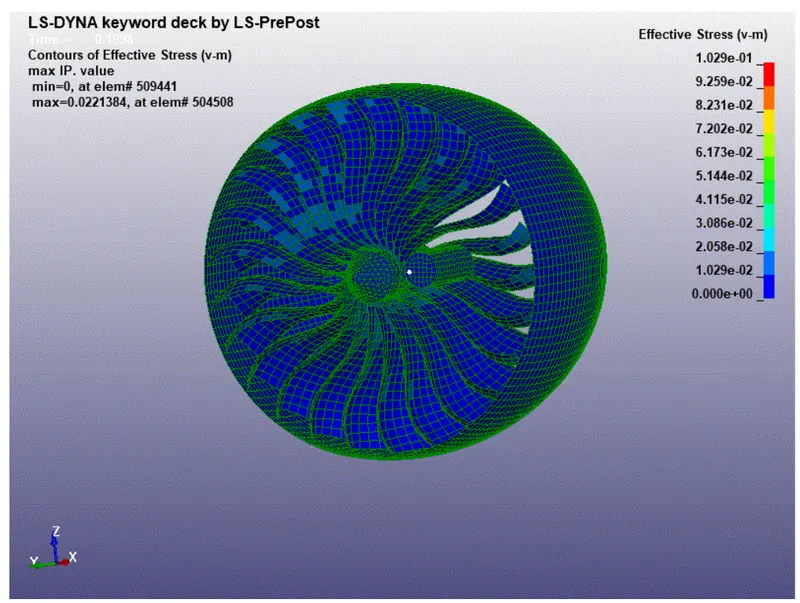
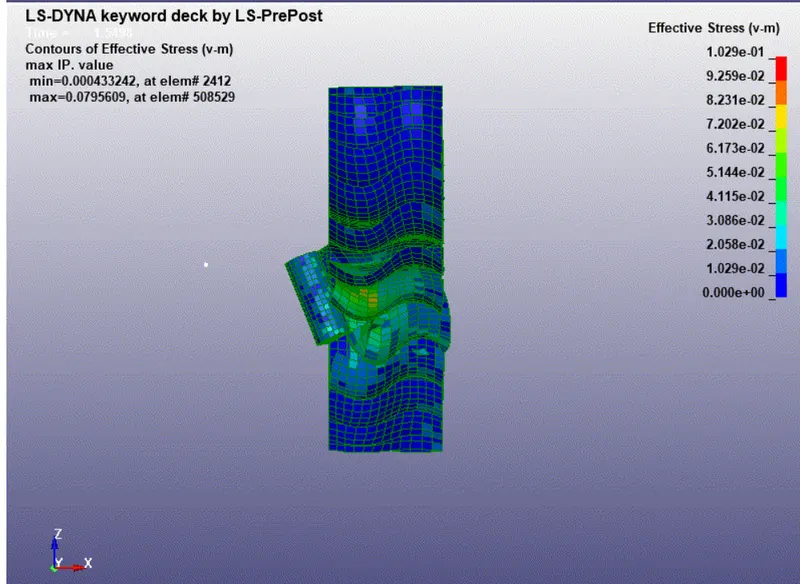
1.As the thickness of the bird is given as 5mm and the thickness of the blade is 2mm it seen that the bird hitting the blade and it is getting broken due to impact of the bird velocity.
2.Due to the imposed velocity given the blade does'nt stop after impacting.
3.Due to the centrifugal force the bird initially pulled slightly inwards and moved away later.
4.The maximum stress acted during the impact is 0.102GPa.
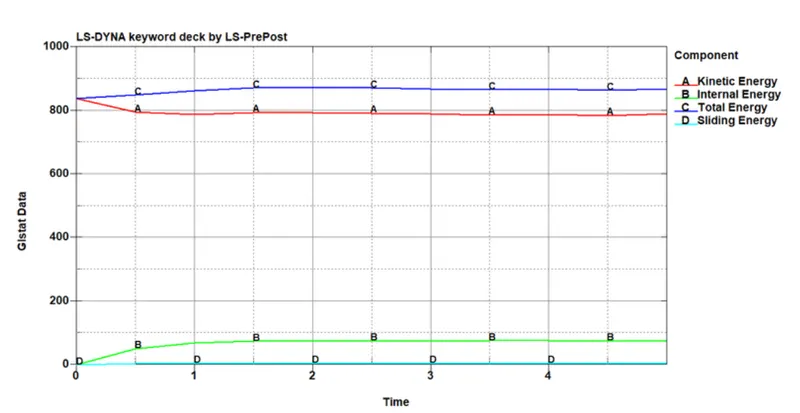
1. From the graph, we can see that bird impacts which is in the form of kinetic energy, the blade gets deforms.
2.The internal energy of the system starts acting in the opposite direction to the kinetic energy. So, it is in the law of conservation of Energy.
3. The total energy of the system remains in linear mode throughout the impact.
Component-1003 Bird:
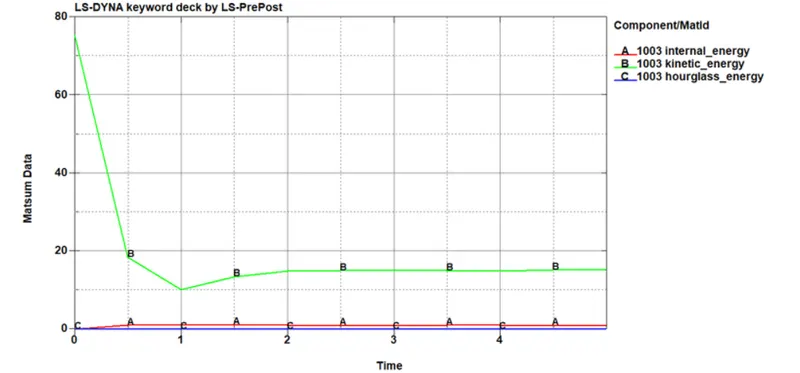
1.The kinetic energy of the bird is decreasing at time of impact and remains constant after 2ms. As the bird is less in size and mass the internal energy produced by the bird is very less.
Component-1001 Blades: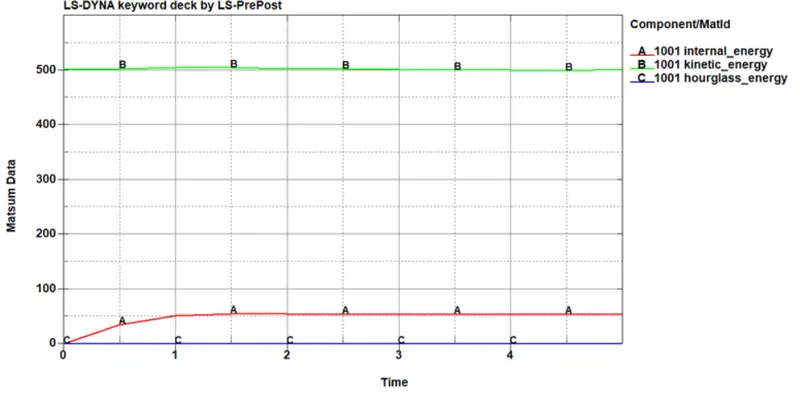
1.The kinetic energy of the blade remains constant because the imposed velocity given to it. The internal energy produced by the blades are sufficient to its properties and comparitively acceptable with the internal energy of the bird.
Contact Energies:
1.The contact automatic surface to surface is used between the blades and birds considering blades as maseter and bird as slave.
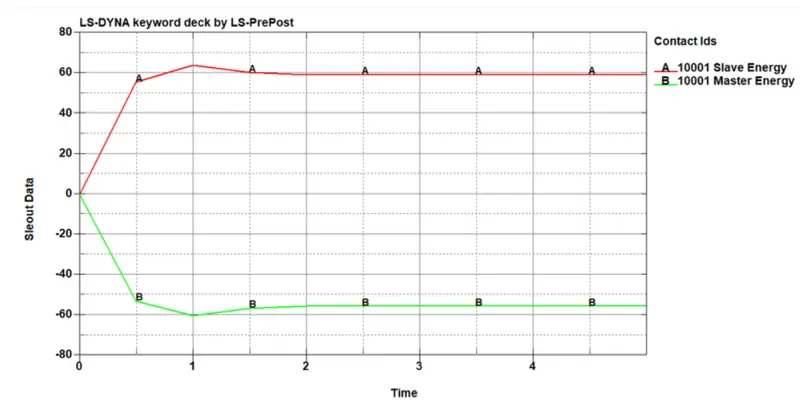
1.The energies produced by the same are equally distributed.
Note:
1.The bird is assigned with elastic material and with general propoerties thus the results obtained form the simulation can not be compared with the realtime data.
2.Generally the bird is modelled with smooth particle hydrodynamics(SPH) which the simulation similar to the real bird.
3.From the simulaiton it is evident that the computional methodlogy can be used for certification.
4.Different types of bird model can be used and the results can be compared with the original data.
5.For getting exact replicate of original data different computational methods can be used along with SPH.
6.The material properties might vary accroding to the blades used by different organizations and it can be solved and results can be compared.
RESULT:
Thus the non-linear transient birdstrike simulation where the bird tries to hit the has turbine blade is performed sucessfully.