Benchmarking
BENCHMARKING :
Benchmarking is the practice of comparing business processes and performance metrics to industry bests and best practices from other companies. Dimensions typically measured are quality, time and cost.Benchmarking is used to measure performance using a specific indicator (cost per unit of measure, productivity per unit of measure, cycle time of x per unit of measure or defects per unit of measure) resulting in a metric of performance that is then compared to others.
Also referred to as "best practice benchmarking" or "process benchmarking", this process is used in management in which organizations evaluate various aspects of their processes in relation to best-practice companies' processes, usually within a peer group defined for the purposes of comparison. This then allows organizations to develop plans on how to make improvements or adapt specific best practices, usually with the aim of increasing some aspect of performance. Benchmarking may be a one-off event, but is often treated as a continuous process in which organizations continually seek to improve their practices.
In 2008, a comprehensive survey on benchmarking was commissioned by The Global Benchmarking Network, a network of benchmarking centres representing 22 countries.
- Mission and Vision Statements and Customer (Client) Surveys are the most used (by 77% of organizations) of 20 improvement tools, followed by SWOT analysis (strengths, weaknesses, opportunities, and threats) (72%), and Informal Benchmarking (68%). Performance Benchmarking was used by 49% and Best Practice Benchmarking by 39%.
- The tools that are likely to increase in popularity the most over the next three years are Performance Benchmarking, Informal Benchmarking, SWOT, and Best Practice Benchmarking. Over 60% of organizations that are not currently using these tools indicated they are likely to use them in the next three years. Benchmarking mainly depends on SWOT analysis and will also be using in future for almost 4-5 years.
PROCEDURE FOR BENCHMARKING :
There is no single benchmarking process that has been universally adopted. The wide appeal and acceptance of benchmarking has led to the emergence of benchmarking methodologies. One seminal book is Boxwell's Benchmarking for Competitive Advantage (1994).The first book on benchmarking, written and published by Kaiser Associates,is a practical guide and offers a seven-step approach. Robert Camp (who wrote one of the earliest books on benchmarking in 1989)developed a 12-stage approach to benchmarking.
The 12 stages of benchmaking process/methodology consists of:
- Select subject
- Define the process
- Identify potential partners
- Identify data sources
- Collect data and select all partners
- Determine the gap
- Establish process differences
- Target future performance
- Communicate
- Adjust goal
- Implement
- Review and recalibrate
The following is an example of a typical benchmarking methodology:
Identify problem areas: Because benchmarking can be applied to any business process or function, a range of research techniques may be required. They include informal conversations with customers, employees, or suppliers; exploratory research techniques such as focus groups; or in-depth marketing research, quantitative research, surveys, questionnaires, re-engineering analysis, process mapping, quality control variance reports, financial ratio analysis, or simply reviewing cycle times or other performance indicators. Before embarking on comparison with other organizations it is essential to know the organization's function and processes; base lining performance provides a point against which improvement effort can be measured.
Identify other industries that have similar processes: For instance, if one were interested in improving hand-offs in addiction treatment one would identify other fields that also have hand-off challenges. These could include air traffic control, cell phone switching between towers, transfer of patients from surgery to recovery rooms.
Identify organizations that are leaders in these areas: Look for the very best in any industry and in any country. Consult customers, suppliers, financial analysts, trade associations, and magazines to determine which companies are worthy of study.
Survey companies for measures and practices: Companies target specific business processes using detailed surveys of measures and practices used to identify business process alternatives and leading companies. Surveys are typically masked to protect confidential data by neutral associations and consultants.
Visit the "best practice" companies to identify leading edge practices: Companies typically agree to mutually exchange information beneficial to all parties in a benchmarking group and share the results within the group.
Implement new and improved business practices: Take the leading edge practices and develop implementation plans which include identification of specific opportunities, funding the project and selling the ideas to the organization for the purpose of gaining demonstrated value from the process.
TYPES OF BENCHMARKING PROCESSES :
Process benchmarking,Financial benchmarking,Benchmarking in the public sector,Performance benchmarking,Technical/Product benchmarking,Strategic benchmarking,Functional benchmarking,Best-in-class benchmarking,Operational benchmarking,Energy benchmarking,Metric benchmarking.
LIST OF VEHICLES FOR COMPARISON:
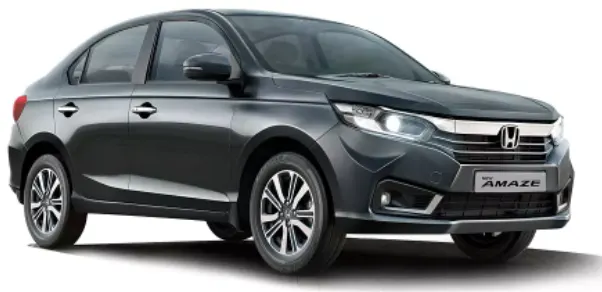
1. HONDA AMAZE: Honda Amaze(Compact Sedan) VX MT 1.2 Petrol is the petrol variant in the Amaze lineup,which has a 5 seater capacity and is priced at ₹ 8.36 Lakh(Manual Transmission) and ₹ 9.19 Lakh(CVT).It returns a certified mileage of 18.6 kmpl(Manual) and 18.3 kmpl(CVT). This VX MT 1.2 Petrol variant comes with an engine putting out 90 bhp @ 6000 rpm and 110 Nm @ 4800 rpm of max power and max torque respectively.
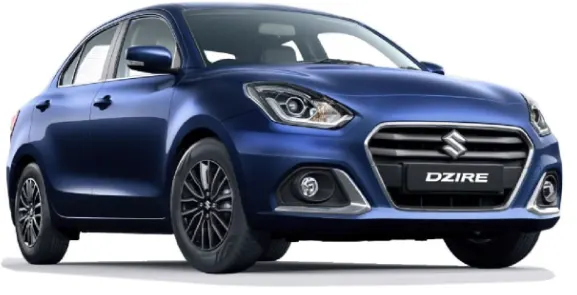
2. MARUTHI SUZUKI DEZIRE: Maruti Suzuki Dzire ZXi Plus is the petrol variant in the Dzire lineup, which has a 5 seater capacity and is priced at ₹ 8.67 Lakh(Manual transimission) and ₹ 9.17 Lakh(AGS) .It returns a certified mileage of 23.26 kmpl for (Manual) and 24.12 kmpl for AGS . This ZXi Plus 1.1 petrol variant comes with an 1.1 petrol engine putting out 89 bhp @ 6000 rpm and 113 Nm @ 4400 rpm of max power and max torque respectively.
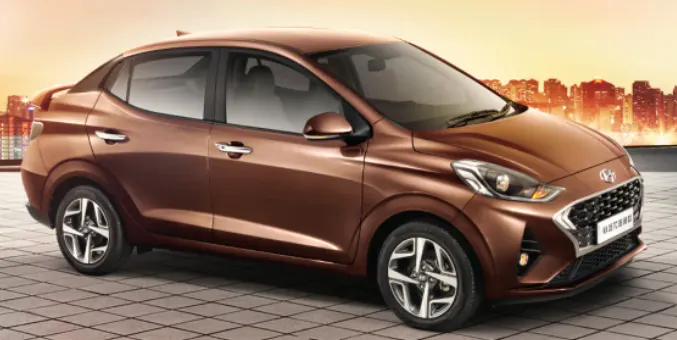
3. HYUNDAI AURA: Hyundai Aura SX Plus 1.0 Petrol is the petrol variant in the Aura lineup, which has a 5 seater capacity and is priced at ₹ 8.87 Lakh(Manual) and ₹ 8.36 Lakh(AMT).It returns a certified mileage of 21 kmpl(Manual) and 20 kmpl for ( AMT). This SX Plus 1.0 Petrol variant comes with an engine putting out 99 bhp @ 6000 rpm and 172 Nm @ 1500 rpm of max power and max torque respectively.
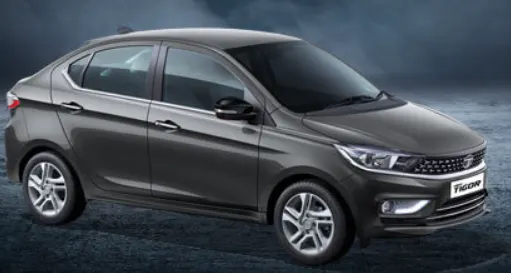
4. TATA TIGOR: Tata Tigor XZ Plus Dual Tone is the petrol variant in the Tigor lineup,which has a 5 seater capacity and is priced at ₹ 7.67 Lakh(Manual) and ₹ 8.27 Lakh(AMT).It returns a certified mileage of 19.27 kmpl(Manual and AMT). This XZ Plus Dual Tone variant comes with an 1.1 petrol engine putting out 84 bhp @ 6000 rpm and 113 Nm @ 3300 rpm of max power and max torque respectively.
COMPARISON STUDY TABLE:
| COMPANY | MODEL | FUEL | TRANSMISSION | MILEAGE(kmpl) | PRICE(in Lakhs) | ENGINE CAPACITY(litre) |
| HONDA | AMAZE | PETROL | MANUAL | 18.6 | 8.36 | 1.2 |
| HONDA | AMAZE | PETROL | CVT | 18.3 | 9.19 | 1.2 |
| MARUTHI SUZUKI | DEZIRE | PETROL | MANUAL | 23.26 | 8.87 | 1.1 |
| MARUTHI SUZUKI | DEZIRE | PETROL | AGS | 24.12 | 9.17 | 1.1 |
| HYUNDAI | AURA | PETROL | MANUAL | 21 | 8.87 | 1.0 |
| HYUNDAI | AURA | PETROL | AMT | 20 | 8.36 | 1.0 |
| TATA | TIGOR | PETROL | MANUAL | 19.27 | 7.67 | 1.1 |
| TATA | TIGOR | PETROL | AMT | 19.27 | 8.27 | 1.1 |
FINAL CONCLUSIONS FROM THE PROBLEM STATEMENT AND COMPARISON STUDY:
- From the problem statement, I came to know that Mr. D.S. Pughazhyendhii wants a car which fits his family of five members, which can be used in daily commuting and long journeys as well and the vehicle should cost him between 8-10 lakhs.
- Based on these requirements I thought that compact Sedans can be a best choice for their family, as it can be used to accommodate a minimum of 5 members, can be used for both long journeys, as well as for daily usage and main thing is budget friendly.
- All the four vehicles that I have compared are all of highend versions and only petrol variants, because Mr. D.S. Pughazhyendhii anyway uses his car for daily commute and rearly for long journeys. For this reason petrol vehicles are more suitable rather than a diesel vehicles which are mostly helpful for repetitive long journeys.
- Among all the four vehicles both automatic and manual transmissions are useful to him. It completely depends his driving comfort and his choice.
- All the vehicles are in between 8-10 lakhs,.i.e. it matches the requirement as well.
- When it comes to a family vehicle, all the four models are very much suitable.
- But if we need to choose only one perfect vehicle then the major factor to segregate the vehicles is the mileage.
- Mileage of a vehicle plays an important role for day to day users and long journey users as well.
- After the comparison of various parameters, Maruthi Suzuki Dezire stands first and it is the best option for Mr. D.S. Pughazhyendhii family.
- The main reason to choose dezire among the four vehicles is it has the highest mileage in both manual and automatic transmissions when compared with others and also the highend version comes in between 8-10 lakhs budget.
- Moreover, a compact sedan with a 5 seating capacity, good mileage, is more useful for both daily usage and long journeys rather than using a long sedan, or big SUV's for which the overall budget increases, maintainance increases, cost of spares increases.
- The second option could be the Hyundai Aura followed by TATA Tigor and in the last is Honda amaze.