Benchmarking
Report For Pughazhyendhii
Mr. D.S. Pughazhyendhii is a married man who lives in Bangalore which is a highly crowded city. His Family comprises five members including his wife, five-year-old boy, his father, and his mother. He visits his native place Madurai which is 500kms away from Bangalore once in a month. Also, he will be using his car to commute to his office. His budget falls between 8 to 10 lakhs on road. Please suggest to him with options so that he will buy a good car for his family. And is fond of big cars.
1. Maruti Suzuki Swift
The Maruti Suzuki Swift Price in Bangalore starts from ₹ 6.90 Lakh and goes upto ₹ 10.07 Lakh. Swift is a Hatchback, offered with a choice of 1197 cc Petrol engine options. For Petrol engine powered by 1197 cc. He can go for Swift ZXI AMT varient which is 8.9 Lakh
Swift ZXI AMT
Type : Hatchback
Price : 8.9 Lakh
Mileage : 20 - 23Kmpl
2. Hyundai i20
The Hyundai i20 Sportz DT has Petrol Engine. The price of the Hyundai i20 Sportz DT in Bangalore is Rs 7.84 Lakh (Ex-showroom), Hyundai i20 Sportz DT Petrol is a Hatchback, offered with a choice of 1197 cc Petrol engine.
Hyundai i20 Sportz DT Petrol
Type : Hatchback
Price : 9.5 Lakh
Mileage : 20.35 kmpl
3. TATA Altoz
The Tata Altroz XZ has Petrol Engine. The price of the Tata Altroz XZ in Bangalore is Rs 7.85 Lakh (Ex-showroom) on road price 9.5 Lakh, it is Hatchback Car. It is powered by a 1199 cc engine which is available with a Manual transmission.
Tata Altroz XZ Petrol
Price : 9.5 Lakh
Mileage : 19 kmpl
Price : 9.75 Lakh
Mileage : 21 kmpl
My Suggestion:
Here my suggestion is he can go for Swift ZXI AMT,it has 1197cc powerfull engine, it is 5 seater Hatchback car and it has Automatic Transmission so Pughazhyendhii can drive in city peacefully and He can travel 500kms with he's family to madurai it is very comfortable for long drive too and good booting space for Lackages and Mileage is 20kmpl to 23kmpl and nice Stylish car for this price segment and TOYOTA glanza is quite bigger then Swift but compare with price, milage, power the Swift is best.
Conclusion:
Finally Pughazhyendhii Happily planing to buy Swift ZXI AMT car without any confusion and he saved one lakh.
Benchmarking
Benchmarking involves a structured comparison between similar products, services or processes on some dimensions of performance. For example it can be used to compare the availability and delivery of features in a product and in this form often provides the basis of consumer tests and reviews. These look at products and services and provide recommendations based on which is best or some form of ranking amongst competitors.
It is particularly useful when comparing not only performance but also practice in other words what do the different organizations do to enable that performance to be delivered? And applied in this way it is a powerful tool in process innovation sin e studying how the ‘best’ achieve their performance can provide powerful clues for changing the way processes operate.
A specific, distinctive vehicle attribute branding is essential to make cars unique and competitive. As a first step on the way, vehicle manufacturers have to benchmark their vehicles in the competitive environment in order to understand and to strengthen or improve the potential of their vehicles.
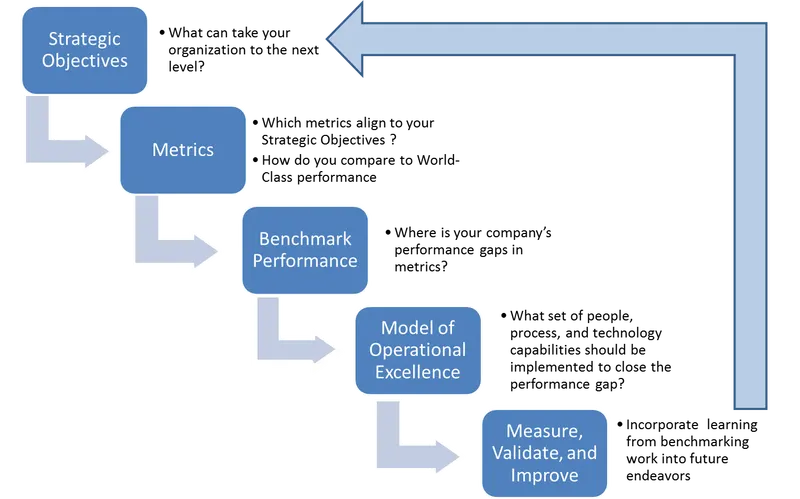
Process benchmarking of this kind can operate at several levels:
- Between similar processes in the same factory or service branch
- Between different factories or service branches
- Between different competing organizations
- Between different sectors using the same process
Whilst if offers a significant learning opportunity benchmarking between competing organizations is harder than the other three because competitors do not want to disclose their process information since it is a source of competitive advantage to tem. So benchmarking of this kind often involves a third party who can collect the data, make the comparison and provide feedback but all on a confidential basis.
Step-by-Step Benchmarking:
Benchmarking is a simple, but detailed, five-step process:
- Choose a product, service, or internal department to benchmark
- Determine which best-in-class companies you should benchmark against – which organizations you’ll compare your business to
- Gather information on their internal performance, or metrics
- Compare the data from both organizations to identify gaps in your company’s performance
- Adopt the processes and policies in place within the best-in-class performers
Benchmarking will point out what changes will make the most difference, but it’s up to you to actually put them in place.
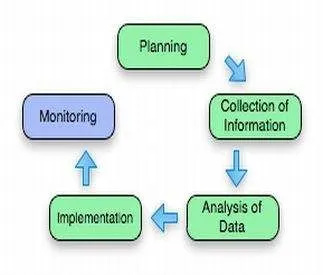
Types of Benchmarking:
- Performance benchmarking
- Practice benchmarking
- Internal benchmarking
- External benchmarking
I. Perfomance Benchmarking:
Involves gathering and comparing quantitative data (i.e., measures or key performance indicators). Performance benchmarking is usually the first step organizations take to identify performance gaps. You need Standard measures and/or KPIs and a means of extracting, collecting, and analyzing that data. You get Data that informs decision making. This form of benchmarking is usually the first step organizations take to identify performance gaps.
II. Practice Benchmarking:
Involves gathering and comparing qualitative information about how an activity is conducted through people, processes, and technology. You need A standard approach to gather and compare qualitative information such as process mapping. You get Insight into where and how performance gaps occur and best practices that the organization can apply to other areas.
III. Internal Benchmarking:
Compares metrics (performance benchmarking) and/or practices (practice benchmarking) from different units, product lines, departments, programs, geographies, etc., within the organization. You need at least two areas within the organization that have shared metrics and/or practices. You get internal benchmarking is a good starting point to understand the current standard of business performance. Sustained internal benchmarking applies mainly to large organizations where certain areas of the business are more efficient than others.
IV. External Benchmarking:
Compares metrics and/or practices of one organization to one or many others. You need for custom benchmarking, you need one or more organizations to agree to participate. You may also need a third party to facilitate data collection. This approach can be highly valuable but often requires significant time and effort. That’s why organizations engage with groups like APQC, which offers more than 3,300 measures you can use to compare performance to organizations worldwide and in nearly every industry. You get an objective understanding of your organization’s current state, which allows you to set baselines and goals for improvement.
Key Benefits:
In addition to helping companies become more efficient and profitable, benchmarking has other benefits, too, such as:
- Improving employee understanding of cost structures and internal processes
- Encouraging team-building and cooperation in the interests of becoming more competitive
- Enhancing familiarity with key performance metrics and opportunities for improvement company-wide
In essence, benchmarking helps employees understand how one small piece of a company’s processes or products can be the key to major success, just as one employee’s contributions can lead to a big win.
Conclusion:
As is clearly apparent, benchmarking can add value to the organization's workflow and structure by identifying areas for improvement and rectification.It is indeed invaluable in an organization's quest for continuous improvement.