Benchmarking
BENCHMARKING:
Benchmarking is a process of measuring the performance of a company’s products, services, or processes against those of another business considered to be the best in the industry, also known as “best in class.”
The point of benchmarking is to identify internal opportunities for improvement. By studying companies with superior performance, breaking down what makes such superior performance possible, and comparing those processes to how your business operates, you can implement changes that will yield significant improvements.
That might mean tweaking a product’s features to more closely match a competitor’s offering, or changing the scope of services you offer, or installing a new customer relationship management (CRM) system to enable more personalized communications with customers.
There are two basic kinds of improvement opportunities: continuous and dramatic. Continuous improvement is incremental, involving only small adjustments to reap sizeable advances. Dramatic improvement can only come about through reengineering the whole internal work process.
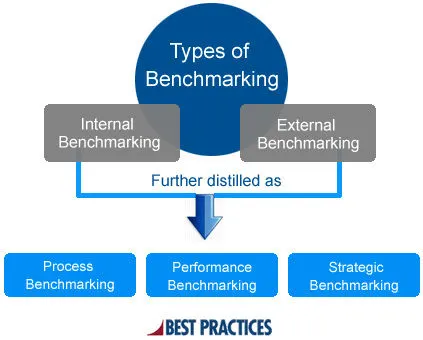
Many types of benchmarking exist; the most commonly recognized are:
- Process — evaluates specific business processes (e.g., purchase planning, e-procurement, service delivery). Process maps are used to facilitate benchmarking.
- Performance — compares product and service as a way to assess the organization’s competitive position against same-sector peers. Focuses on costs, technical quality, ancillary service features, and performance characteristics (also called competitive benchmarking).
- Strategic — seeks to evaluate the organization’s strategic maturity against others across various sectors. Focuses on general approach to the development and management of core competencies, innovations, and change strategies.
Benchmarking analyses often rely on both quantitative and qualitative measures to generate meaningful results. Quantitative analysis can provide metric-based outcomes, while qualitative comparisons often reveal best practices. The benchmarking process usually encompasses four steps:
Step 1: Planning
- Determine the broad business process and tasks to benchmark.
- Identify the resources required for the study.
- Confirm the key activity performance measures or indicators.
- Document the existing process for conducting the activity.
- Identify appropriate reference models as a starting point for your assessment.
Step 2: Analysis
- Collect information to identify the scope for improvement.
- Compare the existing process with that of appropriate reference models to identify differences and innovations.
- Agree on expected targets for improvement.
Step 3: Action
- Communicate the results of the study to key stakeholders.
- Develop an improvement plan to implement changes.
- Implement the improvement plan, monitoring progress and reviewing as necessary.
Step 4: Review
- Review performance when the changes have been implemented; identify and rectify bottlenecks.
- Communicate the results of the implemented changes.
- Schedule future benchmarking activities to continue the improvement process.
Step-by-step benchmarking
Benchmarking is a simple, but detailed, five-step process:
- Choose a product, service, or internal department to benchmark
- Determine which best-in-class companies you should benchmark against – which organizations you’ll compare your business to
- Gather information on their internal performance, or metrics
- Compare the data from both organizations to identify gaps in your company’s performance
- Adopt the processes and policies in place within the best-in-class performers
Benchmarking will point out what changes will make the most difference, but it’s up to you to actually put them in place.
Key benefits:
In addition to helping companies become more efficient and profitable, benchmarking has other benefits, too, such as:
- Improving employee understanding of cost structures and internal processes
- Encouraging team-building and cooperation in the interests of becoming more competitive
- Enhancing familiarity with key performance metrics and opportunities for improvement company-wide
In essence, benchmarking helps employees understand how one small piece of a company’s processes or products can be the key to major success, just as one employee’s contributions can lead to a big win
Key indicators of benchmarking:
- Efficiency: This measure looks at how much output is produced from a given input of resources.
- Effectiveness: This measure looks at the success of a given process, program, or system in achieving its desired objectives.
- Quality: This measure looks at the level of quality in a given product or service.
- Cost: This measure looks at the total costs associated with a given process, program, or system.
- Response Time: This measure looks at the amount of time it takes for a response to a given action.
- Availability: This measure looks at the amount of time a given process, program, or system is available for use.
- Utilization: This measure looks at how much given
- Performance: This measure looks at how well a given process, program, or system is performing.
Requirement:
Benchmarking with presently available cars in the market for the following case:
Mr. D.S. Pughazhyendhii is a married man who lives in Bangalore which is a highly crowded city. His family comprises five members including his wife, five-year-old-boy, his father, his mother. He visits his native place Madurai which is 500kms away from Bangalore once in month. Also, he will be using his car to commute to his office. His budget falls between 8 to 10 lakhs on road. please suggest to him with options so that he will buy a good car for his family.
In my view:
Pughazyendhii is fond of big cars.
He needs a car which is very spacious and he is focusing on Performance. His family is very big so he wants a 5-7seater car for his family members. and ride comfort.it needs to give a good mileage. Provides a social status by not owning on an entry-level but affordable car.
With the shift in mind
With the shift in mind, safety and nice interiors are becoming more crucial factors in purchasing decisions.
Mr. D.S. Pughazhyendhii’s major requirements in a car:
- Good mileage
- 5-7 seats for his family members
- He is also fond of big cars
- Good car for easy and commuting within the city and long drives as well
- Budget: Rs.8-10 lakhs/- on road price
I Would suggest Diesel/petrol Engine vehicles, SUV/MUV is preferrable.
Suitable cars:
- TATA NEXON
- HYUNDAI VENUE
- RENAULT TRIBER
- FORD ECOSPORT
Models/specifications:
1.TATA NEXON: (petrol)
Cost:8.47 lakh
MODEL:
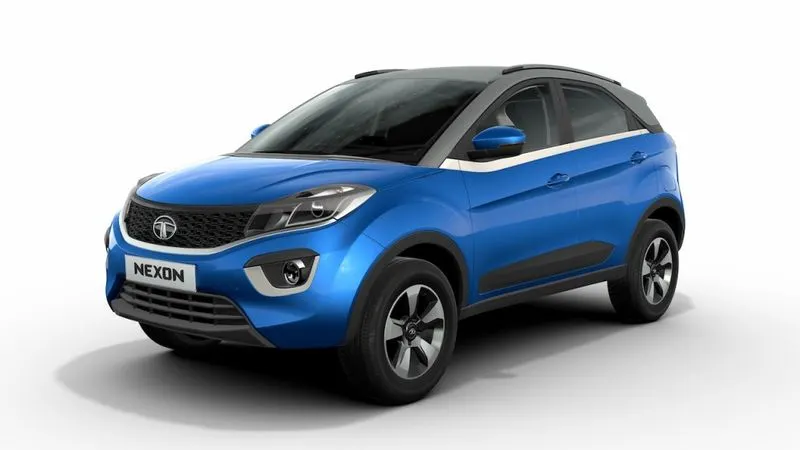
Specifications summary:
Mileage (ARAI): 17-22 kmpl
Fuel Type: petrol
Fuel tank capacity:44L
Type: Petrol/Diesel
Transmission Type: Manual/Automatic.
Body type: SUV
Seating capacity:5
Boot space:350L
Max Power (bhp @rpm): 109bhp @1500-2750rpm
Max Torque (nm @rpm): 260Nm @1750-4000rpm
Engine displacement: 1199cc
Safety: 5-Stars NCAP rating
Features:
- Fortified cabin
- Power steering
- Alloy wheels
- Dual front airbags as standard
- Automatic climate control
- Electronic stability
Pros:
- Upmarket looks, Five-star G-NCAP safety
- Spacious cabin compared to rivals
- Easy to drive and live with
Cons:
- Interior quality
- Motor’s low-end grunt
- Infotainment screen not as good as rivals
2.HYUNAI VENUE: diesel
cost: 9.5-10lakhs
MODEL:
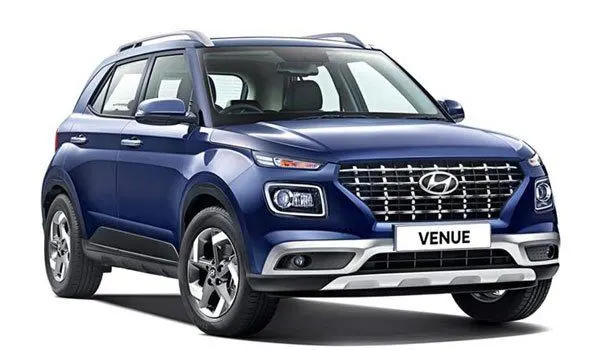
Specifications Summary:
Mileage (ARAI) kmpl: 17 Kmpl to 23.7Kmpl
Fuel Type: Petrol / Diesel
Fuel tank capacity:45L
Type: Petrol/Diesel
Transmission Type: Automatic
Body type: SUV
Seating Capacity: 5
Boot Space: 350 L
Max Power:118.35bhp/4000-6000rpm
Max Torque: 171.6Nmm / 1500-4000rpm
Engine Displacement: 998 CC / 1396 CC
Safety: 4-Stars NCAP rating
FEATURES:
- Power steering
- antilock braking system
- driver airbag
- power windows front
- air conditioner
Pros:
- Quality interiors
- Lots of powertrain options
- Features list
Cons:
- Cabin space is not generous
- 2-litre petrol only available in entry-level trims
- Top -spec variants are costly
3.RENAULT TRIBER: Petrol
Cost:8Lakhs:
MODEL:
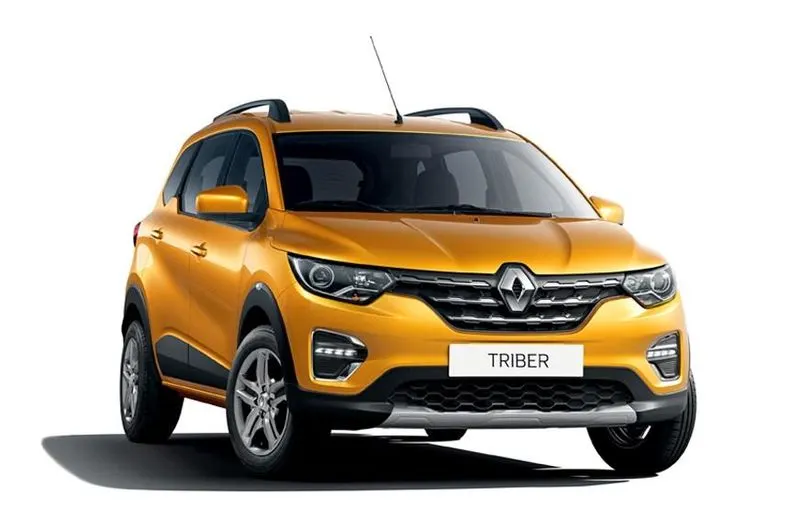
SPECIFICATIONS:
Mileage (ARAI) kmpl: 18.2Kmpl
Fuel Type: Petrol
Fuel tank capacity:40L
Type: Petrol/Diesel
Transmission Type: Automatic 5 speed
Body type: MUV
Seating Capacity: 7
Boot Space: 84L
Max Power (bhp @rpm): 71bhp @6250rpm
Max Torque (Nm @rpm): 96Nm @3500rpm
Engine Displacement: 998 CC / 1396 CC
Safety: 4-stars NCAP rating
FEATURES:
It is a 7-seater MUV with affordable price range
Adjustable steering
It comes with new technology like the smart access card
Central locking
Side impact beam
Anti-locking braking system
Passenger air bag
Pros:
- Plenty of storage spaces in cabin
- Comfortable ride experience
- Boot space behind second row
cons:
- Slow shifting transmission
- Not so quiet cabin experience
4.FORD ECOSPORT: Petrol
Cost:8-10 lakhs
Model:

SPECIFICATIONS :
Mileage (ARAI) kmpl: 15.9Kmpl
Fuel Type: Petrol
Fuel tank capacity:52L
Type: Petrol/Diesel
Transmission Type: Manual
Body type: SUV
Seating Capacity: 5
Boot Space: 352L
Max Power (bhp @rpm): 99bhp@3750rpm
Max Torque (Nm @rpm): 149Nm @4500pm
Engine Displacement: 1496CC
Safety: 4-stars NCAP rating
FEATURES:
Driver airbag
Power windows front
Antilock braking system
Air conditioner
Power steering
Wheel cover
Fog lights front
Prons:
- Looks
- Driving dynamics
- Build quality
- Spacious
- Features and safety
- Power and responsible engines
Cons:
- Spare wheel
- Needs huge updates
- Not so VFM
Let’s took into difference between cars Mention above and select which is suitable for the above conditions.
COMPARISON
MODELS/ TATA HYUNDAI RENAULT FORD ECO
SPECIFICATIONS NEXON VENUE TRIBER SPORT
ARAI Mileage: 17-22kmpl 17-23.7kmpl 18.2kmpl 15.9kmpl
Fuel Type petrol Diesel petrol petrol
Fuel Tank
Capacity: 44L 45L 40L 52L
Transmission
Type: Manual/ Automatic Automatic Manual
Automatic 5-speed
Body Type: SUV SUV MUV SUV
Seating
capacity: 5 5 7 5
Boot space
(Litres): 350L 350L 84L 352L
Max power 109bhp@ 118.35bhp@ 71bhp@ 99bhp@
(bhp @rpm): 1500-2750 4000-6000 6250rpm 3750rpm
rpm rpm
Max torque 260Nm@ 171.6Nm@ 96Nm@ 149Nm@
(Nm @rpm): 4000rpm 1500-4000rpm 3500rpm 4500rpm
Engine
Displacement 1199cc 998cc 998cc/ 1496cc
(cc): 1396cc
Safety: 5-Stars 4-Stars 4-Stars 4-Stars
NCAP NCAP NCAP NCAP
Rating Rating Rating Rating
CONCLUSION:
I would suggest Tata Nexons for Mr. D.S. Pughazhyendhii family, because of the
Five-star G-NCAP safety and it has more power(bhp), NEXON is giving an excellent offering which is safest car in its segment. It is also value for money product with class leading features. Over all it has a good performance.