Benchmarking
Benchmarking in the Automobile Industry
Benchmarking involves a structured comparison between similar products, services or processes on some dimensions of performance. For example it can be used to compare the availability and delivery of features in a product and in thisform often provides the basis of consumer tests and reviews. These look at products and services and provide recommendations based on which is best or some form of ranking amongst competitors.
It help to analysis the company design and deliver better product to customer at competitive price and quality.
Flow Chart of ASI Benchmarking institute in India is as follow:
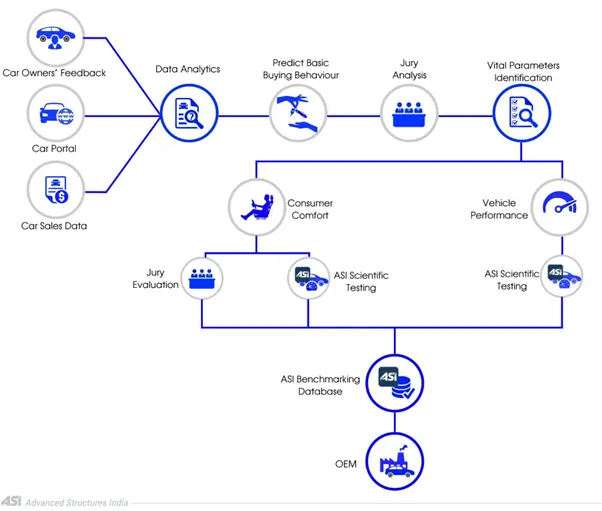
This process narrowed down consumer expectations to the following parameters:
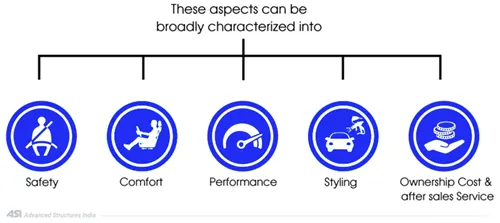
Out of these parameters, cost of ownership and after sales service are widely benchmarked across the world and in India to rank car manufacturers. Testing Safety of the car is in the scope of regulatory agencies in India and abroad. Hence our study has excluded these two parameters. Comfort and Performance affect the consumer in day to day life but are never benchmarked at large scale across the segments. We’ve broken these vital attributes into sub groups for measurement and comparison.
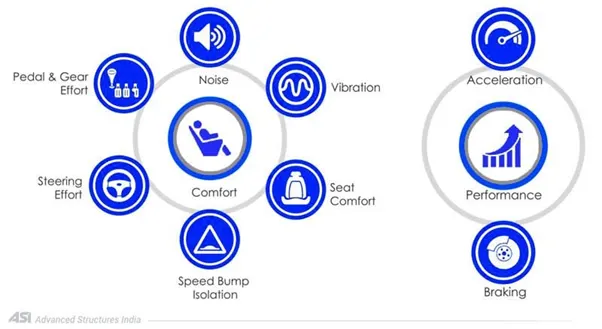
The Scoring on the various parameter is given ASI Benchmarking institution are shown below with sample example.
Following graph shows the comparison for various parameters for driver. As these are Rankings, the lower the better. The scores are on a scale of 1 to 6, 1 being best
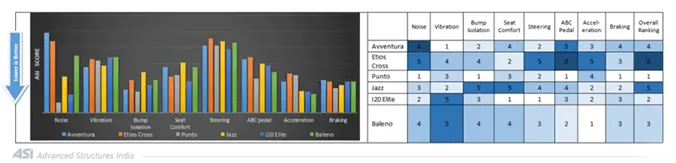
- Noise refers to noise levels as heard by driver and passengers, articulation index and similar parameters.
- Vibration score includes seat pad vibrations, tactile vibration on steering and gear lever, floor vibrations etc. More on this here.
- Bump isolation measures the acceleration and displacement experienced by the driver and passenger when the car is driven on a standard bump at a fixed speed.
- Seat comfort is an extensive in-depth measurement and analysis of seat pressure profile and high pressure zones to ascertain cushion performance, thigh and lumbar support and more parameters under different driving conditions. More in-depth reading of this can be done here.
- Steering score refers to effort required by the driver in doing several steering intensive maneuvers like parallel parking and U-Turn.
- ABC pedal score is a result of effort required by the driver in pressing these pedals under typical running conditions.
- Acceleration refers 0-60 kmph and 0-100 kmph times and g values under normal usage conditions (tyre pressure, fuel carried and occupancy).
- Braking refers to time and de-acceleration from these speeds.
From the above trends, we can see the focus of different cars and their performance on those attributes. This bird’s eye view in explored in detail in the following sections to understand their effect on the overall scores.
Body In White (BIW) Benchmarking
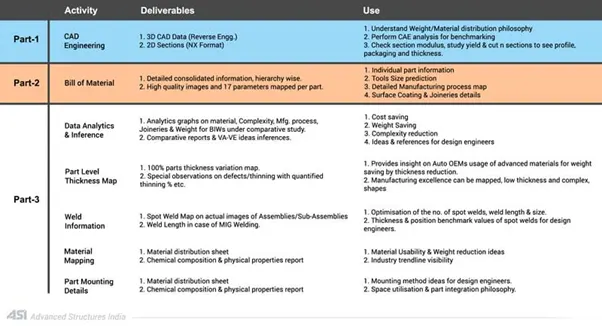
generating 3D CAD Data for a BiW through automotive 3d scanning and reverse engineering which is extremely useful in crashworthiness analysis of a car BiW, and how 2D CAD outputs are useful to automotive design engineers in analysing section modulus for strength requirements.
BIW Benchmarking dine by ASI institution in 3 parts:
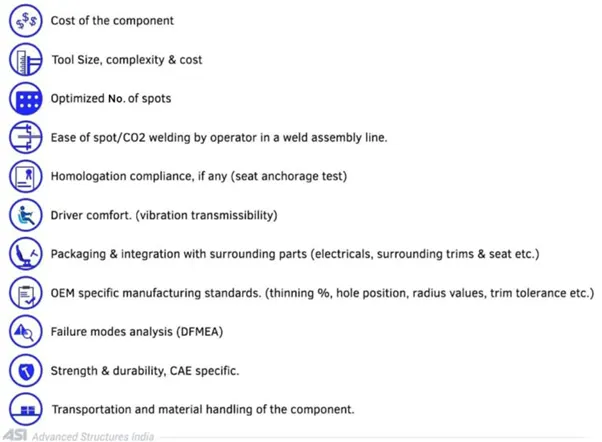
for instance, while designing passenger seat support bracket on Body in White (BIW), the designer needs to consider the following constraints:
Appropriate automotive benchmark data in a suitable format is readily available, detailed study time can be reduced and the decision-making process can be expedited. For e.g. if the benchmark vehicle passes homologation and the seat assembly weight is in range, the thickness map of the benchmark bracket can be used as a reference to start the vehicle design. It will save many iterations for CAE.
Case Study:
Mr. D.S. Pughazhyendhii is a married man who lives in Bangalore which is a highly crowded city. His Family comprises five members including his wife, five-year-old boy, his father, and his mother. He visits his native place Madurai which is 500kms away from Bangalore once in a month. Also, he will be using his car to commute to his office. His budget falls between 8 to 10 lakhs on road. Please suggest to him with options so that he will buy a good car for his family.
Note: Pughazhyendhii is fond of big cars
Given Data:
- of person for commute:- 5 persons
- Budget: 8 to 10 lakhs
- Monthly total driving: 2200 to 2300km
1000 km to native trip
40kmx 26 days =1040km to office
160km misc. travelling
1. MG Astor

Key Specifications of MG Astor
Fuel Type Petrol
Engine Displacement (cc) 1349
No. of cylinder 4
Max Power (bhp@rpm) 138.08bhp@5600rpm
Max Torque (nm@rpm) 220nm@3600rpm
Seating Capacity 5
TransmissionType Automatic
Fuel Tank Capacity 45.0
Body Type SUV
Price 9.98 Lakh
2. Tata Nexon XM S

Key Specifications of Tata Nexon XM S
ARAI Mileage 17.2 kmpl
City Mileage 13.41 kmpl
Fuel Type Petrol
Engine Displacement (cc) 1199
No. of cylinder 3
Max Power (bhp@rpm) 118.36bhp@5500rpm
Max Torque (nm@rpm) 170Nm@1750-4000rpm
Seating Capacity 5
TransmissionType Manual
Boot Space (Litres) 350
Fuel Tank Capacity 44.0
Body Type SUV
Ground Clearance Unladen 209 mm
Service Cost (Avg. of 5 years) Rs.3,570
Price 8.99 Lakh
3.Hyundai Venue E 1.2 petrol

Key Specifications of Hyundai Venue E 1.2 petrol
Engine 1197 cc, 4 Cylinders Inline, 4 Valves/Cylinder, DOHC
Fuel Type Petrol

Key Specifications of Maruti Vitara Brezza VXI
ARAI Mileage 17.03 kmpl
Fuel Type Petrol
Engine Displacement (cc) 1462
No. of cylinder 4
Max Power (bhp@rpm) 103.26bhp@6000rpm
Max Torque (nm@rpm) 138nm@4400rpm
Seating Capacity 5
Boot Space (Litres) 328
Fuel Tank Capacity 48.0
Body Type SUV
Service Cost (Avg. of 5 years) Rs.6,619
Conclusion
I would suggest Tata Nexon XM (S)
Tata Nexon XM (S) is the petrol variant .It returns a certified mileage of 17.4 kmpl. This XM (S) variant comes with an engine putting out 118 bhp @ 5500 rpm and 170 Nm @ 1750 rpm of max power and max torque respectively.
The price of the Tata Nexon XM S in Bangalore is Rs 8.99 Lakh
Comfortable ride quilaty and Quality intreiors coupled with long features list
Seating Capacity 5 Person.