Benchmarking
Benchmarking
Benchmarking is the first stage of Predesign and Development phase of any Product, Process or Service of a Company. It generally follows collecting information about the performance of the top performing companies in different areas and ranking them according to their overall performance. Then compare the performance of own company with them to improve the performance of own company. It is a very practical step before making any changes to the company.
Benchmarking has two fundamental types:
- Benchmarking-1: External Benchmarking - involves comparing the subject company, or property, to external organizations.
- Benchmarking-2: Internal Benchmarking - describes comparisons within an organization.
The objective of benchmarking for a company is to make its product, process and service more capable and desirable than the others already existing in the market. Simply put, it is known to create a benchmark when it performs better than all others in its competition.
Benchmark also means “best in class”, so benchmarking is the process of making the best in its class or segment. It does not mean that a product or service must be top-notch or best in class in all terms, but a company can also make its feature, design or specification a benchmark too. It helps to highlight their product capability and give strong competition to the top benchmarked product with less benchmark score in that feature. Similarly, all other features can be improved to make their product more efficient than the others to make it a better package. Hence, benchmarking also helps to improve the overall business of the company.
Steps
There are five simple steps in the process of benchmarking, which are: -
- First, choose the area or sector of the company that needs improvement and then select the entity (product, process or service) that needs to be benchmarked.
- Then choose all the companies providing those entities against which the selected entity will be benchmarked.
- Categorize all the performance parameters and mark the ratings to the entities according to their performance. Arrange the companies' entities according to total marks or rankings.
- Analyze the data of best class performers against the selected entity and find gaps among the entities of other companies.
- Note down the areas of improvement and adopt new ways to improve the company's benchmark score of the product, process or service.
BENEFITS
In addition to helping companies become more efficient and profitable, benchmarking has other benefits, too, such as:
- It improves employee understanding of cost structures and internal processes.
- It also encourages team-building and cooperation interest in becoming more competitive.
- It enhances familiarity with key performance metrics and opportunities for improvement company-wide.
Case Study
Q. Benchmark with presently available cars in the market for the following case.
Mr. D.S. Pughazhyendhii is a married man who lives in Bangalore which is a highly crowded city. His Family comprises five members including his wife, five-year-old boy, his father, and his mother. He once in a month visits his native place Madurai which is 500kms away from Bangalore. Also, he will be using his car to commute to his office. His budget falls between 8 to 10 lakhs on road. Please suggest to him options so that he will buy a good car for his Family.
Note: Pughazhyendhii is fond of big cars.
A. Segment Selection
First, the segment type has to be selected according to the distance travelled per month, type of terrain and environment, no. of passengers riding the car and any particular preference or choice of the customer.
According to the case following data can be retrieved:-
No. of riders in the Family- 5
Traffic level- Very high
Type of terrain- Plain for office and others for long trip
Long trips distance monthly- 1000 kms
Assuming the customer office in Bangalore is 10 kms away from his home, then monthly distance travelled is- 600 kms
Total estimated distance travelling per month- 1600 kms
Total estimated distance travelling per year- 19000 kms
Economic Analysis
Assuming mileage of cars under Rs 10 lakh - Diesel Car – 20kmpl
Petrol Car – 15kmpl
Present-day fuel prices in Bangalore- Petrol – 102 Rs/Lt.
Diesel – 95 Rs/Lt.
Since the life of diesel cars in India is minimum 10 years and for petrol cars is 15 years, so we evaluate only for the first 9 years only.
Total expenditure on petrol car – Rs 19000 * 9 * 102 / 15 = Rs 11,63,000
Total expenditure on Diesel car – Rs 19000 * 9 * 95 / 20 = Rs 8,12,000
Amount spent extra on Petrol Car over Diesel Car – Rs 3,50,000
General price difference between same variant of Diesel and Petrol Car- Rs 1.5 Lakhs
Total amount saved on Diesel car over Petrol car for 9 years investment before selling the car- Rs 2 Lakhs.
Hence, it can be suggested that under Rs 8-10 lakhs, the customer should go for an SUV or Sedan segment Diesel Engine Car.
Note: *CNG car is not suggested because the customer will get luggage carrying problems for long trips due to decresed luggage space left after CNG cylinder installation in the boot.
** Electric vehicle or any Automatic Transmission Diesel Variant cannot be suggested because it does not come under the budget of the customer.
B. Car Selection
According to the above discussion, the suggestible Diesel cars for SUV and Sedan segment under 8-10 lakh budget are:-
1. Tata Nexon

| Mileage | 22 kmpl |
| Fuel Type | Diesel |
| Engine Displacement (cc) | 1497 |
| No. of cylinder | 4 |
| Max Power (bhp@rpm) | 108.49bhp@4000rpm |
| Max Torque (nm@rpm) | 260nm@1500-2750rpm |
| Seating Capacity | 5 |
| TransmissionType | Manual |
| Boot Space (Litres) | 350 |
| Fuel Tank Capacity | 44.0 |
| Body Type | SUV |
| Ground Clearance Unladen | 209 |
2. Hyundai Venue

| Mileage | 23.4 kmpl |
| Fuel Type | Diesel |
| Engine Displacement (cc) | 1493 |
| No. of cylinder | 4 |
| Max Power (bhp@rpm) | 98.56bhp@4000rpm |
| Max Torque (nm@rpm) | 240Nm@1500-2750rpm |
| Seating Capacity | 5 |
| Boot Space (Litres) | 350 |
| TransmissionType | Manual |
| Fuel Tank Capacity | 45.0 |
| Body Type | SUV |
3. Kia Sonet
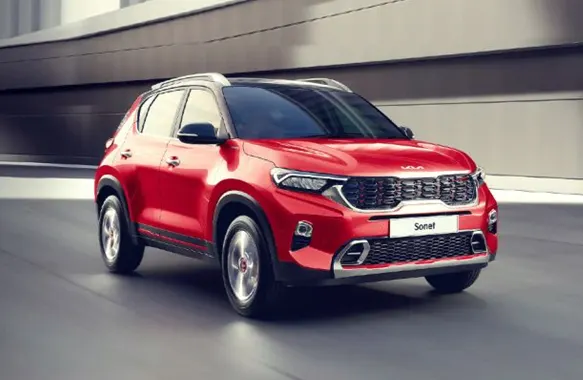
| Fuel Type | Diesel |
| Mileage | 24 |
| Engine Displacement (cc) | 1493 |
| No. of cylinder | 4 |
| Max Power (bhp@rpm) | 98.63bhp@4000rpm |
| Max Torque (nm@rpm) | 240nm@1500-2750rpm |
| Seating Capacity | 5 |
| TransmissionType | Manual |
| Boot Space (Litres) | 392 |
| Fuel Tank Capacity | 45.0 |
| Body Type | SUV |
4. Mahindra XUV300

| Mileage | 22.0 kmpl |
| Fuel Type | Diesel |
| Engine Displacement (cc) | 1497 |
| No. of cylinder | 4 |
| Max Power (bhp@rpm) | 115bhp@3750rpm |
| Max Torque (nm@rpm) | 300Nm@1500-2500rpm |
| Seating Capacity | 5 |
| TransmissionType | Manual |
| Boot Space (Litres) | 257 |
| Fuel Tank Capacity | 42.0 |
| Body Type | SUV |
| Ground Clearance Unladen | 180mm |
5. Honda Amaze
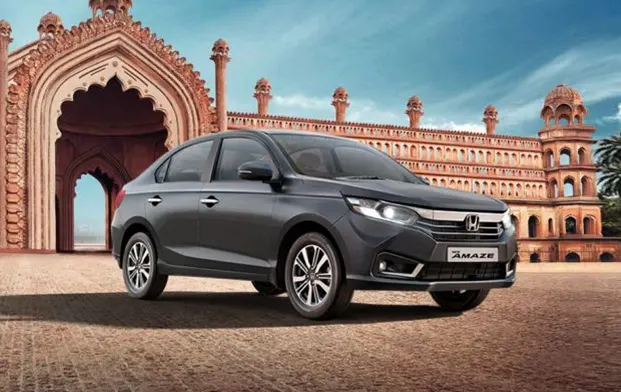
| Mileage | 24.7 kmpl |
| Fuel Type | Diesel |
| Engine Displacement (cc) | 1498 |
| No. of cylinder | 4 |
| Max Power (bhp@rpm) | 97.89bhp@3600rpm |
| Max Torque (nm@rpm) | 200Nm@1750rpm |
| Seating Capacity | 5 |
| TransmissionType | Manual |
| Boot Space (Litres) | 420 |
| Fuel Tank Capacity | 35.0 |
| Body Type | Sedan |
Comparison of Suggestible Cars
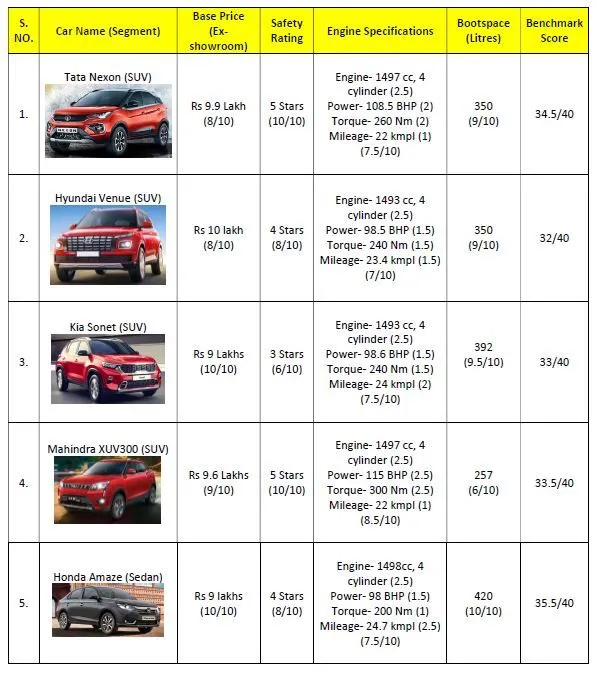
Note: Here, the on-road price of the above-suggested Diesel vehicles is 50 thousand to 1 lakh rupees extra above the budget of the customer, but still the customer has a margin of 1 to 1.5 lakh rupees of the total investment for nine years over a Petrol car of the same variant as studied above. Also, the customer will get his wish of the big car and can enjoy the margin in investing in other products or get an upper variant with some added features.
Results of Benchmarking
As per the given case, the preference of the customer for his new car according to the above benchmark scores should be in this order:
- Honda Amaze
- Tata Nexon
- Mahindra XUV300
- Kia Sonet
- Hyundai Venue
Conclusion
According to the Benchmarking results, the customer should go for Honda Amaze Diesel Manual Variant if his budget is tight, or he can opt for Tata Nexon Diesel Manual Variant which is a bit pricier over his budget, but it is a much safer option as compared to the Honda Amaze.
- Honda Amaze
| Mileage | 24.7 kmpl |
| Fuel Type | Diesel |
| Engine Displacement (cc) | 1498 |
| No. of cylinder | 4 |
| Max Power (bhp@rpm) | 97.89bhp@3600rpm |
| Max Torque (nm@rpm) | 200Nm@1750rpm |
| Seating Capacity | 5 |
| TransmissionType | Manual |
| Boot Space (Litres) | 420 |
| Fuel Tank Capacity | 35.0 |
| Body Type | Sedan |
- Tata Nexon
| Mileage | 22 kmpl |
| Fuel Type | Diesel |
| Engine Displacement (cc) | 1497 |
| No. of cylinder | 4 |
| Max Power (bhp@rpm) | 108.49bhp@4000rpm |
| Max Torque (nm@rpm) | 260nm@1500-2750rpm |
| Seating Capacity | 5 |
| TransmissionType | Manual |
| Boot Space (Litres) | 350 |
| Fuel Tank Capacity | 44.0 |
| Body Type | SUV |
| Ground Clearance Unladen | 209 |