Basics of Probability and Statistics Week 1 Challenge
Tasks
- Why there is a difference in the formula of variance for population and sample
- Difference between stratified and clustered sampling
- How many different samples can be created out of a population of size n
- What is the probability of drawing 2 jacks from a pack of card
- What is the probability that both the numbers on dice are the same while rolling 2 dice
- Why standard deviation when variance can measure the dispersion in data
Task 1
Why there is a difference in the formula of variance for population and sample
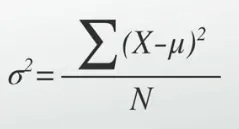
The formula used for determining variance for the population is
Whereas, the variance for a sample is calculated using
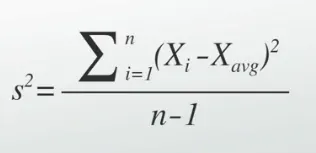
Population variance refers to the value of variance that is calculated from population data, and sample variance is the variance calculated from sample data. Due to this value of the denominator in the formula for variance in the case of sample data is ‘n-1’, and it is ‘n’ for population data. As a result, both variance and standard deviation derived from sample data are more than those found out from population data.
Task 2
Difference between stratified and clustered sampling
|
Factors for Comparison |
Cluster Sampling |
Stratified Sampling |
| Definition | Members of this sample are chosen from naturally divided groups called clusters, by randomly selecting elements to be a part of the sample. | Members of this sample are randomly chosen from non-overlapping, homogeneous strata. |
| Purpose | Cost reduction and increases efficiency. | Enhanced precision and population depiction. |
| Sample selection | Selection of the sample is done by randomly selected clusters and including all the members from these clusters. | Selection of the sample is done by randomly selecting members from various formed strata. |
| Selection of elements that form a Sample | Conjointly | Distinctively |
| Division type | Naturally formed | Depends on the researcher |
| Heterogeneity | Internally, with the clusters | Externally, between various strata |
| Homogeneity | Externally, between various clusters | Internally, with the strata |
Task 3
How many different samples can be created out of a population of size n
Let us consider a case where the size of the population is 4
x = {A,B,C,D}
The different samples possible are : {A}, {B}, {C}, {D}, {A,B}, {A,C}, {A,D}, {B,C}, {B,D},{C,D},{A,B,C},{A,B,D},{A,C,D},{B,C,D},{A,B,C,D}
The total number of samples = 15 = 2^4 -1
Therefore, the total number of samples that can be generated from a population of size N =2^n - 1
Task 4
What is the probability of drawing 2 jacks from a pack of card?
Lets types of cards in a deck of cards
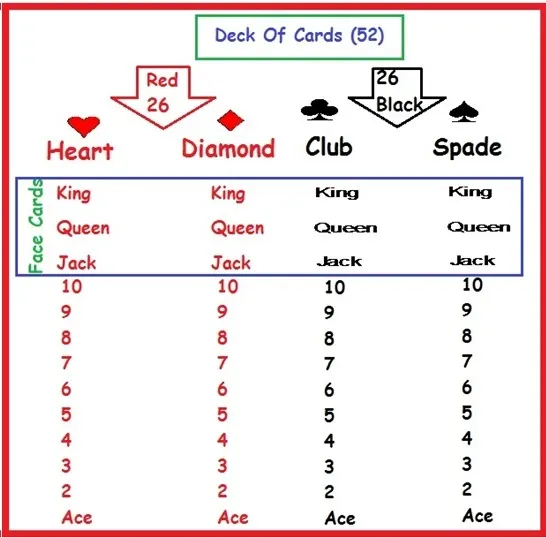
In a pack of cards, there are 4 jack cards around 52 cards
then, probability becomes
P(2 jacks) = 4C2/52C2
= 6/1326
= 1/221.
Task 5
What is the probability that both the numbers on dice are the same while rolling 2 dice?
To make it perfectly clear, consider the sample space for rolling a die twice.
(1, 1) (1, 2) (1, 3) (1, 4) (1, 5) (1, 6)
(2, 1) (2, 2) (2, 3) (2, 4) (2, 5) (2, 6)
(3, 1) (3, 2) (3, 3) (3, 4) (3, 5) (3, 6)
(4, 1) (4, 2) (4, 3) (4, 4) (4, 5) (4, 6)
(5, 1) (5, 2) (5, 3) (5, 4) (5, 5) (5, 6)
(6, 1) (6, 2) (6, 3) (6, 4) (6, 5) (6, 6)
There are 36 equally likely possible outcomes, 6 of which define the event
"rolling the same number two times in a row".
Then, the probability of this event occurring is 6/36, which is equal to 1/6.
Task 6
Why standard deviation when variance can measure the dispersion in data

The unit of variance is not dimensionally the same as that of the mean. So, the standard deviation is introduced which is the square root of variance. Both mean and standard deviation are dimensionally equal.