Assignment 5
Impact Analysis of Crash Tube under varying Geometry
Objective: The project is based on analysis of Crash tube under varying geometry and Kinematic conditions.
Tools Used: Hypermesh, RADIOSS and Hypercrash
SETUP: The setup involves a crash tube impact against a rigid wall, Rigid body has a master node of 500 kg.
Materials Properties:
Young’s Modulus: 210 GPa
Density: 7.8e-03 kg/mm3
Poisson’s Ratio: 0.3
Hourglass Energy in the system is Zero because of QEPH Shell Element formulation, Stiffness is added at material level.
Interface:
Type 2 : It is used for spot welds , uses penalty formulation keeping spot flag 25 and avoids incompatible kinematic situation.
Type 7:It is used for self contact, Surfaces are masters and nodes are slaves.
Type 11: It is used for Edge to Edge contact, used along with Type 7 and Type 11, inhibits situation causing edge penetrating into one another.
LOAD CASES
Initial velocity is 13.3 mm/ms in Z direction, run time is 30 ms. Rigid walls serves as master and nodes as slaves.
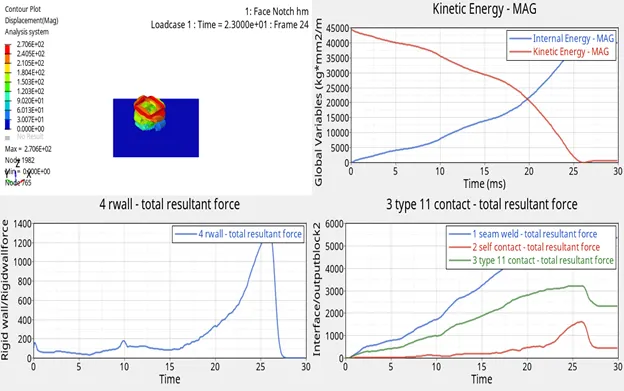
Case 1: Default Model
Type 2 contacts are set to spot flag 25 to inhibit incompatible Kinematic formulation; notches initiate deformation at an early stage.
Initially Internal Energy is zero it maxes out at 42273 Joules due to momentum transfer.
Kinetic energy maximum at the initial stages 44212 Joules reaches a minimum of 1.594 Joules
Energy Error: -3.8%
Mass Error: 0.00%
No. of Cycles: 83,469
Elapsed Time: 249.88 s
Displacement : 280 mm (max)
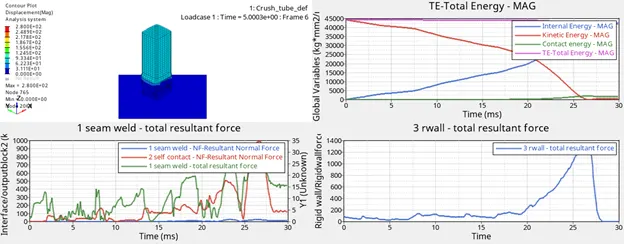
Case 2: Inacti=6
Inacti is changed to 6
Initially Internal Energy is zero it maxes out at 40158 Joules due to momentum transfer.
Kinetic energy maximum at the initial stages 44400.78 Joules reaches a minimum of 5.66 Joules
Energy Error: -3.8%
Mass Error: 0.00%
No. of Cycles: 83469
Elapsed Time: 438.95 s
Displacement : 280 mm (max)
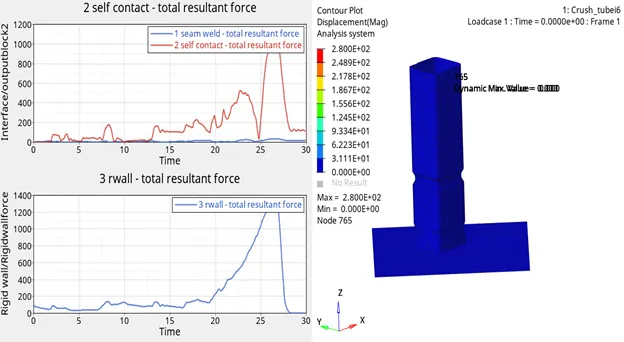
Case 3: Type 11
Type 11 contact is created
Initially Internal Energy is zero it maxes out at 40984 Joules due to momentum transfer.
Kinetic energy maximum at the initial stages 44400.8 Joules reaches a minimum of 0.5256 Joules
Energy Error: -6.4%
Mass Error: 0.00%
No. of Cycles: 90485
Elapsed Time: 658.14 s
Displacement : 264.8 mm (max)
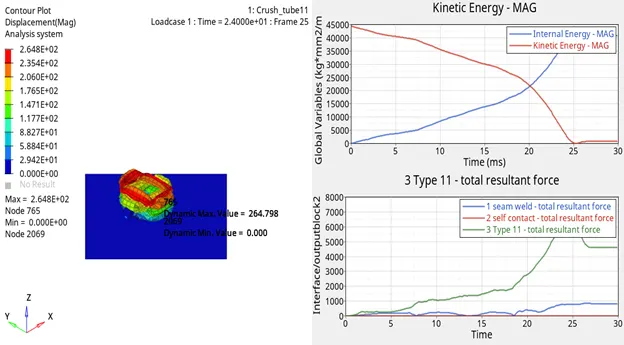
Case 4: Notch removed
Both notches and boundary conditions on rigid body removed
Initially Internal Energy is zero it maxes out at 40489.4 Joules due to momentum transfer.
Kinetic energy maximum at the initial stages 44400.7 Joules reaches a minimum of 1.1793 Joules
Energy Error: -7.4%
Mass Error: 0.00%
No. of Cycles: 100458
Elapsed Time: 391.43 s
Displacement:266.8mm(max)
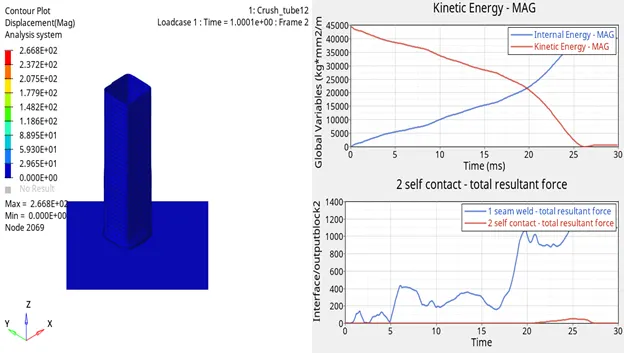
Case 5: Mid notch
New notch is created in middle
Initially Internal Energy is zero it maxes out at 40440 Joules due to momentum transfer.
Kinetic energy maximum at the initial stages 44400 Joules reaches a minimum of 10.90 Joules
Energy Error: -7.3%
Mass Error: 0.00%
No. of Cycles: 102292
Elapsed Time: 830.79 s
Displacement : 265.8 mm (max)
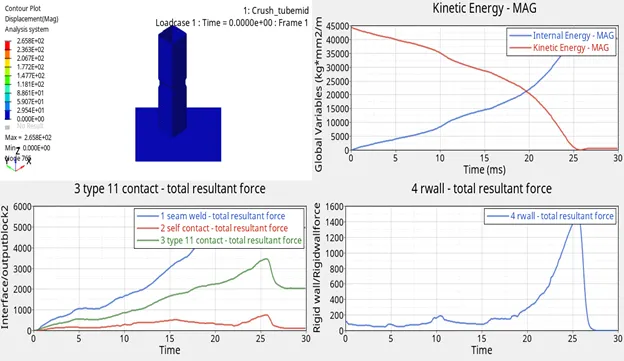
Case 6: 2 opposing faces
New notch is created with nodes opposing 2 faces
Initially Internal Energy is zero it maxes out at 40039.4 Joules due to momentum transfer.
Kinetic energy maximum at the initial stages 44291.7 Joules reaches a minimum of 14.117 Joules
Energy Error: -8.5%
Mass Error: 0.00%
No. of Cycles: 84761
Elapsed Time: 269.44 s
Displacement : 270.6 mm (max)