Assignment 4-RADIOSS Material Laws Challenge
Objective
To carry out the simulation of all 7 cases and compare the results in terms of mass error, energy error, run time, total no of cycles and types of failure using animation. The cases are as follows-
Case-1.Based on Law2- base simulation- [using ‘FAILURE_JOHNSON_0000.rad’ file]
Case-2. Based on Law2- using fail_Johnson card [ ifail_sh=1, Dadv=1, ixfem=1] with failure plastic strain [EPS_p_max]- [using case-1 file]
Case-3. Based on Law2- delete fail/Johnson card- [using case-2 file]
Case-4. Based on Law2- delete EPS_p_max.- [using case-3 file]
Case-5. Based on Law1- keeping the same values of rho, E and nu.- [using case-4 file]
Case-6. Based on Law36-with recommended properties and reference curve -[using case 1 file].
Case-7. Based on Law27- with recommended properties- [using ‘LAW27_0000.rad’ file]
Procedure
Case-1
1.Import the ‘FAILURE_JOHNSON_0000.rad’ file [import-solver deck] and titled ‘Law2_epsmax_failure’
2. Run the simulation as it is [analysis-radioss].
- Save the file name ‘case 1rad’
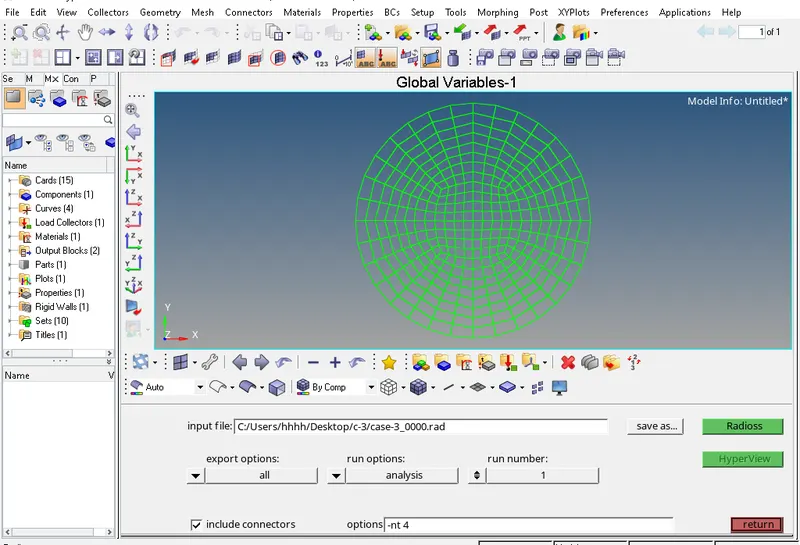
- Tick the box Include connector and type ‘-nt 4’ to assign task to 4 cores in the system.
- Click the ‘RADIOSS’ to run the simulation.
3. Split the screen and visualize the results.
- In hyperview, upload the ‘h3d file’ then click on ‘apply’ by doing so animation file was opened.
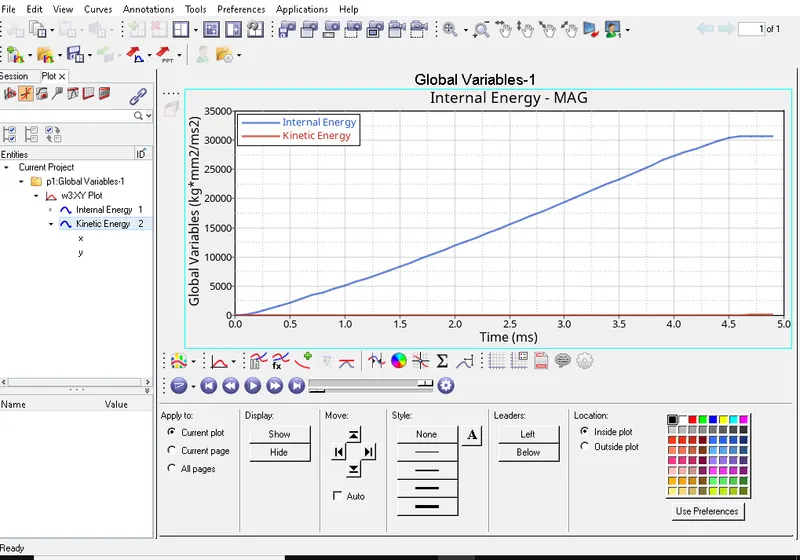
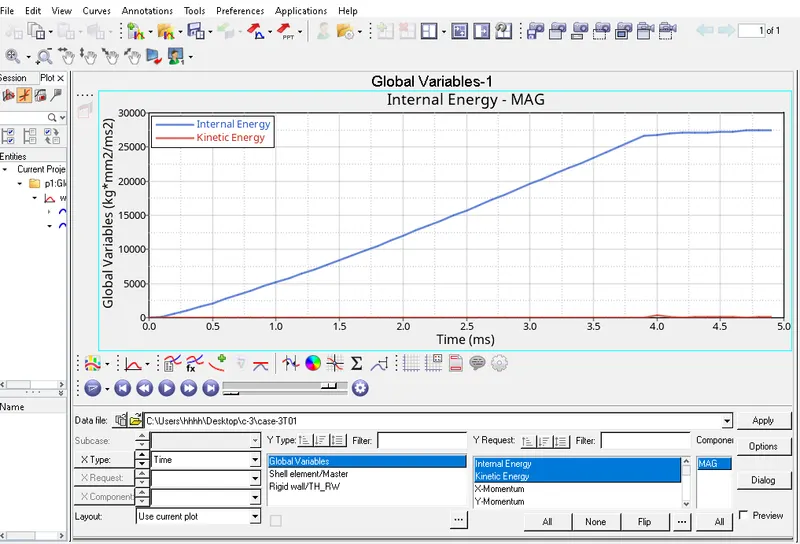
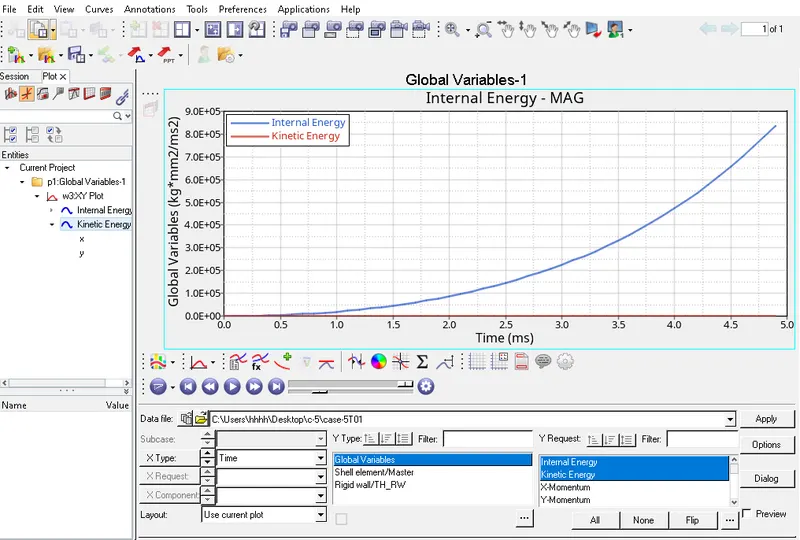
- In hygraph 2D, upload the ‘T01 file’. Then plot the kinetic energy and total energy.
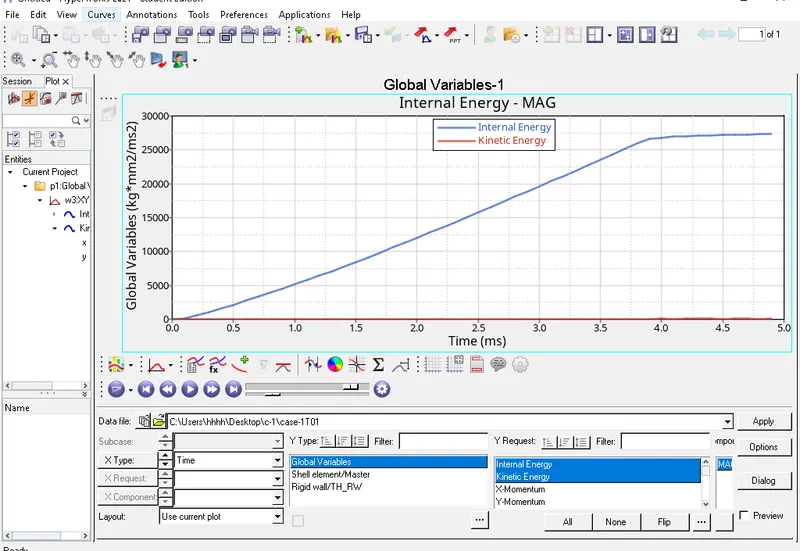
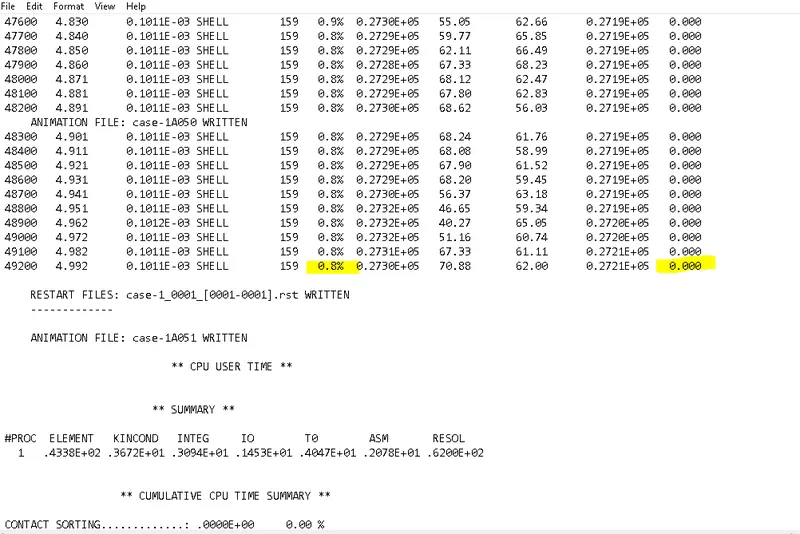
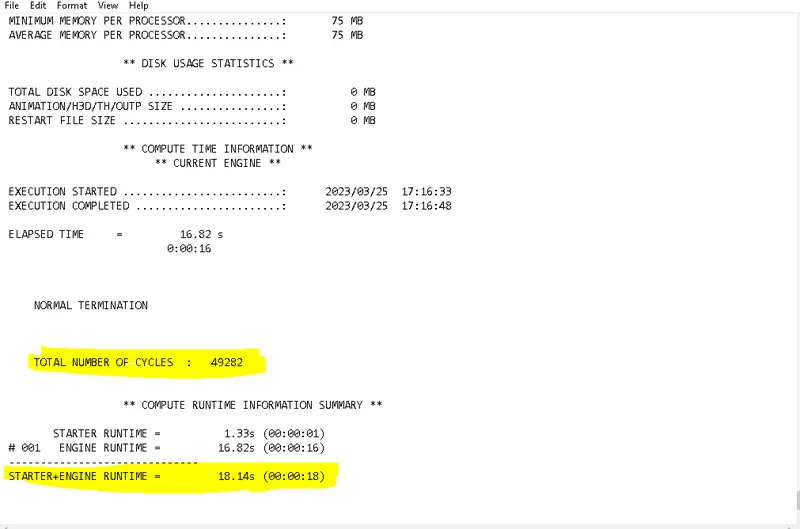
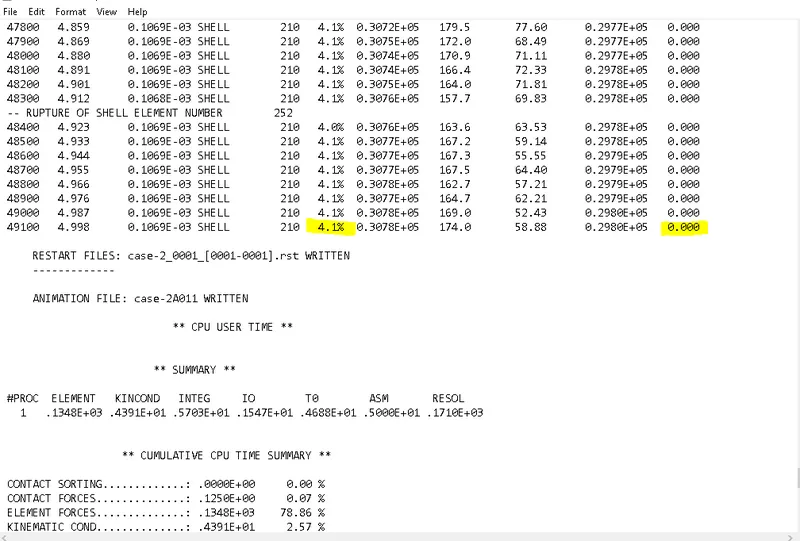
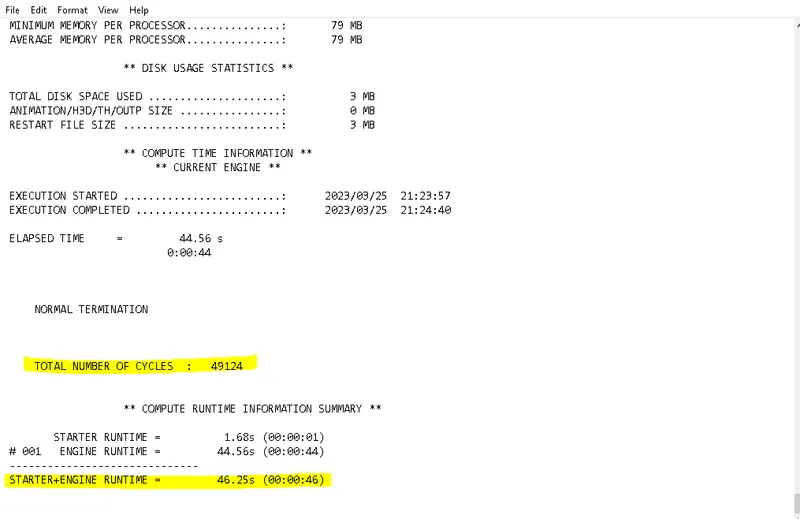
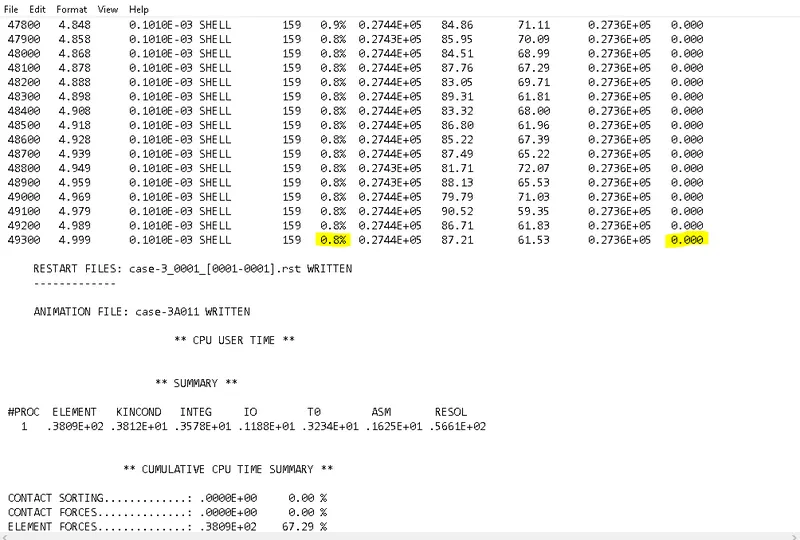
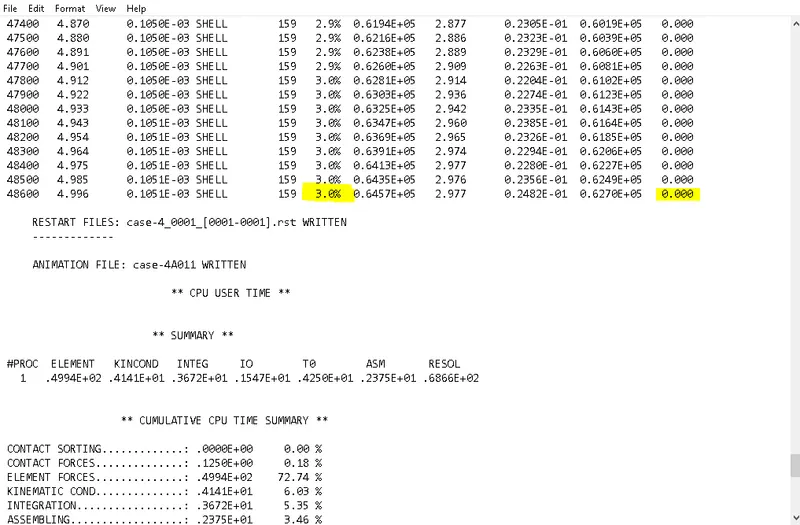
4.open the ‘_0001.out’ file in the note pad and scrolling down to check mass error, energy error, total no of cycle, total simulation time.
Case-2
1. Upload the case 1 file
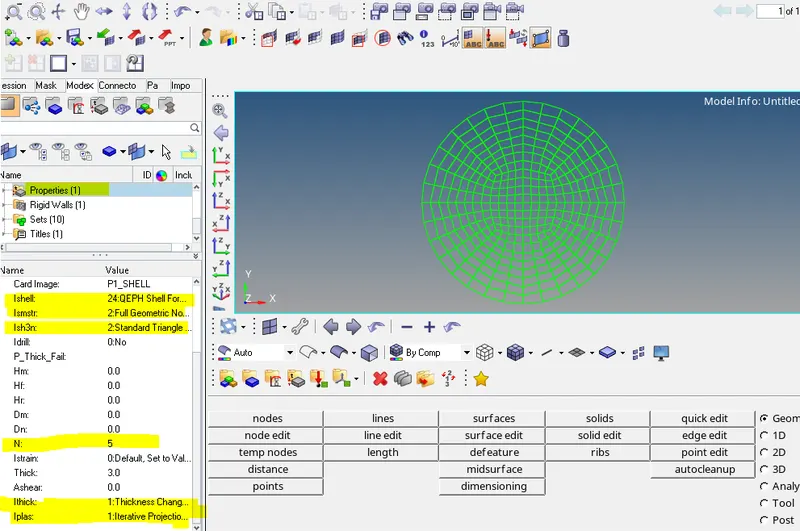
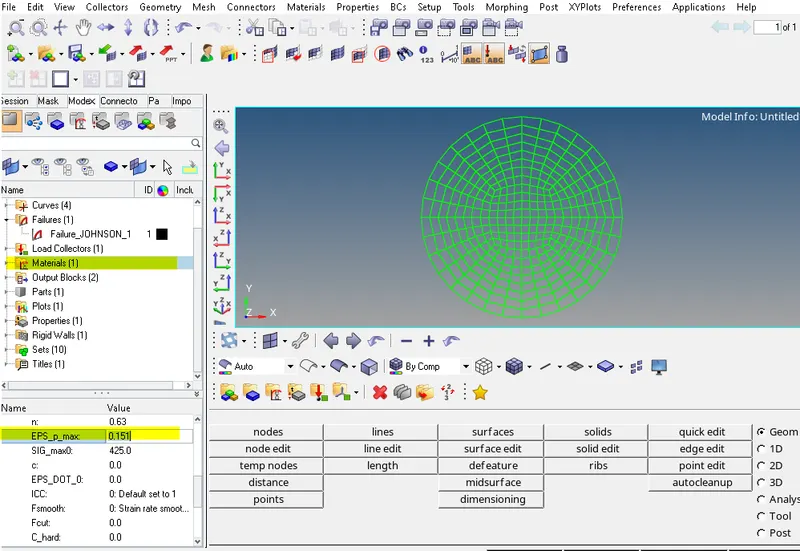
2. Change the fail_Johnson card [ ifail_sh=1, ixfem=1, Dadv=1] with failure plastic strain [EPS_p_max]
- ifail_sh=1—which determine failure of element
- ixfem=1—which allow s the failed elements to crack.
- Dadv=1 – it get activated with ixfem only.
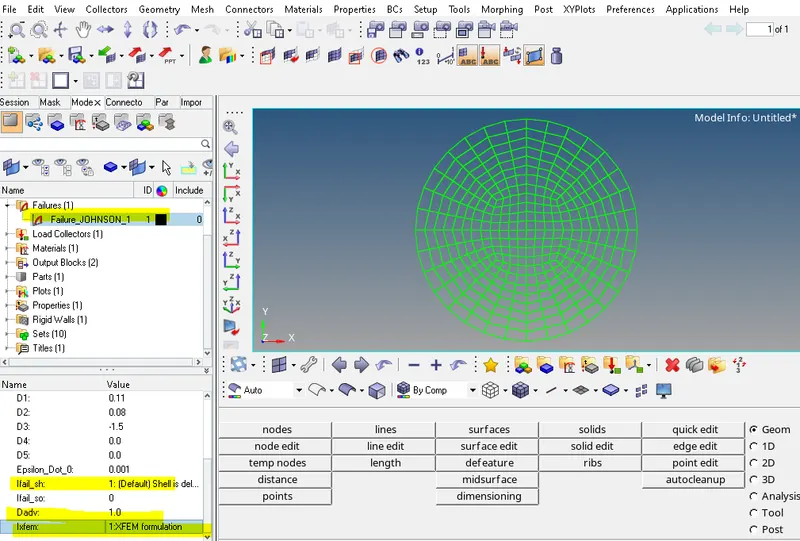
3. Run the simulation and analyse the results similar to case-1.
Case-3
1. Upload the case 2 file.
2. delete fail/Johnson card
3. Run the simulation and analyse the results similar to case-1.
Case-4
1. Upload the case 3 file.
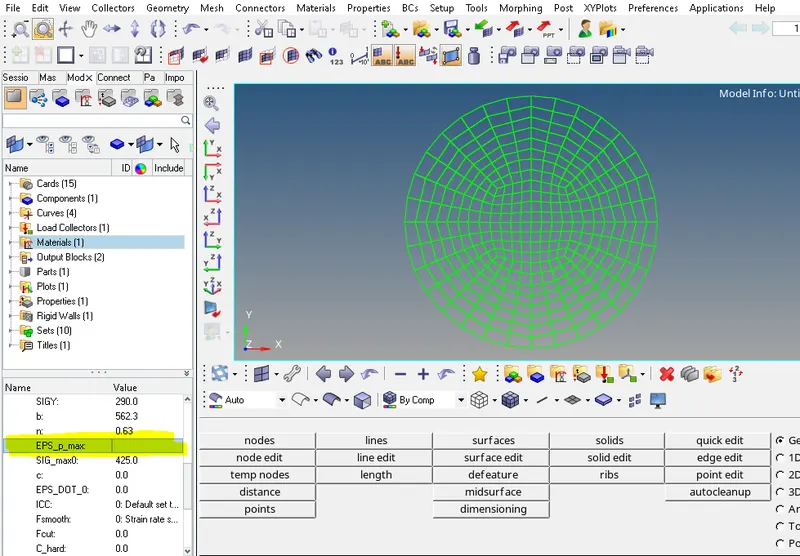
2. delete EPS_p_max
3. Run the simulation and analyse the results similar to case-1.
Case-5
1. Upload the case 4 file
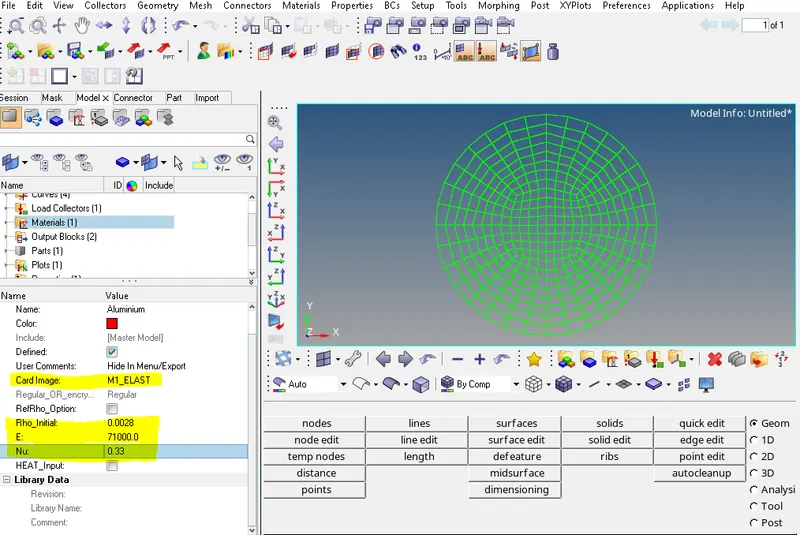
2. Change the material law [Law 1] and keep the same value of rho, E, and nu.
3. Run the simulation and analyse the results similar to case-1
Case-6
1. Upload the case 1 file
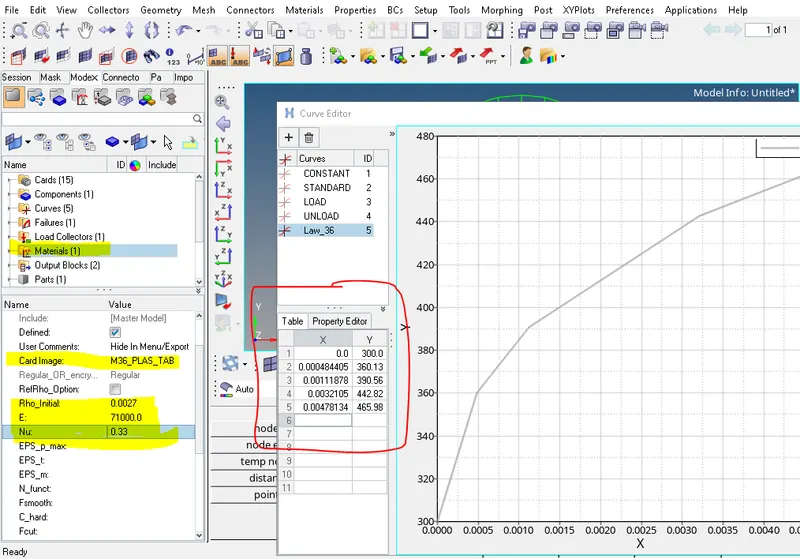
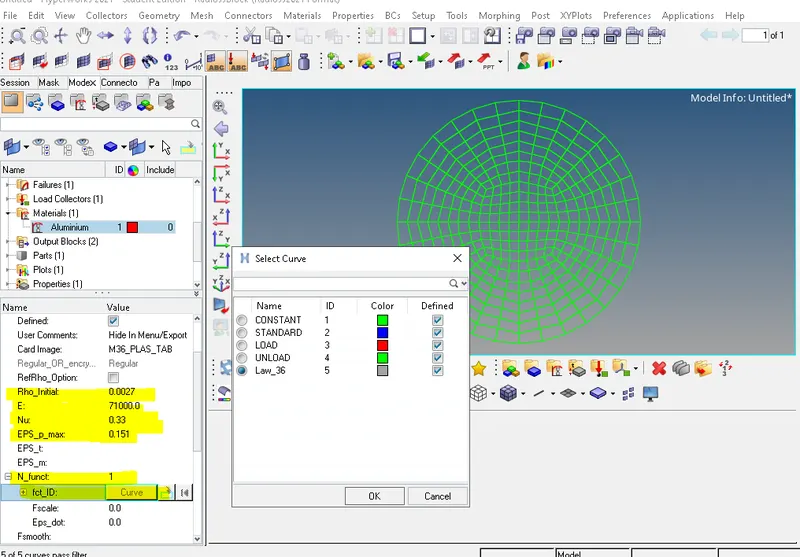
2. Change the material law [Law 36] and plot the curve using reference values and add curve by using function N_funct by changing its value 1.
3. Run the simulation and analyse the results similar to case-1
Case-7
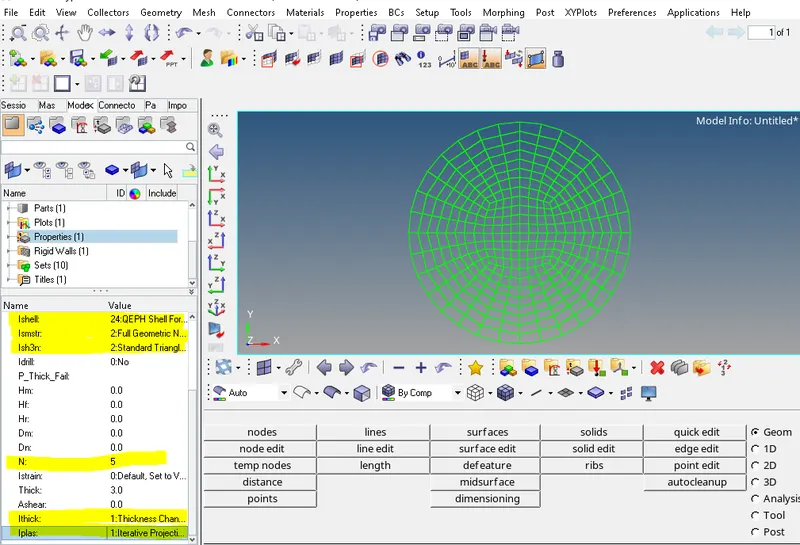
1. Upload the ‘LAW27rad’ file and set the recommended values of the shell properties
2. Run the simulation and analyse the results similar to case-1
Comparison among all 7 cases are shown in table
|
Energy error, (%) |
Mass error, (%) |
No. of cycle |
simulation time, (sec) |
Energy plot |
Simulation |
|
|
Case-1 |
0.8 |
0 |
49282 |
18.14 |
Internal energy [IE] increasing and become constant, KE remain constant |
Elements were cracked then deleted |
|
Case-2 |
4.1 |
0 |
49125 |
46.25 |
IE increasing and become constant, KE remain constant |
Elements were cracked then deleted |
|
Case-3 |
0.8 |
0 |
49310 |
16.82 |
IE increasing and become constant, KE remain constant |
Elements were cracked then deleted |
|
Case-4 |
3 |
0 |
48643 |
19.77 |
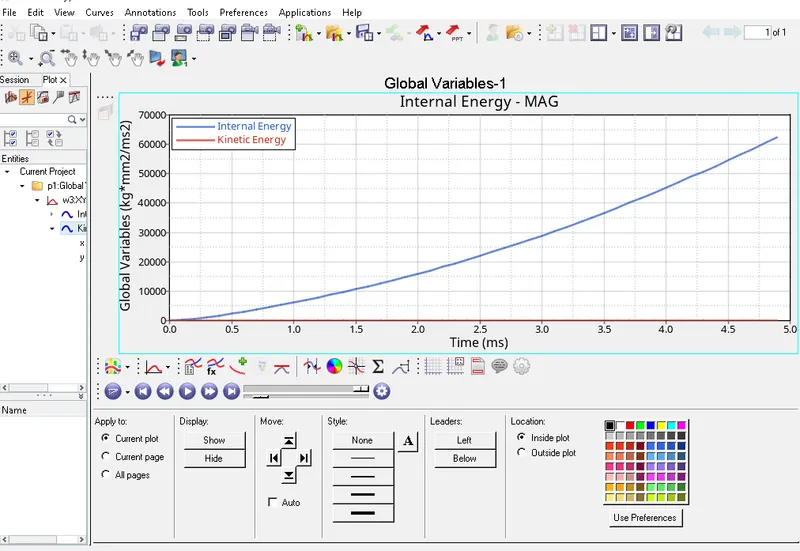
IE increasing continuously, KE remain constant |
Elements were not get fail due infinite plastic strain |
|
Case-5 |
2.4 |
0 |
47879 |
12.49 |
IE increasing rapidly continuously, KE remain constant |
Elements were not fail due to elastic card [Law 1] |
|
Case-6 |
0.8 |
0 |
53024 |
19.74 |
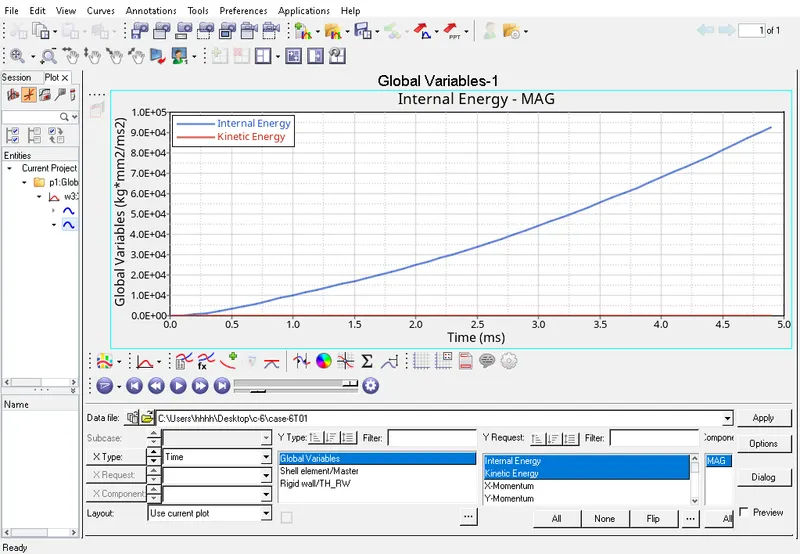
IE increasing continuously, KE remain constant |
Elements were deleted but not cracked. |
|
Case-7 |
0.8 |
0 |
49508 |
100.81 |
IE increasing and become constant after some turbulence, KE remain constant |
Elements were cracked then deleted |
Observations of results
Case-1
This case has EPS_p_max=0.151 and fail/Johnson card with ixfem=0. This means elements were deleted as they cross the EPS_p_max value, which is visible in the animation file.
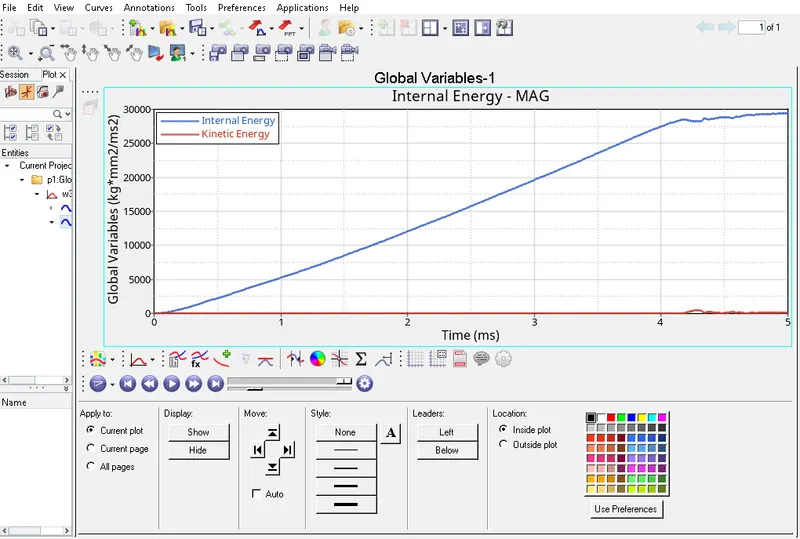
Internal Energy increase linearly until the elements were got deleted at around 4ms, then it became constant.
Case-2
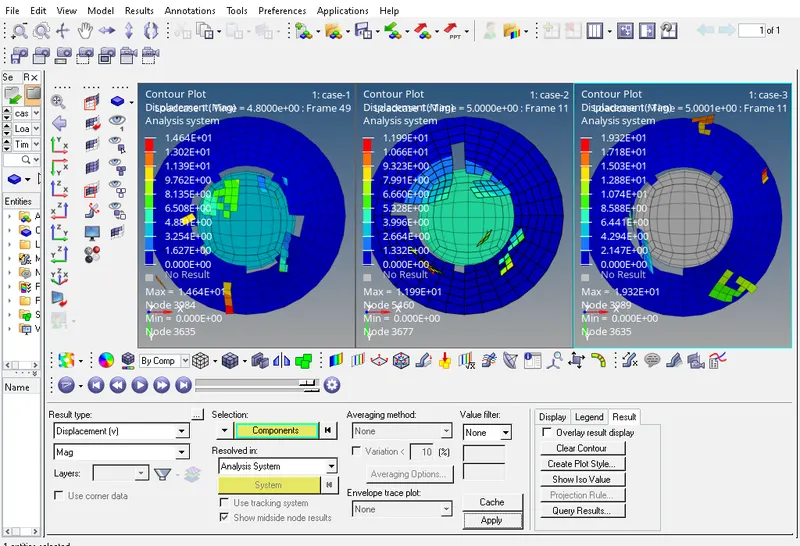
This case has EPS_p_max=0.151 and fail/Johnson card with ifail_sh=1, Dadv=1, ixfem=1. ixfem=1,which allows the failed elements to crack. Therefore, more realistic failure was seen in the animation.
Case-3
In this case, fail/Johnson card was deleted and elements were failing due to the EPS_p_max=0.151. This means, if maximum plastic strain value reaches to 15.1%, the elements will be deleted from the system. In this case elements were failed rapidly as compared to above 2 cases and we get maximum displacement of the failed elements. whereas, case -2 shows the least displacement of the elements due to ixfem crack formulation.
Case-4
In this case, fail/Johnson card and EPS_p_max were deleted [EPS_p_max=10^30 default value]. Therefore, elements were not failing due to the very high value of EPS_p_max.the material behave like a pseudo-elastic also called elasto-plastic.
Case-5
In this case, plate was defined with pure elastic material [Law-1]. There is no plasticity involved. Therefore, no elements were deleted nor cracked.
Case-6
In this case, Internal energy increased linearly with the time. Elements were not cracked even at the higher stress value.
Case-7
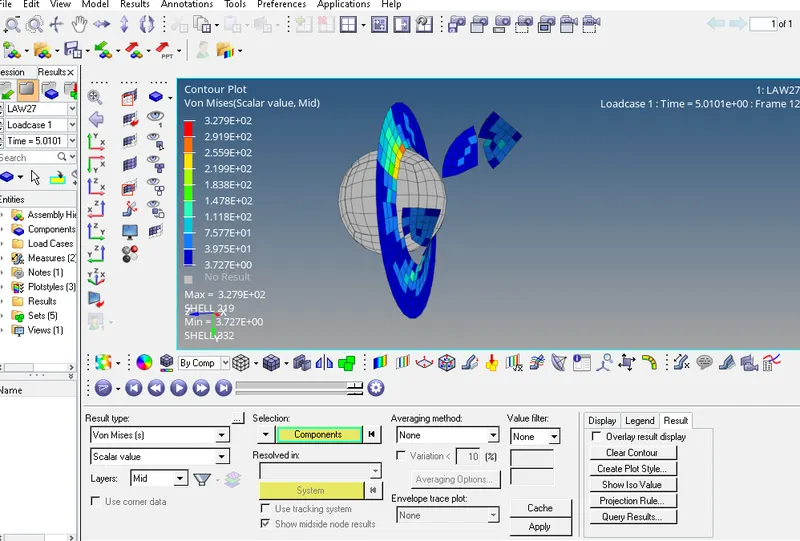
Here plate behaves as a brittle material. Plate does not bend much as the above cases and it suddenly break in to large fragment at the bending as seen in the animation file. When the elements were deleted, then large amount of energy was wasted as seen in the energy plot.
Learning outcomes
Use of material LAW In the simulation
Law 1- use for pure elastic material and remain within the elastic limit. We required rho, E, and nu values. It is not used for large deformation.
Law 2-[Johnson-cook] used for isotropic elasto-plastic material. It used for large deformation.
The failure model can be express using multiple options in fail_Johnson card
Law 36- used for isotropic elasto-plastic material with user defined functions. Here we can use the lab data to plot the curve.
Law 27- used for brittle material