Assignment 4
Objective:
- To analyse the plate failure behaviour using the different materials models for LAW 1 LAW2 LAW27 LAW36 using RADIOSS
- To compare the results for the total number of cycles, Energy error, mass error and simulation time.
- To Simulate & plot the results using HYPERVIEW & HYPERGRAPH
Case 1
Law 2 with EPS Max Failure and Failure Johnson card
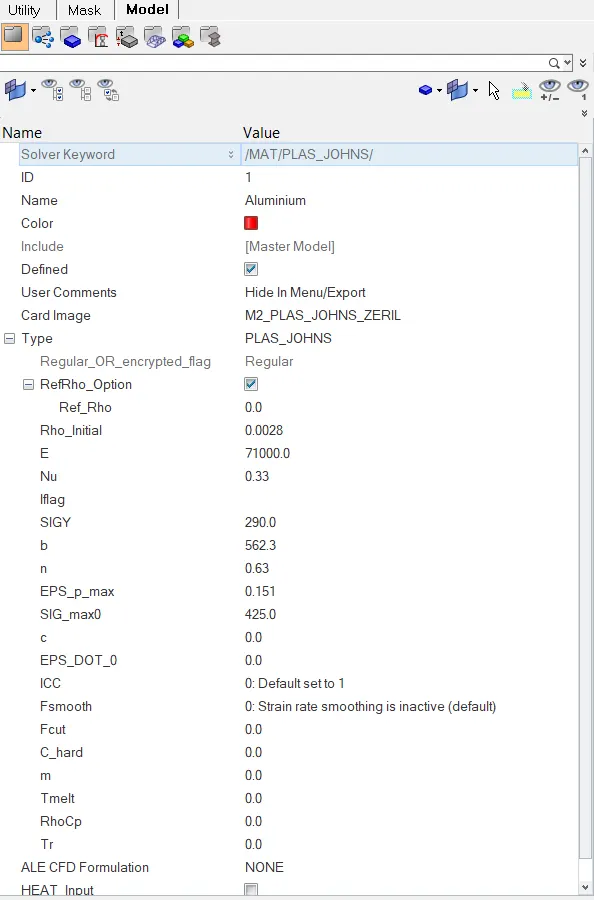
Material Card
law2 plas_johns
This law represents an isotropic elasto-plastic material using the johnson-cook material model.
This model represents the material stress as a function of plastic strain, strain rate and temperature.
Built-in failure criterion based on the maximum plastic strain (EPS max).
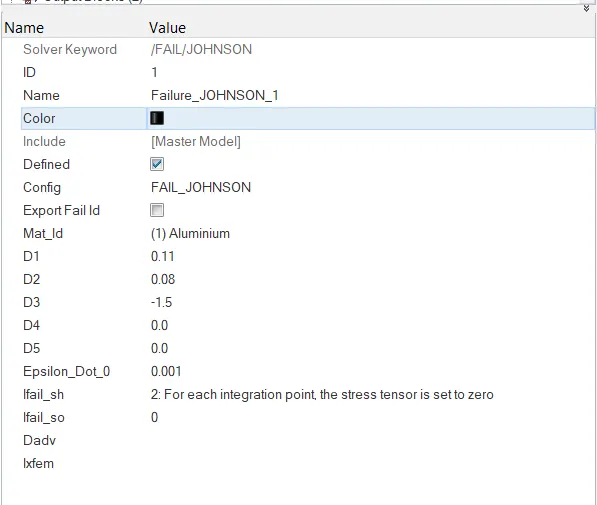
Failure Card
Since build in failure criterion does not take care of compression fails, a Failure card is applied- For three typical loadings (example: pure tension, pure shear or pure compression) material parameter D1 D2 and D3 are defined in failure card along with EPS max value.
On

Simulation Time - 67.61 s
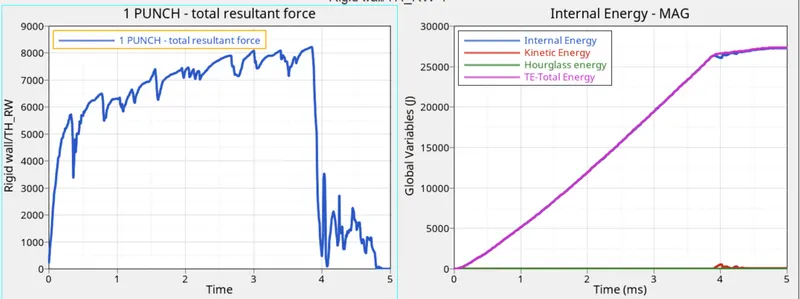
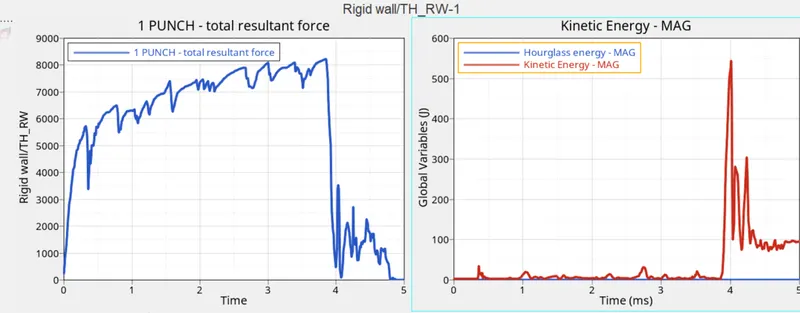
Energy Error - 0.2% and mass error - 0 (Energy Error is under acceptable limits)
The graph shows the energy activities carried out during rupturing of the plate which at strain value of 0.1481
All the energy levels are initially 0
Hourglass glass energy is 0 because Ishell -24 QEPH is used in element properties.
Kinetic Energy is maximum at 4.014ms with the value of 550.4 the component is fixed, so exhibits very less kinetic energy.
Internal Energy also reached maximum Value of 27254.3J.
Total resultant force reaches its peak value 8215.5 N just before the elements are getting deleted at 4.014ms.
.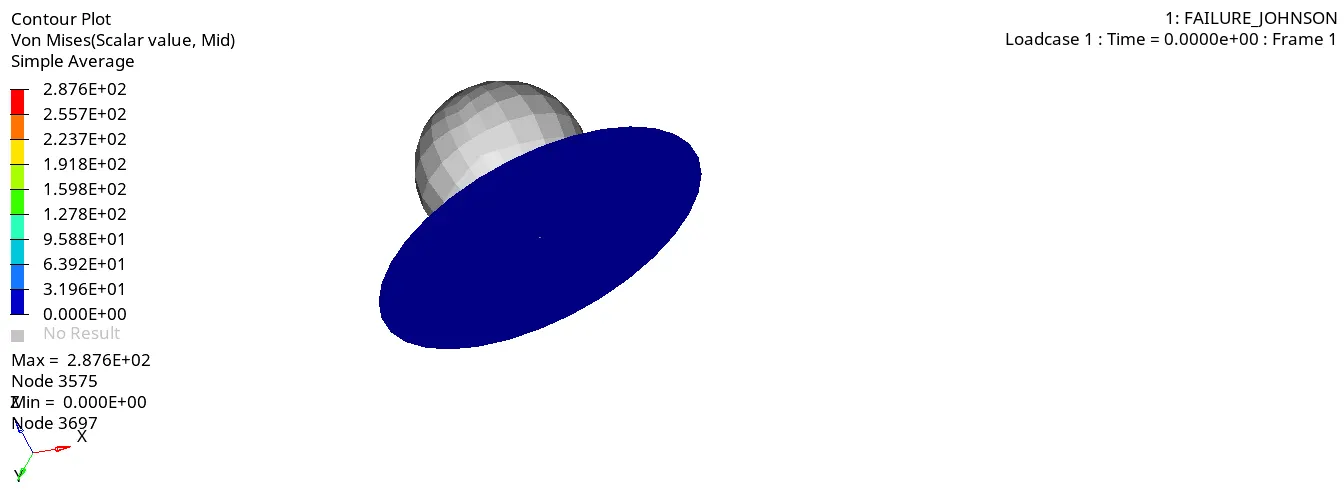
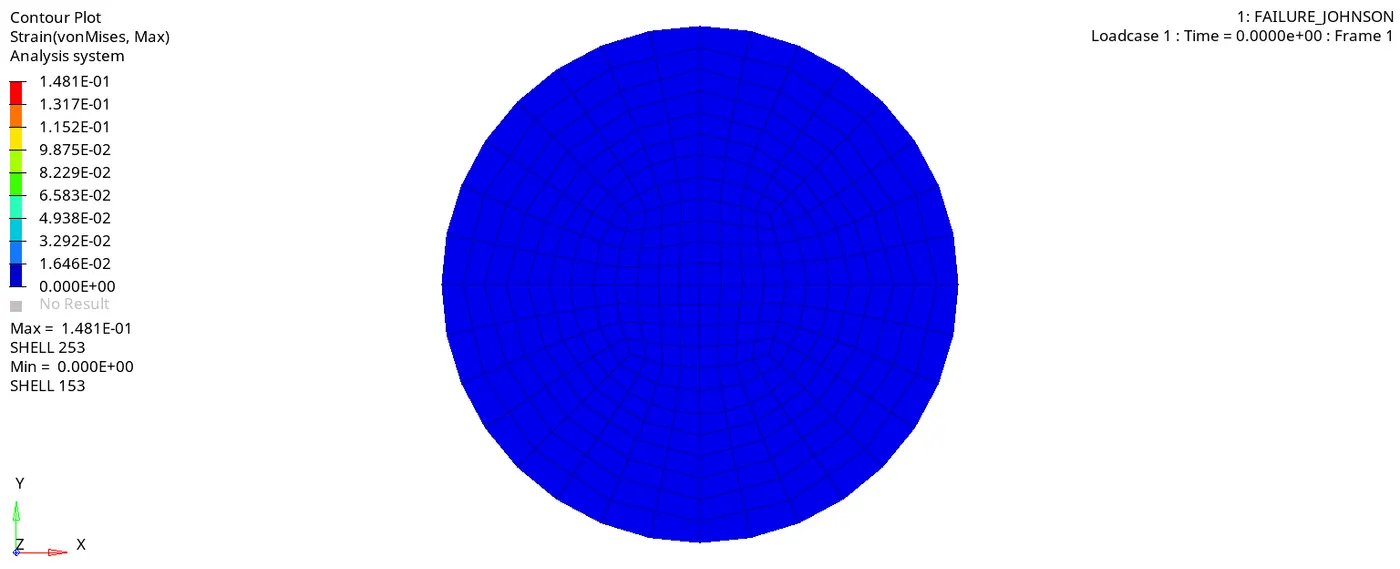
Here, Ixfem=0, so the element is deleted if it reaches the rupture criteria.
We can observe that elements are getting deleted as the maximum plastic strain values are reached in the elements. But the crack propagation cannot be observed well as Ixfem is 0 in this case.
Case 2
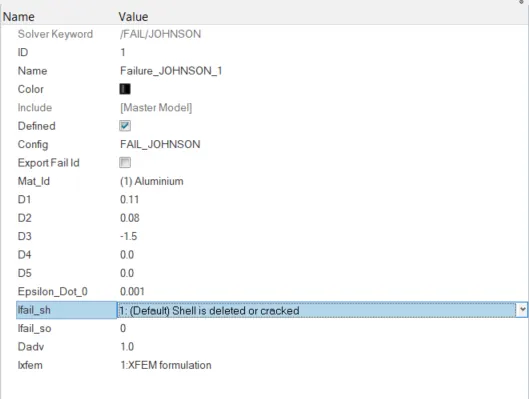
Law 2 with EPS Max Failure and Ifail =1, Dadv =1 and Ixfem = 1
Using the same material but in this case Ixfem=1, so the element will crack if it reaches the rupture criteria.
Ifail_sh =1,
Shell is deleted or cracked when D=∑Δεpεf≥1">D=∑Δεpεf≥1D=∑Δεpεf≥1 for one integration point or layer. ;
Dadv = 1 Criterion for the crack advancement (Only active if with Ixfem =1),
Material - similar to case 1
Failure Model
Simulation Results -
ELAPSED TIME = 68.77 s
TOTAL NUMBER OF CYCLES: 49397

Energy error - 4.0% Mass Error - 0
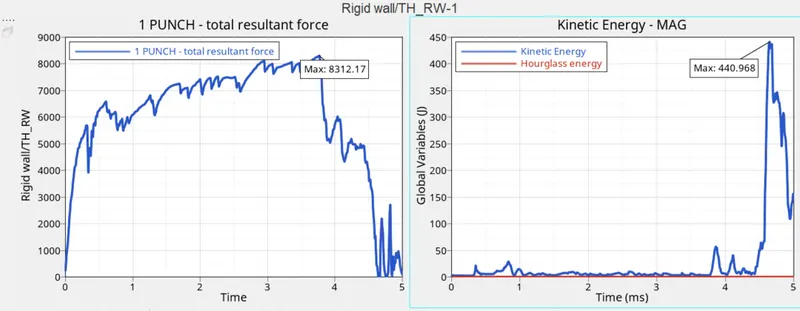
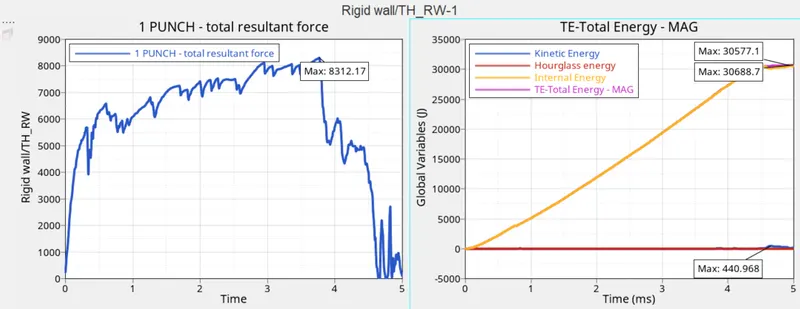
Kinetic Energy is maximum at 4.664ms with the value of 440.968 the component is fixed, so exhibits very less kinetic energy.
Internal Energy also reached maximum Value of 30577.1.
Total resultant force reaches its peak value 8312.17 N just before the elements are getting deleted at 4.014ms
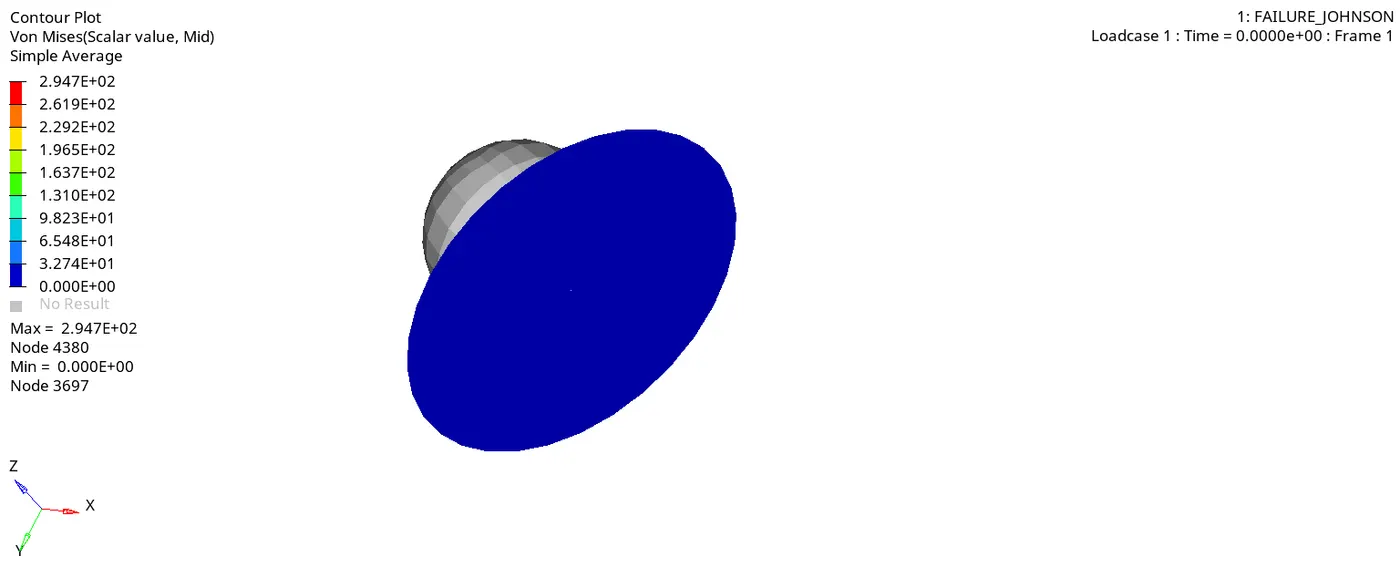
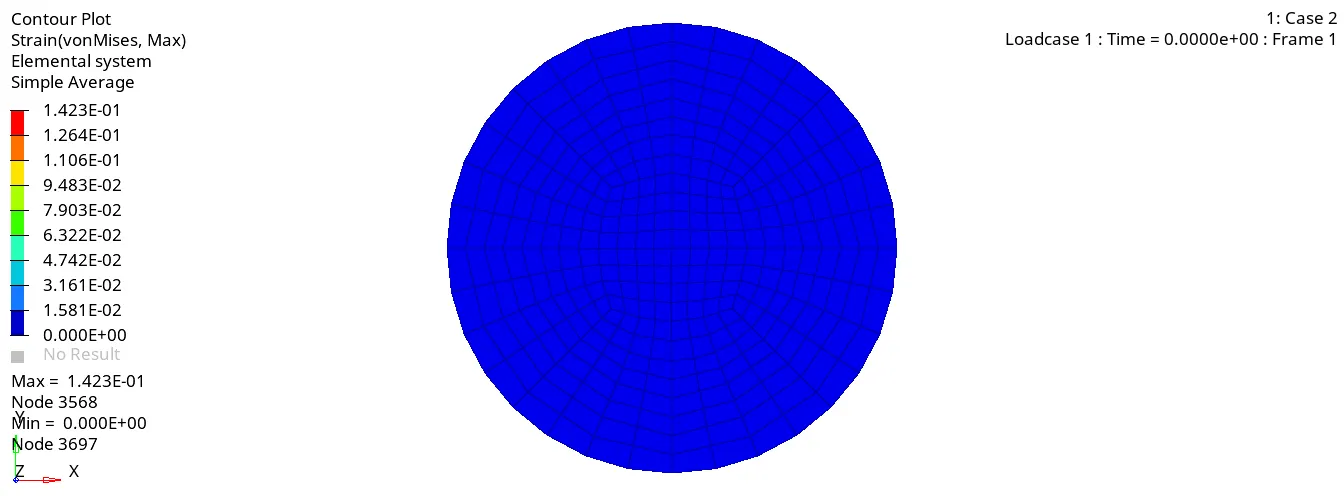
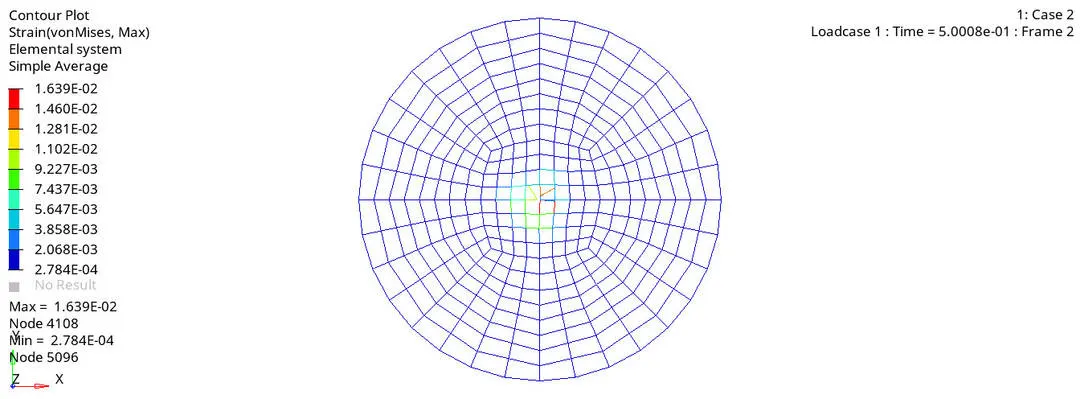
In this case, we can see the crack propagation before element deletion. And we observe due to Dadv, Along with that Ixfem =1 hence crack propagation can be visible in this case before the elements getting deleted.
Case 3 – Law 2 with deleted Fail Johnson card
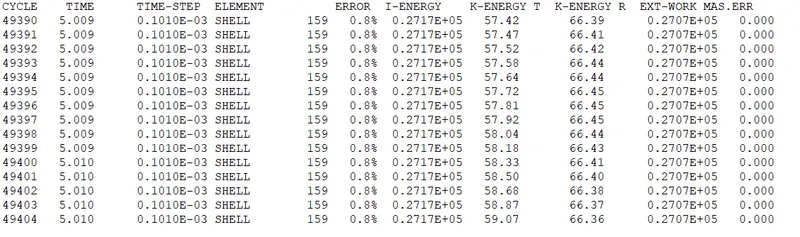
ELAPSED TIME = 67.46 s
TOTAL NUMBER OF CYCLES: 49405
Energy Error = 0.8% mass error = 0
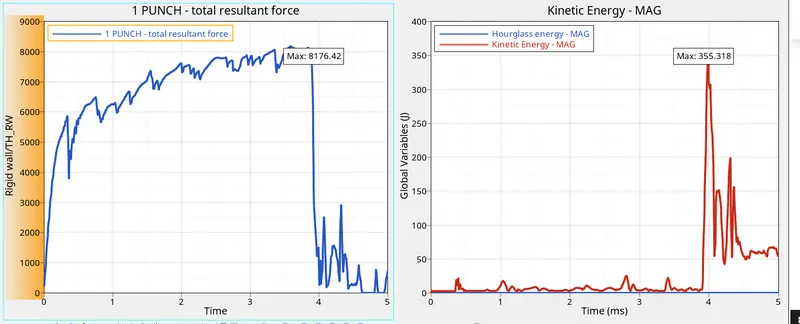
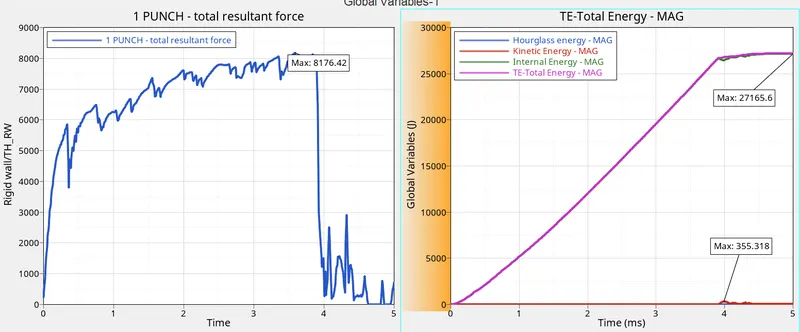
The internal energy shows the work done on the element in which it is the deformation of the plate.
Hourglass Energy is not observed.
The kinetic energy of the plate is very little.
The total resultant force of rigid ball reaches its peak value 8176.42 N at the time of impact.
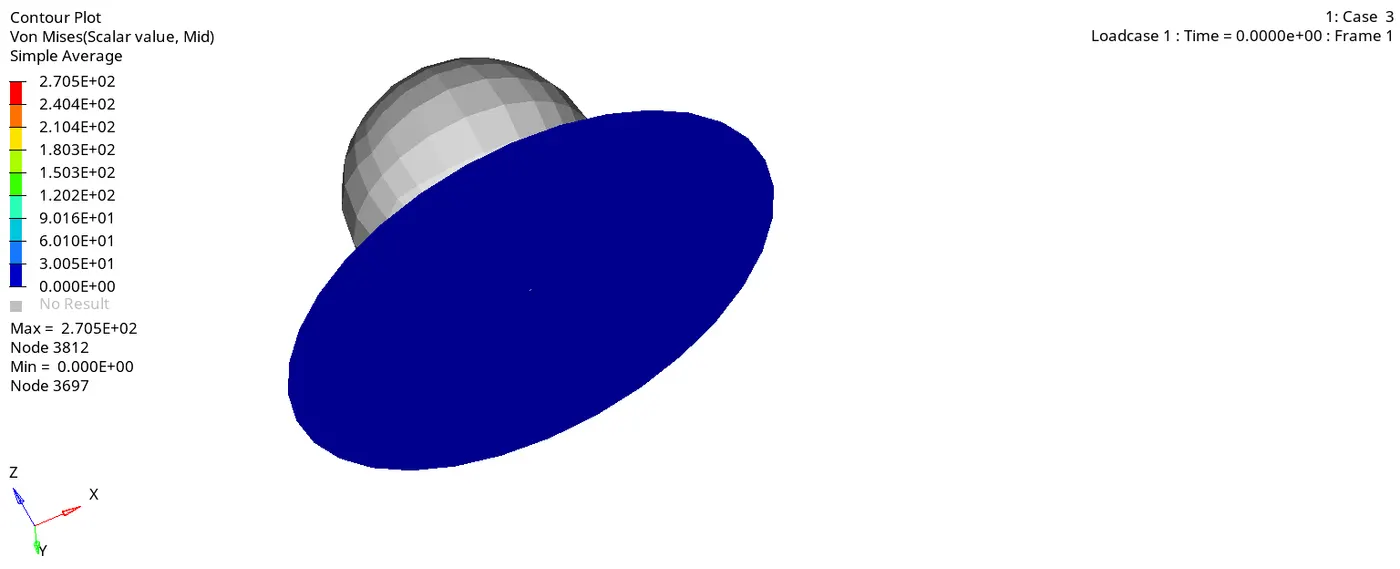
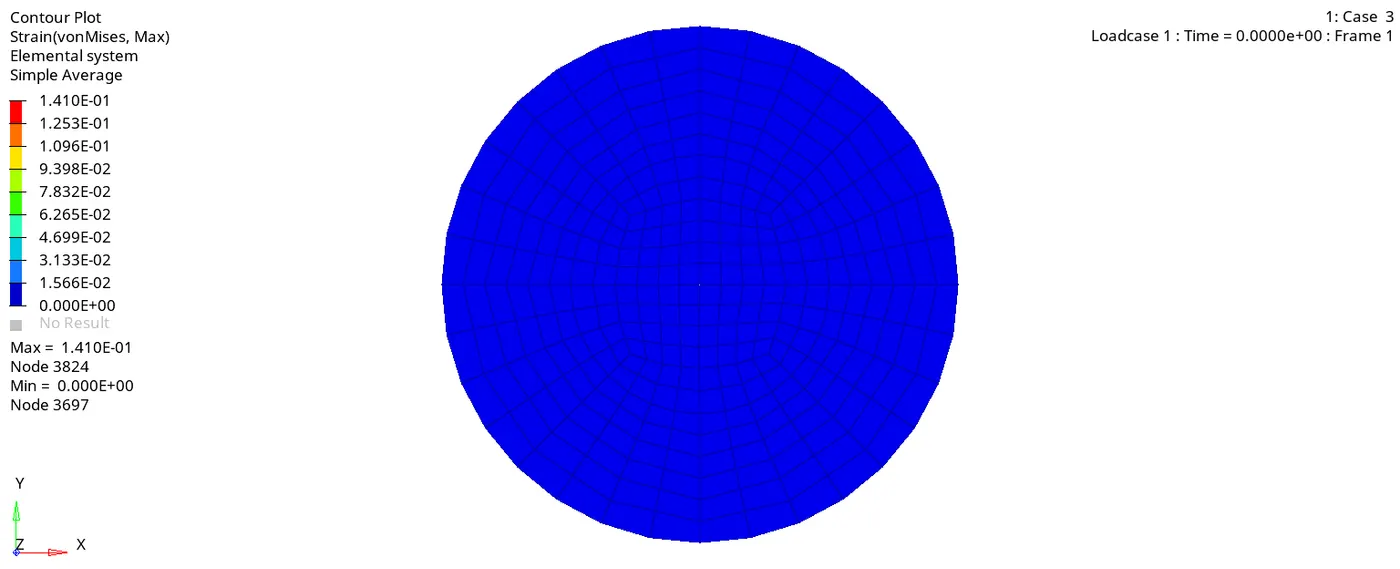
As the failure formulation is deleted here, instead of elemental cracking, the elements get deleted.
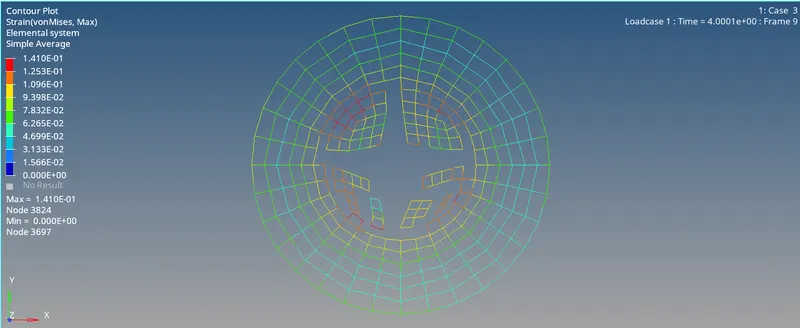
Eps max failure criteria considered. Elements are deleted once it reaches 15.1% of the True plastic strain value.
The deletion of elements occurs at a strain value of 0.1410.
Case 4 – Law 2 without EPS Max Failure
ELAPSED TIME = 71.94 s
TOTAL NUMBER OF CYCLES: 49304

Energy Error - 1.1% and mass error - 0
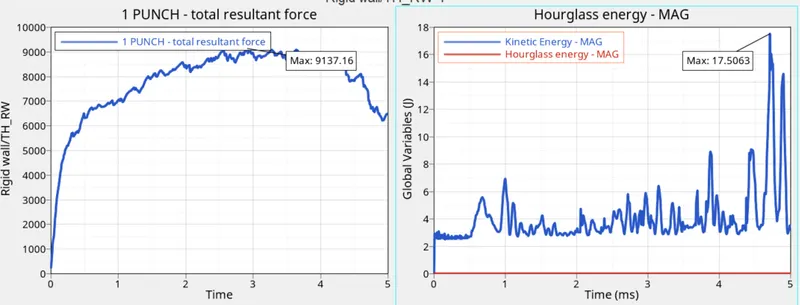
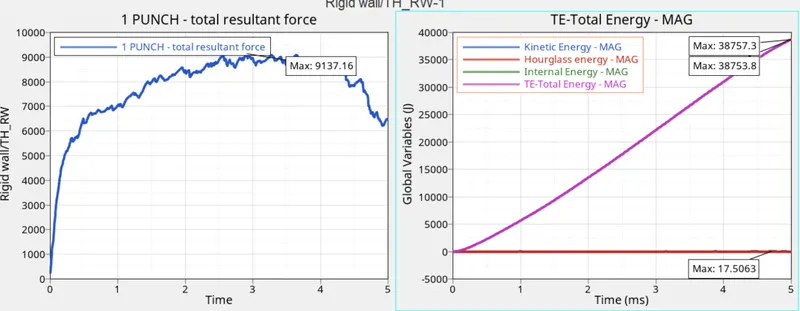
From the above graphs, it can be seen that internal & total energy goes on increasing with time because the plate is resisting the force. Max value of both is 38757.3 J.
Energy is increased till the end of the cycle.
Kinetic energy is low, as there is no movement of the rupture plate is involved.
Hourglass energy is zero because we have used Ishell=24 (QEPH).
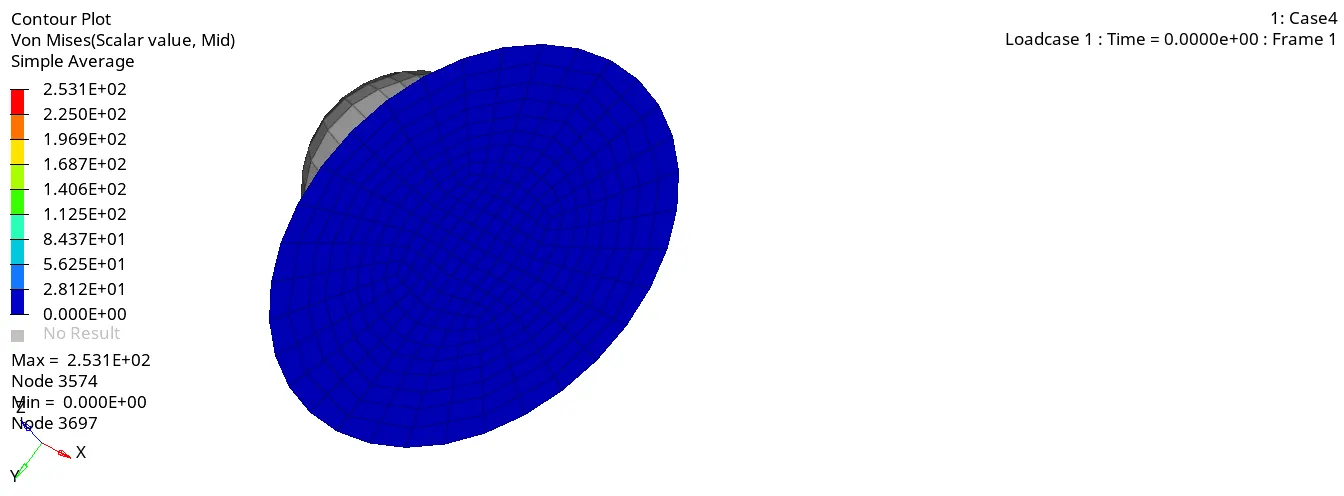
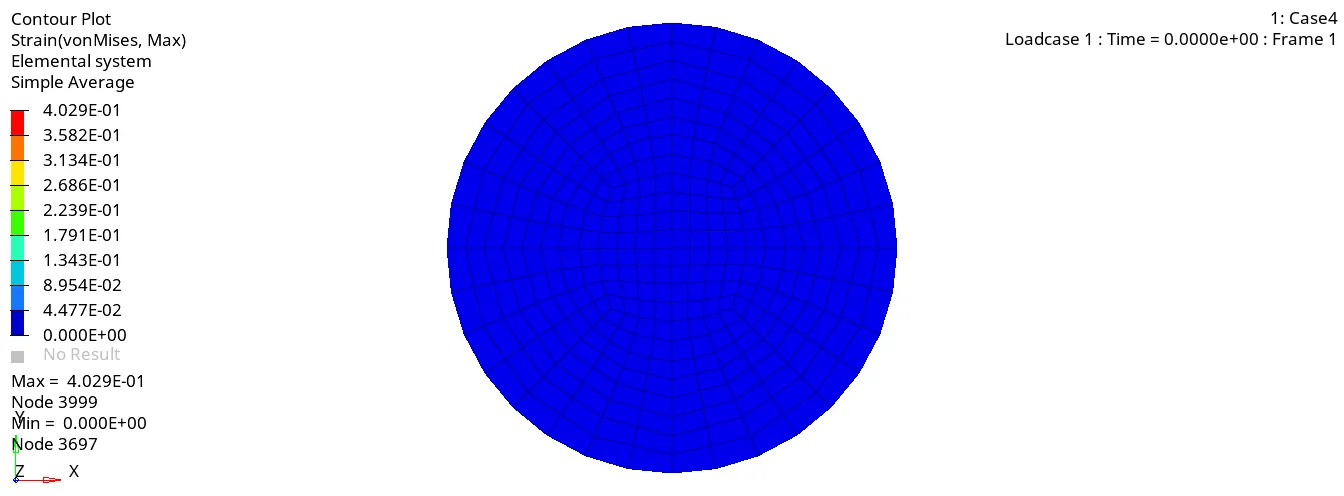
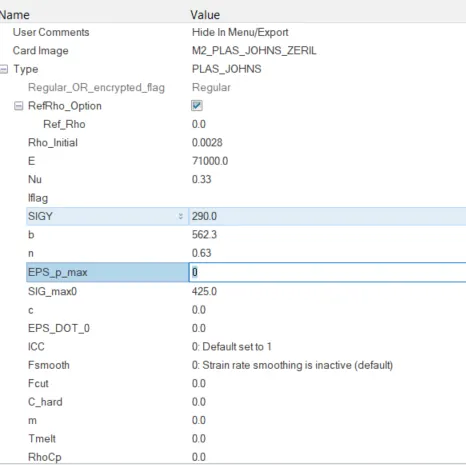
EPS_P_max is kept zero but the failure card is still present having Ifail_sh value =2

EPS_P_max=0 alone will not let the elements to be get deleted.
CASE 5- Law1 elastic
ELAPSED TIME = 65.15 s
TOTAL NUMBER OF CYCLES: 47969

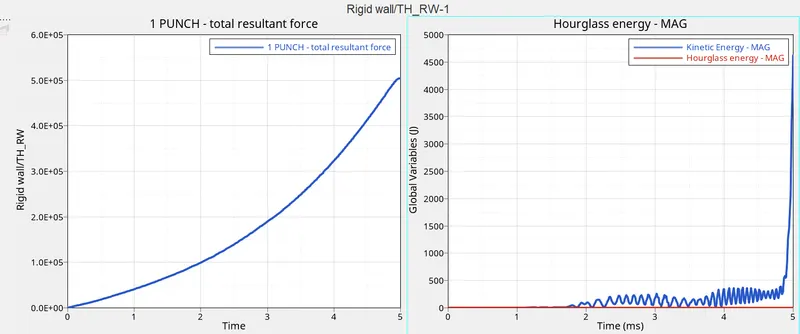
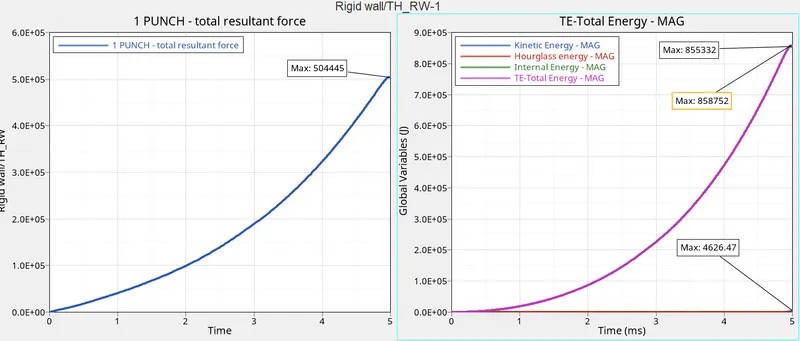
Internal & total energy goes on increasing exponentially with time because the plate is resisting the force till the last travel of the punch.
Kinetic energy is low, with respect to the internal energy plate is involved.
Hourglass energy is zero because of Ishell=24 (QEPH).
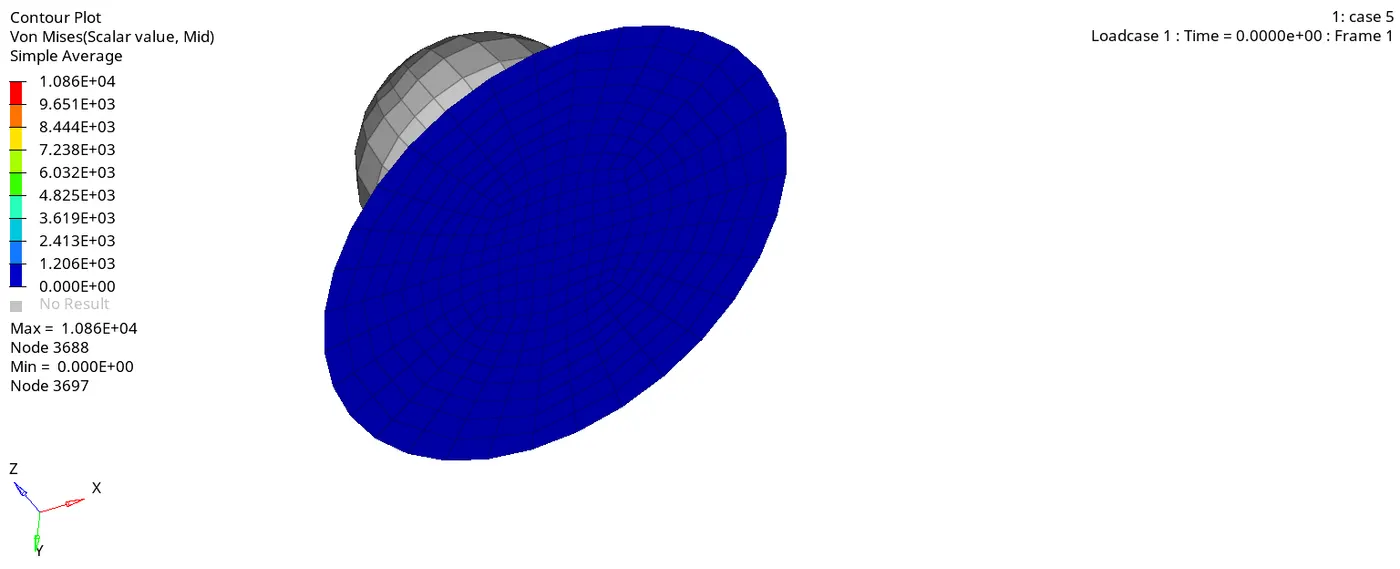
max stress comes as 10860 Mpa
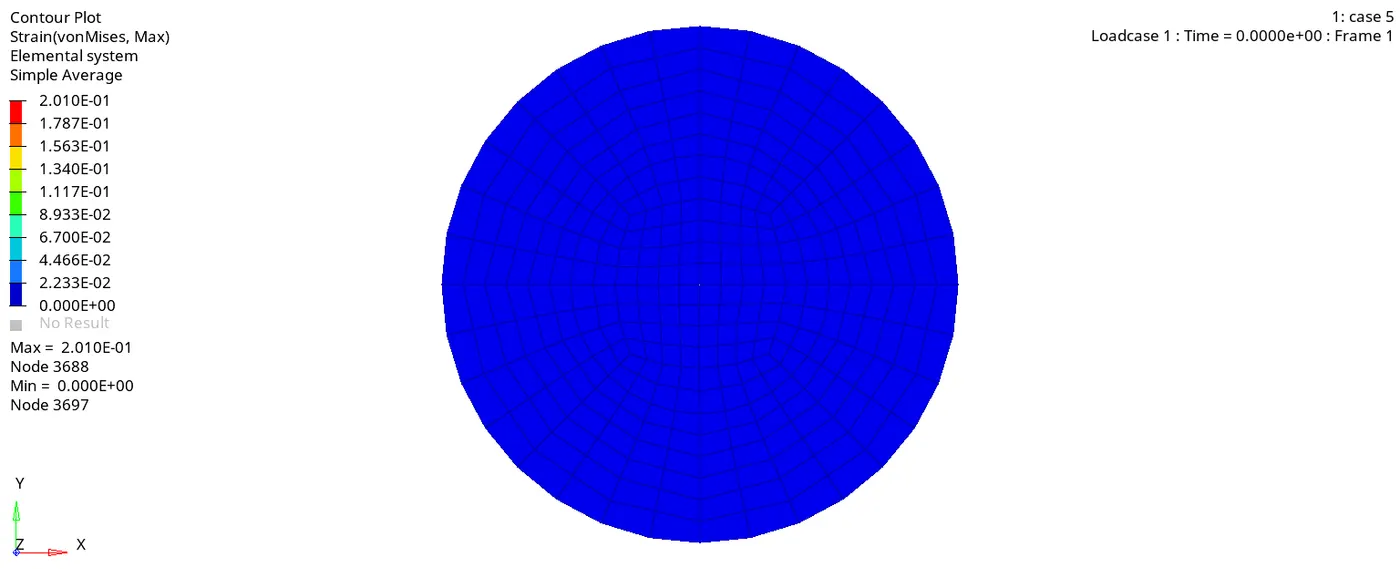
In this case, stress-induced is high because there is no failure criteria & and we have defined the material as elastic in nature. Thus the rupture plate act as elastic material & whatever deformation is there will take place in elastic phase only. Thus more strain will cause more stress. Elements neither deleted nor ruptured.
Case 6 – Law 27 (plas_brit)
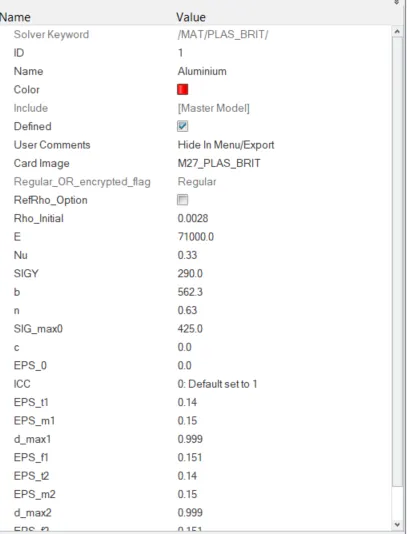
This law combines an isotropic elasto-plastic Johnson-Cook material model with an orthotropic brittle failure model. Material damage is accounted for prior to failure. Failure and damage occur only in tension. This law is applicable only for shells.
Element properties
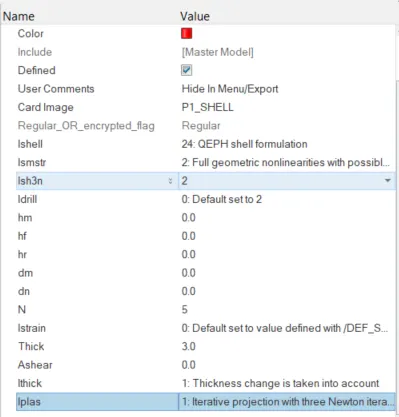
ELAPSED TIME = 62.14 s
TOTAL NUMBER OF CYCLES : 49356

Energy Error = 1.1% Mass error - 0
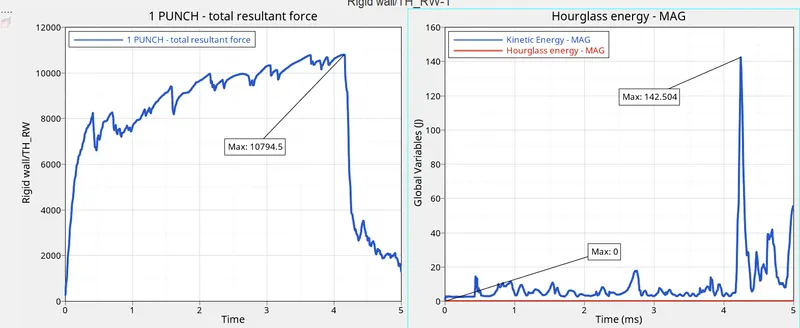
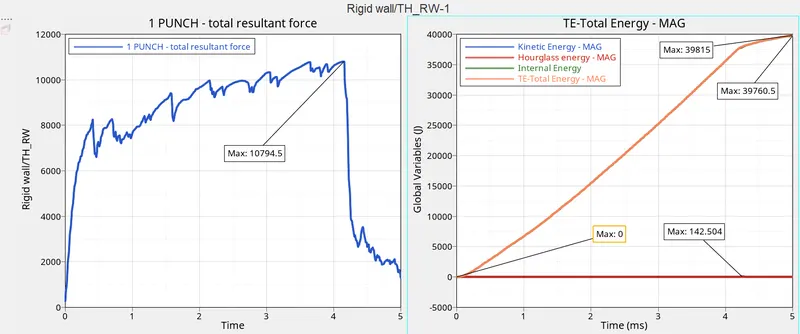
Internal Energy and Total Energy sloped changed after the impact, it kept on increasing but with less steep slope.
Kinetic Energy remained low.
Resultant Force of rigid body starts reducing after the impact.
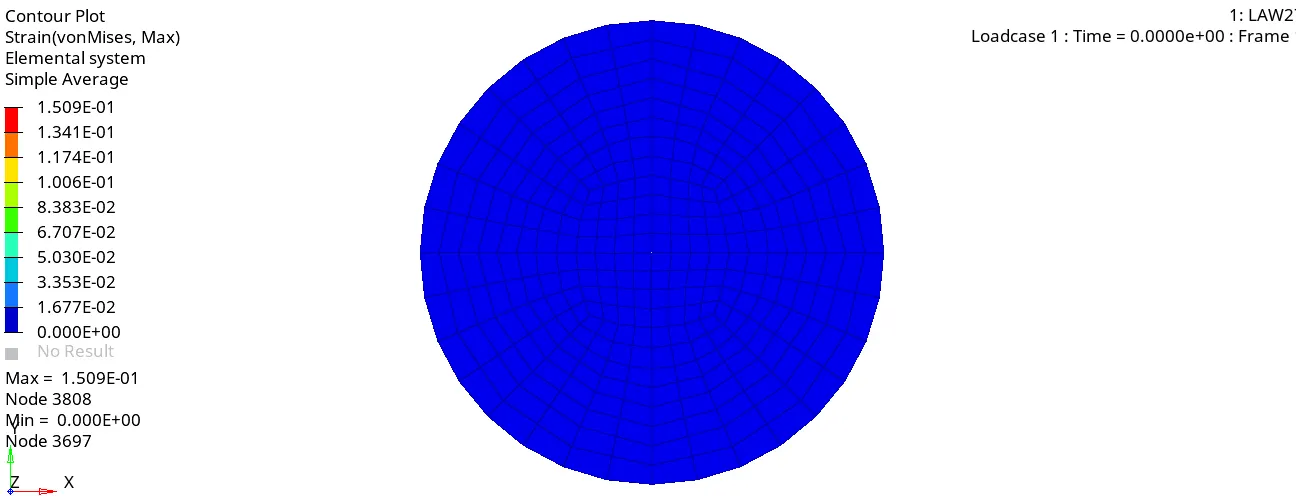
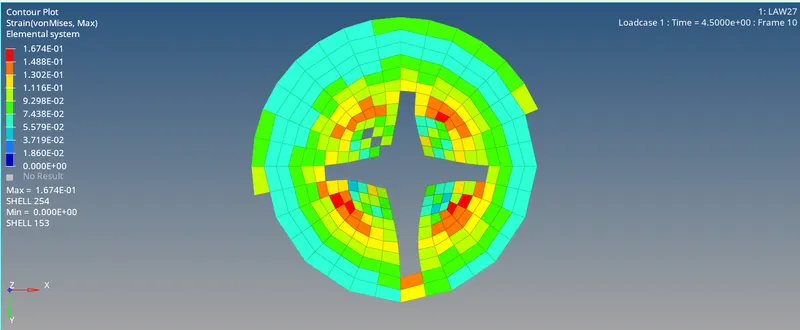
Elements get deleted once the failure criteria is reached. The plate break into two parts showing its brittle nature.
The damage parameters are:
- Tensile rupture strain εt1">εt1εt1
Damage starts if the highest principal strain reaches this tension value.
- Maximum strain εm1">εm1εm1
The element is damaged if the highest principal strain is above the tension value. The element is not deleted.
- Maximum damage factors
This value should be kept at its default value (0.999).
- Failure strain εf1">εf1εf1
The element is deleted if the highest principal strain reaches the tension value.
Element is deleted if ef1= 0.151
maximum strain value reached = 0.1674
Case 7 – Law 36 with Strain rates curve
This law models an isotropic elasto-plastic material using user-defined functions for the work-hardening portion of the stress-strain curve (for example, stress vs. plastic strain) for different strain rates.
Material Card
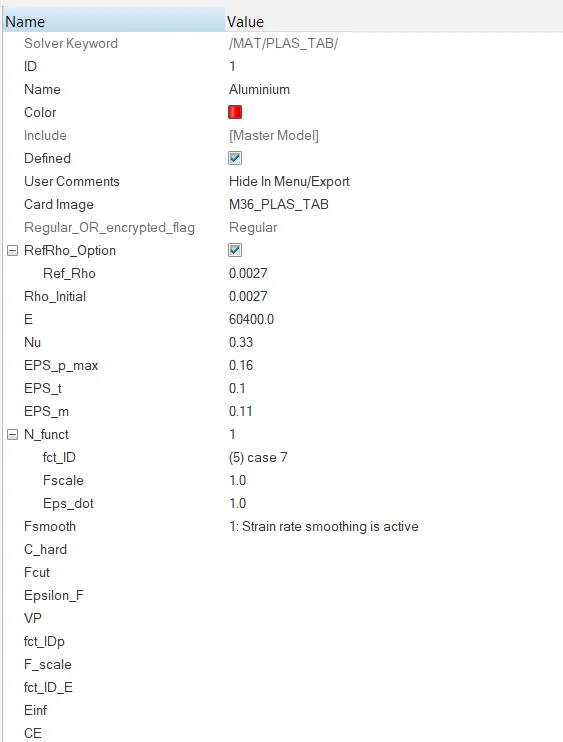
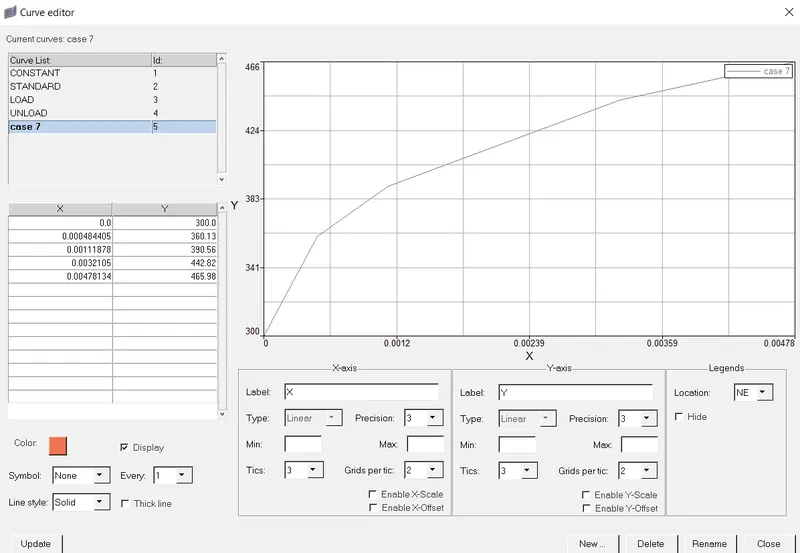
The Law36 model requires a function id (fct_ID) and it is assigned using a curve that determines the Yield stress corresponding to strain rate.
ELAPSED TIME = 64.83 s
TOTAL NUMBER OF CYCLES: 49036

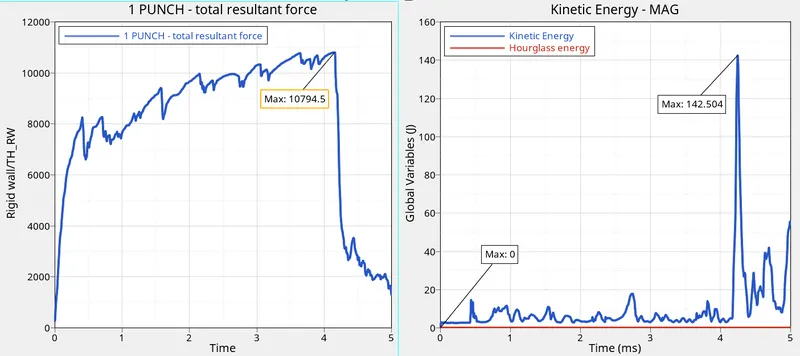
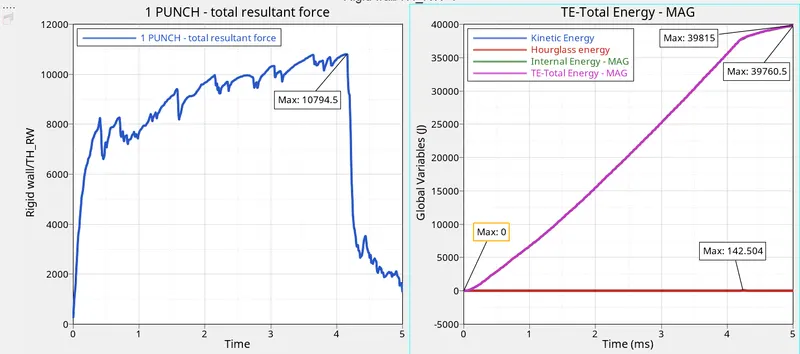
Internal energy and total energy reached its maximum value 39760.5j & 39815j respectively at the end of the simulation.
maximum kinetic energy 142.50 reached at the time of impact.
Hourglass energy is zero because of Ishell=24 (QEPH).
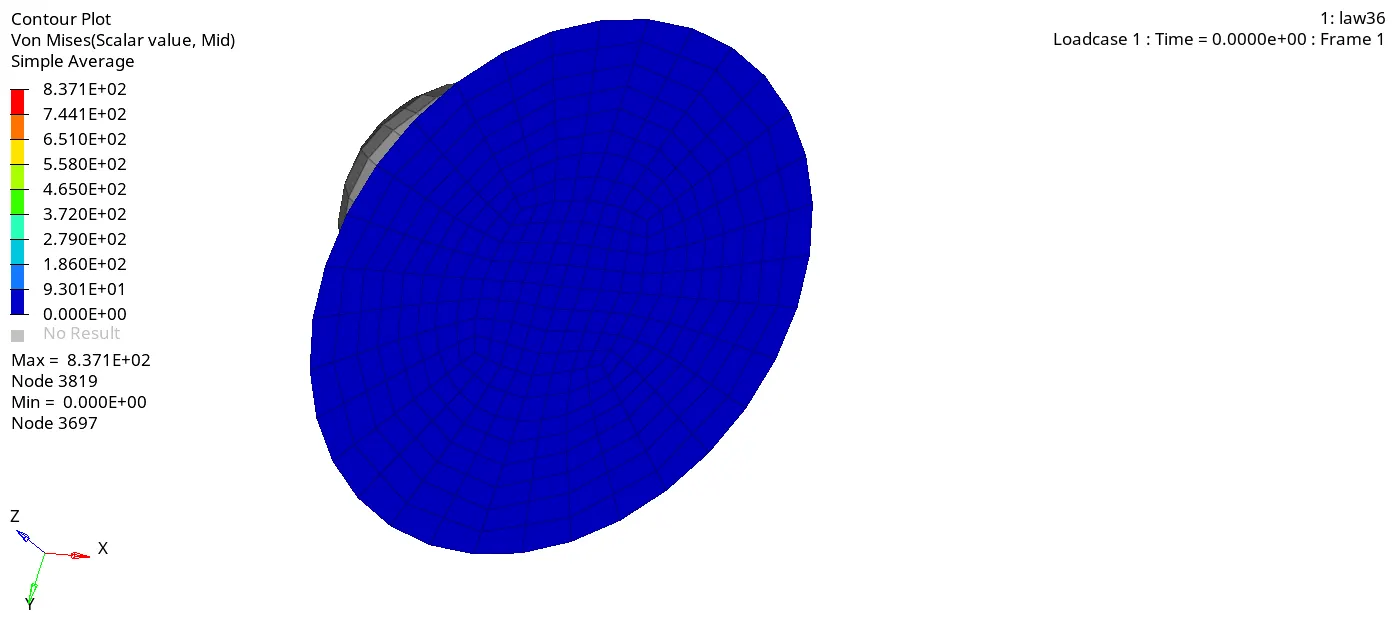
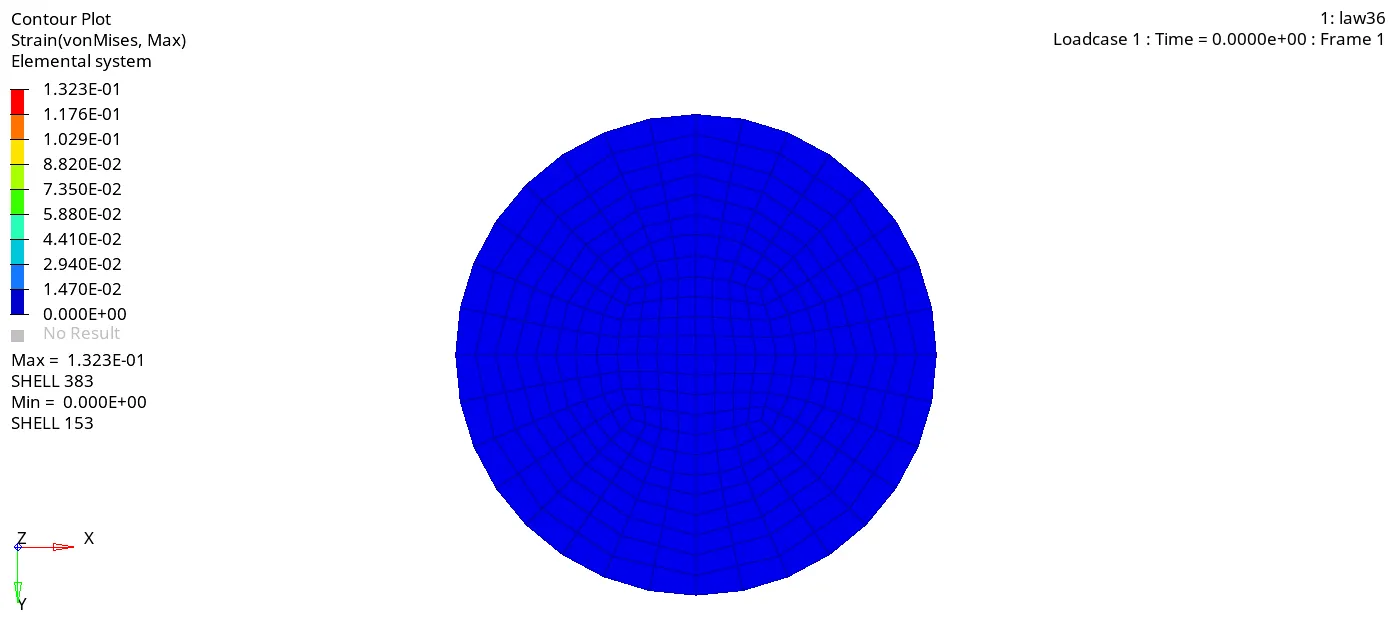
The LAW36 model has 4 damage and rupture parameters:
- EPS p max is the maximum plastic strain for element deletion for any loading like tensile, shear or compression
- EPS_t is the beginning of the tensile damage. From this point, the stress value defined in the curve is reduced by the factor σ=σ(εm−ε1/εm−εt)
Where EPS 1 is the largest principal strain
- EPS_m is the end of tensile damage. The stress value is null but the element is not deleted.
- EPS_f is the tensile failure strain value for element deletion
Conclusion
|
CASE |
MATERIAL MODEL/MATERIAL LAW |
NUMBER OF CYCLE |
ENERGY ERROR (%) |
MASS ERROR(%) |
SIMULATION TIME(SECONDS) |
REMARKS |
|
CASE1 |
FAIL JOHNSON, JOHNSON COOK MM(LAW2) |
49479 |
0.2% |
0 |
67.61 s |
Elements are deleted without crack formation. Fail/john card initiated the failure as eps_max value is not reached |
|
CASE2 |
FAIL JOHNSON, JOHNSON COOK MM(LAW2) with Ifail =1, Dadv =1 and Ixfem = 1 |
49397 |
4.0% |
0 |
68.77 s |
First cracked are formed and then element deletion occurs. due to the use of Ixfem |
|
CASE3 |
JOHNSON COOK MATERIAL MODEL(LAW2) without Fail Johnson card |
49405 |
0.8% |
0 |
67.46 s |
eps_p_max was 0.151. The element was deleted when the plastic strain was 15% .material failed for the least amount of stress among all cases |
|
CASE4 |
JOHNSON COOK MATERIAL MODEL(LAW2) without EPS_max value |
49304 |
1.1% |
0 |
71.94 s |
eps_p_max was set to zero. But the failure card is still present having Ifail_sh value =2 |
|
CASE5 |
ELASTIC PLASTIC MODEL(LAW1) |
47969 |
0.3% |
0 |
65.15 s |
No deletion of elements but stress generated was very high. |
|
CASE6 |
PLAS_BRIT(LAW27) |
49356 |
1.1% |
0 |
62.14 s |
The material was brittle and failure occurred when strain became more than EPS_f1=0.15 |
|
CASE7 |
PLAS_TAB(LAW36) |
49036 |
-1.4% |
0 |
64.83 s |
Isotropic elastoplastic material. Elements deleted when EPS_p_max=0.16 |