Assignment 2-RADIOSS Engine File Editing & 3D Meshing Challenge
1. Check the material properties of the rail component and calculate the speed of sound in steel rail= 5188 mm/ms
2. The length of the rail is about 1000 mm.calculate the time takes for a shock wave to travel from one end of the rail to the other.= 0.1927 ms
3. Time for sound to travel length of rail= 0.1927 ms
5. Set the frequency of animation output to a time that will give 20 animation steps(/ANIM/DT)=0.009635
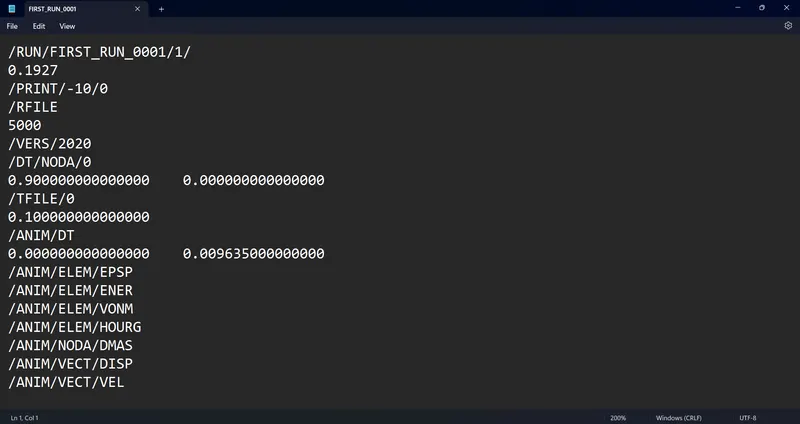
Calculation:
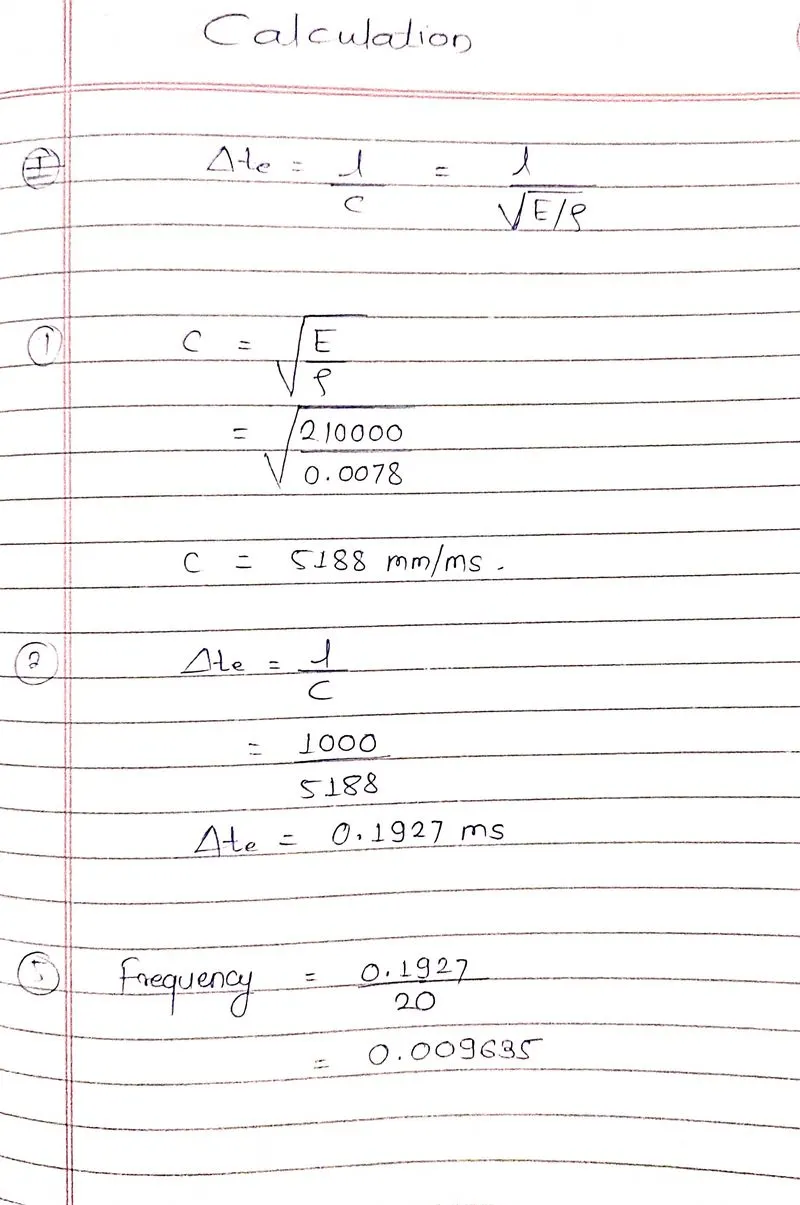
Objectives:- To perform 3D meshing on given models and edit the engine file.
Procedure:-
Model 1: 2D to 3D Meshing
- Import a geometry and do geometry cleanup.
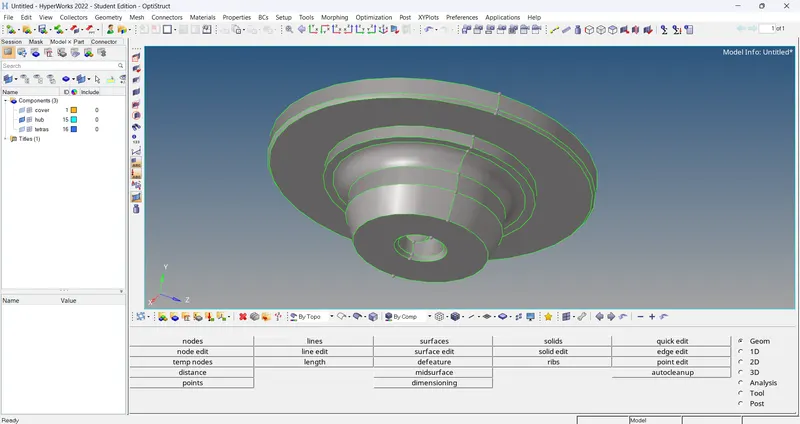
- Then select 'automesh' option in '2D' section and enter element size and mesh type 'tria' instead of mixed.
- Then click on mesh and 2D tria mesh is generated on surface.
- After generating 2D mesh, enter quality criteria and parameters and clear the off elements present in mesh.
- After clearing off elements, select 'tetramesh' option in '3D' section. Then enter the tetramesh parameters and go to tetramesh. Then select the elements and click on mesh. The 2D mesh is converted to 3D tetramesh.
- Then to clear tet collapse, select 'check elem' option in 'tool' section and set tet collapse parameter as 0.15. Then click on tet collapse, the failed elements are showed in status bar. Then click on the save failed option to save the tet collapse failed elements.
- Then isolate the failed elements by clicking on 'mask' option in 'tool' section. Then right click on elements to select the 'retrieve' option. This will automatically selct the failed elements as your masing entities.
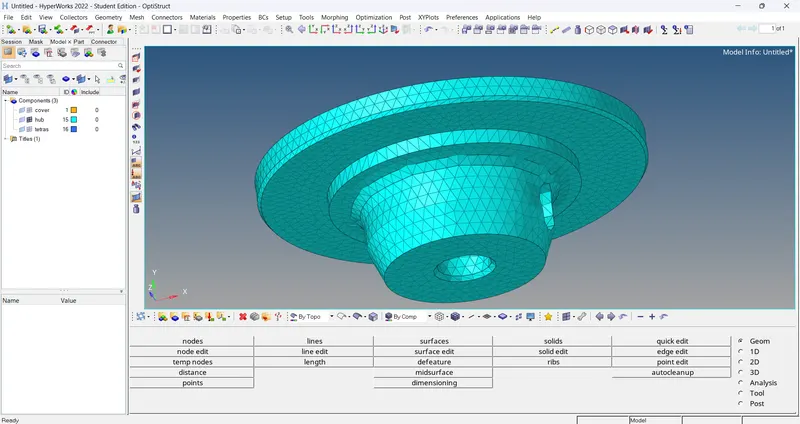
- Click on 'mask' to hide the failed elements, then select the 'reverse' option to show only the failed elements. Then to clear failed elements, select 'translate' option in 'tool' section.
- Then pick a node in any one failed elements which has minimum height. Then select N1, N2, N3 which represent the oppositr plane of the prior selected node. Then enter the magnitude value. Click on 'translate+/translate-' to move the node.
- After correcting the failed elements, parallelly check the tet collapse value in the 'check elem' option.
Model 2: Volume tetra mesh
- Import a geometry and do geometry cleanup.
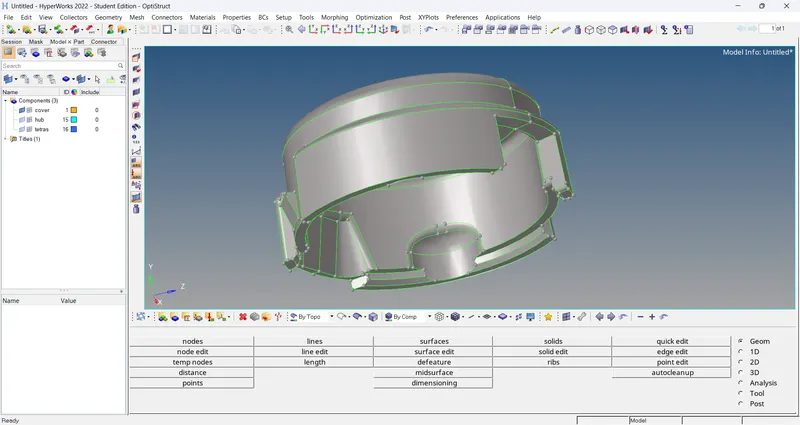
- Then select 'tetramesh' option in '3D' section. Then enter tet collapse value and tick the checkbox of 'fill viods, fix midnodes and smoothing' in tetramesh paramenters. After that go to 'volume tetra' and enter elements size. Then select 'surf' as a enclosed volume and select the suraface.
- Then click on mesh, the 3D tetra mesh is generated.
- Then to clear tet collapse, select 'check elem' option in 'tool' section and set tet collapse parameter as 0.15. Then click on tet collapse, the failed elements are showed in status bar. Then click on the save failed option to save the tet collapse failed elements.
- Then isolate the failed elements by clicking on 'mask' option in 'tool' section. Then right click on elements to select the 'retrieve' option. This will automatically selct the failed elements as your masing entities.
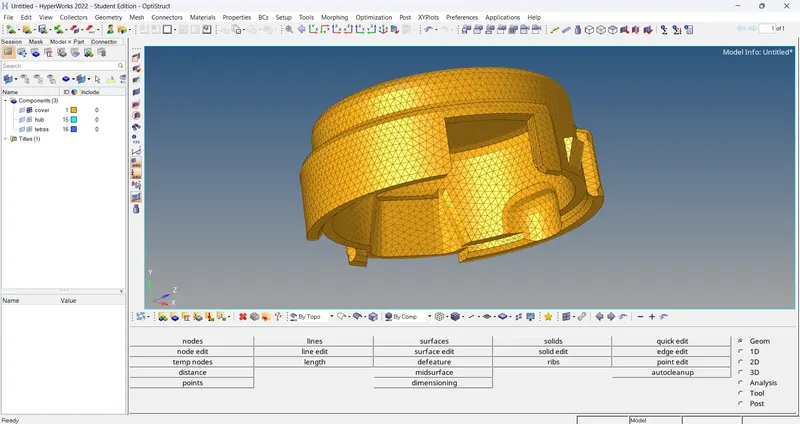
- Click on 'mask' to hide the failed elements, then select the 'reverse' option to show only the failed elements. Then to clear failed elements, select 'translate' option in 'tool' section.
- Then pick a node in any one failed elements which has minimum height. Then select N1, N2, N3 which represent the oppositr plane of the prior selected node. Then enter the magnitude value. Click on 'translate+/translate-' to move the node.
- After correcting the failed elements, parallelly check the tet collapse value in the 'check elem' option.
Model 3: Hexa Meshing
- Import a geometry and do geometry cleanup.
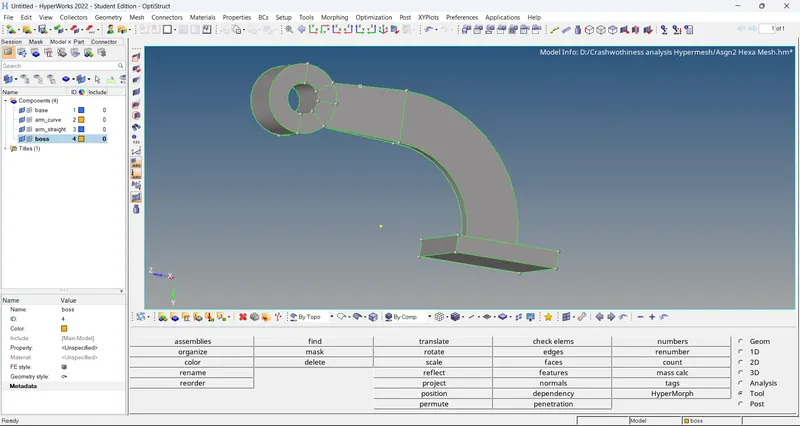
- Then go to automesh and mesh the surface with mesh type 'quads only' to avoid penta6 elements. There are 3 methods to create hexa elements.
- Then go to 3D section and select element offset. And select solid layers and select the elements and select the surface then select number of layers as 5 and thickness as 25. Then click on offset+. The hexa elements are created.
- Go to 'tool' section, select 'faces' option and select the faces and enable wireframe geometry. Then go to 'linear solid' option in '3D' section and select source and destination elements and then select alignment nodes. After that set density and click on 'solid' option. The hexa elements are created.
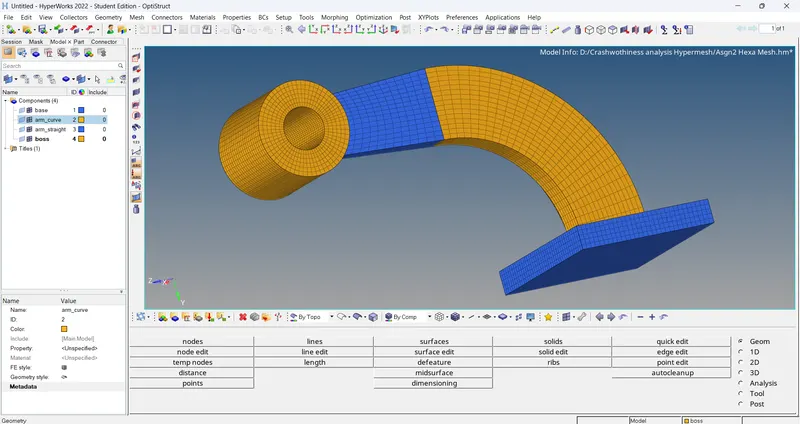
- Go to 'solid map' in '3D' section and click on general. Then select source geom as none and select elements to drag. Then select destination surface and select surface as a along geometry. Then set element size as 5 and click on mesh. The hexa elements are generated.
Conclusion : We generated 3D tetra mesh and hex mesh on given model and edit engine file successfully.