Analytical study of Vehicle Propulsion Forces.
Aim:
To study the vehicle propulsion force acting on a vehicle analytically.
Formulae:
01.
Aspect Ratio (AR):
`AR = frac {H} {W} times 100`
H = Side wall height of the tire in mm.
W = Width of the tire in mm.
02.
Wheel Diameter (dw):
`dw = D + 2 times H`
D = Interior rim diameter in inches.
H = Side wall height of the tire in mm.
03.
Static radius of wheel (rw):
`rw = frac {dw} {2}`
dw = Wheel diameter in mm.
04.
Circumference of wheel (Cw):
`Cw = pi times dw`
dw = Wheel diameter in mm.
05.
Motor Torque (Tm):
`Tm = frac {Fte times r} {G}`
Fte = Total Tractive Effort.
r = Tire radius in mm.
G = Gear ratio.
06.
Wheel Torque or Axle Torque (Tw):
`Tw = Fte times r`
Fte = Total Tractive Effort in N.
r = Tire radius in mm.
07.
Angular speed of the motor shaft `(omega)`:
`omega =frac{v}{r} times G`
v = Linear velocity of the vehicle m/s
r = Radius of the tire in mm.
G = Gear ratio.
08.
Rolling Resistance Force (Frr):
`Frr = murr*m*g`
μrr = Coefficient of rolling resistance.
m = Total mass of a vehicle in kgs.
g = Gravitational acceleration m/s^2.
09.
Aerodynamic Darg Force (Fad):
`Fad = frac{1}{2}*rho*A*Cd*v^2`
⍴ = Density of air kg/m^3.
A = Cross sectional area of vehicle front mm^2.
Cd = Coefficient of drag.
v = Velocity of vehicle in m/s.
10.
Hill Climbing Force (Fhc):
`Fhc = m*g*sinpsi`
m = Total mass of the vehicle in kgs.
g = Gravitational acceleration in m/s^2.
Ψ = Angle of climb in radians.
11.
Linear Acceleration Force (Fla):
`Fla = m*a`
m = mass of the vehicle in kgs.
a = Linear acceleration of the vehicle in m/s^2.
12.
Angular Acceleration Force (Faw):
`Faw = Ir*frac{G^2}{r^2}*frac{a}{etag}`
I = Moment of Inertia of circular section.
G = Gear ratio.
r = Radius of the tire in mm.
a = Linear acceleration of the vehicle in m/s^2.
ηg = Efficiency of the gear system.
13.
Total Tractive Effort (Fte):
`Fte = Frr+Fad+Fhc+Fla+Faw`
Frr = Rolling Resistance Force in N.
Fad = Aerodynamic Drag Force in N.
Fhc = Hill Climbing Force in N.
Fla = Linear Acceleration Force in N.
Fwa = Angular Acceleration Force in N.
14.
Vehicle Propulsion Power (Pte):
`Pte = Fte*v`
Fte = total Tractive Effort in N.
v = Velocity in m/s.
Objectives:
01. What should be the maximum speed of the motor used in an electric scooter capable to run at 90 kmph, if the fixed gear ratio is 7 and tire size is 90/100 R10 53J? Assume the following arrangement from motor to wheel.
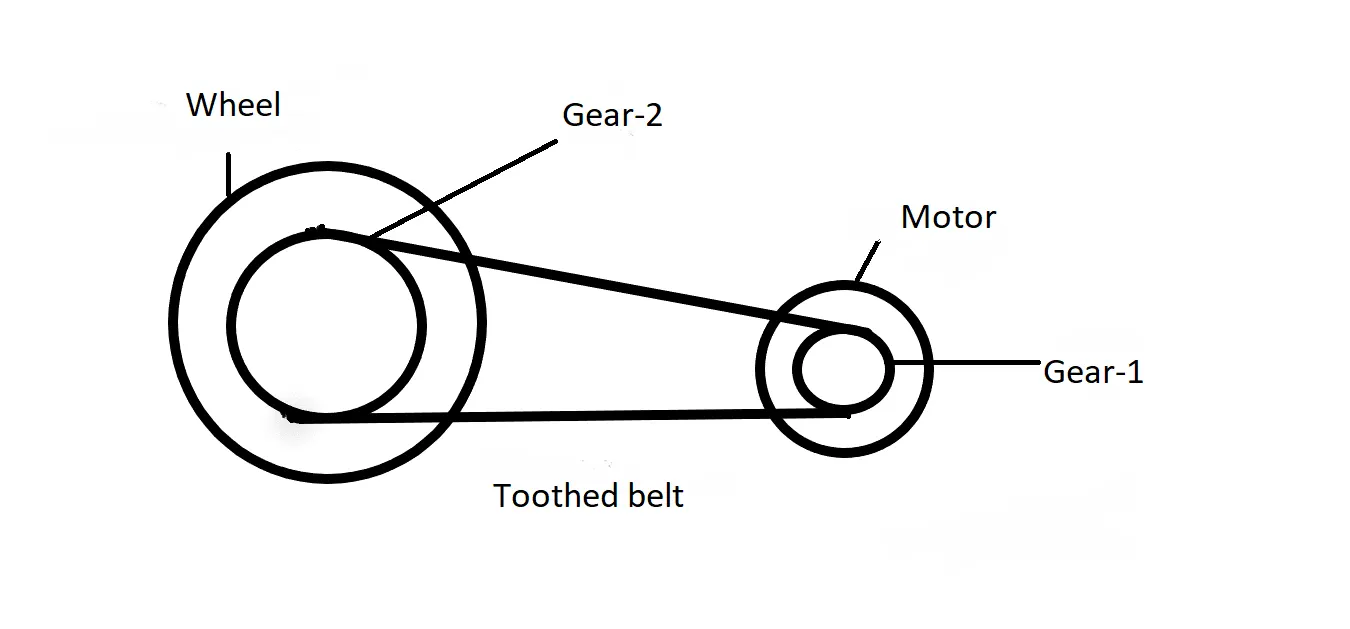
02. Recalculate the same value if tire code is 90/90 R18 51P.
03. Prepare a simple excel calculator to identify vehicle propulsion power based on given inputs and outputs. Implement formulas in cells.
Inputs: Kerb Weight (kg), Payload (kg), Coefficient of rolling resistance, Air density (kg/m3), Width (m), Height (m), Drag coefficient, Acceleration (0 to top speed in specified seconds), Hill climbing angle, Speed
Output: Total power in kW.
04. What are the limitations of this calculation?
05. Assuming that tire pressure reduction by 15% results in increase of rolling resistance effect by two times, how much will be the difference in total traction power keeping all other parameters same?
06. See the video of Range rover sport dragon challenge. How much is the gradeability? What was the average speed? Which are the forces acting on car?
Introduction:
In mechanical and automobile engineering the study of forces acting on a vehicle is very important to determine the required specifications of the engine or motor of the vehicle. Study of forces make it easier to select the engine type or battery model of a required capacity. Because the approach for design and simulation is backward. We must know the power output which will be required to generate the enough propulsion for the vehicle of a given mass. By knowing this we can determine the required sizing of the motor to generate the required power of the propulsion. Further by referring the available information we can select the battery of a required capacity.
The approach for design and simulation is backward:
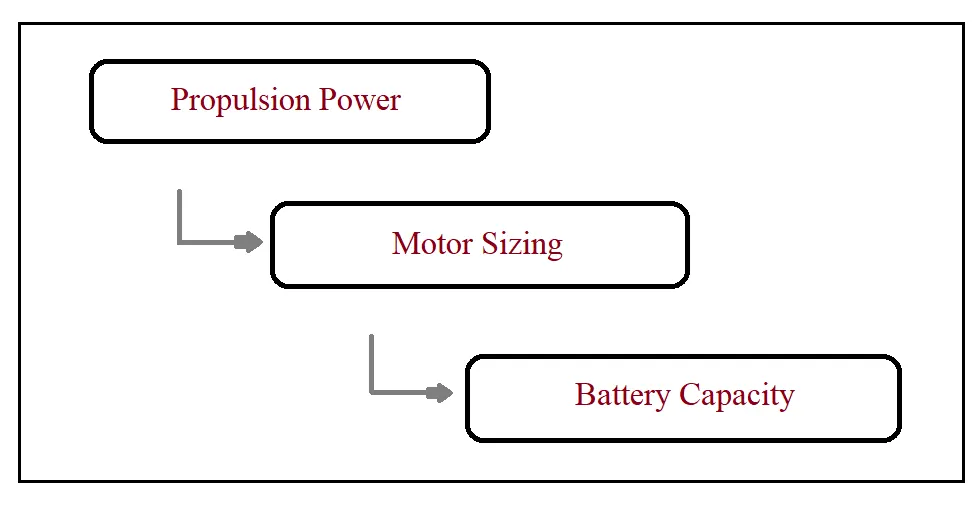
Figure-01: Flow diagram for backward approach of design and simulation.
Basically there are two types of forces acting on the vehicle while it's in motion:
i] Forces required to bring the vehicle at higher speed. (Acceleration)
ii] Forces required to maintained the achieved speed.
Various components of tractive forces. In other words there must be enough tractive forces which has to balance all opposing forces.
Rolling resistance force, Aerodynamic drag force, Hill climbing force and Acceleration forces are the forces acting on a vehicle.
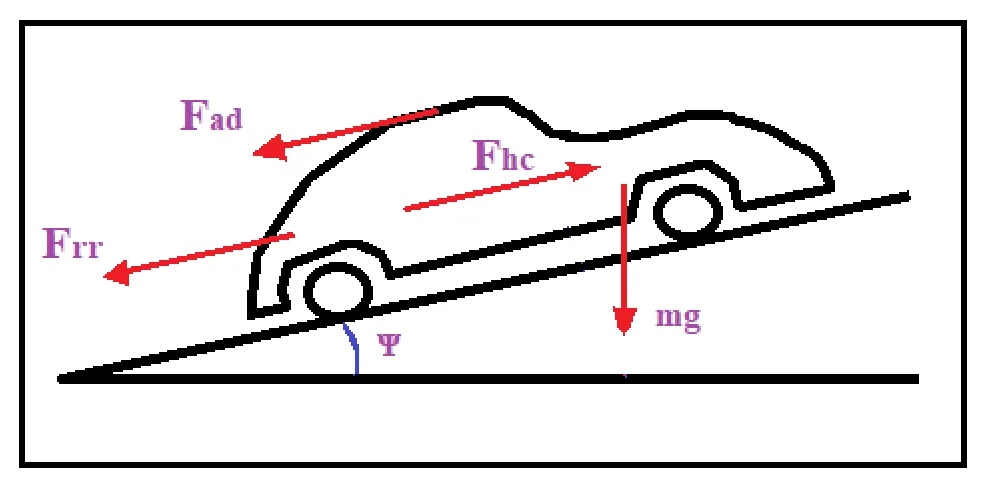
Figure-02: Forces acting on a moving vehicle.
01. Rolling Resistance Force (Frr):
Rolling resistance, sometimes called rolling friction or rolling drag, is the force resisting the motion when a body (such as a ball, tire, or wheel) rolls on a surface.
`Frr = murr*m*g`
μrr = Coefficient of rolling resistance.
m = Total mass of a vehicle in kgs.
g = Gravitational acceleration m/s^2.
Rolling resistance coefficient depends on tyre material, tyre structure, temperature, tyre pressure, tread geometry, road roughness, road material and presence or absence of liquid on road.
Coefficient of the rolling resistance varies with speed.
As tire pressure increases value of the coefficient of rolling resistance decreases.
For most common range of inflation pressure this equation can be used for passenger car on a concrete road with acceptable accuracy with speed upto 128 kmph.
μrr = 0.01(1 + 0.001v)
02. Aerodynamic drag Force (Fad):
The force on an object that resists its motion through a fluid is called drag. When the fluid is a gas like air, it is called aerodynamic drag or air resistance. When the fluid is a liquid like water it is called hydrodynamic drag, but never "water resistance".
The drag force is a function of frontal area, shape, protrusions, ducts and air passage, etc.
`Fad = frac{1}{2}*rho*A*Cd*v^2`
⍴ = Density of air kg/m^3.
A = Cross sectional area of vehicle front mm^2.
Cd = Coefficient of drag.
v = Velocity of vehicle in m/s.
Aerodynamic drag force is always applicable in the oppsite direction of motion of a vehicle.
Air on the front of the car creates high pressure and on the rear creates low pressure, this particular high pressure and low pressure situation actually creates an effect known as aerodynamic drag.
Shape of a car offering low value of drag coefficient is a Teradrop shape.
03. Hill Climbing Force (Fhc):
The force which is required to move the vehicle in forward direction while it is climbing the slope of an angle Ψ.
Usually up gradient is considered for vehicle performance analysis.
Because down gradient is not opposite force which vehicle engine or motor has to cope up with.
`Fhc = m*g*sinpsi`
m = Total mass of the vehicle in kgs.
g = Gravitational acceleration in m/s^2.
Ψ = Angle of climb in radians.
Fhc can also be represented as Gradeability.
Grability is ability of vehicle to climb on a high hill or slope at given constant speed.
It is stated in degrees and percentage.
Higher value of gradeability results in compromised performance.
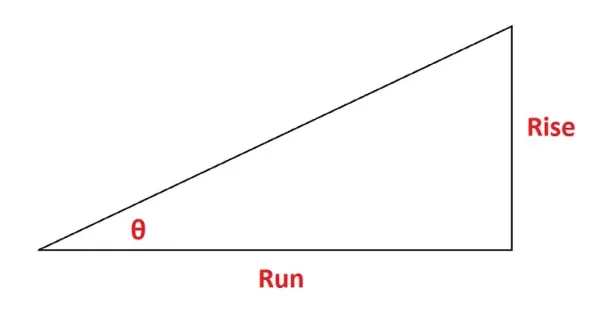
Figure-03: Triangle of gradeability.
Pecentage of Gradeability = `frac{RISE}{RUN}*100`
Example: 5 Steps and 25 Run. Find percentage of Gradeability.
That means five steps of rise for the run of 25 steps.
= 5/25 * 100
= 0.2 * 100
= 20 %
04. Linear Acceleration Force (Fla):
As per Newton's third law of motion:
`Fla = m*a`
m = mass of the vehicle in kgs.
a = Linear acceleration of the vehicle in m/s^2.
05. Angular Acceleration Force (Faw):
We must also consider angular acceleration because of rotating parts of the vehicle.
Angular acceleration is required to turn the rotating parts faster.
`Faw = Ir*frac{G^2}{r^2}*frac{a}{etag}`
I = Moment of Inertia of circular section.
G = Gear ratio.
r = Radius of the tire in mm.
a = Linear acceleration of the vehicle in m/s^2.
ηg = Efficiency of the gear system.
05. Total Tractive Force (Fte):
Tractive force can either refer to the total traction a vehicle exerts on a surface, or the amount of the total traction that is parallel to the direction of motion.
`Fte = Frr+Fad+Fhc+Fla+Faw`
Frr = Rolling Resistance Force in N.
Fad = Aerodynamic Drag Force in N.
Fhc = Hill Climbing Force in N.
Fla = Linear Acceleration Force in N.
Fwa = Angular Acceleration Force in N.
Problem Statement:
Following data is given for a vehicle,
|
Vehicle |
|
|
Kerb weight (kgs) |
110 |
Payload (kgs) |
130 |
Coefficient of rolling resistance. |
0.01 |
Air density (kg/m^3) |
1.25 |
Width (m) |
0.5 |
Height (m) |
1 |
Frontal area (m^2) |
0.5 |
Drag coefficient |
0.2 |
Speed (kmph) |
60 |
Angle (degrees) |
20 |
Speed during Hill climbing |
30 |
Speed = 90 kmph.
Gear ratio: 07
Tire size: 90/100 R10 53J.
To Find:
01. Prepare the excel calculator for the power requirements of the vehicle of a given specifications.
02. Maximum speed of the motor for 90/100 R10 53J.
03. Maximum speed of the motor for 90/90 R18 51P.
04. Output: Total power in kW
05. What are the limitations of this calculation?
06. Assuming that tire pressure reduction by 15% results in increase of rolling resistance effect by two times, how much will be the difference in total traction power keeping all other parameters same?
07. See the video of Range rover sport dragon challenge. How much is the gradeability? What was the average speed? Which are the forces acting on car?
Solution:
Objective-01: Prepare the excel calculator for the power requirements of the vehicle of a given specifications.
Excel Calculator_Propulsion Power Requirements.
Objective-02: Maximum speed of the motor for 90/100 R10 53J.
Step-i) Calculating wheel radius (rw):
Width of tyre (W) = 90 mm
Aspect ratio (AR) = 100%
Radial plies
Interior rim diameter (D) = 10 inches
= 10*25.4
= 254 mm
Aspect ratio = H/W *100
100 = H/90 *100
Therefore, Side wall height (H):
= 90 mm
Step-ii) Calculating Wheel Diameter (dw):
dw = D + 2H
= 254 + 2 *90
= 434 mm
Step-iii) Statistics radius of the wheel (rw):
rw = dw/2
= 434/2
= 217 mm
Step-iv) rw will decrease by 5% under vehicle load:
Therefore, rw = 95/100 *217
= 206.15 mm
Step-v) calculating Angular speed of the motor shaft (ω1):
ω1 = v/r * G
= 25*1000/206.15 * 7
= 848.89 rad/sec.
Therefore, Maximum speed of the motor for 90/100 R10 53J ω1 = 848.89 rad/sec.
Objective-03: Maximum speed of the motor for 90/90 R18 51P.
Step-i) Calculating wheel radius (rw):
Width of tyre (W) = 90 mm
Aspect ratio (AR) = 90%
Radial plies
Interior rim diameter (D) = 18 inches
= 18*25.4
= 457.2 mm
Aspect ratio = H/W *100
90 = H/90 *100
Therefore, Side wall height (H):
= 81 mm
Step-ii) Calculating Wheel Diameter (dw):
dw = D + 2H
= 457.2 + 2 *81
= 619.2 mm
Step-iii) Statistics radius of the wheel (rw):
rw = dw/2
= 619.2/2
= 309.2 mm
Step-iv) rw will decrease by 5% under vehicle load:
Therefore, rw = 95/100 *309.2
= 294.12 mm
Step-v) calculating Angular speed of the motor shaft (ω2):
ω2 = v/r * G
= 25*1000/294.12 * 7
= 595 rad/sec.
Therefore, Maximum speed of the motor for 90/90 R18 51P ω2 = 595 rad/sec.
Objective-04: Total power in kW.
From excel calculator we know the following:
Frr = 23.544 N
Fad = 17.36 N
Fhc = 805.10 N
Considering accelaration from 0 to 90 kmph in 10 seconds.
We are calclating following parameters accordingly.
Step-i) Force due to linear acceleration (Fla):
Fla = m*a
= 240*2.5
Therefore, Fla = 600 N
Step-ii) Force due to angular acceleration (Faw):
Faw = Ir * G^2/r^2 * a/ηg
= 1 * 7^2/(0.20615)^2 * 2.5/0.80
Therefore, Faw = 5 N
Step-iii) Calculating Total Tractive Effort (Fte):
Fte = Frr + Fad + Fhc + Fla + Faw
= 23.544 + 17.36 + 805.10 + 600 + 5
Fte = 1451 N
Step-iv) Propulsion Power required (Pte):
Pte = Fte * v
= 1451 * 25
Pte = 36275 W
Therefore, Pte = 36.27 KW
Therefore, Total Power required for the vehicle at speed of 90 kmph is 36.27 KW.
Obective-05: What are the limitations of this calculation?
The limitation of this excel calculator tool for calulation is that, all the calculations are done with certain assumption and it depends on us to enter all the values of coefficient of drag, air density and coefficient of rolling resistance.
Objective-06: Assuming that tire pressure reduction by 15% results in increase of rolling resistance effect by two times, how much will be the difference in total traction power keeping all other parameters same?
Increase in rolling resistance effect by two times.
Therefore, Frr2 = 23.544 * 2
= 47.088 N
Therefore, Fte2 = Frr2 + Fad + Fhc + Fla + Faw
Fte2 = 14.74.58 N
Therefore, Pte2 = Fte2 * v
Pte2 = 1474.58 * 25
= 36863.7 W
= 36.86 KW
Now, difference in power = Pte2 - Pte
= 36.86 - 36.27
= 0.59
Percentage of difference in power = (36.86 - 36.27)/36.27 * 100
= 0.59/36.27 *100
= 1.63 %
Therefore, Percentage of difference in power = 1.63%
Objective-07: See the video of Range rover sport dragon challenge. How much is the gradeability? What was the average speed? Which are the forces acting on car?
Since the angle of climbing a hill (Heaven's Gate) is 45°, Therefore the percentage of gradeability is 100%.
The average speed of the vehicle is 45 kmph.
Following are the forces acting on the vehicle:
i. Rolling resistance force.
ii. Aerodynamic drag force.
iii. Hill climbing force.
iv. Linear acceleration force.
v. Angular acceleration force.
Conclusion:
We studied the different forces acting on a moving vehicle. The power output of the engine or a motor is a function of tyre pressure and speed of the vehicle. The greater the angle of climbing and velocity of the vehicle; greater the power requirement of the vehicle. While designing or choosing the battery or motor for a specified performance of the vehicle all the critical parameters such as speed of the vehicle, angle of climb and mass of the vehicle are considered at their extreme values.