Analytical study of the DC machine torque speed characteristics using matlab.
Aim:
Analytical study of the DC machine torque speed characteristics using matlab.
Objectives:
Implement DC machine torque speed characteristics equations in MATLAB script file.Distinguish between power cables and signal cables and also prepare a table where these cables are used in the wiring of an electric vehicle.State voltage levels and consideration as high & low for a battery pack of electric vehicles.
Introduction:
A DC Machine is an electro-mechanical energy conversion device. There are two types of DC machines; one is the DC generator, and another one is known as DC motor.
A DC generator converts mechanical power (ωT) into DC electrical power (EI), whereas, a DC motor converts d.c electrical power into mechanical power. The AC motor is invariably applied in the industry for conversion of electrical power into mechanical power, but at the places where the wide range of speeds and good speed regulation is required, like in electric traction system, a DC motor is used.
The construction of the dc motor and generator is nearly the same. The generator is employed in a very protected way. Hence there is an open construction type. But the motor is used in the location where they are exposed to dust and moisture, and hence it requires enclosures for example dirt proof, fireproof, etc. according to requirement.
Although the battery is an important source of DC electric power, it can only supply limited power to any machines. There are some applications where large quantities of DC power are required, such as electroplating, electrolysis, etc. Hence, at such places, DC generators are used to deliver power.
Generally, three characteristic curves are considered important for DC motors which are,
(i) Torque vs. armature current
(ii) Speed vs. armature current
(iii) Speed vs. torque.
These are explained below for each tpye of DC motor. These characteristics are determined by keeping the following two relations in mind.
Ta ∝ ɸ.Ia
and
N ∝ Eb/ɸ
These above equations can be studied at emf and torque equations of the dc nachines. For a DC motor, magnitude of the back emf is given by the same emf equation of a dc generator i.e. Eb = PɸNZ / 60A. For a machine, P, Z and A are constant, therefore, N ∝ Eb/ɸ
Characteristics Of DC Series Motors
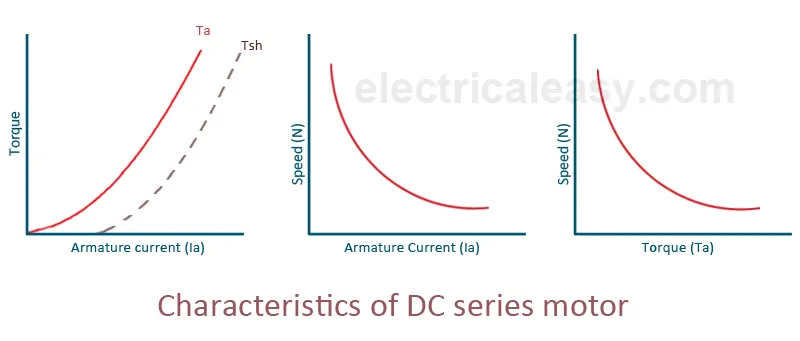
Torque Vs. Armature Current (Ta-Ia)
This characteristic is also known as electrical characteristic. We know that torque is directly proportional to the product of armature current and field flux, Ta ∝ ɸ.Ia. In DC series motors, field winding is connected in series with the armature, i.e. Ia = If. Therefore, before magnetic saturation of the field, flux ɸ is directly proportional to Ia. Hence, before magnetic saturation Ta α Ia2. Therefore, the Ta-Ia curve is parabola for smaller values of Ia.
After magnetic saturation of the field poles, flux ɸ is independent of armature current Ia. Therefore, the torque varies proportionally to Ia only, T ∝ Ia.Therefore, after magnetic saturation, Ta-Ia curve becomes a straight line.The shaft torque (Tsh) is less than armature torque (Ta) due to stray losses. Hence, the curve Tsh vs Ia lies slightly lower.In DC series motors, (prior to magnetic saturation) torque increases as the square of armature current, these motors are used where high starting torque is required.Speed Vs. Armature Current (N-Ia)
We know the relation, N ∝ Eb/ɸ
For small load current (and hence for small armature current) change in back emf Eb is small and it may be neglected. Hence, for small currents speed is inversely proportional to ɸ. As we know, flux is directly proportional to Ia, speed is inversely proportional to Ia. Therefore, when armature current is very small the speed becomes dangerously high. That is why a series motor should never be started without some mechanical load.But, at heavy loads, armature current Ia is large. And hence, speed is low which results in decreased back emf Eb. Due to decreased Eb, more armature current is allowed.
Speed Vs. Torque (N-Ta)
This characteristic is also called as mechanical characteristic. From the above two characteristics of DC series motor, it can be found that when speed is high, torque is low and vice versa.

Characteristics Of DC Shunt Motors
Torque Vs. Armature Current (Ta-Ia)
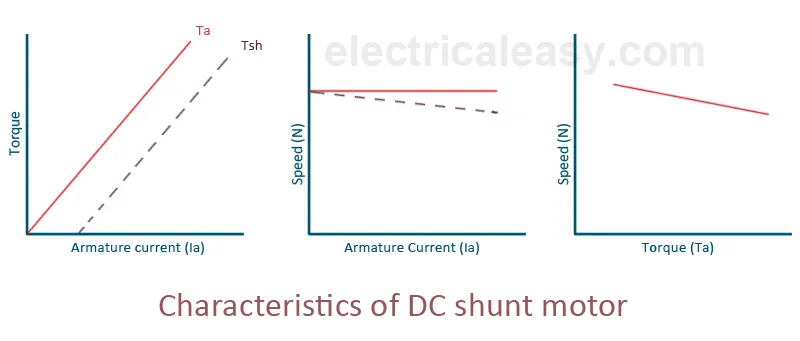
In case of DC shunt motors, we can assume the field flux ɸ to be constant. Though at heavy loads, ɸ decreases in a small amount due to increased armature reaction. As we are neglecting the change in the flux ɸ, we can say that torque is proportional to armature current. Hence, the Ta-Ia characteristic for a dc shunt motor will be a straight line through the origin.Since heavy starting load needs heavy starting current, shunt motor should never be started on a heavy load.
Speed Vs. Armature Current (N-Ia)
As flux ɸ is assumed to be constant, we can say N ∝ Eb. But, as back emf is also almost constant, the speed should remain constant. But practically, ɸ as well as Eb decreases with increase in load. Back emf Eb decreases slightly more than ɸ, therefore, the speed decreases slightly. Generally, the speed decreases only by 5 to 15% of full load speed. Therefore, a shunt motor can be assumed as a constant speed motor. In speed vs. armature current characteristic in the following figure, the straight horizontal line represents the ideal characteristic and the actual characteristic is shown by the dotted line.

Problem Statement: Implement DC machine torque speed characteristics equations in MATLAB script file. It asks user to input data and plots speed (RPM) versus torque (Nm). Submit the .m file for evaluation and attach the screenshots of all the required plots.How can you distinguish between power cables and signal cables and also prepare a table where these cables are used in the wiring of an electric vehicle?What voltage levels are considered as high & low for a battery pack of electric vehicles?
Solution: I.
Matlab Program for DC machine torque speed characteristics equations:
clc
clear all
close all

% Let's consider the speed of the motor (w) in rad/sec.
% Considering the array for the speed of the motor.

w = linspace(0,800,20);

% Input data for the supply voltage of the battery in volts.

V = input('Enter the value of supply voltage of the battery - ')

% Input data for the Motor speed constant.

K = input('Enter the value of the motor speed constant - ')

% Input data for the resistance of the armature.

R = input('Enter the value of resistance of the armature - ')

% Conversiion of motor speed from rad/sec to rpm.

w = w*(60/6.28);

% Torque and Speed relationship equation for DC machine.

T = ((V-w*K)/R).*K

% Where
% T = Torque of the motor.
% V = Supply Voltage.
% w = Rotataional speed.
% K = Motor Constant.
% R = Resistance of Armature.

% Plotting the relation between the torque and the speedof the DC machine
% for user input values.

plot(w,T,'color','r','linewidth','7');
xlabel('Speed of the motor (rpm)');
ylabel('torque of the motor (N/m)');
title('Speed vs. Torque relationship of the DC motor');
axis([0 1400 0 260]);
Plot of the DC machine torque speed characteristics:
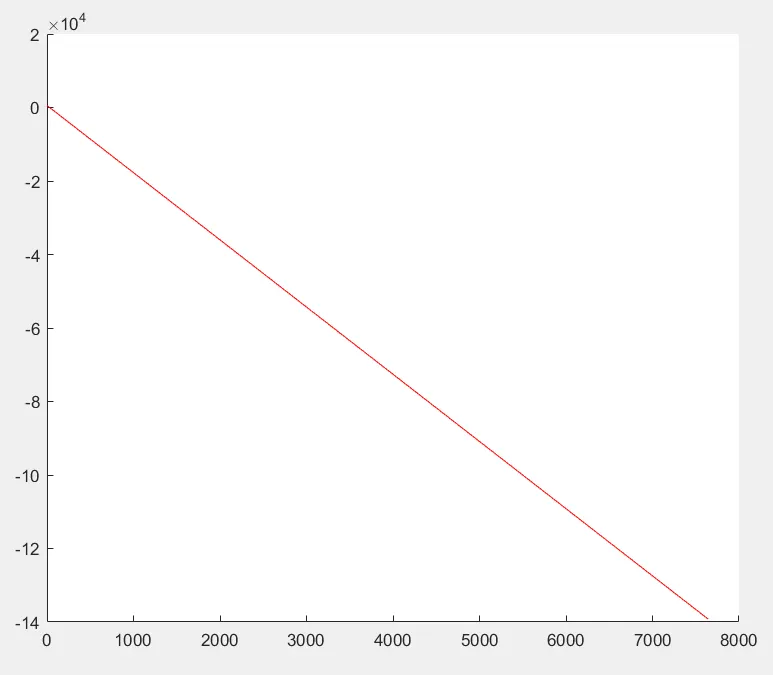
Figure01: DC machine torque speed characteristic curve.
X-Axis: Speed of the Motor.
Y-Axis: Torque of the Motor.
II.
A power cable is an electrical cable, an assembly of one or more electrical conductors, usually held together with an overall sheath. The assembly is used for transmission of electrical power, Power cables may be installed as permanent wiring, within buildings, buried in the ground, run overhead, or exposed. Power cables that are bundled inside thermoplastic sheathing and that are intended to be run inside a building are known as NM-B (nonmetallic sheathed building cable).
A signal cable is an electrical cable, an assembly of one or more electrical conductors, usually held together to tranfer the data or signal from one device to another.
Following table shows the use of the power cable and the signal cable in an electric vehicle:
Sr. No. |
Power Cables |
Signal Cables |
01. |
The power cable of this development target vehicleconnects the inverter and two three-phase alternatingcurrent (AC) motors (one used for driving the vehicle andthe other for generating electricity). |
The signal cables are use to transmit the command signals to the other necessary auxiliaries of the car. Example: Lightening system, Fuel Level indicators, hill assist and traction control, etc. |
02. |
Power Cables are used to transmit the power from battery to motor and vice versa. |
Signal cables are used to transmit the signals from master controller to the output devices. |
03. |
Charging of the vehicle is also done by using the power cable but it's not the actual part of the vehicle if we are charging the vehicle externally at power station. |
Signal cables also carries the feedback signals from output devices to the controllwe to obtain the necessary outputs. |
III.
Battery is the heart of the electric vehicle because it is the only source of the power of the vehicle.
Lithium-ion batteries are having high energy density and long cycle life therefore they have become the leading battery type for use in EVs.
An electric vehicle battery is often composed of many hundreds of small, individual cells arranged in a series/parallel configuration to achieve the desired voltage and capacity in the final pack.
Common battery capacity ranges, on the other hand, are as follows:
Hybrid vehicles: 0.5 to 2 kWh.Plug-in hybrid vehicles: 4 to 20 kWh.Electric vehicles: 30 to 100 kWh or more.
Voltage of the battery is the potential difference between the positive and negative terminal of the battery.
Larger the difference greater is the capacity of the battery.
Higher the difference higher will the flow of the current.
The battery voltages of the electric car can increase upto or over 800 V which is considered as high voltage levels.
If the battery voltage fall below the critical voltage level of 400 V then the voltage level is considered as the low voltage level.
Both High voltage level and Low voltage level depends on capacity of the battery and application of the vehicle.
For example the battery used in Tata Nexon is of 30 KWh whereas the battery used in the Jaguar I-Pace is of 90 KWh.
Conclusion:
When speed is high, torque is low and vice versa.
That means the speed of the motor is inversely praportional to the torque of the motor.