Advanced Sheet Metal Design Using NX Cad Challenge_6_Bracket
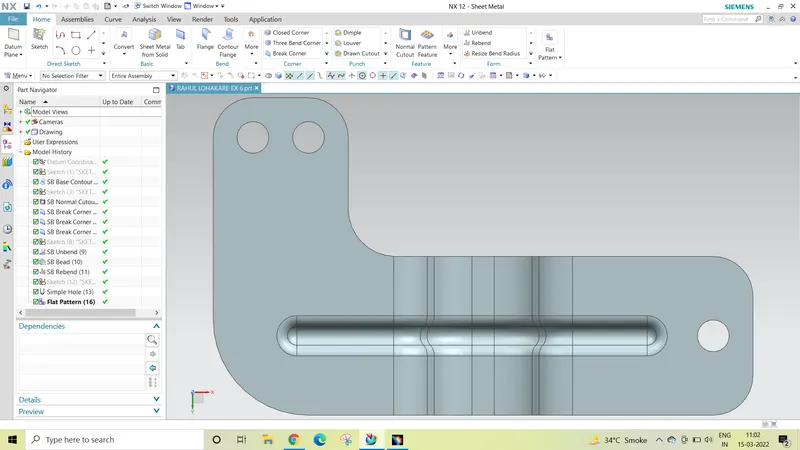
Objective : To design a sheet metal Bracket using NX CAD SOFTWARE with suitable command.
Introduction
Sheet metal is any metal that has a thickness in between 0.5 to 6 millimetre.
A bracket is an intermediate component used to fix one thing (like a shelf) to another (like a wall). It may be thought of a kind of fastener, but this is somewhat misleading: actual fasteners like screws are used to connect the bracket to the other parts.
In addition to creating a connection between two parts, a bracket may provide support. Some brackets, such as gusset brackets, are designed with a diagonal section that reduces the strain on the bracket and allows it to support heavier loads.
One of the easiest and most cost-effective ways to make brackets, especially simple ones like angle brackets, is sheet matel fabrication. Brackets typically consist of two or more planes connected along one edge, and often to simplest way to fabricate this kind of object is to bend a flat object (i.e. a piece of sheet metal) in two or more places: the simplest example would be adding a 90° bend to a flat rectangle with a straight profile, turning it into a bracket with an L-shaped profile.
What are brackets and how are brackets used?
Brackets are connecting devices used to join two objects. In architecture, they may be made of wood or stone and used to join walls with features like parapets or eaves. In engineering, however, they are often made of sheet metal and used to support objects like shelving, countertops, flooring, sections of furniture, and mounted televisions.
Although there are many types of brackets, they are most commonly L-shaped, with the vertical section of the bracket attached to a wall (or another large upright structure) and the horizontal section attached to a smaller object being fitted to the wall, such as a shelf.
Brackets often have holes in them, either threaded or unthreaded, so that screws or other fasteners can be fed through them, but this is not a defining feature of the bracket.
Most brackets are functional, with their purpose being to connect and support objects. However, brackets can also be decorative: since brackets are often visible (such as on shelves mounted above eye level) they may have cosmetic features and flourishes, from intricately machined decorative features to gold plating.
How are brackets made?
Brackets can be made in various ways, such as casting or CNC machining. However, the best way to make simple brackets is sheet metal fabrication.
One of the most common sheet metal processes is bending, in which a machine called a brake is used to bend sheet metal to an angle up to 120°. This is perhaps the most important process when making sheet metal brackets, since virtually all brackets incorporate at least one bend.
Other sheet metal processes must also be used. Before any bending takes place, the sheet metal must be cut to size using a machine such as a laser cutter or plasma cutter. A punching machine may be used to make holes in the bracket (for screws), and welding may be required to add gussets or other features.
In addition to sheet metal processes described above, CNC machining may be used to add more complex features to brackets, especially with custom designs for nonstandard components.
Best materials for sheet metal brackets
Brackets can be made from a variety of metals, depending on certain factors, including: the load it must support, cosmetic requirements, surface finishing requirements, minimum and maximum thickness, required bending angles, and budget for manufacturing.
Possible sheet metal bracket materials include:
- Steel
- Stainless steel
- Aluminum
- Brass
Common types of bracket
There are several bracket types that can be made using sheet metal fabrication and other processes. Bracket varieties vary depending on the application and the objects they are designed to support.
L-Bracket
An L-bracket is one of the most common bracket types. As the name suggests, it has an L-shaped profile after being bent along a single axis, usually creating a 90° angle.
L-brackets are used in many applications where a horizontal object (e.g. a shelf) needs mounting to a vertical object (e.g. a wall).
U-Bracket
A U-bracket is another type of bracket. Unlike an L-bracket, a U-bracket is bent along two axes, forming a U-shaped profile.
U-brackets can be used to grip an object between its two flanges, or to mount two parallel horizontal objects one above the other.
Z-Bracket
A Z-bracket is another bracket type that incorporates two bends. However, unlike a U-bracket, in which both bends are made on the same face of the sheet metal, a Z-bracket bends one flange inwards and the other outwards, making a Z-shaped profile.
Z-brackets can be used to mount parallel surfaces that are offset from one another.
Gusset Bracket
A gusset bracket is a type of bracket supported with extra material to improve its strength and load-bearing capacity. It is like an L-bracket but with an extra triangular section of material between the vertical and horizontal sections.
Gussets can either be welded onto the bracket, or included within a single piece: if the latter, the horizontal and vertical faces of the bracket are bent from the edges of the triangle.
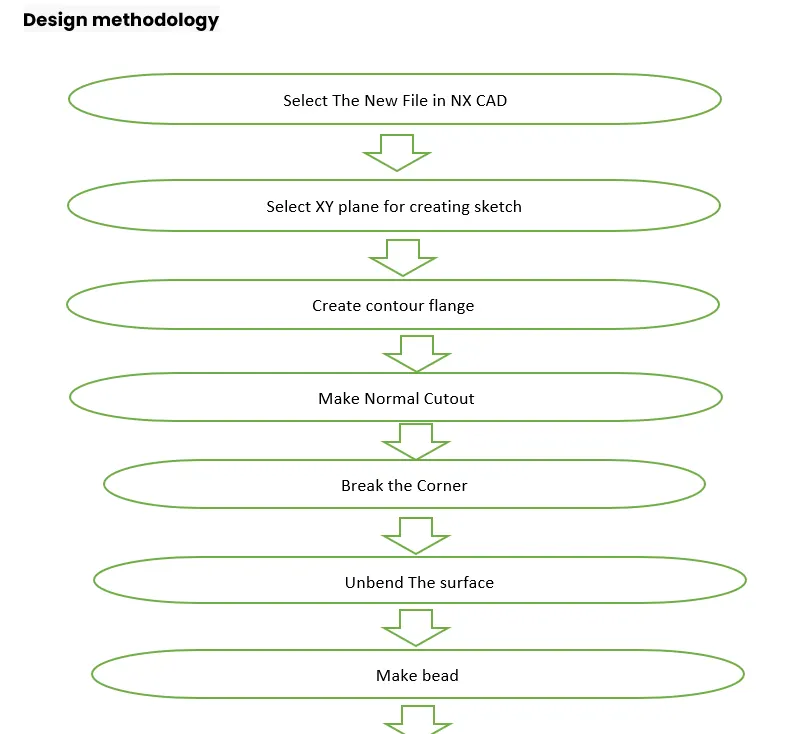
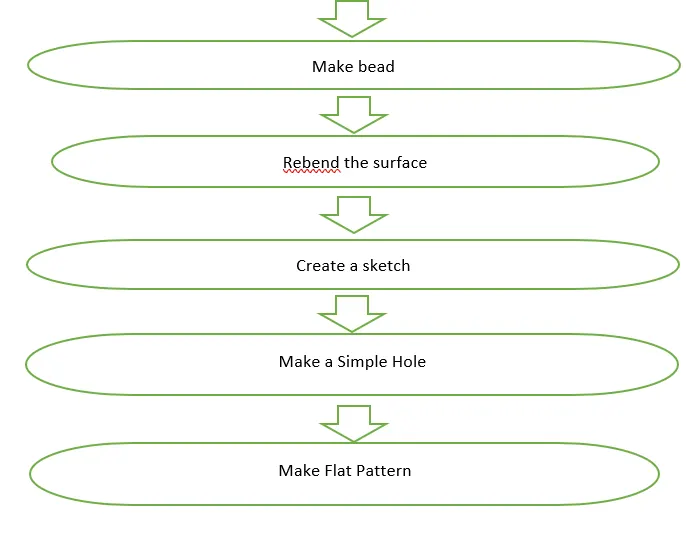
Design methodology
Description
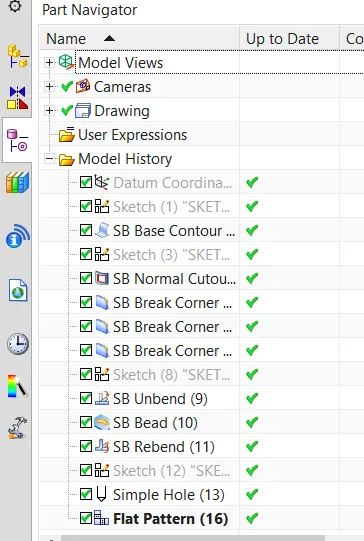
SKETCH : It is used to draw a 2D sketch.
UNBEND: Flattens a bend and material adjacent to the bend.
HOLE : Adds a hole to one or more solid bodies in a part or assembly with opctions for counterbored,countersunk and threaded.
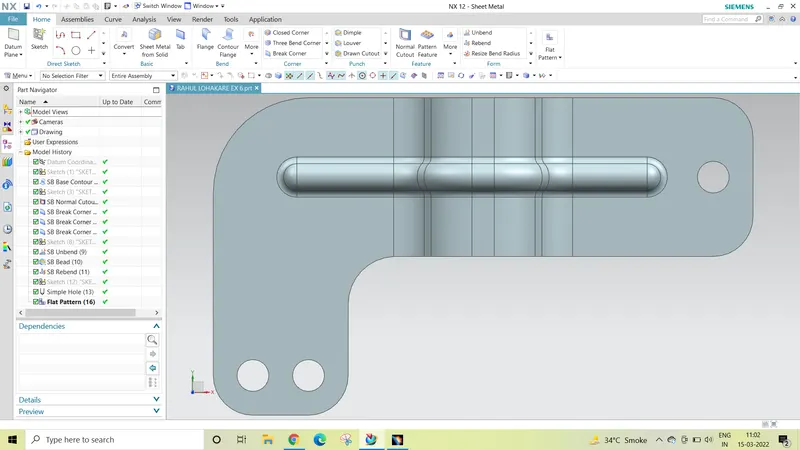
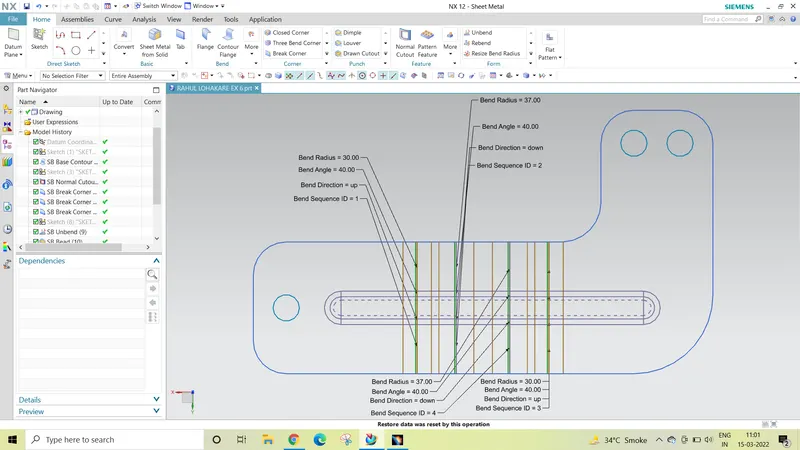
FLAT PATTERN : Creates a flat pattern feature from the formed sheet metal part.
REBEND: Resotres an unbend feature to its previous bent stste, along with any features added after the unbend feature.
NORMAL CUTOUT: Cuts material by projecting a sketch onto the model and then cutting perpendicular to the faces intersected by the projection.
BREAK CORNER: Rounds or chamfers a sharp corner of a tab or flange.
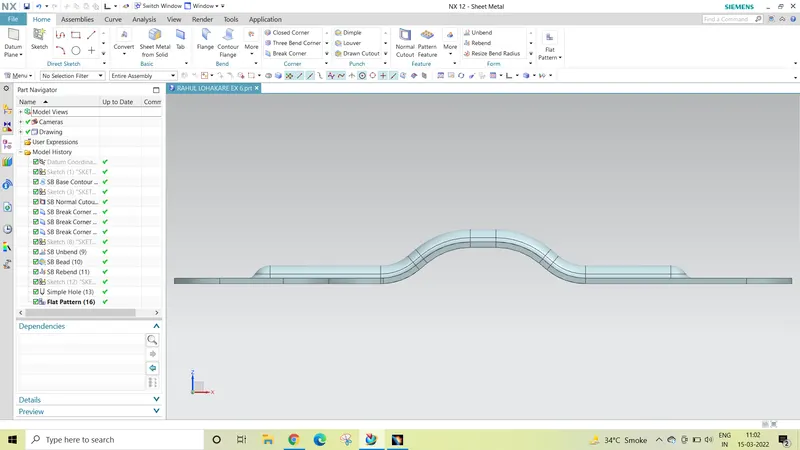
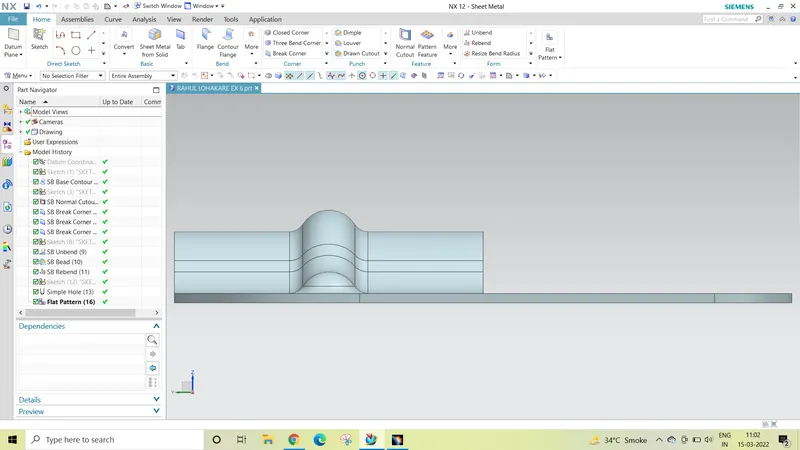
BEAD : Lifts material along the contour of a sketch that simulates a stamping tool.
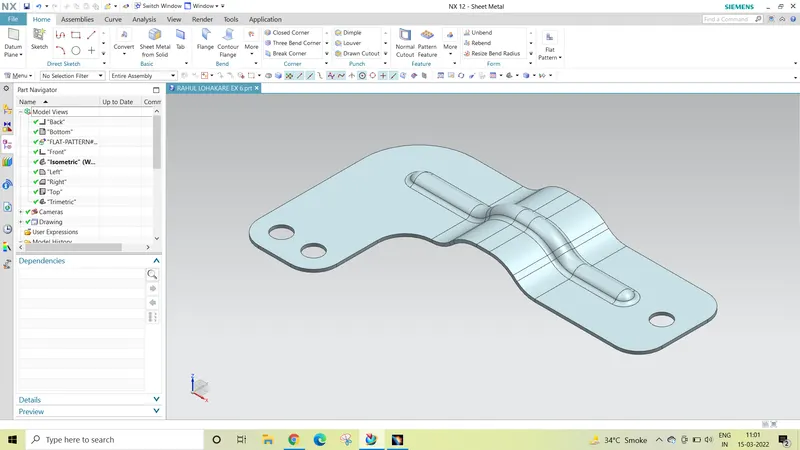
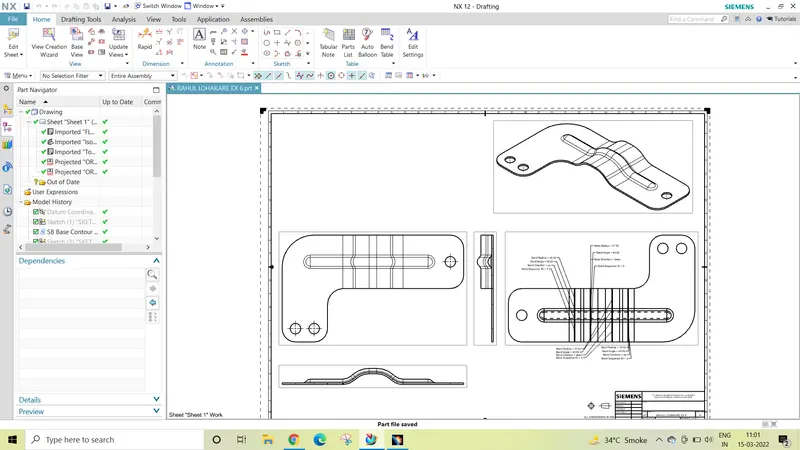
Iso view
Conclusion
USING NX CAD sheet metal Bracket done successfully.