 Free · 3 lessons · no payment
Turbulence and RANS Modelling: 3 free lessons
Three free lessons from Skill-Lync's Turbulence and RANS Modelling course. They define turbulence through Reynolds' dye experiment and show where it appears, from the sun's surface to engines. They then outline the course projects and derive the incompressible mass and momentum conservation equations, ending at the Navier-Stokes form.
Last updated 16 Nov 2026 · 3 free lessons (1 h 17 min) · full course: 49 lessons (19 h 41 min), paid · ₹40,000
 Free lesson 1 · 24 minWhat Turbulence Is and Why Engineers Study It
What will you learn in the free Turbulence and RANS Modelling lessons?
- Defining turbulence and its key characteristics
- Why time averaging simplifies turbulent flow
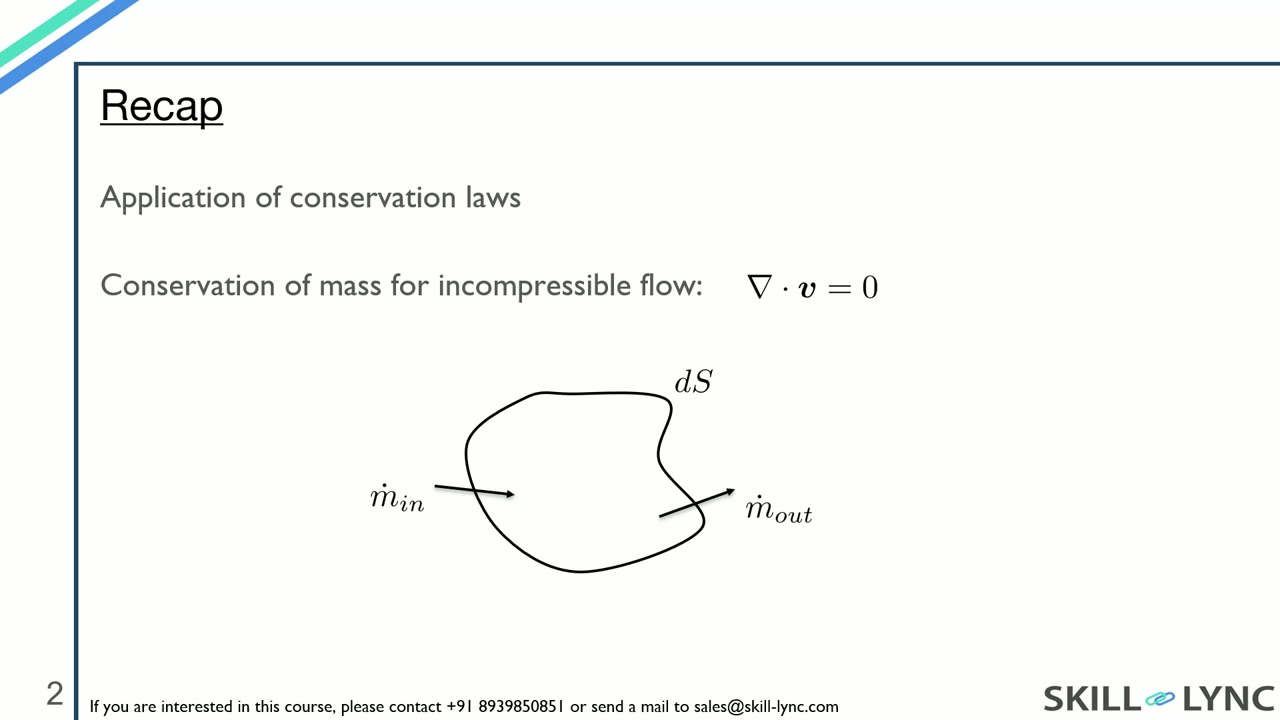
- Continuum assumption and conservation of mass
- Momentum conservation leading to Navier-Stokes equations
Free lessons you can watch now
- Lesson 1 · 24 minWhat Turbulence Is and Why Engineers Study ItThe instructor introduces turbulence through Reynolds' dye experiment and a smoke-cloud example, listing its unsteadiness, spatial randomness and eddies of different sizes. Examples range from the sun and Jupiter to ocean currents, jet engines and cycling, and the lesson ends on why this matters for choosing CFD turbulence models.
 Lesson 2 · 27 minCourse Structure, Averaging and the Continuum AssumptionThe instructor explains the course format, including weekly sessions, challenges and two projects, one coding a two-dimensional turbulence model. The lesson then shows how time averaging smooths a turbulent velocity signal, covers the continuum assumption and mean free path, and derives the incompressible mass conservation equation.
 Lesson 3 · 27 minMomentum Conservation and Deriving the Navier-Stokes EquationsThe instructor applies momentum conservation to a cubic fluid element, covering pressure, viscous and body forces. The lesson introduces the convective derivative and Einstein notation, relates shear stress to the strain rate tensor, and combines these steps into the Navier-Stokes momentum equation.
Which lessons of Turbulence and RANS Modelling are free?
The first 3 lessons are free on Grow by Skill-Lync: 1 h 17 min of video from Skill-Lync's Turbulence and RANS Modelling course that you can watch here at no cost: leave your name and phone number once and they play (as of 16 Nov 2026). The full course is paid (₹40,000); its other 46 lessons are listed in the outline below so you can see what each one covers.
How long is the Turbulence and RANS Modelling course?
The full course has 49 lessons and 19 h 41 min of recorded video, plus the projects and assignments that come with enrolment. The free lessons alone take about 1 h 17 min, so you can finish them in an evening and decide whether to continue.
What comes after the free lessons?
Lesson 4 onwards is in the paid Turbulence and RANS Modelling course on Skill-Lync, with mentor support and a certificate. For a career in CFD, the Post Graduate Program in Computational Fluid Dynamics goes further with industry projects and placement support.