Week 9 - Project - A pillar Design with Master Section
INTRODUCTION :
Master sections development takes place during feasibility check and concept validation stages of the product life cycle. These are typically the guides for design requirements and which decides the component packaging after the development of the concept design, i.e class A surfaces.
Master section helps us to decide the feasibility of the concept design, the clearances, the packaging and the fixation strategy of a component before converting the concept design into a solid 3D engineering design.
During the period of vehicle concept design the evaluation of the master section performance depends mainly on the reference vehicle data and experience of structure design engineer.
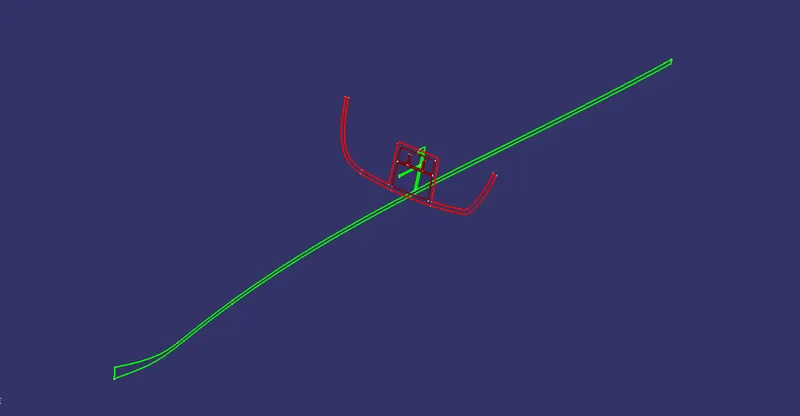
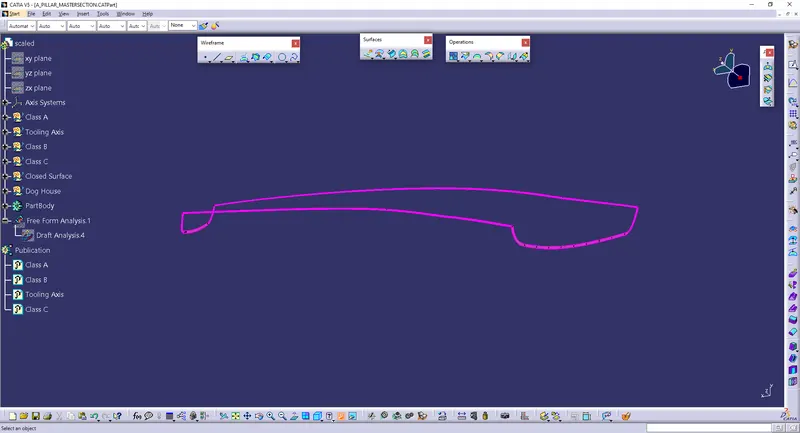
Master Section Used in the A-Pillar Design -
MATERIAL CONSIDERATIONS :
Automotive Industry has developed a broad range of ABS, PC/ABS, PP compounds, and Reinforced Elastomers to enhance safety, performance, and the appearance of vehicle interior pillars.
Interior pillars must provide multiple properties that support a high-quality aesthetic appearance, high impact protection, safety functionalities, and medium to high heat resistance. When airbag deployment functionalities are required, interior pillars also need materials with low-temperature impact resistance. For unpainted pillar applications, low-gloss aesthetics and easy flow are required.
The family of PULSE™ GX Engineering Resins offers appropriate features and supports requirements such as low gloss, low-temperature impact resistance in combination with low density and an easy flow that enable weight and cost reduction. PULSE™ 2000EZ Engineering Resin is a favorable material of choice in the North American market; it provides an outstanding combination of good, low temperature ductility with very high heat resistance and easy flow, enabling thin-wall part designs.
As an alternative, cost-effective materials solution for pillars without airbag deployment, Trinseo Automotive offers customized MAGNUM™ ABS Resins with either lower or sufficient heat resistance
Besides these ABS and PC/ABS solutions, INSPIRE™ Performance Polymers (low emission, low gloss, and good scratch resistance) and VELVEX™ Reinforced Elastomers (very low gloss, very good scratch and mar resistance) meet the needs of cost-efficient interior pillars.
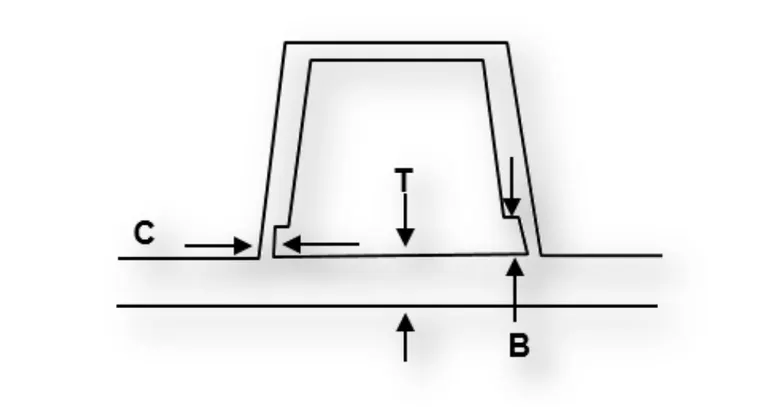
For this model , the engineering feature which has been given in the master section is DOG HOUSE following are the design considerations for the same.
DOG HOUSE:
- Dog house is an engineering feature used in plastic trim design as supporting feature.
- A Draft of 1.5 degrees per side is the maximum limit.
- In case of a slide 3 degrees of Draft can be provided
- At the intersection part dog house wall thickness must me less than or equal to 40% of the wall thickness of the component.
- It's height should be between 3 and 6 mm.
Tooling Axis :
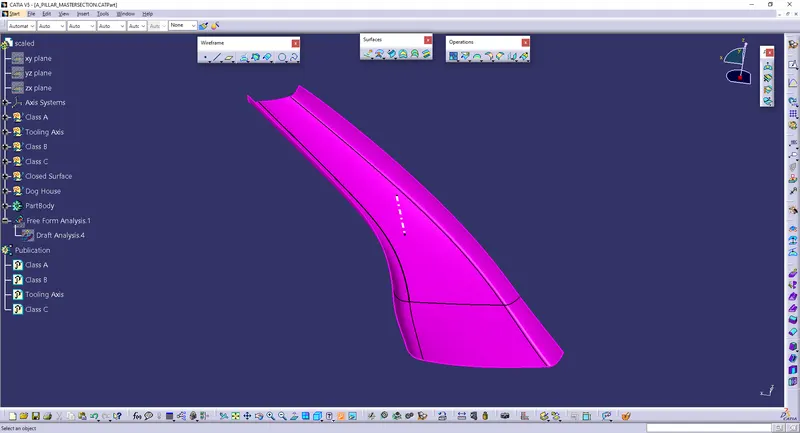
The direction in which the mold called the tooling axisor core and cavity opens is Tooling axis
Considering the ejection from the cavity of the mold after manufactering the interior trim must have the nominal 3 degree draft angle. Hence the tooling axis is crested by considering this factor
The white clour line is the tooling axis of this surface
Class A Surafce :
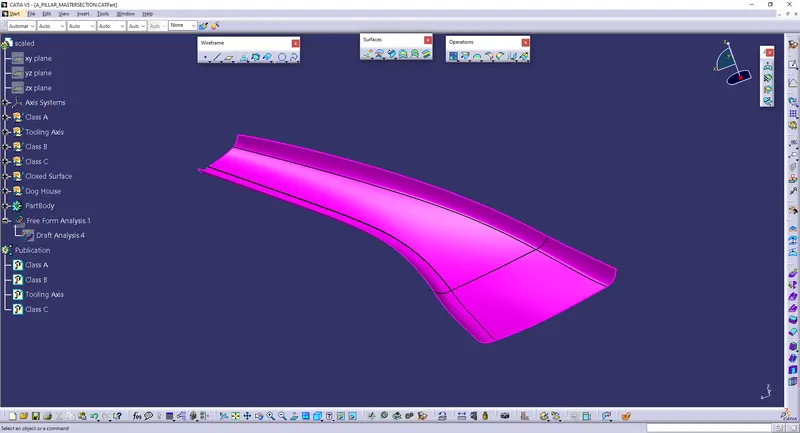
Class surface are the one which will be visible to the customer
It's the exterior of the parts
It has a optimal asthetic shape and high surface quality
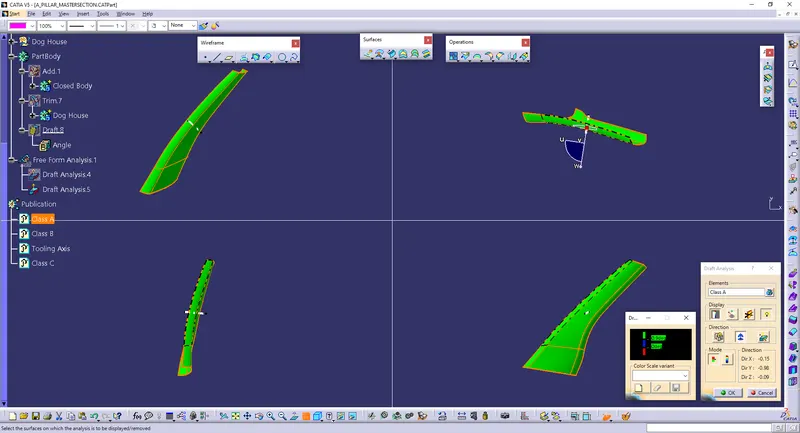
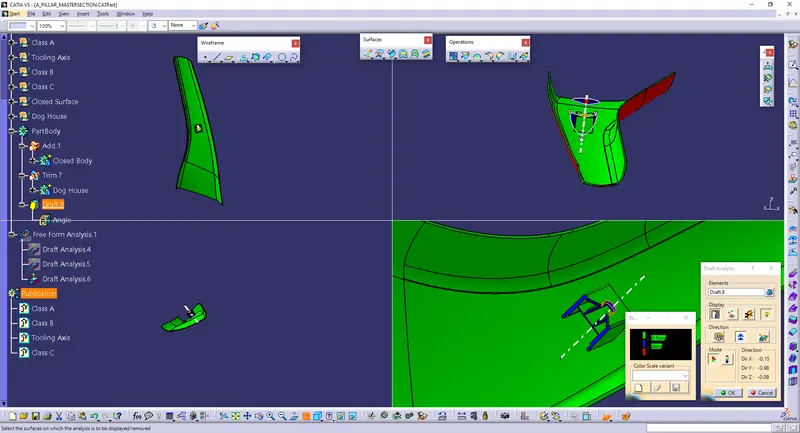
Draft Analysis :
This type of analysis is performed based on colour ranges identifying zones on the analysed element where the deviation from the draft direction at any point.
The Green colour denotes the draft angle is in the standards (3 degree).
The Blue colour denoted its is below (3 degree).
The Red colour denotes the surface is not producable.
For class A :
For Solid Body:
Class B Surface :
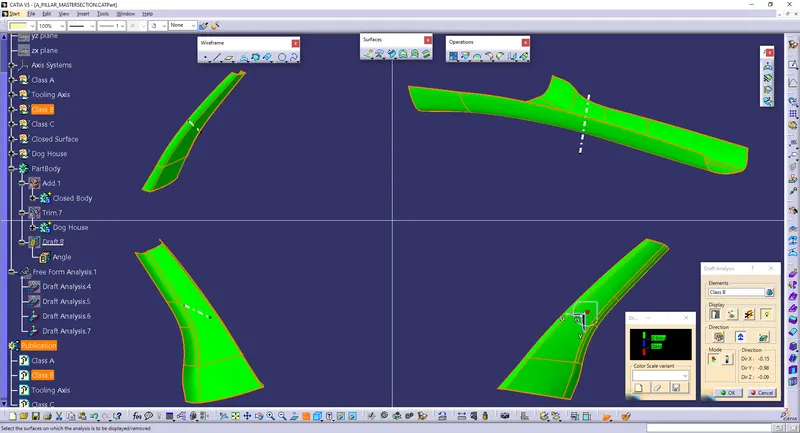
Class B is the inner side of the Class a surface which will not be seen by the customer
where it will faced in the side of core
where the ejection will make there contact
It contains the engineering aspects of a model.
Class C Surface :
Surface that joins class-A and class-B surfaces is class-C surface.
Which will determine the thickness.
Class C is often specified for interior surfaces not readily visible.
CONCLUSION:
This reports concludes the creation of HEAT STAKES & LOCATORS by following all Design Consideration for this model.