Week 9 - Project_1 - Door Trim Lower with Engineering Features
Door Trim Lower with Engineering Features
Aim
Create the Door Trim Lower Plastic component through the given Class-A surface. To begin with, the tooling axis for the given Class-A Surface should be created meeting the requirements of the draft angle and at the end perform the Draft analysis on the model.and Create the Heat Stakes and the locators considering the design rules mentioned in the video for the door applique.
Objective
To Design a Door trim lower in CATIA V5 using the given Class A surface and design parameters.
Input data
We use class-A-surface as input data.
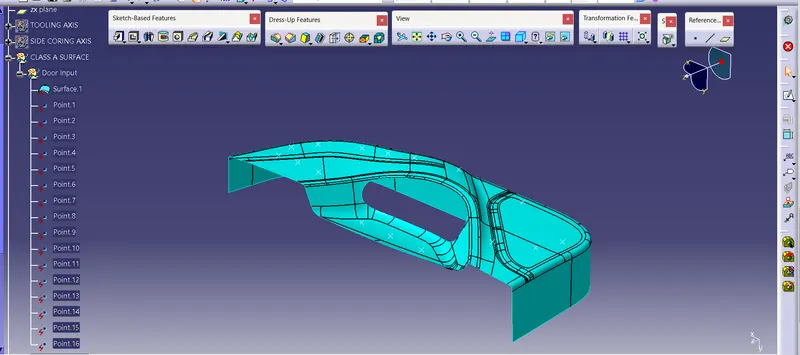
Tooling direction
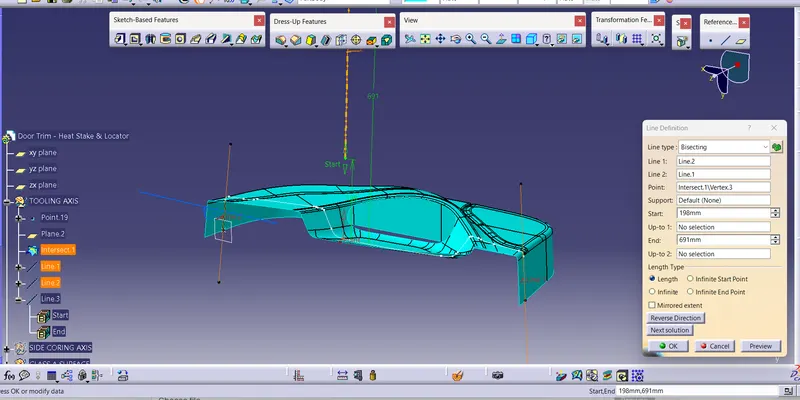
Tooling direction in which 2 halves of the mold get separated against each other. for this model am going to use the normal-to-face method instead of bisecting method because my tooling direction is Y axis and i get a flatter surface in Y direction so , am extracted the flat face and create a point at the centre of the extracted surface and i create the tooling axis through the surface along with point which created before. and this method clears the draft analysis so am continuing with this method.
B-Surface creation
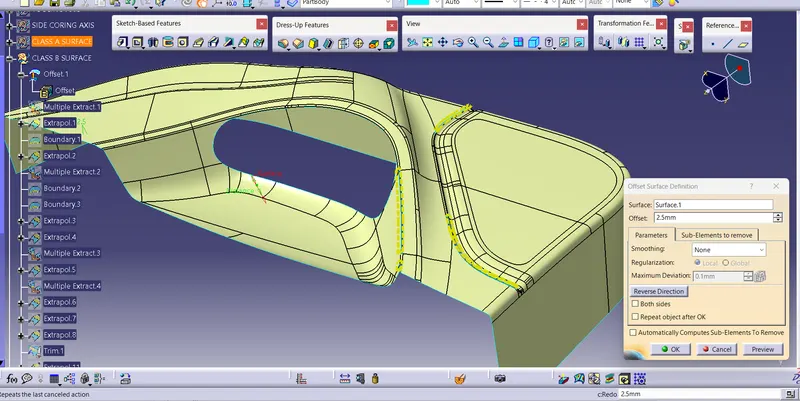
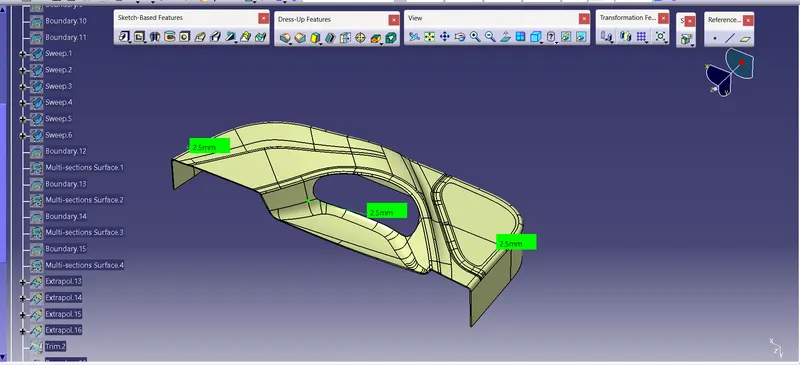
As usual B surface is created using the standard procedure by extract, , extrapolate, join, Trim, split, and offset ,multiple extract, multi section surface commands. The B-surface is created parallel to the A-surface .here I offset our A surface to 2.5mm
C-Surface creation
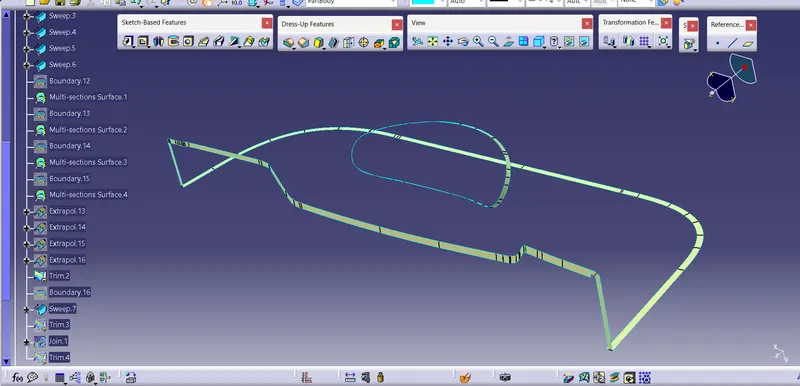
Class C surface for this component is created using the sweep command. All the ends of the component surface were facing downwards, so the C surface will create perpendicular to A surface
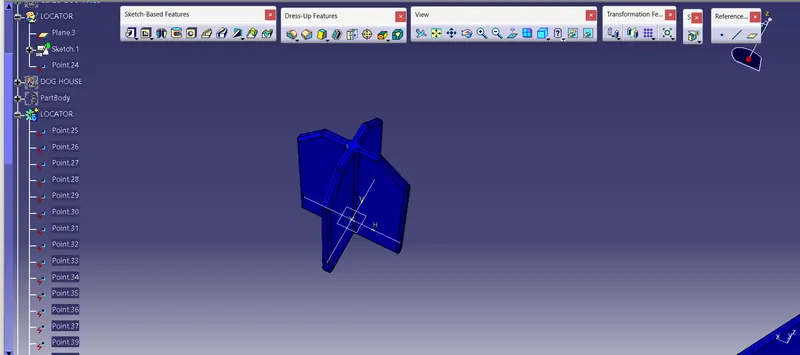
What is Locators?
The 3-2-1 method is a work-holding principle where three pins are located on the 1st principle plane, i.e., either XY, YZ, ZX. And two pins are located on the 2nd plane perpendicular to the 1st plane, and at last, one pin on the plane is mutually perpendicular to the 1st and 2nd planes. The aim is to constrain the movement of the workpiece along all three axes.
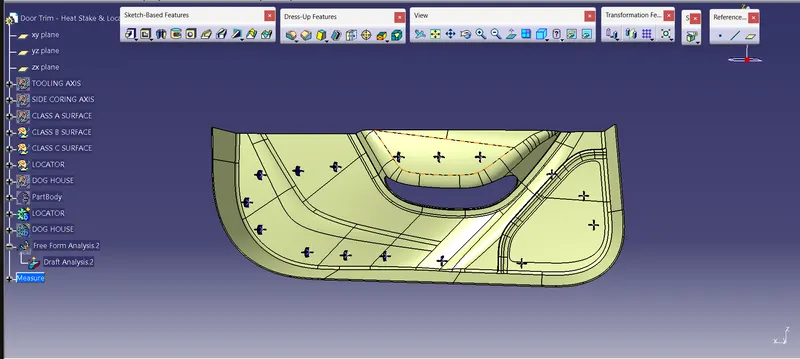
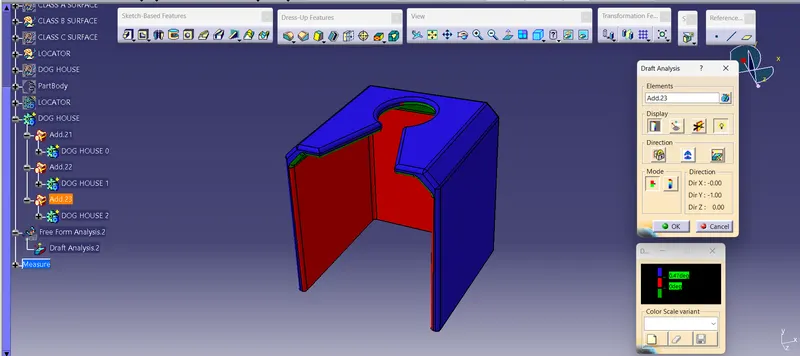
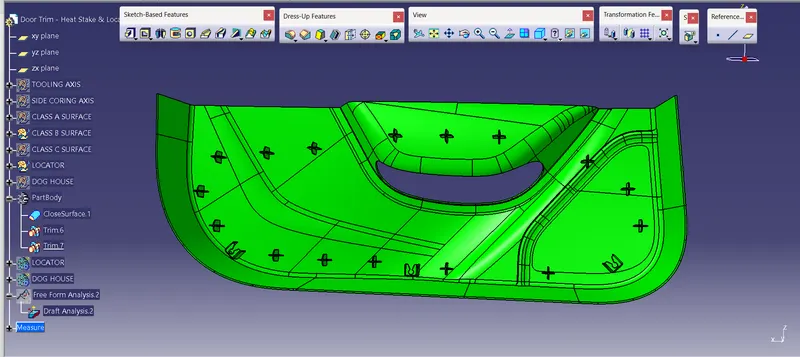
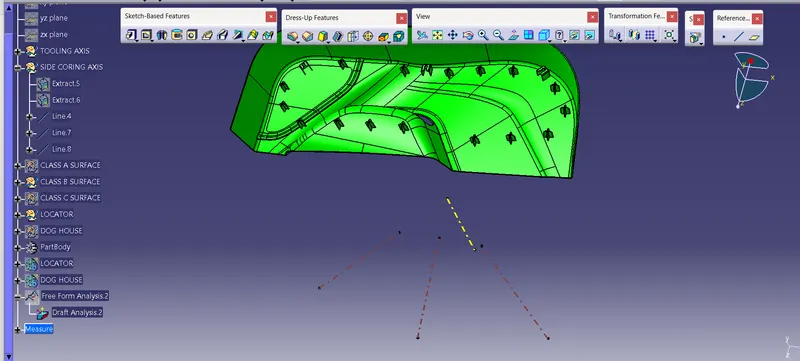
side coring axis
For a each dog house i create saparate coring axis.
features & oprations used
- Extract
- Offset
- Trim
- Split
- Swept
- Fillet
- chamfer
- Multiple extracts
- Multi-section surface
- Join
- Extrapolate
- Union Trim Draft
- Pad
- Close surfaace
- thick surface
- draft
Draft Analysis
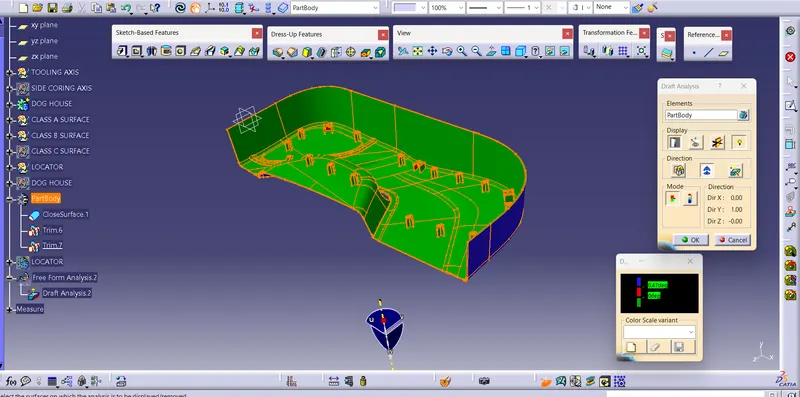
The Draft Analysis allows the user to easily analyze a part for a proper draft angle and check to the manufacturability of the component.In this model In this model we have some complex curvatures in the A surface even am giving 3 degree draft angle for the C surface still it creates some complexity it will refelects in our draft Analysis we can't do anything for this kind of problem its happens sometime. Solution for this problem was give some suggestuin for Class _A -Surface engineers to make some changes in A surface then you can proceed furtherly.As you can see the draft analysis heat stakes are showin 0 degree we dont worry about it locators gets cleared with the core side.
Conclusion
I have successfully completed the Door trim lower design with Engineering Features challenge by using CATIA V5.