Week 9 - Project 1 - Door Trim Lower with Engineering Features
Project 1 - Door Trim Lower with Engineering Features
AIM
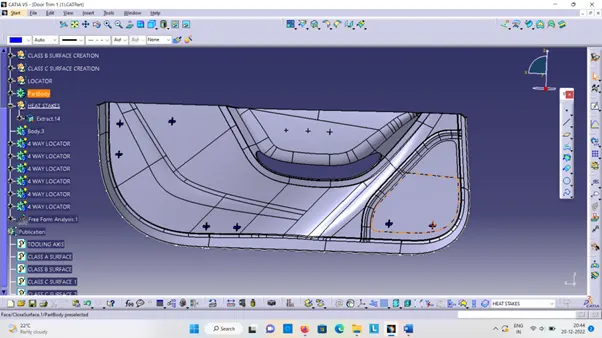
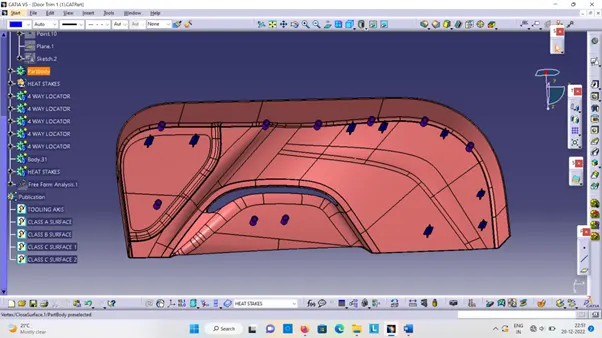
To study the creation of locator and heat stakes.
OBJECTIVE
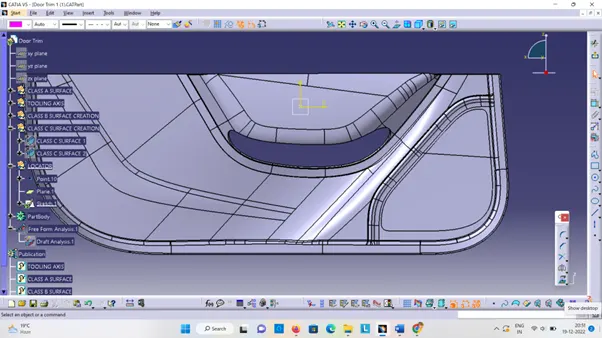
Create the Door Trim Lower Plastic component through the given Class-A surface. To begin with, the tooling axis for the given Class-A Surface should be created meeting the requirements of the draft angle and at the end perform the Draft analysis on the model.
THEORY
Heat Stakes design :-
Counter Part Thickness - Will be given as input
Component Wall Thickness - Will be given as input
Length of the Rib - 22 mm
Height of the Ribs - 3 mm to 6 mm
Inner Diameter of Heat Stake (d) - 5 mm
Outer Diameter of Heat Stake (d) - 7 mm
Minimum clearance between heat stake and counterpart - 0.5 mm
Height of the Heat stake - Depends on the rib height and counter-part thickness
Minimum fillet of Heat Stakes - 0.25 mm
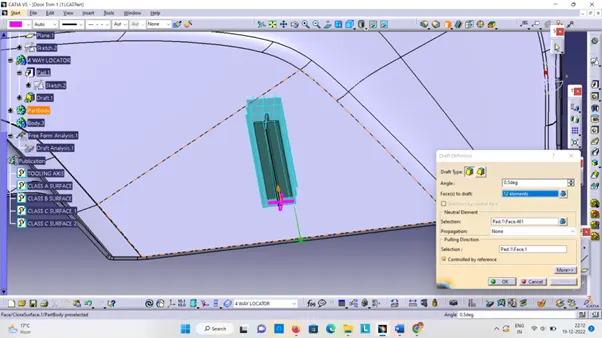
Minimum Draft Angle of Heat Stakes - 0.5 degrees
Locator:
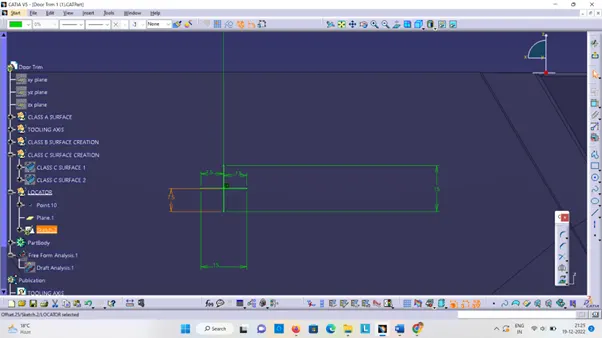
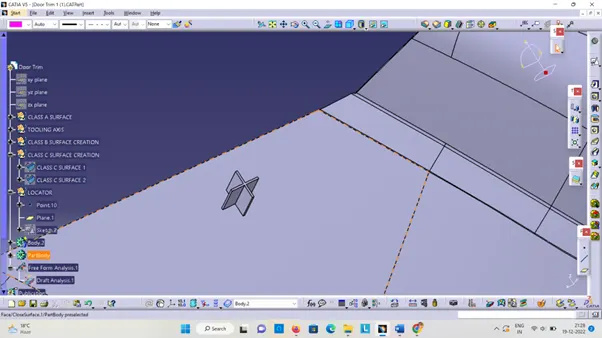
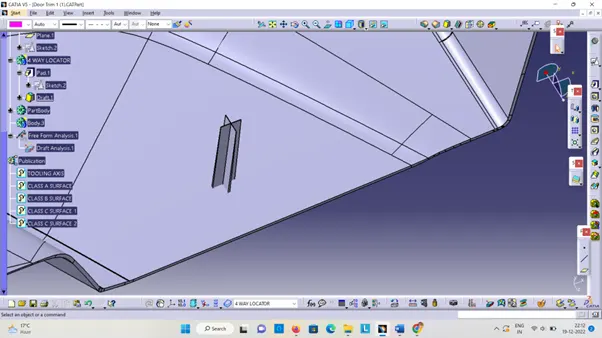
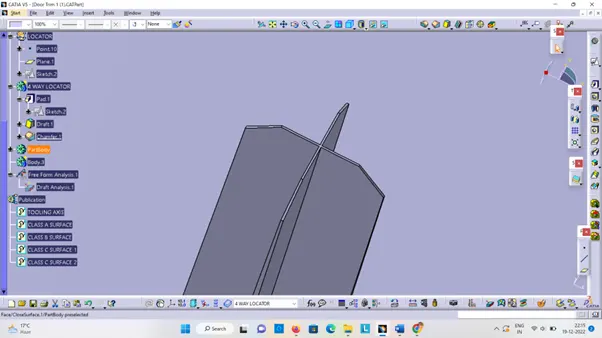
Height of the locators should be 1 mm (or) 2 mm greater than the heat stakes
Thickness, fillet and draft angle are of same as rib design rules.
Ideal Chamfer value - 5 mm x 45 degrees
Ideal length of the locators - 15 mm
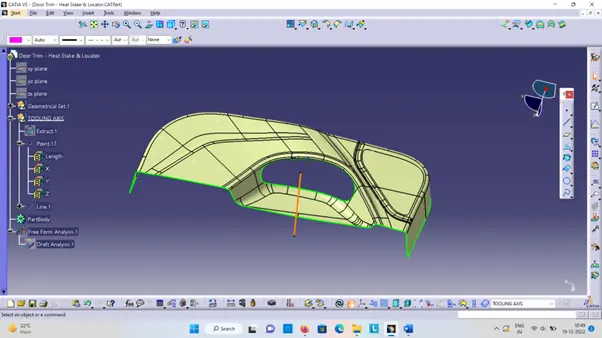
TOOLING AXIS
Here the tooling axis is created parallel to the Y axis because in this direction we can see the whole surface and surface is not planar. Extract the surface then create one point and create line (Point - Direction).
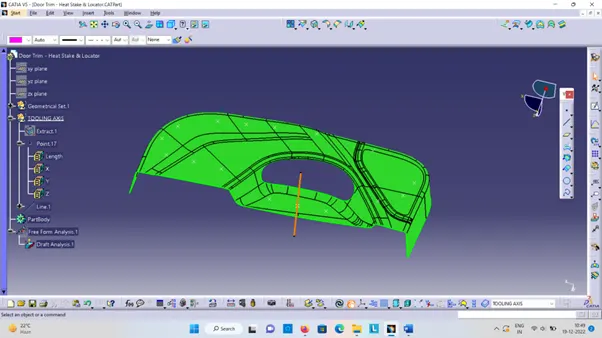
DRAFT ANALYSIS OF CLASS A SURFACE
Here draft analysis carried for class A surface with respect to tooling axis. Here colour code used is a green colour indicating that the draft is 3 degree or above. The red colour indicates that the draft is 0 degree and the blue colour indicates that the draft is minus value. From draft analysis we can see that green colour is all over the surface and hence it is suitable for further process because it follows optimum draft.
Heat Stake:
Heat staking is the process to attach two separate components together by melting the base plastic material into a shape that will hold the secondary component. It’s a permanent attachment method that does not require any additional material such as an adhesive or a solvent to make the permanent bond. The only addition is the heat applied to melt the plastic and a tool to shape the plastic to form the mechanical connection.
REASONS FOR HEAT STAKING:
1.Mutiple staking shapes for different benefits.
2.Excellent durability.
3.No extra materials are needed.
4.Increased efficiency.
5.Easy Maintenance.
CONCLUSION
Creation of locator and heat stakes are studied