Week 9 - Project 1 - Door Trim Lower with Engineering Features
Door Trim Lower with Engineering Features
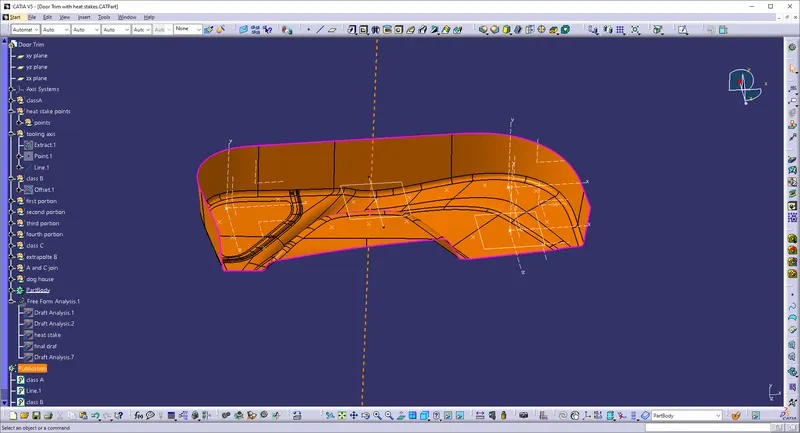
TOOLING AXIS : Tooling axis means the direction in which core and cavity open and close.Tool is nothing burt mold, tooling axis is created to know in which direction the mold open and close, parts drafts are given along this axis.
MATERIAL SELECTION AND REASON FOR SELECTING THAT PARTICULAR MATERIAL :
DOOR TRIM LOWER Made of highest quality ACRYLONITRILE BUTADIENE STYRENE (ABS) materials.
REASON FOR CHOSSING ABS MATERIAL:
- High rigidity.
- Good impact resistance, even at low temperatures.
- Good insulating properties.
- Good abrasion and strain resistance.
- High dimensional stability (Mechanically strong and stable over time)
- High surface brightness and excellent surface aspect.
MANUFACTURING PROCEDURE :
Injection Molding
It is a manufacturing process used for the mass production of plastic components. It works by injecting molten material(plastic) into a mold. Under the application of heat and pressure, the material solidifies into the required shape. Once the product cools, it is ejected from the mold with the help of ejector pins.
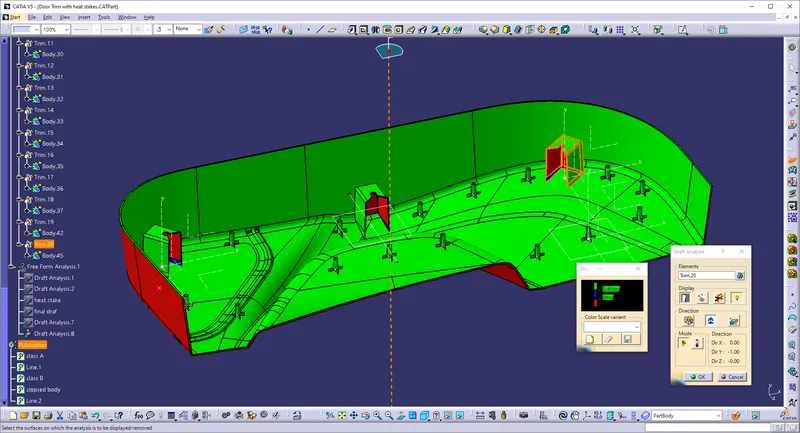
DRAFT ANALYSIS : Draft analysis is done to check weather the tooling axis and draft angle are correct or not and to find weather the component is manufactured and ejected or not. Draft Analysis is a tool in CATIA which identifies the zones which deviates from the specified values of angles along a defined draft direction using colour codes.
DRAFT ANALYSIS 1
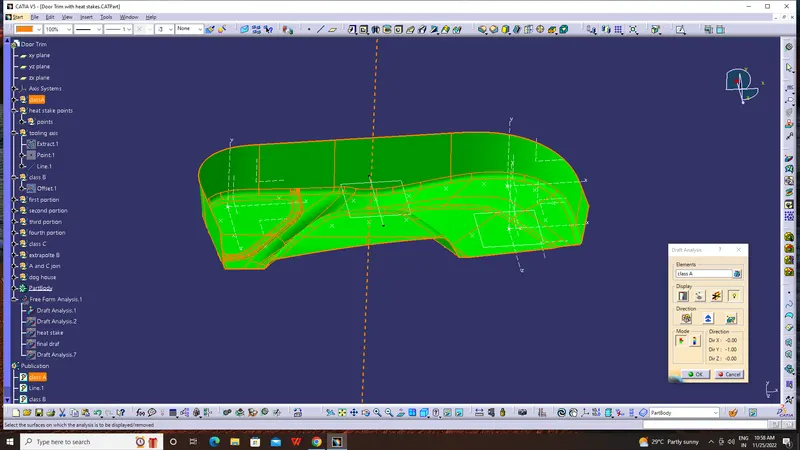
DRAFT ANALYSIS 2
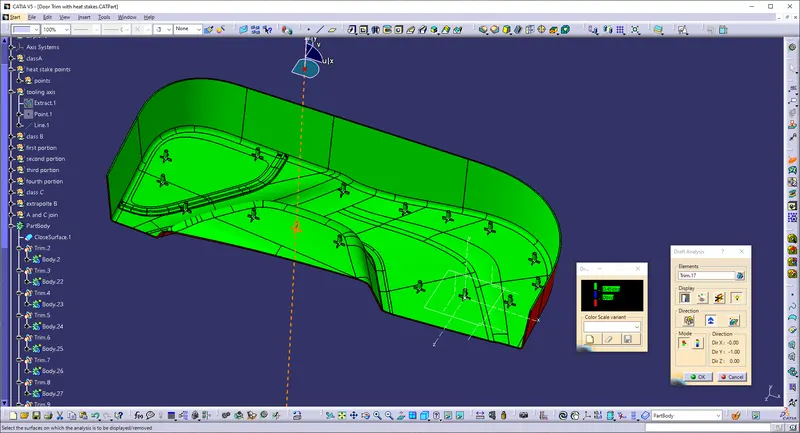
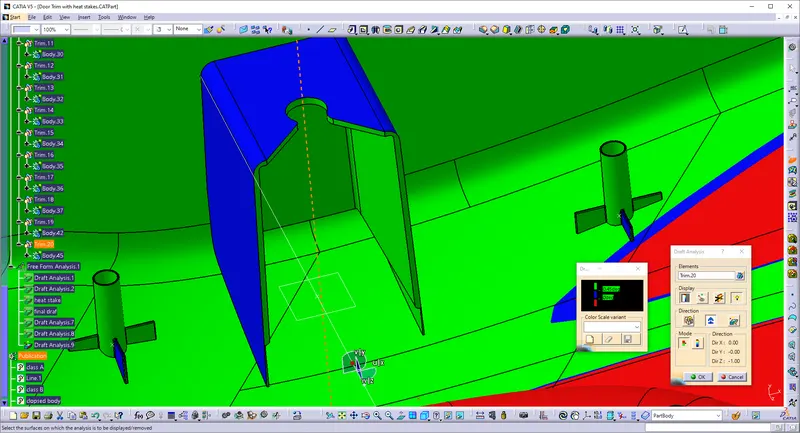
CLASS A SURFACE : Asurface is the aesthetic surface created by the class-A engineer. It is the visible aesthetic surface of any automotive component. class A surface is any of a set of freeform surfaces of high efficiency and quality.
CLASS B SURFACE : B surface is the offset of the class A surface. Class B surfaces are Engineering Surfaces which are invisible to the eyes or often on the back side of the Class A surfaces. It is mainly the thickness of the component or Class A.
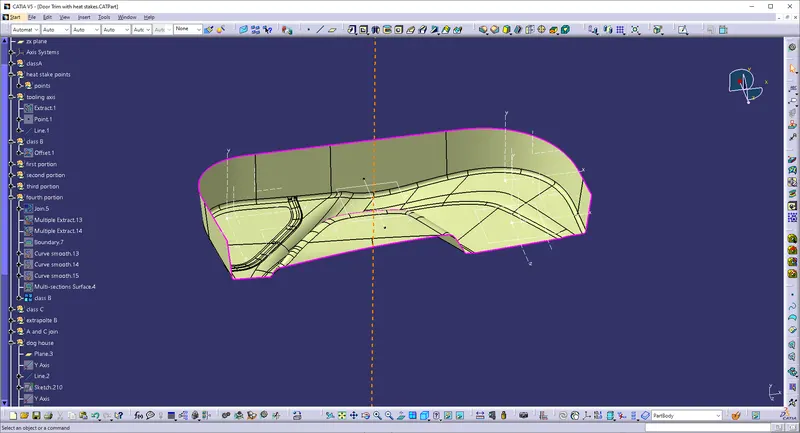
CLASS C SURFACE : C surface is joining surface between A and C. Class C surfaces are connectors between Class A and B surfaces. This surface connects both A and B surfaces along the Tooling Axis. It contains the draft as per the design. Its is basically the thickened surface between both A and B surface.
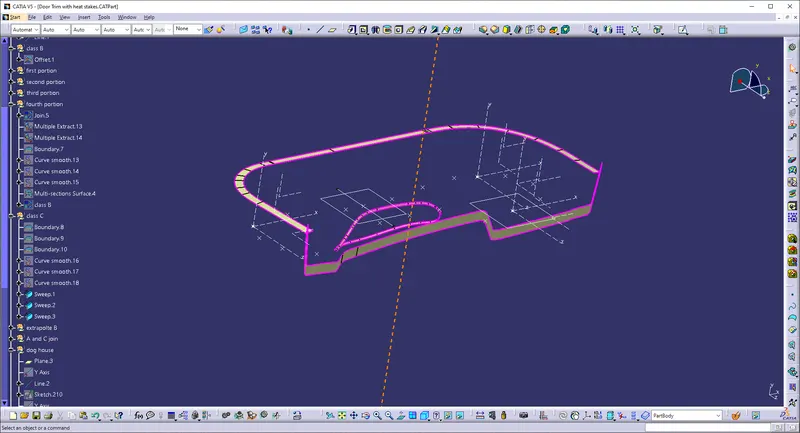
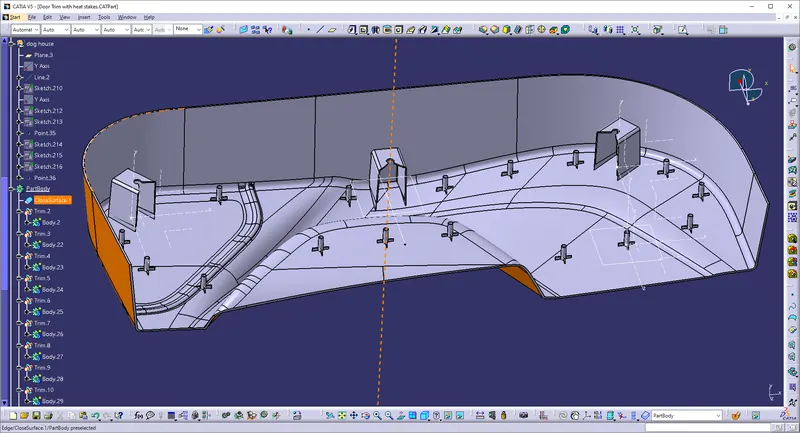
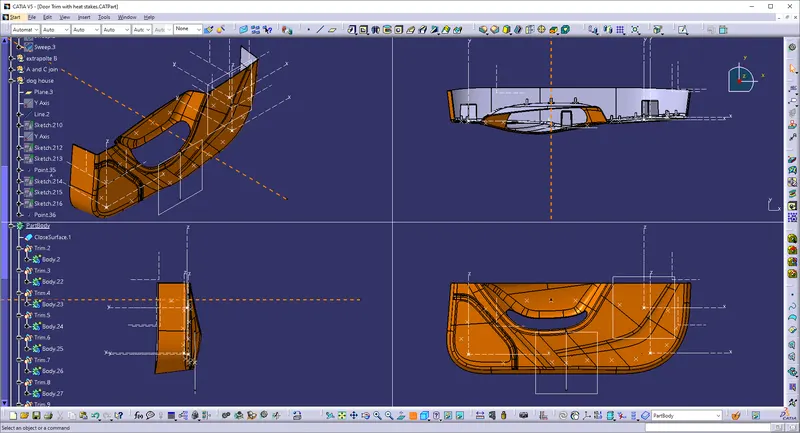
CLOSED SURFACE BODY
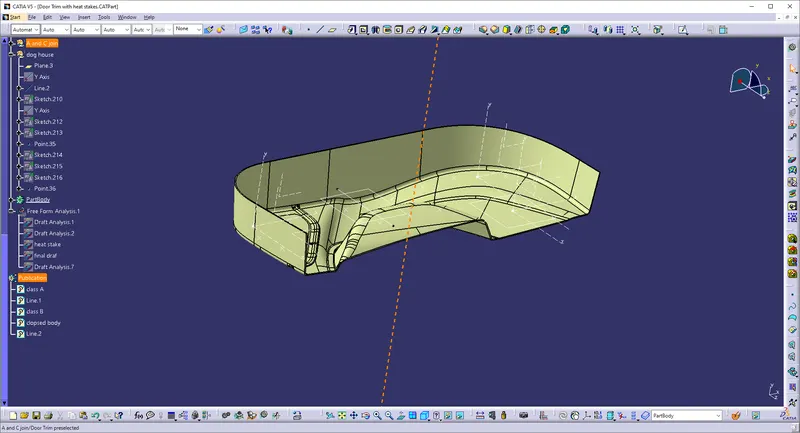
SOLID BODY
HEAT STAKES
Heat staking also known as thermoplastic staking is the process of joining two dissimilar materials together. In heat staking we use local heating and cooling to raise the temperature of plastic components and allow plastic reforming to be carried out. This reforming can be used in a wide variety of applications.
Heat staking can be performed using wide range of thermoplastic materials including polypropylene, ABS, polycarbonate and many others. The integrity of a thermal staked assembly depends greatly upon the geometric relationship between the boss and the thermal tip.
The heat staking tip is brought into contact with the thermoplastic part to be reformed. The heating tip is then heated by direct electrical heating within the tip for a short period of time. The heated tip softens the plastic material and forms the melted plastic into the shape of the tip.
DOG HOUSE
Dog house is an engineering feature used in plastic trim design. Dog houses are used as supporting feature. Sometimes other engineering features like snaps; locators etc. are mounded on them to increase their strength. Dog houses are subjected to draft analysis to prevent breakage of the component during ejection from mould cavity. Dog house and other engineering components are built on B-surface.
GUIDE LINES OF DOG HOUSE
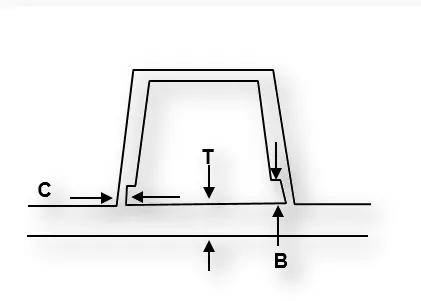
C- is where doghouse contacts back side of surface.
Dog house wall thickness at intersection of partwaqll(c) should be 40% or less than main wall stock(T).
Height of (B) should be between 3-6mm.
dog house draft outer faces -1.5 degree
dog house inner face draft-0.5-1 degree
Coring or sink mark cut 3-6mm
height of the dog house is 60mm
dog house outside fillets -3.5mm
dog house inside fillet- 1mm
CONCLUSION
This project imparted a great deal of knowledge regarding the creation of tooling axis and performing proper draft analysis on a component which are essential steps to ensure a design is fit for manufacture. It also provided valuable insights on the design of a plastic component using Class A, B and C surfaces using CATIA.