Week 9 - FVM Literature Review
FVM LITERATURE REVIEW:
FINITE VOLUME METHOD:
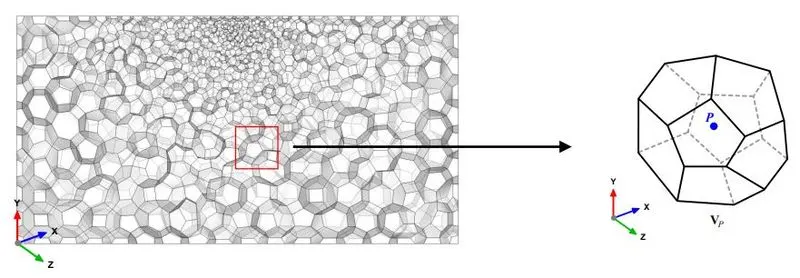
In Finite volume method,the entire fluid domain is divided into a finite number of cells,each associated with finite sized volume.
Governing equations are solved at the cell centroids.i.e., the cell centers act as nodes and store the volume averaged values of field variables.
The mathematical foundaztion of FVM is the gauss divergence theorem
`oint_V(nabla.veca)dV=oint_Sveca*hatndS`
where a is a generic vector. `hatn` denotes the outer normal to the surface.
Gauss divergence theorem states that the integral of the divergence of a given vector over a closed volume is equal to the flux of this vector across a closed surface bounding the volume.
This theorem permits to consruct dyanmic equations for volume-averaged quantities,such as the total mass in the volume,rather than pointlike ones,like in Finite differences.
Finite volume formulation secures built-in conservation laws,which is an extremely useful for numerical implementations.
WORKING OF FINITE VOLUME METHOD:
- Taking the governing equations usually avaible in PDE form.Convert the governing equations into their finite volume integral form.
- Apply Gauss divergence theorem to convert volume integralsto surface integrals and approxiamte/discrete those integrals.
- Use interpolations/Gradient schemes on the semi-discretized equations to approximate face averaged values and face averaged gradients.
- Apply the boundary conditions suitably and solve the algebraic/discrete equations using appropriate solution method.
DIFFERENCES BETWEEN FINITE DIFFERENCE METHOD AND FINITE VOLUME METHOD:
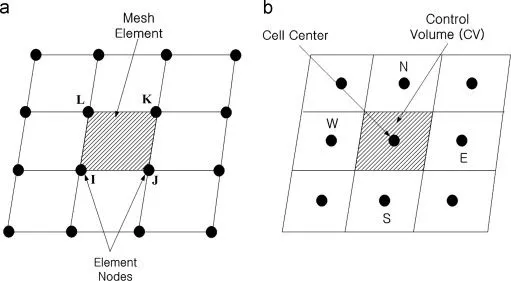
- In FDM,governing equations are in differential form while in FVM, governing equations are in integral form.In FDM,soluiton computed at each node.i.e.,interaction of mesh lines.In FVM,solution computes at the cell centroids.
- FDM requires use of structured grid,difficult to implement for complex geometries,FVM can handle unstructered grid and hence complex geometries with ease.
- In FDM,easy to obtain higher order schemes,so preferable for applications that requires very high accuracy while for FVM,deriving schemes higher than second order is next to impossible due to the complexity involved.
- For FDM,Does not ensure conservation.For FVM,Imposes and ensures conservation at both cell and domain levels
- For complex geometry like 3D simulation,finite difference method is harder while finite volume method is popular and robust can be applied for complex geometry,moving parts.
- Differential schemes are faster and error can be minimized if you have regular grids (squares and rectangles).Integral schemes are slightly slower but score over FDM when the mesh is irregular.
GRADIENT SCHEMES:
Gradient schemes are used to approximate ther gradient times in the governing equation like pressure gradient term.The gradients are evaluated at cell centroids.
GAUSS GRADIENT SCHEME:
Approximate the gradient/slope using gauss divergence theorem.Gradients are computed from face values which in turn require interpolation.
LEAST SQUARE GRADIENT SCHEME:
Approximate the gradient at the cell centroids using neighbor cell centroid values(not face values).This method is designed to compute the gradient such that sum of square of the errors is minimum.It results in more equations than the number of unknowns(one for each face)The resultant equations can be solved by matrix inversion method.
INTERPOLATION SCHEMES:
Interpolation schemes are used to evaluate the face values that arise as part of the convective flux and diffusive flux terms in the discretisation of Navier Stokes equation in the integral form.
UPWIND INTERPOLATION SCHEME:
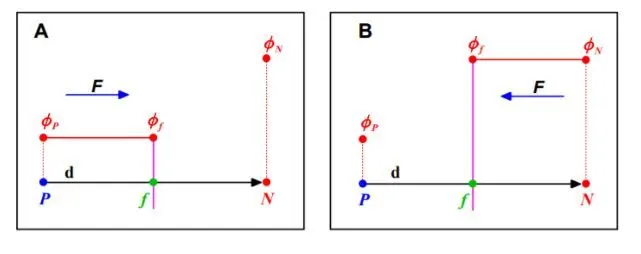
This is a first-order accurate interpolation scheme.The scheme is bounded(non-oscillatory) and has a diffusive character.The scheme is based on the direction of flow.The face value is considered the same as the cell centroid of the neighboring cell in the upwind direction.
We compute the face values by the equation
`phi_f={phi_f=phi_p for dotFge0, phi_f=phi_N for dotF<0`
LINEAR INTERPOLATION OR CENTRAL DIFFERENCING SCHEME:
This is a second-order accurate interpolation scheme,which is unbounded and might generate oscillary solutions.The face values are computed as a linear interpolation from the owner and neighboring cells
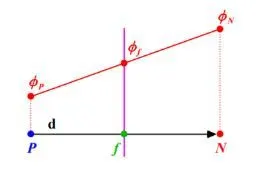
The face values are computed as
`phi_f=f_xphi_P+(1-f_x)phi_N`
where,
`f_x=(fN)/(PN)-|x_f-x_N|/|d|`
LINEAR UPWIND DIFFERENCING:
This is the second order accurate interpolation scheme.It is employed for highly convective (strong gradient)flows.The scheme is unbounded and prone to oscillations.
The face values are calculated as
`phi_f=phi_P+1/2(phi_P-phi_(PP))=2/3(phi_P)-(1/2)phi_(PP) for dotFge0;`
`phi_f= phi_N+1/2(phi_N-phi_(NN))=2/3(phi_N)-(1/2)phi_(NN) for dotF<0;`
QUADRATIC UPWIND INTERPOLATIPON SCHEME(QUICK):
This is a third-order accurate interpolation schemes.The face values approximated using a three-point quadratic function with two surrounding nodes and one upstream node.The scheme is highly oscillatory.
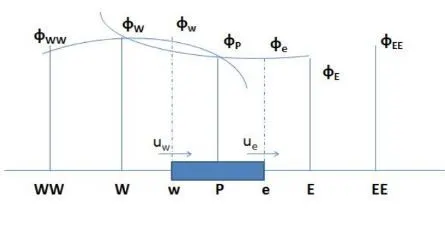
The face values are calculated as
`phi_(face)=(6/8)phi_(i-1)+(3/8)phi_i-(1/8)phi_(i-2)`
FLUX LIMITERS:
For the second and higher-order interpolations(high resolution),which predict face values based on gradients at cell centroids,in the presence of strong gradients,due to overshooting the face values might exceed the local minimum/maximum.
This will create new maxima and minima in the solution and might lead to the solution blowing-up.This issue can be overcome by using a flux limiter function.
The flux limiter function keeps monitoring the ratio of successive gradients and locally switches to the first-order scheme(low resolution) when it detects strong gradients.