Week 9 - Creating connection for Rear door
Aim
- To create and Apply different PIDs for different components of the given Rear door FE model.
- Perform suitable connections.
OBJECTIVE:
- To give different types of connections for rear door model of car.
- These connections are given to the model using ANSA in NASTRAN deck which will be used later for NVH simulation.
PROCEDURE:
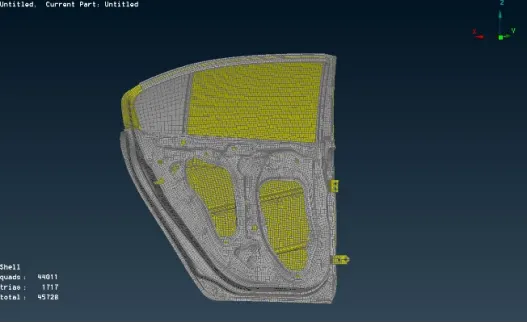
Step 1: Import the model. Before assigning connections for the model once observe the real car model as it gives idea for the different types of connections used for various mechanisms.
Imported rear door CAD model
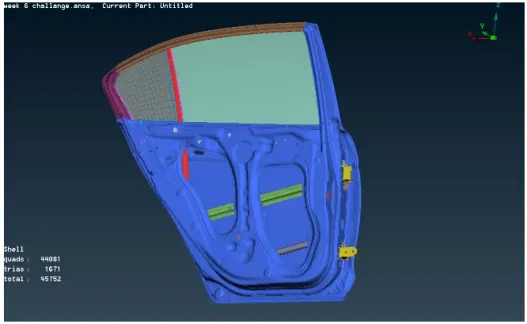
Step 2: Assign different PID’s for Glass and the parts which are needed to be welded.
PID’s assigned for the model
Step 3: In this challenge we use different kinds of connections. The various connections are as follows:
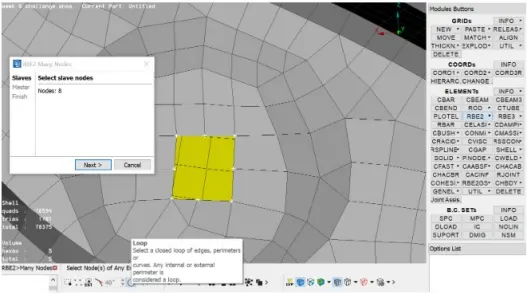
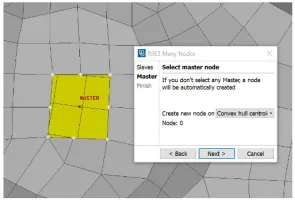
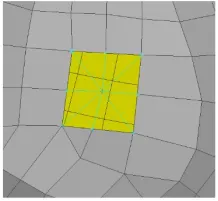
- RB2 Rigidis simply used to rigidize the hole. This type of connection is used where there are no bolts or washer elements. Use Elements --> RB2 --> Many nodes for connection, we can select all the nodes using loop selection. After selecting all the slave nodes a master node will be formed which connects all the slave nodes.
Selecting slave nodes using loop
Master node is created for the selected slave nodes Rigid RB2 connection
-
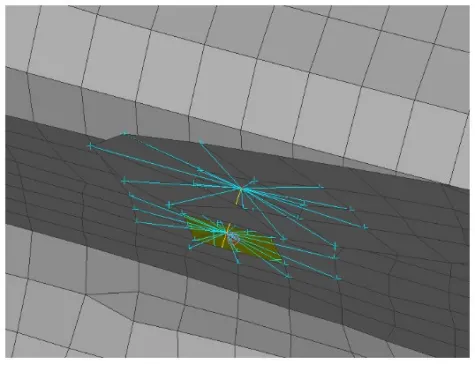
Cluster or Spider RB2: This connection is used when a manual bolt connection must be deployed between two or more surfaces.
For automatic bolt connection one must follow these steps, Create COG for the hole --> COG is basically a 3D point, convert this 3D point to bolt --> Now open connections manager and select the bolt symbol which has created in earlier step --> Then assign P1,P2,P3 --> Select FE type as Bolt and give the required values and constraints --> apply and then realize the connection.
Deployed bolt connection without body
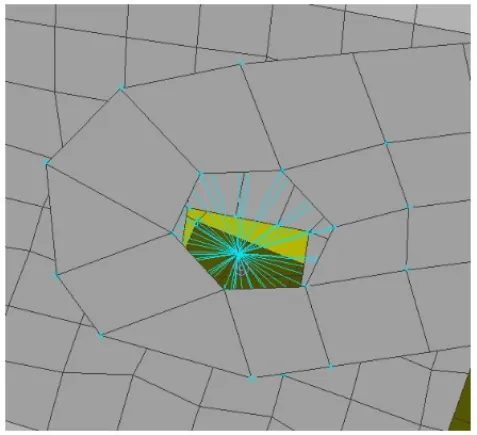
Deployed bolt connection with body
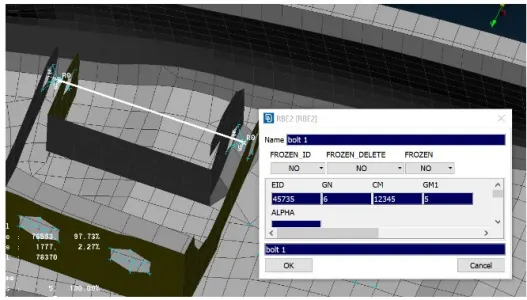
- Hinge connection must be constrained to only five degrees of freedom as this allows the door to open.
Info of RB2 two node for hinge
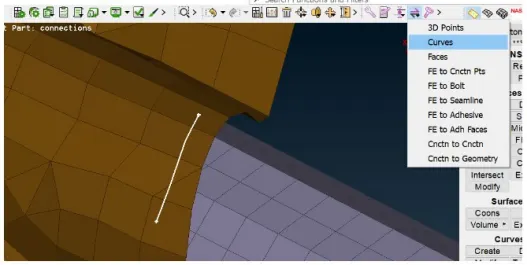
- Spot welds are also parts of connections. In ANSA spot weld can be deployed between different surfaces. Create curve --> convert the curve to spot weld --> Then open connections manager and select the spot weld curve and then assign P1, P2, P3.
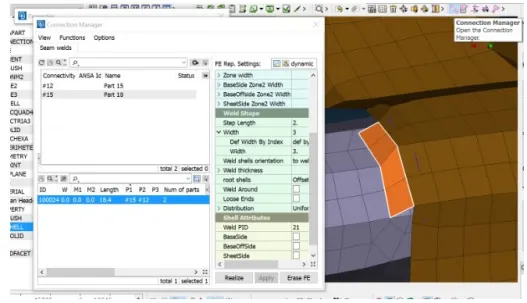
- Mostly overlap shell is used when the surfaces are parallel and y joint shell is used in perpendicular surfaces.
Converting curve to spot weld
Realized spot weld using overlap shell
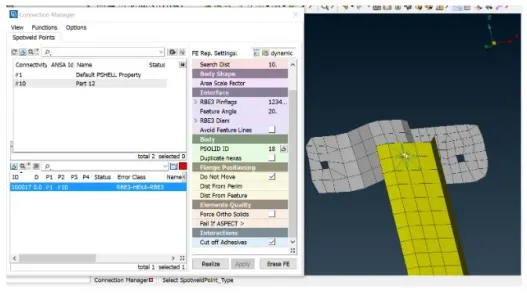
- Spot weld using RBE3-HEXA-RBE3:Create COG --> Convert COG to spot welding point -->Use connections manager to generate RBE3-HEXA-RBE3.
Realized Spot weld using RBE3-HEXA-RBE3
Generated RBE3-HEXA-RBE3
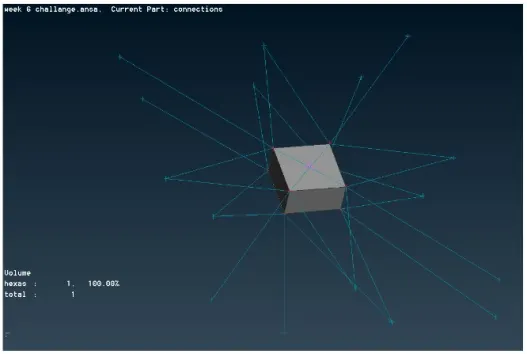
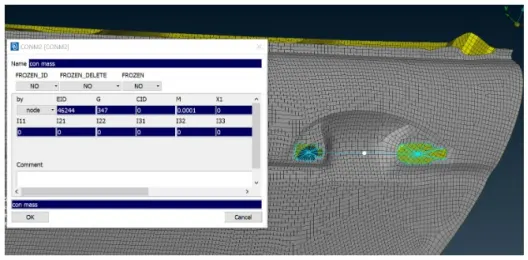
CONMi: It is referred to as con mass. It is basically a concentrated mass connection where a point is created for representing the weight of it. We must give the mass in tonnes. Here we gave the handle mass as 100 grams which is 0.0001 ton.
Con-mass for handle
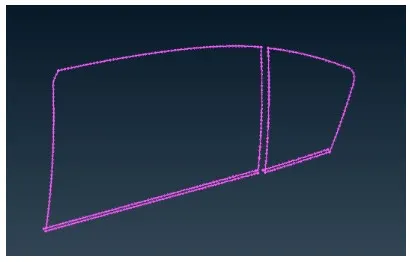
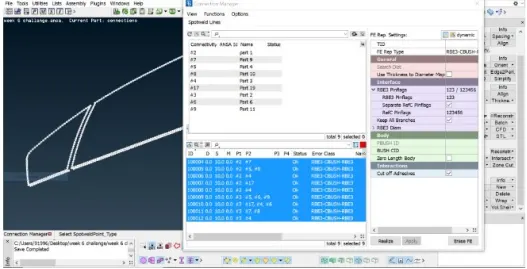
- CBUSH Connection:This connection for the glass is always given in closed. 1st create curves using Perimeter --> FEAt2Curve option which is available in mesh mode. Then convert those curves to Seam Lines. Now using connections manager assign ‘P’, ‘S’ values and select RBE3-CBUSH-RBE3 as FE type for generating CBUSH connection.
Curves which are converted to seam lines
Connections manager for deploying CBUSH
Generated RBE3-CBUSH-RBE3 Connection
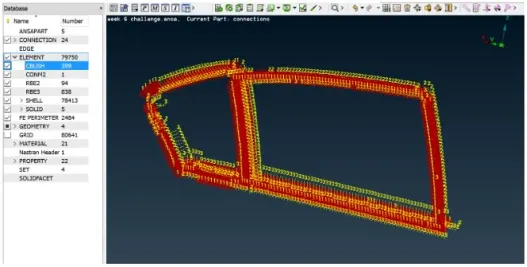
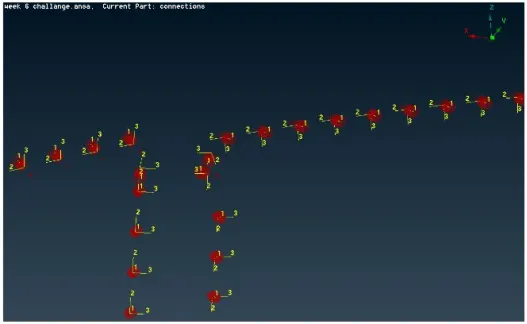
- Generated RBE3-CBUSH-RBE3 Connection has its own Local coordinates which are different from each other. This could create some disturbances during simulation. So, we need to convert all the CBUSH coordinates to Global coordinates. This can be done by changing the CID value to 0 in CBUSH properties.
- We can change all the CID values in a single shot using Modify option.
Local coordinates before modifying
-
LEARNING OUTCOME:
- Assigned various connections according to the required mechanism.
- Learned and implemented all the connections in ANSA.
- Studied different real-life concepts about connections used in cars.
CONCLUSION:
In this challenge, I have deployed connections with RB2 and RB3 elements successfully. Constrained the hinges to five degrees of freedom. Learned different concepts regarding the tailored cut. Learned almost all types of connections used in ANSA.