Week 9 Challenge
About Energy management system :
- Here The vehicle industry is experiencing a technological revolution in the powertrains of vehicles.
- So the hybrid electric vehicle HEV is an effective choice to solve the problems of the low energy density of a power battery and the short driving distance of an electric vehicle EV.
- Here Different configurations of HEVs have different control strategies production costs and applicable conditions.
- But However for any configuration the ultimate goal is to achieve the comprehensive optimization of the efficiency of the engine and the motor so as to improve the vehicles performance parameters such as economy emissions and durability.
- Here The procedure of realizing the goal is commonly called an Energy Management Strategy(EMS).
- The act of load sharing is mainly implemented through the EMS systems.
- But According to the power demand of vehicle the power request from sources distributed among different energy giving sources like ultracapacitors batteries and fuel cells based on their power demand capability.
Power flow procces in EMS system:
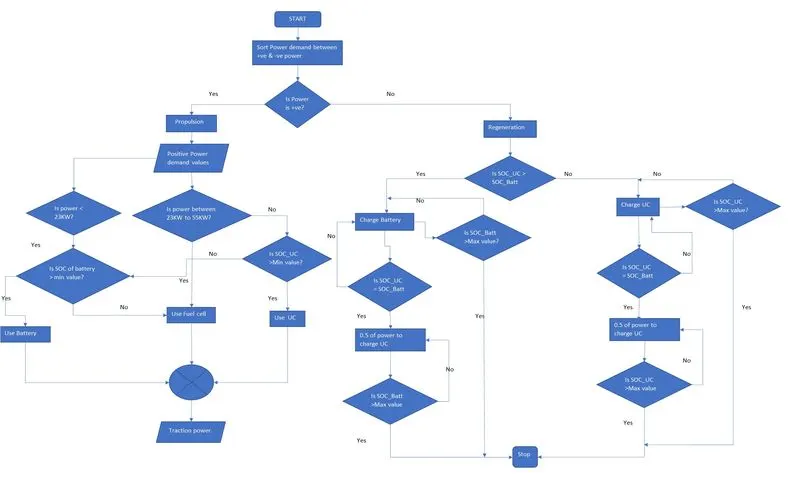
Power Sharing :
- Here The fuel cells having a range of operating condition to produce the power needed for propulsion.
- Here we are taking fuel cell with have capability to produce power in the range of minimum 23KW to maximum 72KW.
- But for better effeciency of fuel cell power usage it is derived that fuel cells will operate at maximum efficiency in moderate power generation area as seen from polarization curve.
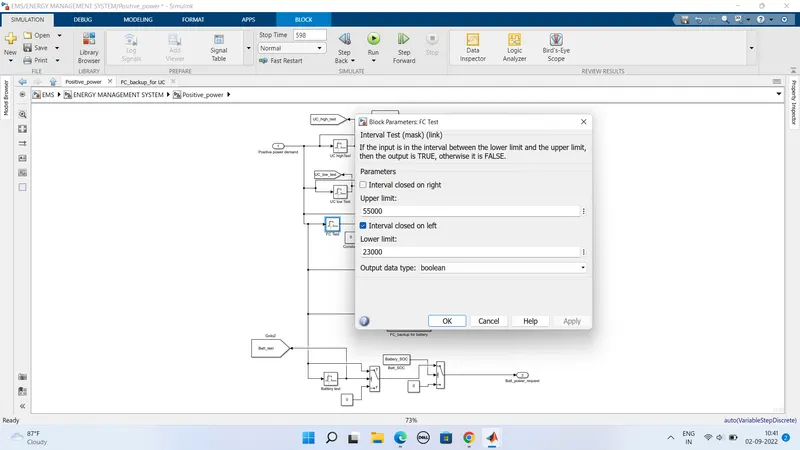
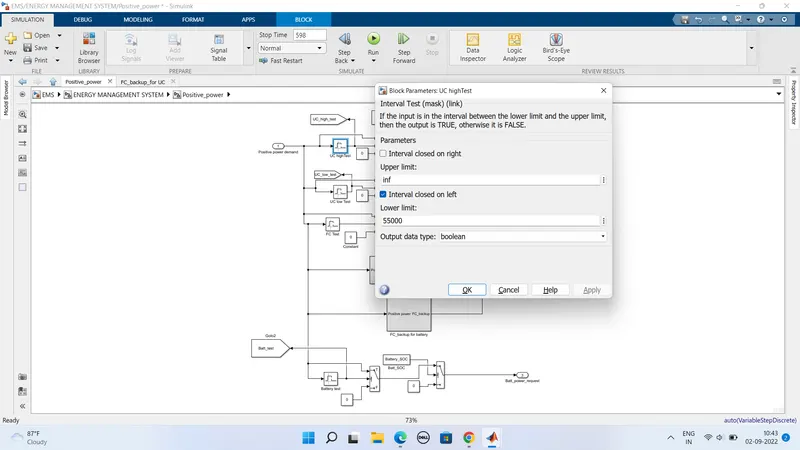
- So we are considering lesser power production level for maximum fuel cell power generation as 55KW.
- The Batteries are prefered to operate in lower power demand conditions and ultracapacitors are prefered to operate in peak power demands.
- So we are get the final power sharing between three components as
- From 0 to 23 KW is drawn from battery unit based on its SOC condition.
- Above 23KW to 55KW will be drawn from fuel cell power.
- And above 55KW will be drawn from ultracapacitors based on its SOC condition.
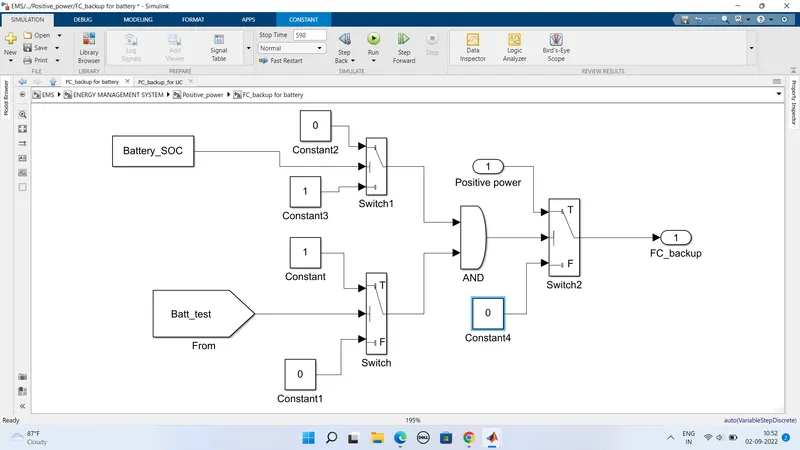
- So If SOC of UC is not enough to supply required power demand in that case the power is drawn from battery as battery backup.
- If SOC of battery and UC are not enough to supply power demand in that case alternate source is only fuel cell.
- Here the Power is drawn from fuel cell as fuel cell backup.
- But at this operating conditions the overall efficieny of vehicle is reduced as fuel cell cant support with full efficiency for peak power demands and lesser power demands.
Power demand Condition Source
If UC-SOC >35% Ultra Capacitor
1) 0-9999
If UC-SOC <35% Fuel cell Battery
If Battery SOC>35% Battery
2) 10000-22999
IF SOC<35% Fuel cell
3) 23000 54999 No condition Fuel cell
If UC-SOC UltraCapacitor
4) 55000 and >35%
above
If UC-SOC <35% Fuel cell
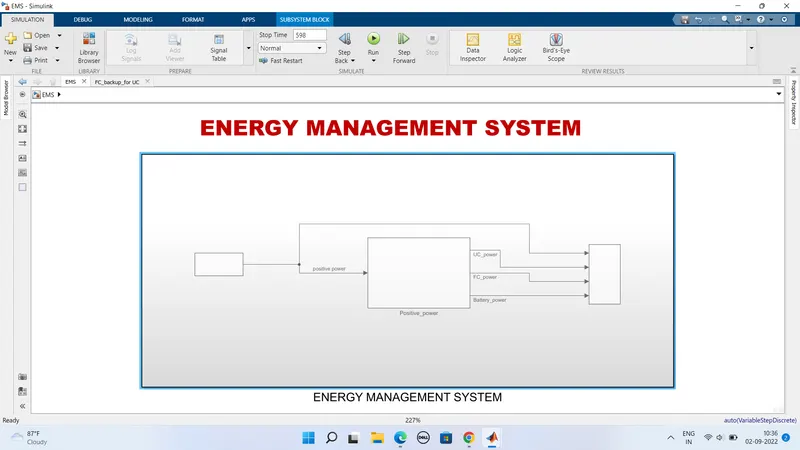
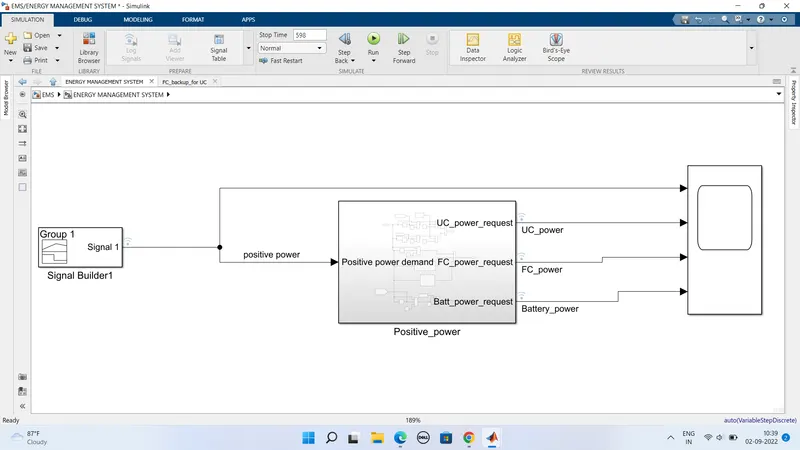
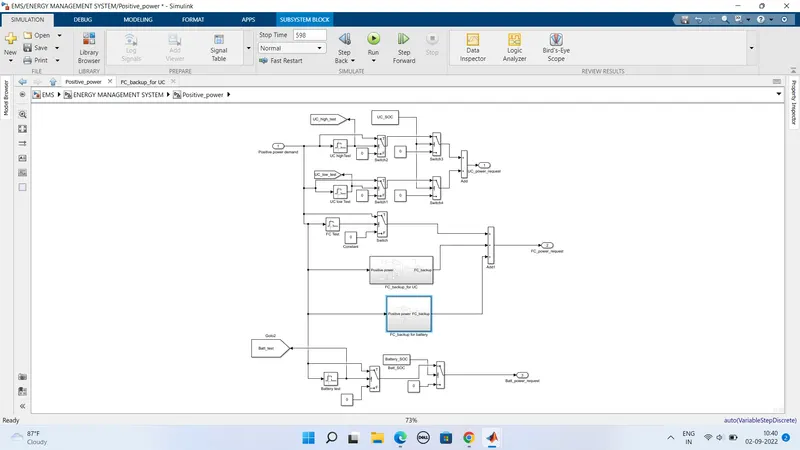
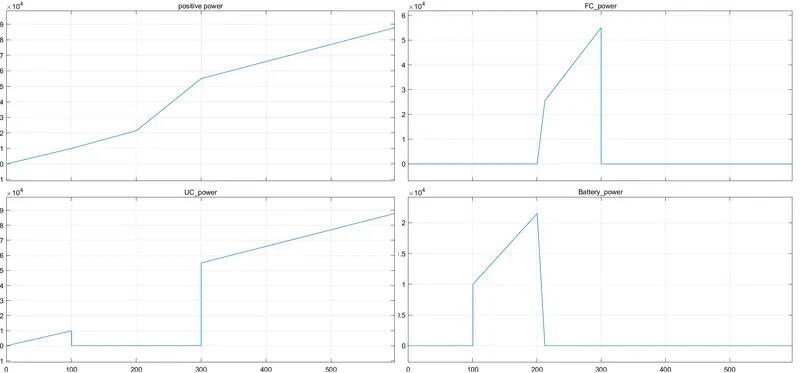
Conclusion:
we have Completed the energy management strategy model with battery UC and fuel cell for the positive power and distribute the power demand among these components. and Seted the simulation stop time to 598 sec. The output of the model obtained by the power request from UC fuel cell and battery.