Week 8 Worm Gear Challenge
WORM GEAR SIMULATION
OBJECTIVE
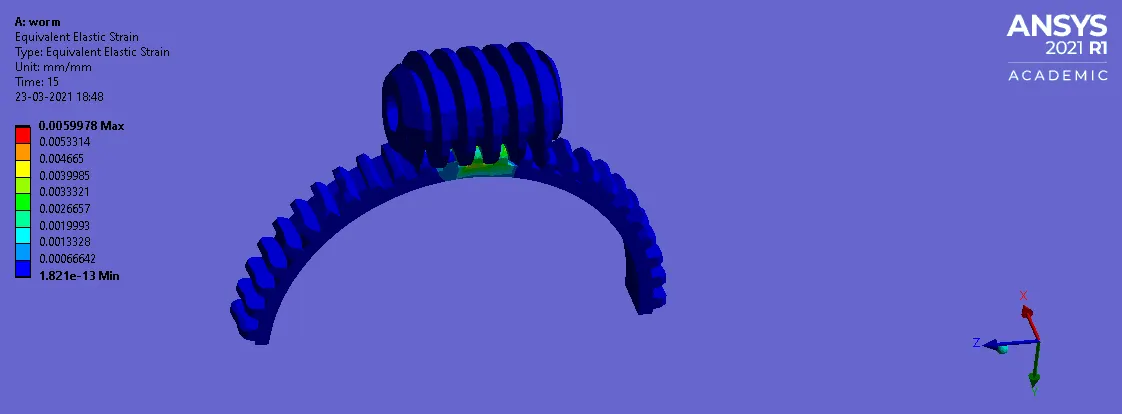
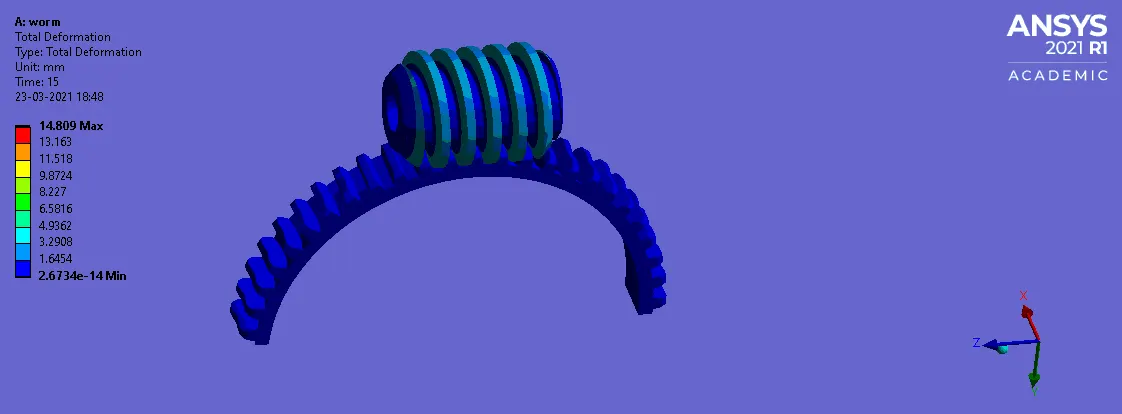
To perform transient structural analysis on a worm gear component with the best mesh parameters to extract the Equivalent stress, Equivalent elastic strain and the total deformation in the model.
PROCEDURE
- Create a new transient structural simulation
- Import structural steel from general materials as the desired material for all the components
- Import the geometry file onto the Design modeler - extrude cut a part of the gear model so that the simulation could run on the academic version of Ansys
- Then the model module of transient structural is again updated.
- Open the model in ansys mechanical module.
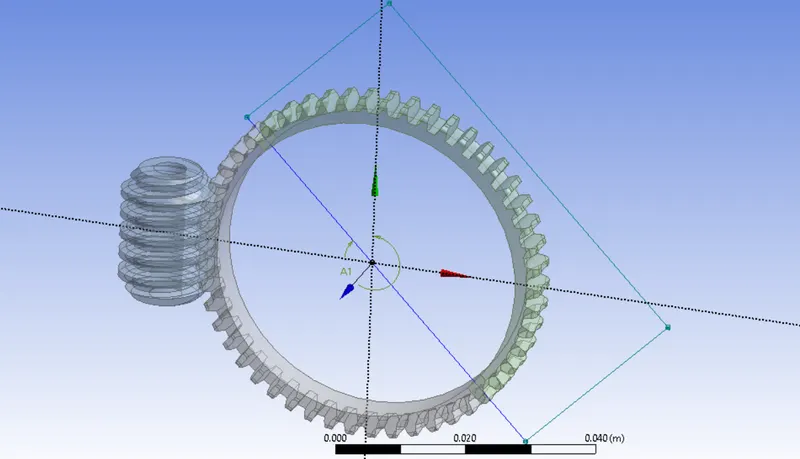
Material assignment
The structural steel is added to all two components.
Contact region
Flip the default contact and target faces.
Specify more target areas at the main gear
Set the contact type to frictional
Joint and Joint load
Two revolute joints are defined for both the gear and worm.
The axis of rotation is defined as Z
A joint load is defined for the worm gear and angular displacement is set for the worm with 50deg displacement at each time step

Mesh
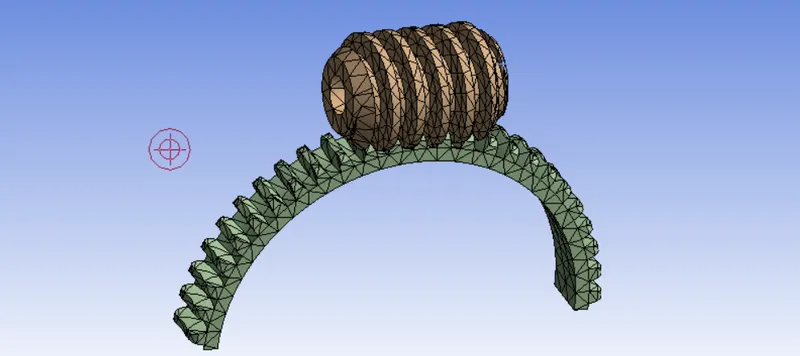
Create mesh with target length of 2-2.5mm.
NOTE: This is a crucial factor because if the mesh length is set beyond 3mm then the elems get distorted and the solution may not converge
Set adaptive meshing to 'off' since adaptive meshing feature fails in a transient analysis

Analysis settings
A total of 15 steps are performed with the angle of rotation in the revolute joint increments to a specific deg at each time step
The initial time step is set to 0.2. However if a solution involving any case fails to converge, then the min and max step size can be reduced to 0.2 and 0.5 respectively (with carry over time step since multi-time steps)
Large deflection = on
Direct/Iterative solver - program-controlled.
Weak springs - program-controlled.
RESULTS
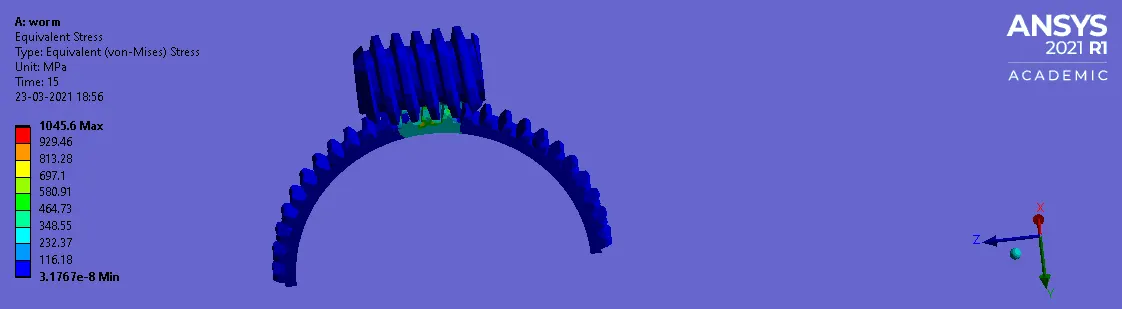
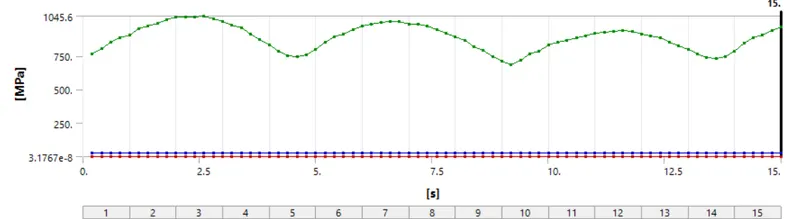
Equivalent stress
Equivalent strain
Total deformation
CONCLUSION
Hence the worm and gear simulation is performed by refining the mesh to extract the equivalent stress, stain and total deformations.