Week 8 - Simulating Cyclone separator with Discrete Phase Modelling
Simulating Cyclone separator with Discrete Phase Modelling
Aim-To perform analysis on cyclone separator and calculate the separation efficiency and pressure drop.
Objective:-
To write about any four empirical models used to calculate the cyclone separator efficiency.
To perform an analysis on a given cyclone separator model by varying the particle diameter from 1 μm to 5 μm and calculate the separation efficiency and pressure drop in each case.[Use the velocity's as 3m/sec.]
To perform an analysis on a given cyclone separator model by varying the particle velocity from 1 m/sec to 5 m/sec and calculate the separation efficiency and pressure drop in each case.[Use particle diameter size as 3 μm for all cases & keep flow velocity same as particle velocity]
Koch and Licht, Lapple, Li and Wang and Iozia and Leith are four model used to find cyclone separation efficiency
Following are the model used for different operating condition:-
- For ambient condition/room temperature (T=293K and Pr<2 bar)-Li and Wang model is used.
- For low inlet velocity-Koch and Licht model.
- For high pressure(293 K and 5.16 bar)-Koch and Licht model.
- For high temperature(1144K and 1 bar)-Lapple model.
- For high temperature and high pressure(1221 K and 6 bar)-Lapple model.
- Iozia and Leith logistic model show a good agreement with an experimental data for the cyclone size range of D = 0.25 – 0.4m. However it is unable to predict correctly the efficiency for small cyclone (D < 0.1m). Iozia and Leith model is only suitable for efficiency prediction of cyclone diameter around 0.25 m
Explanation
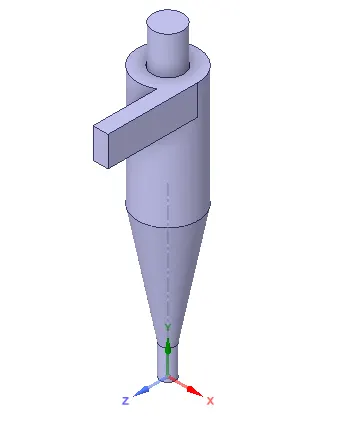
In ANSYS Fluent open space claim setup and load cyclone separator 3D model and extract volume by selecting 3 edges. Geometry done.
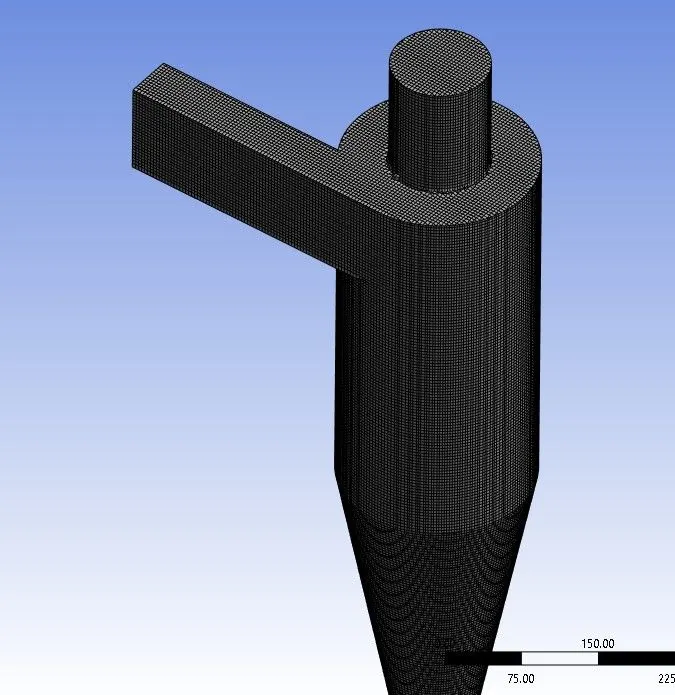
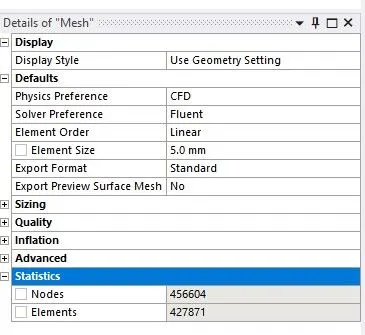
In meshing apply 5mm mesh by body selection and cartesian mesh elements. Give named selection inlet, outlet escape and outlet trap. Meshing done.
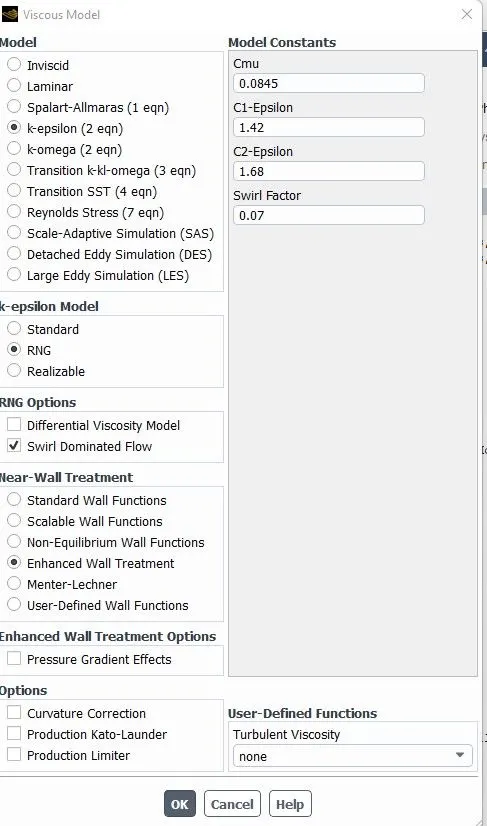
In setup enable gravity -9.81 in +y direction and pressure based and steady state approach. Select viscous model as k-epsilon and RNG( to capture swirl flow) and swirl dominated flow and enhanced wall treatment.
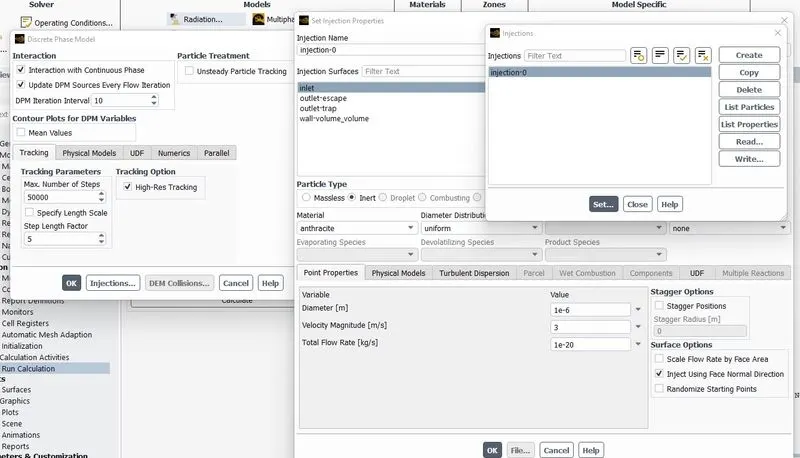
Enable Discrete Phase Model(DPM) coupled flow and enable update DPM source every flow iteration and DPM interval as 10 and in tracking parameter for 50000 time step maximum.
create injection of inert anthracite discrete phase and select surface for inlet and given discrete phase velocity and size of particle. And select ok. DPM done.
Now in boundary for inlet give velocity and in dpm select reflect for inlet similarly for top outlet select escape and bottom outlet select trap.
Methods - SIMPLE and second ordered.
Similarly do this for different particle size and different velocity and compare result of cyclone separator efficiency and pressure drop.
Geometry
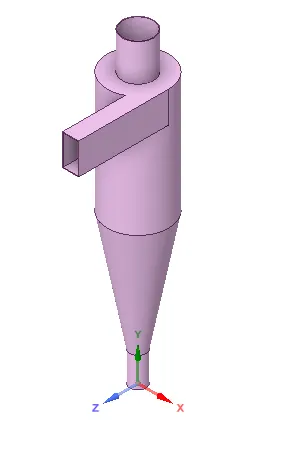
Extracted volume
Meshing
Setup
Boundary
Inlet as velocity inlet and reflect surface.
Outlet escape as pressure outlet and escape surface.
Outlet trap as pressure outlet and trap surface.
And Method as pressure velocity SIMPLE and second order.
Cases:-
For following cases compare efficiency of cyclone and find pressure drop
Case 1:-velocity inlet 3m/s and particle diameter 1 micrometre
Case 2:-velocity inlet 3m/s and particle diameter 3 micrometre
Case 3:-velocity inlet 3m/s and particle diameter 5 micrometre
For following cases compare efficiency of cyclone and find pressure drop
Case 4:-velocity inlet 1m/s and particle diameter 5 micrometre
Case 5:-velocity inlet 5m/s and particle diameter 5 micrometre
Results:
Case 1:-velocity inlet 3m/s and particle diameter 1 micrometre
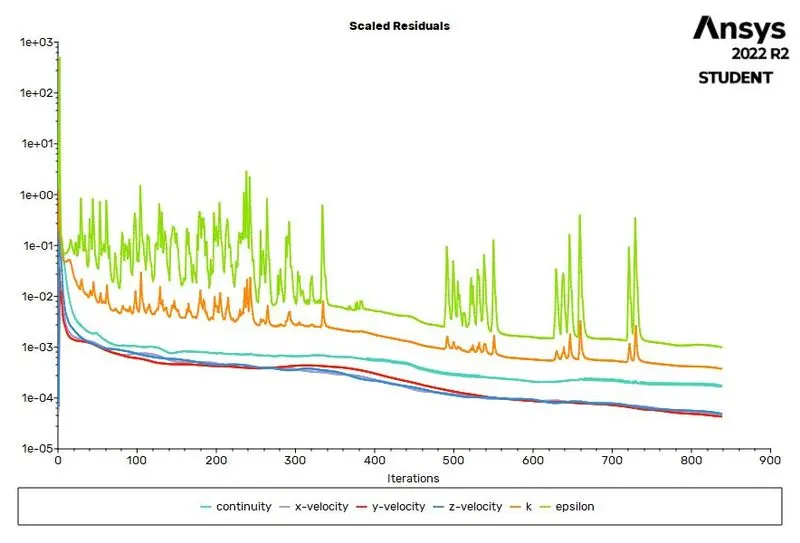
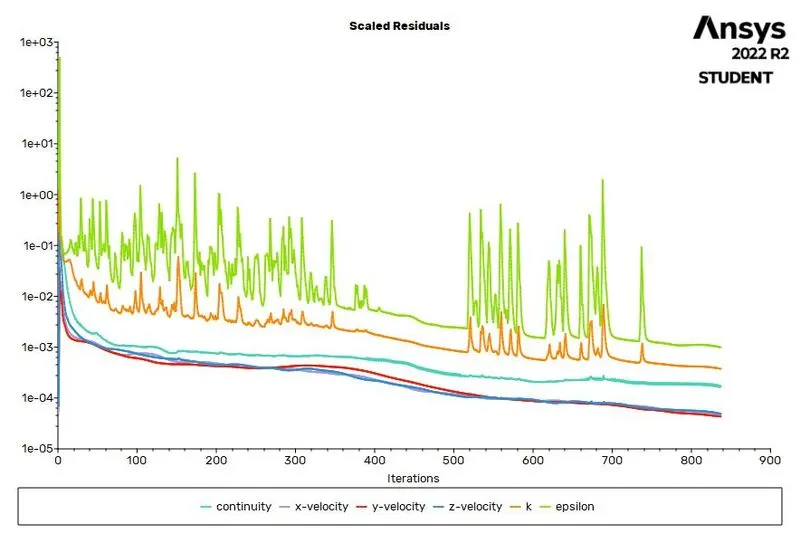
Residual
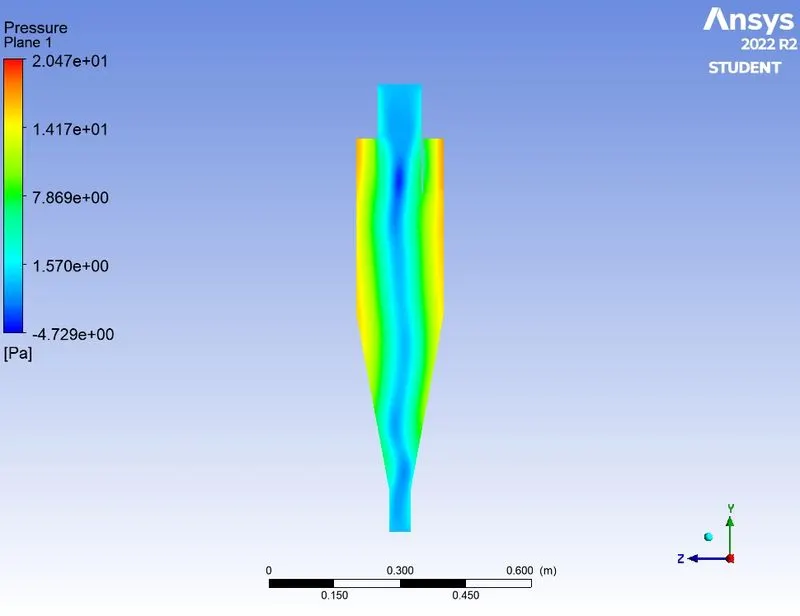
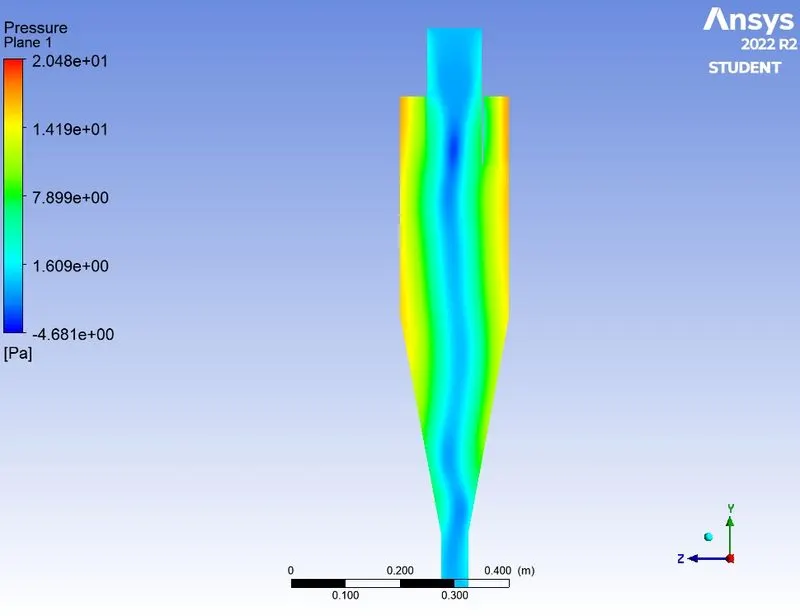
Pressure contour
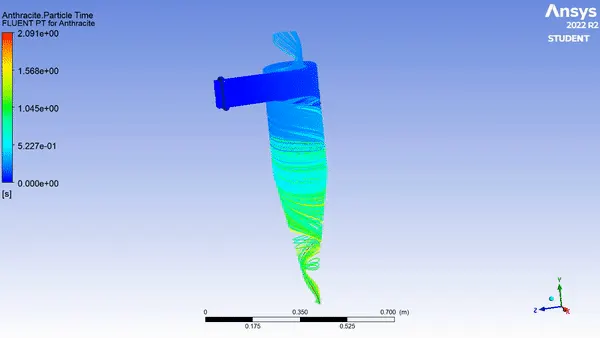
Case 2:-velocity inlet 3m/s and particle diameter 3 micrometre
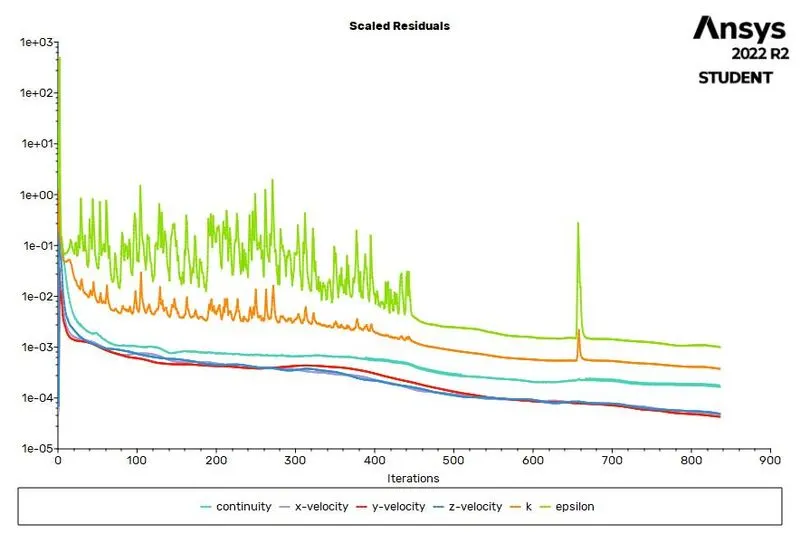
Pressure contour
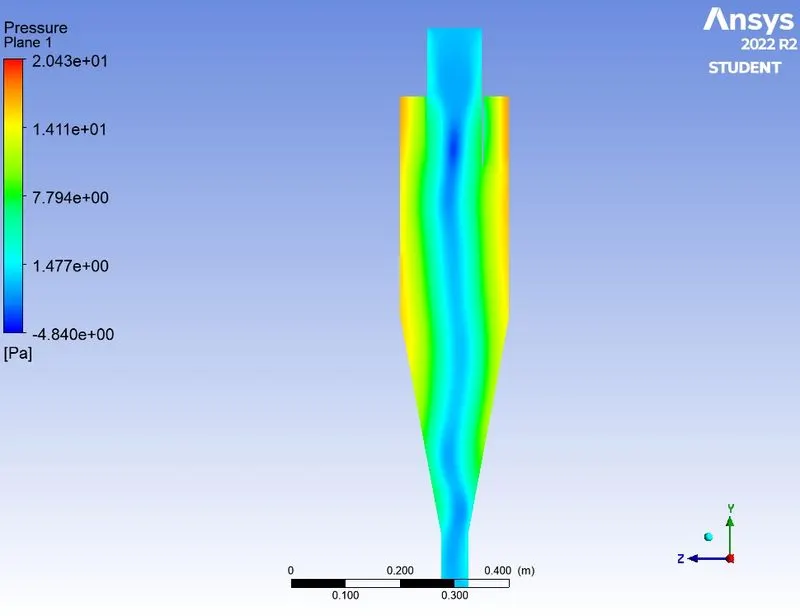
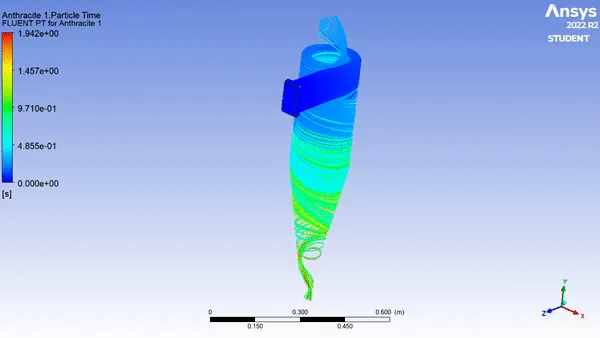
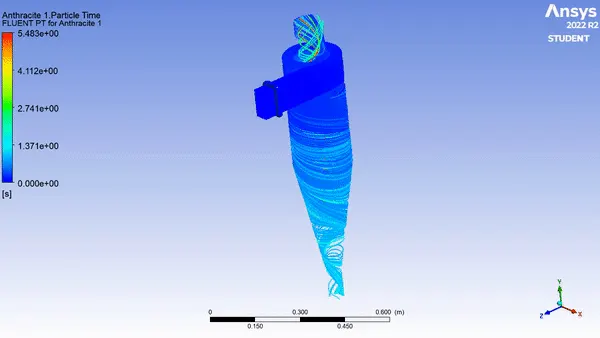
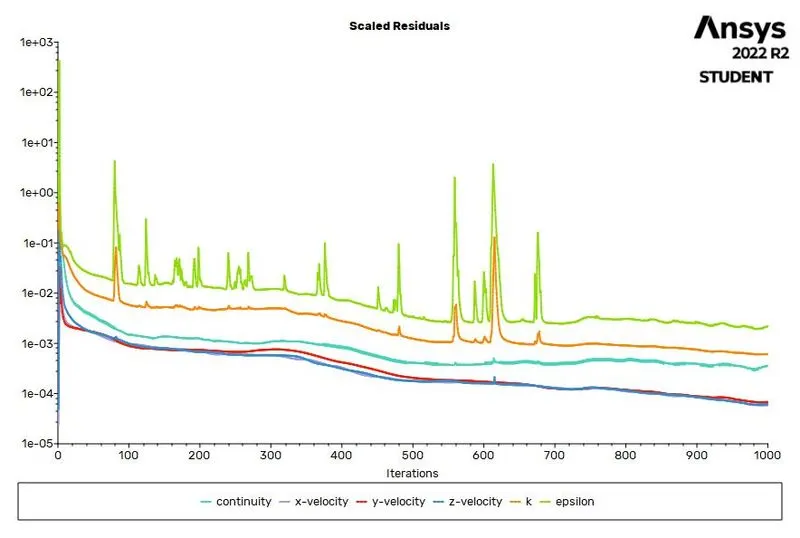
Case 3:-velocity inlet 3m/s and particle diameter 5 micrometre
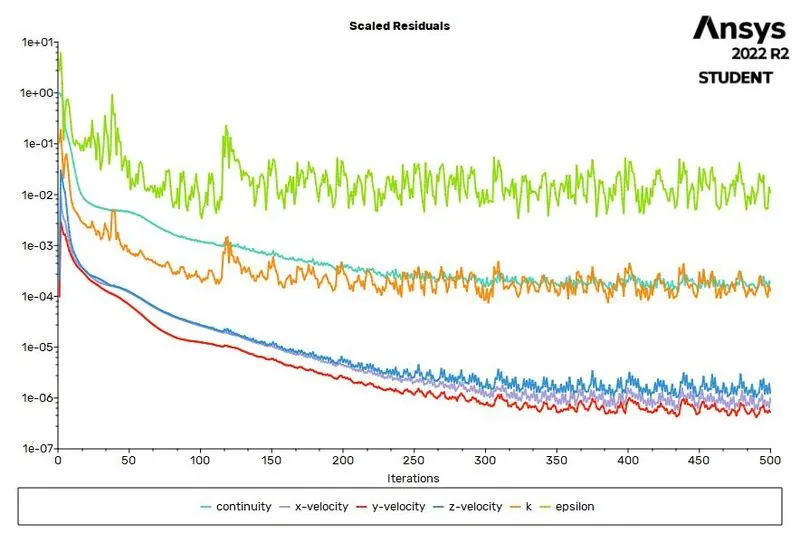
Residuals
Case 4:-velocity inlet 1m/s and particle diameter 5 micrometre
Pressure contour
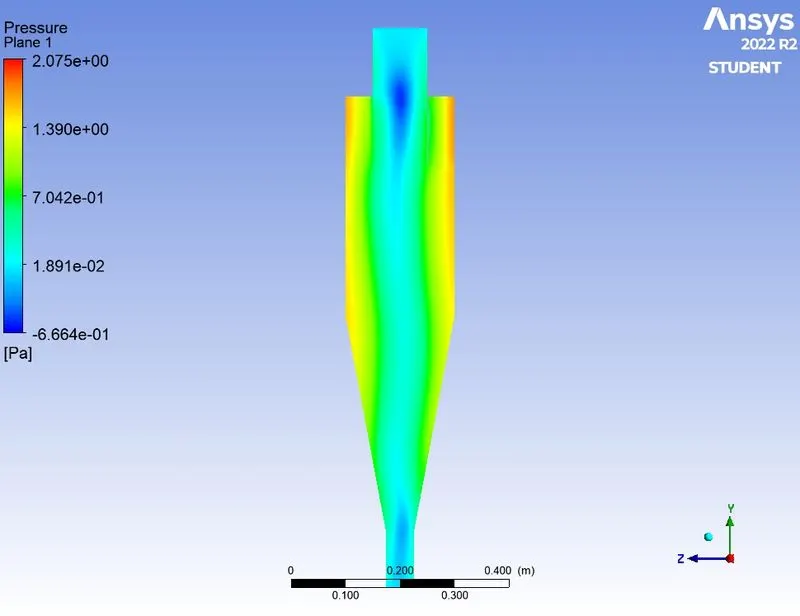
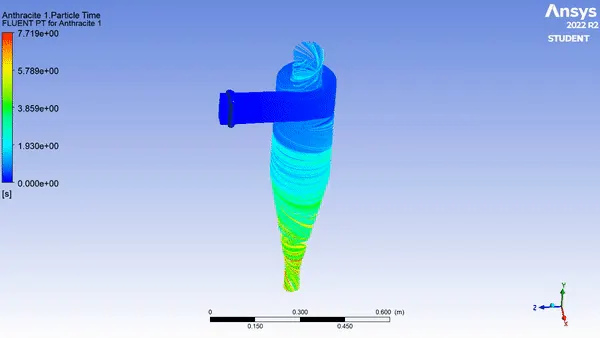
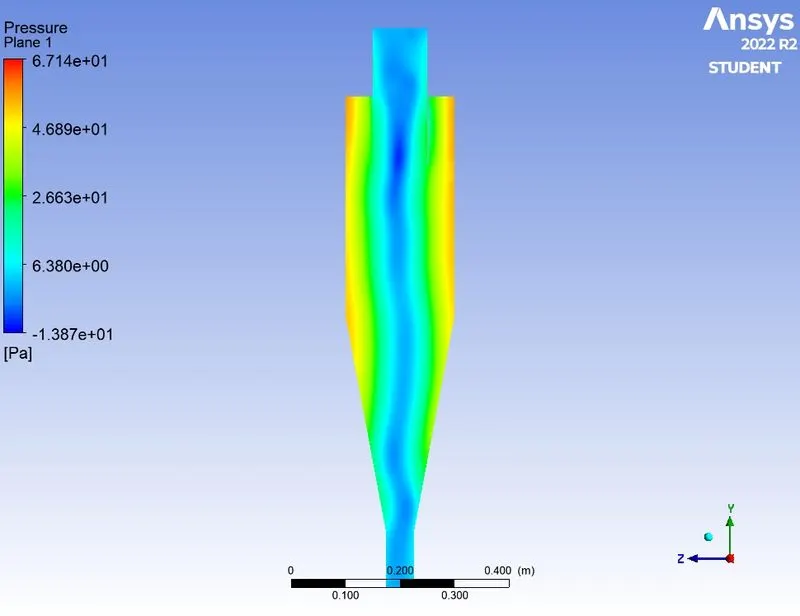
Case 5:-velocity inlet 5m/s and particle diameter 5 micrometre
Pressure contour
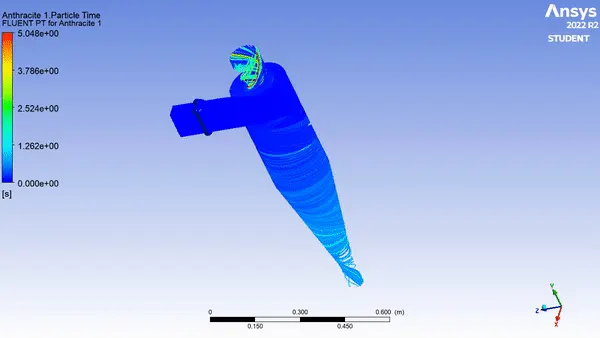
Constant velocity with varying particle diameter
| case | Particle track | Particle trap | Separation efficiency(%) |
|
1micrometre 3m/s |
378 | 323 | 85 |
| 3micrometre 3m/s | 378 | 327 | 86 |
| 5micrometre 3m/s | 378 | 290 | 76 |
Constant particle diameter with varying velocity
| Case | Particle track | Particle trap | Separation efficiency(%) | Total pressure inlet (pa) | Total pressure outlet escape (pa) | Pressure drop(pa) |
| 1m/s 5micrometre | 378 | 305 | 80 | 2.635 | 0.320 | 2.315 |
| 5m/s 5micrometre | 378 | 270 | 71 | 79.803 | 11.637 | 68.166 |
For same velocity and increasing particle size cyclone separator efficiency decreases .