Week 8 - Simulating Cyclone separator with Discrete Phase Modelling
Aim – simulating cyclone separator with discrete phase modelling.
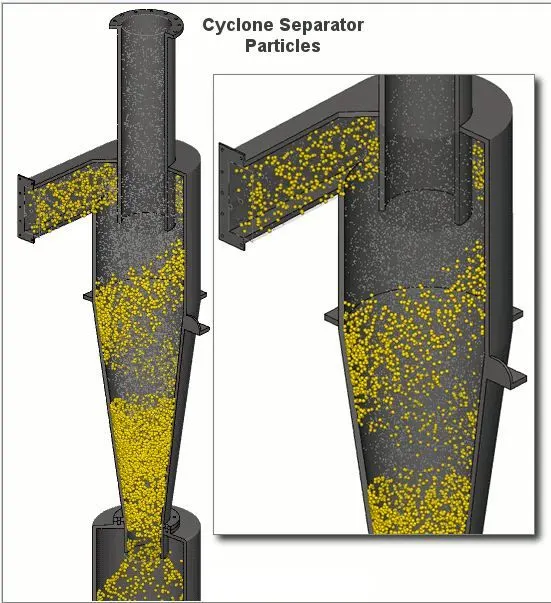
Introduction - A cyclone is a centrifugal separator in which particles, due to their mass, are pushed to the outer edges as a result of centrifugal force. Incoming air is automatically forced to adopt a fast-revolving spiral movement - the so-called “double vortex”.
There are two main designs of cyclone separator, these are the gas cyclone and hydro cyclone. Gas cyclones are used to remove entrained particles from a gas stream. Hydro cyclones are used for separating fluids of different densities.
Out of all of the particulate-control devices, cyclone separators are among the least expensive. They are often used as a pre-treatment before the flue gas enters more effective pollution control devices. Therefore, cyclone separators can be seen as "rough separators" before the flue gas reaches the ne filtration stages.
Here are some advantages and disadvantages of using cyclone separators.
- cyclone separators are beneficial because they are not expensive to install or maintain, and they have no moving parts. This keeps maintenance and operating costs low.
- The removed particulate matter is collected when dry, which makes it easier to dispose of.
- Finally, this unit take up very little space. Although effective,
- there are also disadvantages in using cyclone separators. Mainly because the standard models are not able to collect particulate matter that is smaller than 10 micrometres effectively and the machines are unable to handle sticky or tacky materials well.
Empirical models for Cyclone Separator Efficiency:
Iozia and Leith Model:
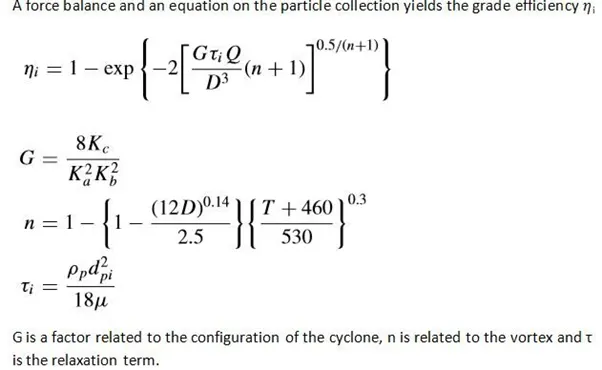
Iozia and Leith logistic Model is a modified version of Barth (1956) model which is developed based on force balance. The model assumes that a particle carried by the vortex endures the influence of two forces: a centrifugal force Z, and flow resistance, W.
The collection efficiency i of particle diameter dpi can be calculated by
Li and Wang Model:
The Li and Wang model include particle bounce or re-entrainment and turbulent diffusion at the cyclone wall. A two-dimensional analytical expression of particle distribution in the cyclone is obtained. Li and Wang model was developed based on the following assumptions:
- The radial particle velocity and the radial concentration profile are not constant, for uncollected particles within the cyclones.
- Boundary conditions with the consideration of turbulent diffusion coefficient and particle bounce re-entrainment on the cyclone wall.
Koch and Licht Model:
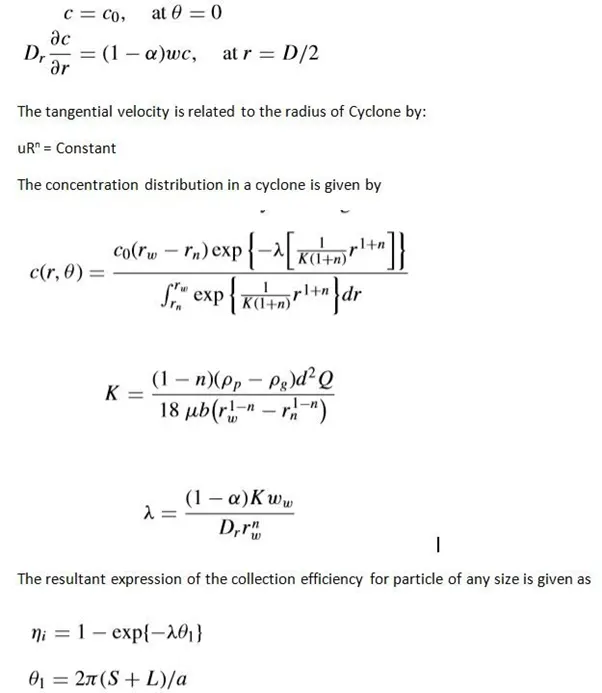
Koch and Licht collection theory recognized the inherently turbulent nature of cyclones and the distribution of gas residence times within the cyclone.
Koch and Licht describe particle motion in the entry and collection regions with the additional following assumptions:
The tangential velocity of a particle is equal to the tangential velocity of the gas flow, i.e. there is no slip in the tangential direction between the particle and the gas.
The tangential velocity is related to the radius of cyclone by uRn =constant.
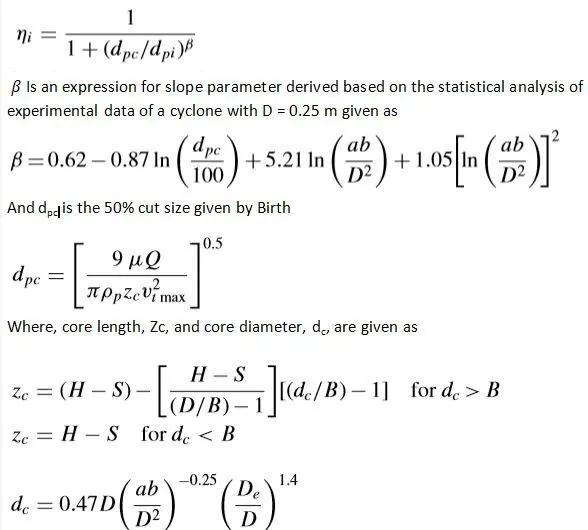
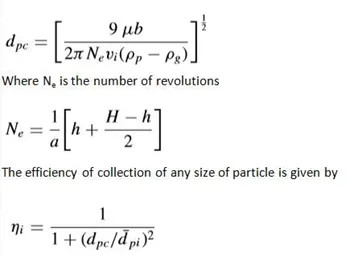
Lapple model was developed based on force balance without considering the flow resistance. Lapple assumed that a particle entering the cyclone is evenly distributed across the inlet opening. The particle that travels from inlet half-width to the wall in the cyclone is collected with 50% efficiency. The semi-empirical relationship developed by Lapple to calculate a 50% cut diameter, dpc, is
Applications:
- Chemical and Petrochemical Processes
- Industrial, Metallurgical and Power Generation
- Food & Pharmaceutical
- Cement Industry
Methodology- There are two different Phases as given below:
- Continuous Phase - It consists of fluid flowing within the fluid volume.
- Discrete Phase- It consists of smaller particles interacting with Continuous Phase. It exchanges momentum, mass and energy with Fluid Phase or Continuous Phase.
To carry out this analysis, Simulation will be done using DPM (Discrete Phase Modelling). It is employed when there are solid Particles in Gas, or Liquid or Liquid Droplets in Gas, or Bubbles in Liquid.
There are two ways to carry out DPM
- Un-coupled Flow - In this type of flow, Discrete Phase will not have any interaction with Continuous Phase.
- Coupled Flow- It will influence the flow of Continuous Phase.
Since, the size of the particles injected in to Cyclone Separator is very small, the usage of both type of flow should not matter much.
Procedure - In this project, we will perform an analysis on a given Cyclone model in two different manners.
- By varying particle diameters
- By varying particle velocities.
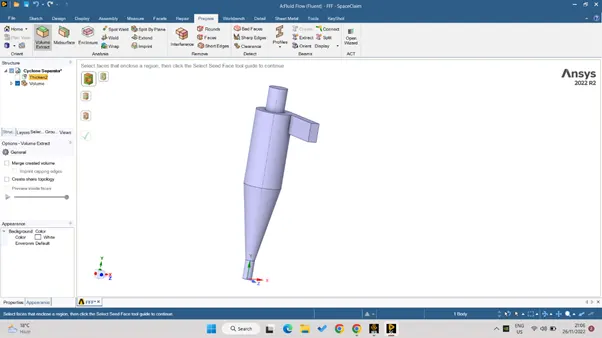
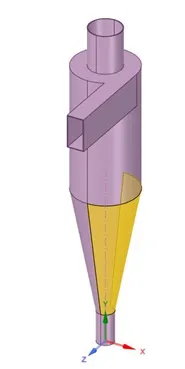
Step_1 setting up the geometry
- Extract the volume.
- Prepare<select the edge<ok.
- We only need the solid volume here to see the simulation.
- Thus we are supressing the physics for the outer thickness.
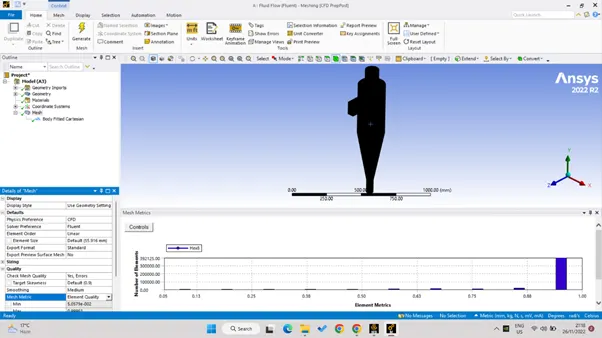
Step_2- pre-processing and mesh
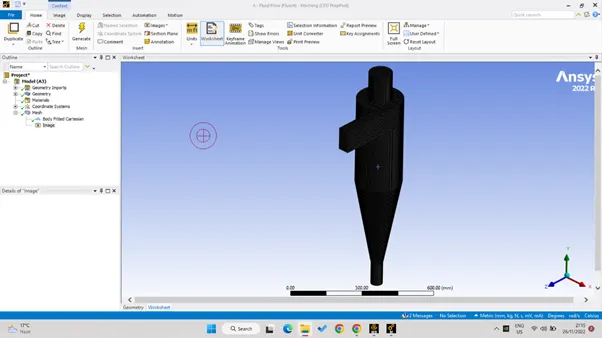
- Generate the mesh.
- Insert the method > select method <change it to Cartesian< update.
- Change the element size to 5mm.
- Here the no of particle trapped = total number to cell count in the inlet.
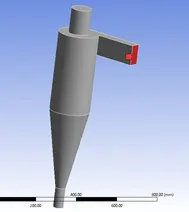
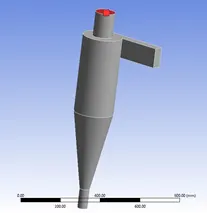
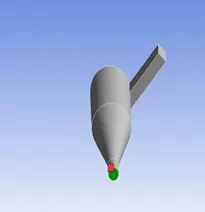
- Here the rectangular face is name as the inlet, circular above face as the outlet escaped, circular outlet at the bottom as the outlet trap.
Step _3 modelling and solver approach
- Setup< pressure based< steady state <absolute.
- Enable the gravity and provide the -9.81m/s^2 in the y direction.
- The turbulence model is K-epsilon< RNG<swirl dominating flow< standard wall function.
- Under model< discrete phase model< enable the interaction with the continuous phase.
- Here the default no of steps is 50,000 and if any particle remains incomplete in the separation process inside the separator we need to increase the no of time steps.
- Here under injection method< create the injection method under injecting type< surface< inlet first< diameter of particle as varying with the following case.
- Material default anthracite< dia distribution uniform< close< ok.
- Boundary condition inlet- velocity type (velocity will be same as the particle velocity), also under DPM (discrete phase method) as reflect.
- Escape outlet< pressure type < DPM < escape.
- Outlet trap<pressure type< DPM trap.
- Initialization the hybrid.
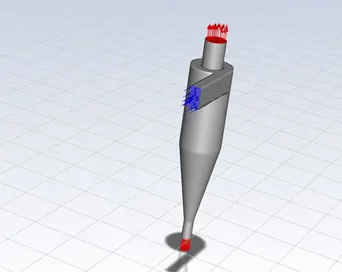
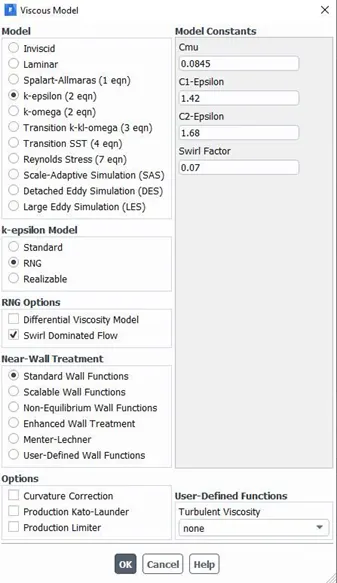
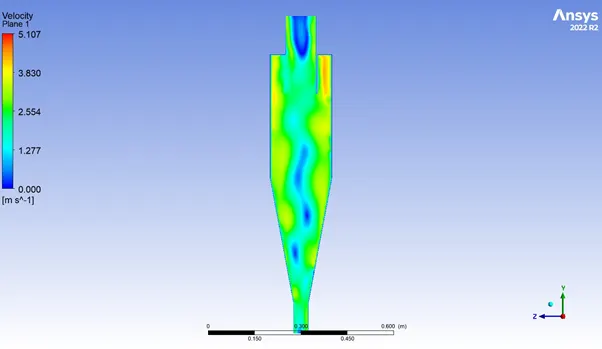
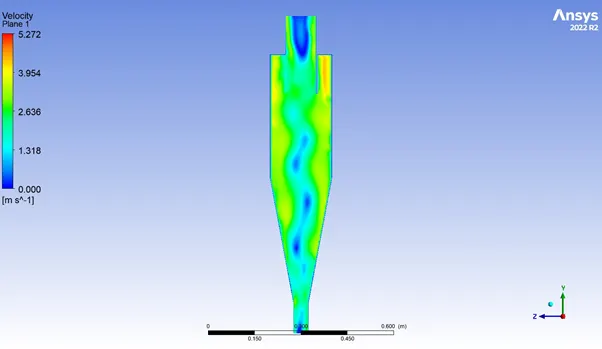
Result – the following result is obtained from the end result of the simulation. Also the pressure and velocity contour can be seen here.
|
Inlet velocity |
Particle diameter |
Particle tracked |
Particle escaped |
Particle trapped |
Inlet pressure |
Outlet pressure |
Outlet trap pressure |
Separate efficiency |
Pressure difference |
|
3 m/s |
5e-6 |
378 |
91 |
287 |
23.98Pa |
3.68Pa |
2.01Pa |
75% |
21.58 |
|
3m/s |
3e-6 |
378 |
52 |
326 |
23.43Pa |
3.15Pa |
3.22Pa |
86% |
20.21 |
|
3m/s |
1e-6 |
378 |
41 |
337 |
24.69Pa |
3.28Pa |
3.11Pa |
89% |
21.58 |
|
5m/s |
5e-6 |
378 |
63 |
315 |
68.76Pa |
9.34Pa |
9.41Pa |
83% |
59.35 |
|
1m/s |
5e-6 |
378 |
52 |
326 |
2.50Pa |
0.3241Pa |
0.2970Pa |
86.24% |
2.203 |
|
|
|
|
|
|
|
|
|
|
|
The velocity contour for all case
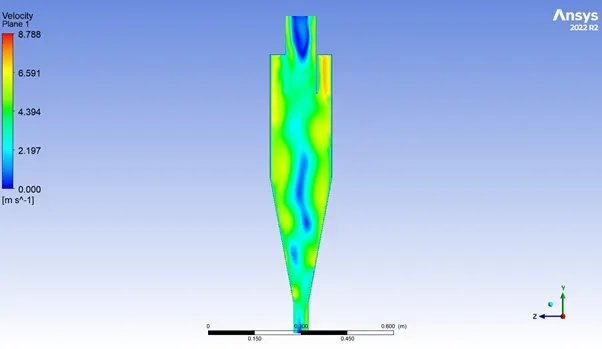
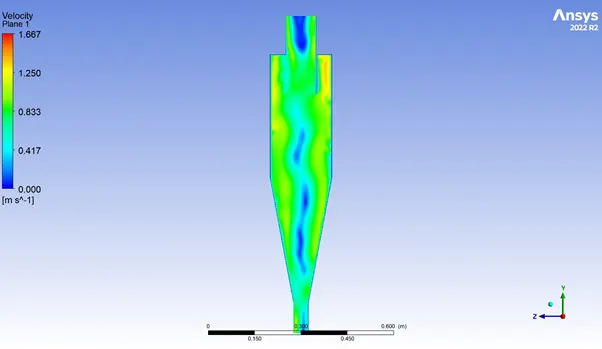
Pressure contour for all 5 case respectively: -
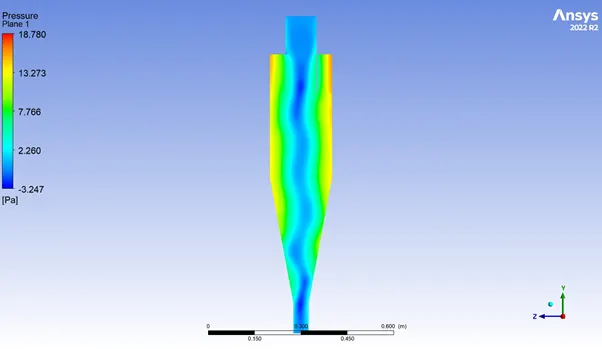
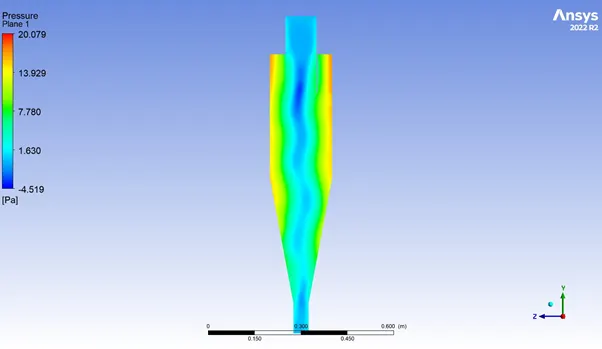
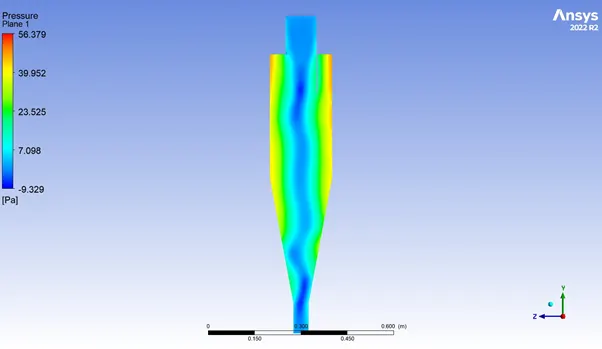
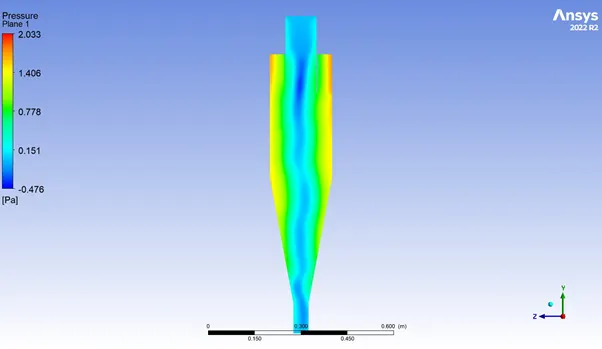
The video file of the simulation which is uploaded on the google drive and the link of the file is here.
This video shows the streamline of the particle flow inside the separator.
https://drive.google.com/file/d/1jKLnQHLxmmelRzAX0KqeAy-G7QxDuG59/view?usp=sharing
Learning outcome - Here we can conclude some points from the result
- The larger the particle size the less particle trap in the separator hence it has the less efficiency.
- As the particle size decreases less number of particle escape from the separator and more particle get trapped.
- Also as the inlet velocity increases the inlet pressure also seen to be increased at a drastic level.
- Thus for the good efficiency it is advised to go with high possible inlet velocity and small particle size.
Conclusion – the cyclone separator is efficient device for the separation purpose at the industry as it has very less running and maintenance cost thus it makes this device versatile in the industry.
Here in this challenge I have performed the simulation over the cyclone separator for different cases and generated the desired result which shows the efficiency of the separator.
Also this challenge helped me in the learning of discrete phase analysis where the Euler-Langrangian approach is used under DPM in the fluent, where the flued is treated as the continuous mode and has been solved by Naviour-Strokes equation and the dispersed phase has been solved by particle tracing by the DPM solver setting.