Week 8 - Simulating Cyclone separator with Discrete Phase Modelling
Aim: To perform analysis on cyclone seperator and calculate the seperation effeciency and pressure drop
Objective
- To write a few words about any four emperical models used to calculate the cyclone seperator effeciency
- To perform an analysis on a cyclone seperator model by varying the diameter from 1`mu`m to 5 `mu`mand claculate the seperate effeciency in each case
- To perform an analysis on a cycolone seperator model by varying from1m/s to 5m/s and calculate the seperation effeciency and pressure drop in each case
Theory
Cyclone Seperator is a device used to remove particulate matter from air, gas or waterstream without the use of filters through vortex generation.The gravitational and centrifugal are the main forces responsible for the seperation of particulate matter from fluid streams.The cyclone seperator consist of one inlet and two outlets.At inlet, dusty gas enters with high tangential velocity and outer vortex is generated due to swirling motion.The heavy particulate matter gets collected at the bottom of the cyclone seperator. The axial velocity of fluid in the conical section, gets reversed and fluid forms inner vortex and cleaned gas exits from the top outlet.
Empirical Models
1) Lozia and Leith Model
This model was devoloped based on the force balence. In this model, since particle under goes vortex flow , two main forces are consideres i.e centrifugal force and flow resistance.
2)Li and Wang Model
This model includes Particle bounce or re entrainement and turbulent diffusion at the cyclone wall.
3)Koch and Licht Model
This model includes the inherently turbulent nature of cyclones and the distribution of gas residence times within the cyclone
4)Lapple Model
This model was devoloped based on force balence without considering the flow resistance .Lapple assumed that a particle entering the cyclone is evenly distributed across the inlet opening.
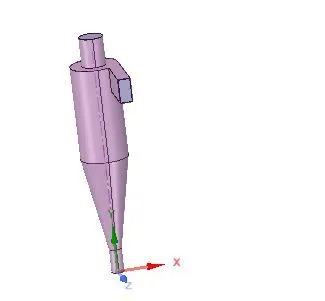
Geometry
- Import the cyclone seperator model in to space claim to clean up
- Extract the fluid volume for further calculation
Mesh
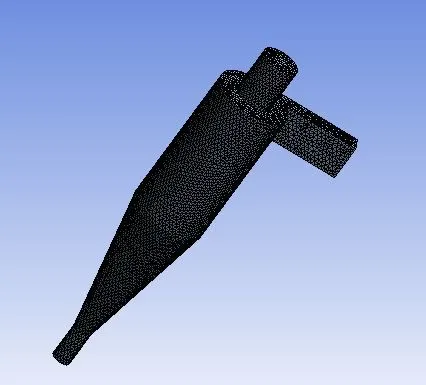
- Naming the Boundary condetion as Inlet , Top & Bottom Outlet , Wall
- Generating Mesh by varying the grid size
Case setup
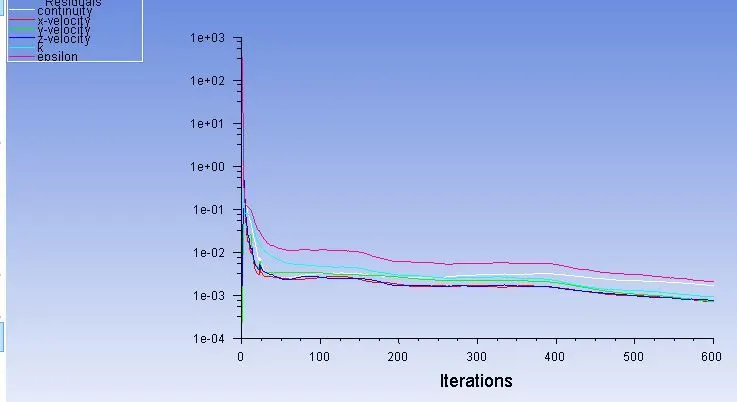
- Pressure Based , Absolute Velocity, Steady state solver is used for siulation
- Opted K-epsilon,RNG, Swirl Dominated flow turbulence model
- Discreate phase modeling is performed with coupled analysis
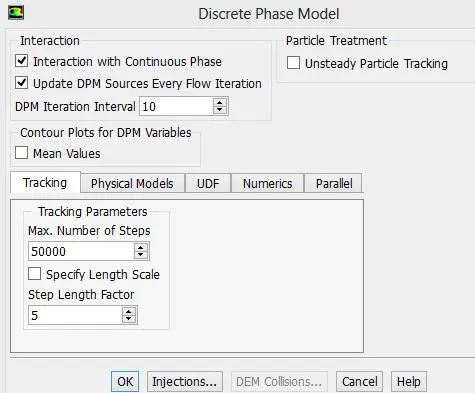
- Velocity inlet ,Pressure outlet , Wall Boundary with no slip boundary condtion is applied
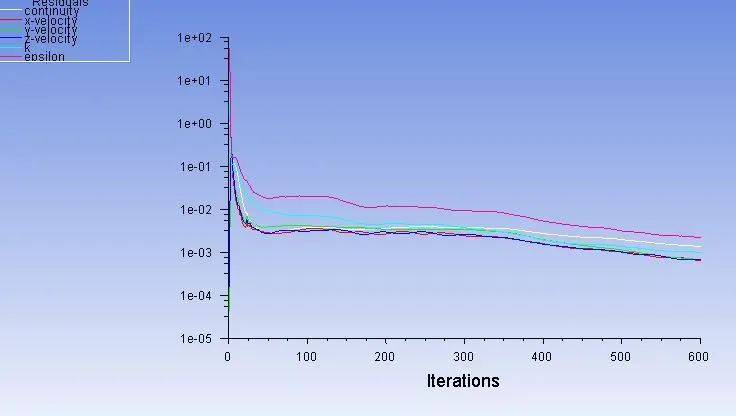
- Initialize the solution and run the calculation
- After the simulation, export the particel history data to get the information Particle track
Results
Case-1(a) -1 `mu`m, 3m/s
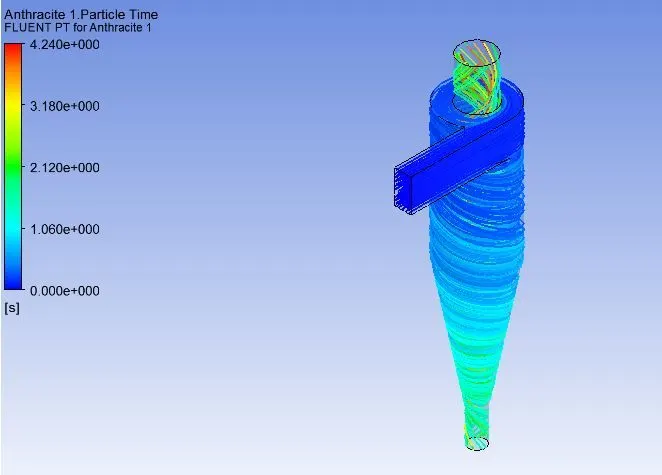
Number of Particle tracked=120
Number of Particle trapped=80
Seperation Effeciency= (80/120)=0.66
Case-1(b) 3`mu`m, 3m/s
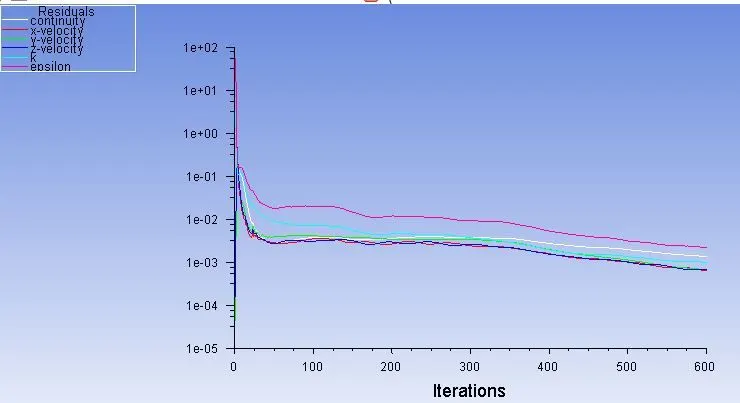
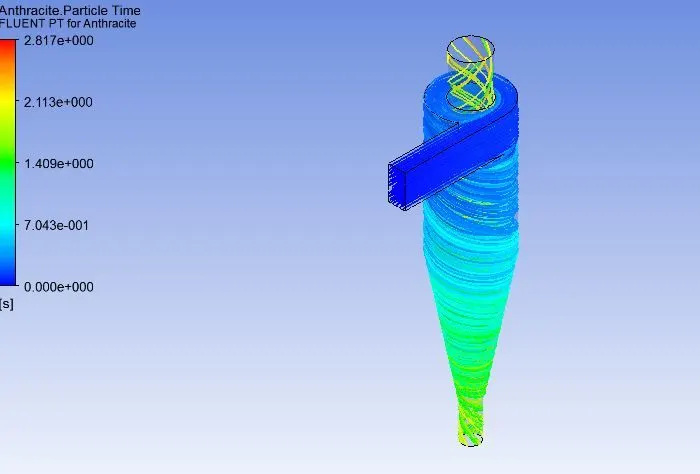
Number of Particle tracked=120
Number of Particle trapped=100
Seperation Effeciency= (100/120)=0.83
Case-1(c) 5`mu`m , 3m/s
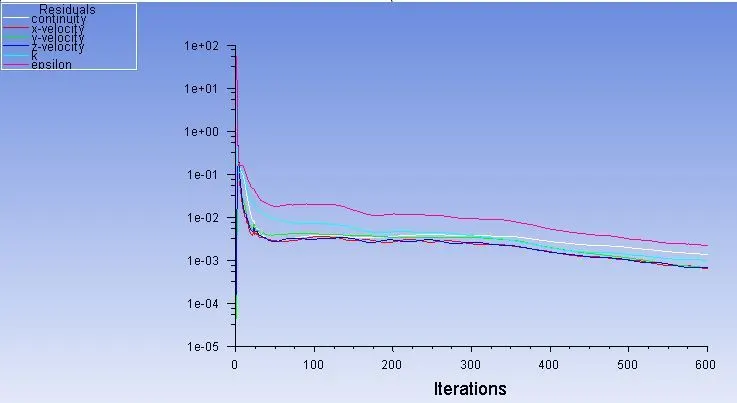
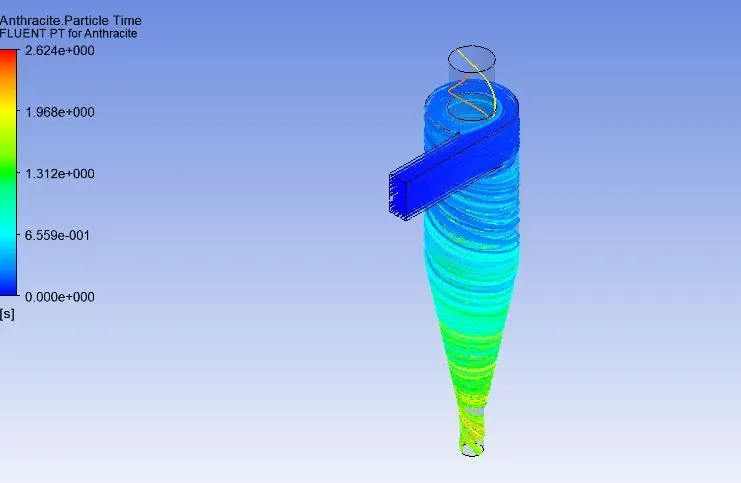
Number of Particle tracked=120
Number of Particle trapped=118
Seperation Effeciency= (118/120)=0.98
Case-2 (a) 1m/s ,5`mu`m
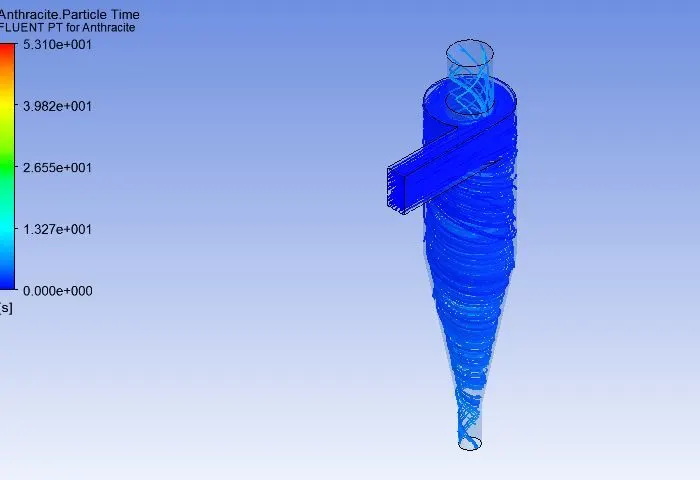
Case-2(b) 3m/s ,5 `mu`m
Case-2(c)- 5m/s, 5micron
Conclusion
- Simulation is performed by varying velocity 1m/s to 5m/s and 1`mu`m to 5`mu`m. From the result it is observed that Heavier particle is trapped at the bottom outlet and lighter particle are escaped at the top outlet
- Cyclone effeciency depends on Particle size, density, inlet velocity and other parameters. If Particle size , density, inlet velocity increases , the cycone effeciency will inreases othervise decreases
- Pressure drop occurs because of the expansion of gases in cyclone chammber, rotating energy , and wall friction