Week 8 Multi cell Battery Pack
Problem Statement - How weakest cell limits the usable capacity of the battery pack? What is the solution?
Solution -
Weak cells (ones with lower capacity / higher internal impedance) tend to exhibit higher voltage than the rest of the series cells at full charge termination. These cells are then weakened further by continuous overcharge cycles. The higher voltage of the weaker cells at charge completion causes accelerated capacity degradation. If the maximal recommended charging voltage is exceeded even by as little as 10 percent, it will cause the degradation rate to increase by 30 percent.
On the discharge side, the weak cells tend to have lower voltage than the other cells, due to either higher internal resistance, or a faster rate of discharge that results from the lower capacity. This means that if any of the weak cells hits the cell under voltage protection limit while the pack voltage is still sufficient to power the system, the full capacity of the battery will never be used as the pack protector will prevent over discharge (which would damage the cell) by stopping the discharge of the whole pack when one cell voltage goes below the cell under voltage threshold (usually around 2.7 V).
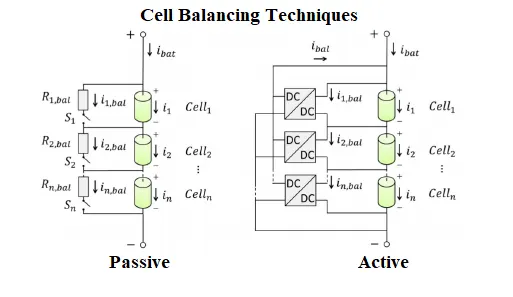
The fundamental solution of cell balancing equalizes the voltage and state of charge among the cells when they are at a fully charged state. Cell balancing is typically categorized in two types:
- Passive
- Active
Passive Cell Balancing
The passive cell balancing method is somewhat simple and straight forward. Discharge the cells through a dissipative bypass route. This bypass can be either integrated or external to the integrated circuit (IC). Such an approach is favorable in low-cost system application. The fact that 100% of the excess energy from a higher energy cell is dissipated as heat makes the passive method less preferable to use during discharge because of the obvious impact on battery run time.
Active Cell Balancing
Active cell balancing, which utilizes capacitive or inductive charge shuttling to transfer charge between battery cells, is significantly more efficient because energy is transferred to where it is needed instead of being bled off. Of course the trade-off for this improved efficiency is the need for additional components at higher cost.