Multi cell Battery Pack
Multi cell Battery Pack
Aim:
Explaining the effect weakest cell has on the limits of usable capacity of the battery pack and the ways to tackle it.
Answer:
A typical Lithium-Ion battery pack consists of three or four cells in series, with one or more cells in parallel. This combination gives both the voltage and power necessary.
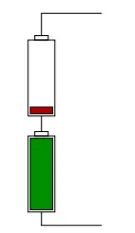
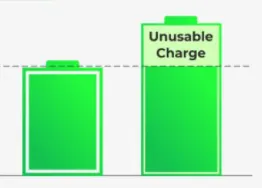
Fig: Unbalanced Cell
Lets say that one battery is 75 % charged, while another is 100 % charged. While we need to use the battery for traction, the battery is not consumed completely during discharged. The battery with higher charge is not discharged completely. In this case, the battery with 75 % charge will discharge completely, while the battery with 100 % charge, will discharge until 25 % charge left. This is owing to the fact that one of the battery is not par with other batteries. Amongst batteries in the module, this cell with less charge will deem all other high charged batteries unusable. This battery is the weak link that has a major say in the overall output. This also stands true while charging, while charging the batteries with 0 % charge, will charge till only 75 %, while all other will have reached their charging to complete. In this the 75 percent will not be charged as all other have reached the 100 percent. This will only limit battery performance in overall case even in the next cycle.
The figure shows a simple two cell battery pack with the lower cell having SOC equal to 100 % and the upper cell having SOC equal to 0 %. We might define battery-pack SOC to be 0 % because we cannot discharge without overdischarging the top cell. However, a value of 0 % implies that we can charge the battery pack, and we know that we cannot do so without overcharging the lower cell. We might define battery-pack SOC to be 100 % because we cannot charge without overcharging the bottom cell. However, that implies that we can discharge the battery pack, which we cannot do without overdischarging the top cell.
Most typical battery chargers detect full charge by checking whether the voltage of the entire string of cells has reached the voltage regulation point. Individual cell voltages can vary as long as they don’t exceed the limits for overvoltage protection. However, weak cells one with lower capacity / higher internal impedance, tend to exhibit higher voltage than the rest of the series cells at full charge termination. These cells are then weakened further by continuous overcharge cycles. The higher voltage of the weaker cells at charge completion causes accelerated capacity degradation. If the maximal recommended charging voltage is exceeded even by as little as 10 percent, it will cause the degradation rate to increase by 30 percent.
On the discharge side, the weak cells tend to have lower voltage than the other cells, due to either higher internal resistance, or a faster rate of discharge that results from the lower capacity. This means that if any of the weak cells hit the cell under-voltage protection limit while the pack voltage is still sufficient to power the system, the full capacity of the battery will never be used as the pack protector will prevent over-discharge by stopping the discharge of the whole pack when one cell voltage goes below the cell under-voltage threshold.
Solution:
When a lithium battery pack is designed using multiple cells in series, it is very important to design the electronic features to continually balance the cell voltages. This is not only for the performance of the battery pack but also for optimal life cycles. The use of cell balancing enables us to design a battery with a larger capacity for an application because balancing allows the battery to achieve a higher state of charge . A lot of companies choose not to use cell balancing at the start of their design to reduce cost but without the investment in the cell balancing hardware and software, the design does not allow the SOC to approach 100 percent.
Cell balancing is the process of equalizing the voltages and state of charge among the cells when they are at a full charge. No two cells are identical. There are always slight differences in the state of charge, self-discharge rate, capacity, impedance, and temperature characteristics. This is true even if the cells are the same model, same manufacturer, and the same production lot. Manufacturers will sort cells by similar voltage to match as close as possible, but there are still slight variations in the individual cell's impedance, capacity, and self-discharge rate that can eventually lead to a divergence in voltage over time.
Cell Balancing Techniques
The fundamental solution of cell balancing equalizes the voltage and state of charge among the cells when they are at a fully charged state. Cell balancing is typically categorized into two types:
- Passive
- Active
Passive Cell Balancing
The passive cell balancing method is somewhat simple and straight forward. Discharge the cells through a dissipative bypass route. A passive system potentially burns off excess energy from the high cells through a resistive element until the charge matches the lower energy cells in the pack. Such an approach is favorable in low-cost system applications.
Fig: Passive Cell Balancing
There are two different categories of passive cell balancing method: fixed shunting resistor and switching shunting resistor. A fixed shunting resistor circuit is usually connected to the fixed shunting to prevent it from being overcharged. With the help of the resistors, the passive balancing circuit can control the limit value of each cell voltage without damaging the cells. Energy consumed by these resistors for balancing a battery may result in thermal losses in the BMS. This, therefore, proves the fixed shunting resistor method to be an inefficient cell equalizing circuit. The fact that 100% of the excess energy from a higher energy cell is dissipated as heat makes the passive method less preferable to use during discharge because of the obvious impact on battery run time.
Active Cell Balancing
Active cell balancing is significantly more efficient because energy is transferred to where it is needed instead of being bled off. Of course, the trade-off for this improved efficiency is the need for additional components at a higher cost. An active cell balancer generally transfers energy from one cell to another. That is from high voltage/ high SoC to a cell with a lower SoC. The purpose of an active balancer is that if you have a pack of cells with lower capacity, you can extend the life or the SoC that you have on the pack by moving energy from one cell in the pack with more energy than the other cell.
Fig: Active Balancing
Instead of wasting all that energy as heat, an active cell balancer efficiently balances cells with tiny converter circuits that pass energy from the highest voltage cells to the lowest voltage cells. There are two different categories of active cell balancing methods: charge shuttling and energy converters. Charge shuttling is used to actively transport charges from one cell to another to achieve equal cell voltage. Energy converters use transformers and inductors to move energy among the cells of a battery pack.
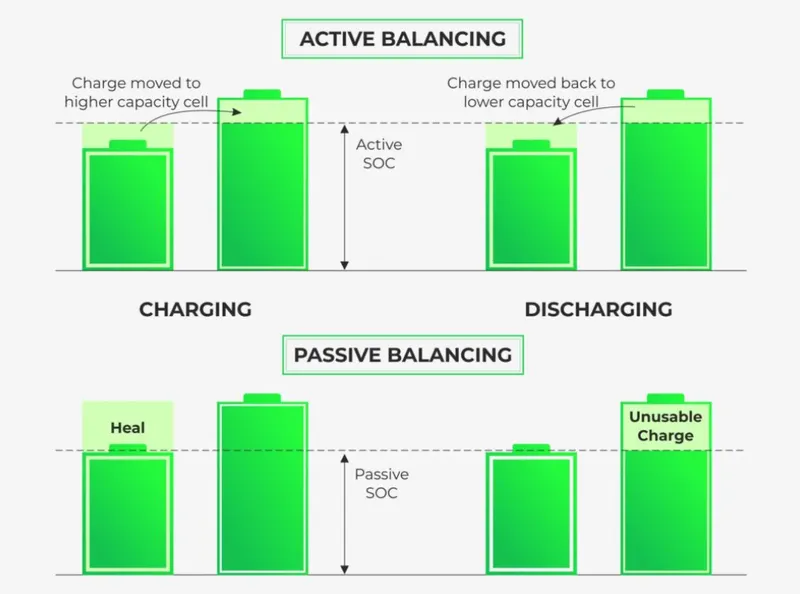
Fig: Comparision of active and passive balancing
Conclusion:
The weakest cell affects the performance and life cycles of the battery. Cell balancing is not only important for improving the performance and life cycles of the battery, it adds an element of safety to the battery. One of the emerging technologies for enhancing battery safety and extending battery life is active and passive advanced cell balancing. New cell balancing technologies track the amount of balancing needed by individual cells, the usable life of battery packs is increased, and overall battery safety is enhanced.